


WEBVTT
00:00:00.000 --> 00:00:03.439
Could glaucoma surgery become a 10-minute office procedure?
00:00:04.160 --> 00:00:06.320
First human results from OB Core.
00:00:06.719 --> 00:00:19.839
Short answer OBI Core is one of the more interesting new glaucoma procedures because it attempts to combine the pressure-lowering power of filtration surgery with the convenience of an office-based slit lamp procedure.
00:00:20.079 --> 00:00:23.039
But the current evidence is still extremely early.
00:00:23.199 --> 00:00:34.880
The publicly reported human experience consists of a small first-in-human series of approximately 10 eyes with detailed results, followed by a company update describing 11 treated eyes.
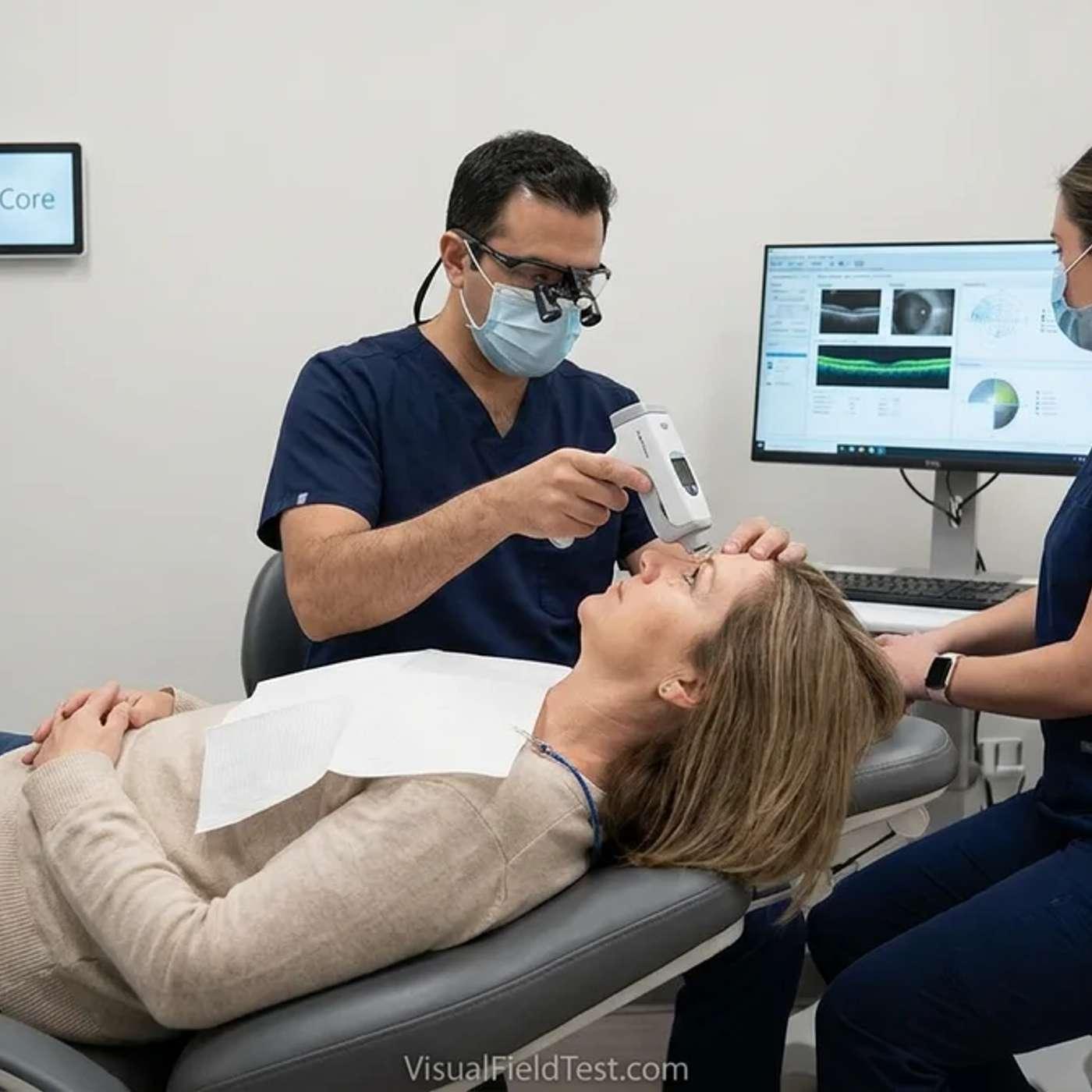
00:00:35.119 --> 00:00:44.880
Follow-up is short, patient-level data are not publicly available, and approximately 30% of eyes required reintervention in the initial detailed report.
00:00:45.200 --> 00:00:50.479
The technology is therefore promising, but not yet proven to replace trabeculectomy.
00:00:50.640 --> 00:00:55.520
Its most important scientific question is not whether it can lower pressure initially.
00:00:55.679 --> 00:00:57.759
The early data suggests that it can.
00:00:57.920 --> 00:01:10.719
The difficult question is whether the subconjunctival bleb can remain functional for years without recreating the fibrosis, needling, medication, and monitoring burden of conventional filtering surgery.
00:01:10.959 --> 00:01:17.120
The bottom line, OBI core, is not a conventional angle-based minimally invasive glaucoma surgery.
00:01:17.200 --> 00:01:23.280
It creates a direct pathway from the anterior chamber to a subconjunctival or subtenon filtration space.
00:01:23.519 --> 00:01:34.640
The device appears to use a 27-gauge 6mm punch needle to create an oblique scleral microchannel, approximately 150 x 50 micrometers in diameter.
00:01:34.959 --> 00:01:44.640
It does create a subconjunctival filtration bleb, meaning it shares the central biological weakness of trabeculectomy, exangel stent, and preser flow microshunt.
00:01:44.799 --> 00:01:48.239
Wound healing and fibrosis can eventually reduce flow.
00:01:48.480 --> 00:01:54.400
The detailed first in human report involved 10 eyes followed for up to approximately six weeks.
00:01:54.640 --> 00:02:05.439
Mean intraocular pressure fell from 30.1 to 10.2 millimeters of mercury, a calculated absolute reduction of 19.9 millimeters of mercury, or approximately 66%.
00:02:06.159 --> 00:02:14.639
Mean glaucoma medications fell from 2.2 to 0.8, an absolute reduction of 1.4 medications, or approximately 64%.
00:02:15.360 --> 00:02:27.680
70% of eyes reportedly achieved complete success under the study definition, and approximately 78% were medication-free, although the denominators and patient-level data were not fully disclosed.
00:02:27.919 --> 00:02:34.479
30% required reintervention, including repeat OBI core procedures or other filtration procedures.
00:02:34.719 --> 00:02:44.159
The reasons for those interventions have not been publicly separated into fibrosis, obstruction, inadequate flow, or surgical learning curve effects.
00:02:44.400 --> 00:03:00.000
A September 2026 company update described 11 treated eyes, including mild, moderate, and advanced glaucoma, with early pressures in the single digits to low teens, and no reported device or procedure-related adverse events.
00:03:00.240 --> 00:03:03.919
No detailed aggregate results from the 11th eye were provided.
00:03:04.159 --> 00:03:09.199
The 10-minute description is not yet supported by a published procedural time dataset.
00:03:09.439 --> 00:03:21.919
The channel creation step may take seconds, but the full visit, including preparation, anesthesia, mitomycin C, intraocular pressure management, and postoperative testing, has not been formally reported.
00:03:22.560 --> 00:03:24.000
What is OBI Core?
00:03:24.319 --> 00:03:32.000
Manufacturer and Development Status, OBI Core is being developed by Hexeris Ophthalmics, a Canadian company based in Dieppe, New Brunswick.
00:03:32.240 --> 00:03:40.159
Hexeris describes OBICOR as a device for minimally invasive bleb surgery usable either at the slit lamp or in an operating room.
00:03:40.479 --> 00:03:46.800
The clinical trial registry uses the more generic name Hexerus Microinvasive Sclerotrephine, or MIST.
00:03:47.199 --> 00:03:56.639
The registered first in human study is a Canadian, multi-center, open-label single-arm study intended to enroll 25 adults with primary open-angle glaucoma.
00:03:57.039 --> 00:04:06.080
The first five cases are planned in an operating room, after which, the safety monitor may allow the remaining procedures to move to an aseptic slit lamp setting.
00:04:06.400 --> 00:04:12.639
Hexiris states that OBI Corps has a Health Canada medical device license and is FDA registered.
00:04:12.800 --> 00:04:20.560
FDA registration does not by itself mean that a device has received United States clearance or approval for routine commercial use.
00:04:20.800 --> 00:04:29.120
The company has indicated that commercial introduction in selected markets may begin in early 2027, subject to regulatory requirements.
00:04:29.439 --> 00:04:30.720
Device design.
00:04:31.040 --> 00:04:52.480
The publicly described OBI core system consists of a handpiece, a 27-gauge punch needle, a needle approximately 6 mm long, an actuator that advances the cutting element, a scleral punch that removes a small core of tissue, a resulting oblique microchannel approximately 15050 micrometers in diameter.
00:04:52.720 --> 00:04:56.399
The device is not described as leaving a permanent implant in place.
00:04:56.639 --> 00:04:58.800
Instead, it creates a tissue channel.
00:04:58.959 --> 00:05:08.879
A related hexerus patent describes the concept as a drainage pathway created by removing a small tissue core with no artificial tube left inside that channel.
00:05:09.120 --> 00:05:10.800
That is an important distinction.
00:05:11.120 --> 00:05:13.920
Zen and Preserflow leave a permanent implant.
00:05:14.240 --> 00:05:19.279
OBI core appears to create a microsclerostomy without leaving a permanent tube.
00:05:19.439 --> 00:05:28.639
A separate hexerus product called Obi-Shunt is being developed as an implantable device, but it is a different product and should not be confused with OBI core.
00:05:29.199 --> 00:05:31.279
What drainage pathway does it create?
00:05:31.519 --> 00:05:44.000
The publicly described pathway is anterior chamber, scleral microtunnel, posterior subconjunctival or subtenon space, absorption through surrounding tissues and episcleral vessels.
00:05:44.240 --> 00:05:49.120
The approach is abbex sterno, meaning the surgeon approaches the eye from the outside.
00:05:49.279 --> 00:05:55.279
The device is placed through the conjunctiva and sclera with the punch directed into the anterior chamber.
00:05:55.439 --> 00:06:04.319
The described target location is generally the superior or superotemporal sclera, approximately 1.0 to 1.5 millimeters behind the limbus.
00:06:04.560 --> 00:06:11.600
The procedure is therefore a form of penetrating filtration surgery, although it is much smaller than a traditional trabeculectomy.
00:06:11.920 --> 00:06:13.279
Is a bleb formed?
00:06:13.439 --> 00:06:14.079
Yes.
00:06:14.480 --> 00:06:16.959
OBI core is a bleb forming procedure.
00:06:17.120 --> 00:06:25.279
Aqueous humor is intended to collect in a posterior subconjunctival or subtenon space, creating a filtration reservoir.
00:06:25.439 --> 00:06:27.839
This reservoir is commonly called a bleb.
00:06:27.920 --> 00:06:31.839
The fluid is then absorbed through surrounding tissue and blood vessels.
00:06:32.480 --> 00:06:39.199
This means OBI core does not completely escape the biological problems of conventional glaucoma filtration surgery.
00:06:39.439 --> 00:06:52.959
It may reduce tissue trauma, but it still depends on a functioning drainage channel, a healthy subconjunctival space, controlled wound healing, a bleb that remains open rather than becoming scarred or encapsulated.
00:06:53.199 --> 00:06:55.120
How is the procedure performed?
00:06:55.360 --> 00:07:01.040
The exact first inhuman operative protocol has not been published in a peer-reviewed clinical paper.
00:07:01.199 --> 00:07:05.279
However, the publicly described technique includes the following elements.
00:07:05.600 --> 00:07:08.160
Publicly described procedural sequence.
00:07:08.399 --> 00:07:11.279
The eye is anesthetized with topical anesthesia.
00:07:11.439 --> 00:07:15.600
The procedure is performed at the slit lamp in an aseptic office environment.
00:07:15.839 --> 00:07:20.720
A small subconjunctival or subtenon pocket is created or accessed.
00:07:20.959 --> 00:07:27.839
A bolus of cohesive ophthalmic viscoelastic is placed in the anterior chamber to reduce excessive early flow.
00:07:28.079 --> 00:07:33.040
The OBI core device is positioned on the superior or superotemporal sclera.
00:07:33.199 --> 00:07:38.720
The actuator advances the punch needle through the conjunctiva and sclera into the anterior chamber.
00:07:38.879 --> 00:07:42.639
A small scleral tissue core is removed, creating the microchannel.
00:07:42.800 --> 00:07:46.480
Mitomycin C is injected into the subconjunctival pocket.
00:07:46.800 --> 00:07:50.879
Pylocarpene may be used to pull the iris away from the internal opening.
00:07:51.120 --> 00:07:54.319
The surgeon performs a sytal test to look for leakage.
00:07:54.480 --> 00:07:57.360
Postoperative antibiotics and steroids are prescribed.
00:07:57.439 --> 00:08:00.560
The bleb and intraocular pressure are monitored closely.
00:08:00.800 --> 00:08:08.879
The described technique includes mitomycin C at 0.4 mg per milliliter, equivalent to approximately 0.04%.
00:08:09.439 --> 00:08:17.279
The registered MIST trial specifies a subconjunctival mitomycin C concentration of 0.02% to 0.04%.
00:08:18.000 --> 00:08:20.399
Is it performed entirely at a slit lamp?
00:08:20.639 --> 00:08:26.240
The intended office-based version appears to be performed at the slit lamp without major capital equipment.
00:08:26.399 --> 00:08:31.439
However, the first five cases in the registered study are planned in an operating room.
00:08:31.600 --> 00:08:34.639
The procedure can also be performed in an operating room.
00:08:34.799 --> 00:08:37.519
The surgeon must still enter the anterior chamber.
00:08:37.679 --> 00:08:41.200
The eye must be prepared with sterile or aseptic technique.
00:08:41.360 --> 00:08:50.159
The practice must be capable of recognizing and managing hypotany, bleeding, iris obstruction, wound leakage, and other intraocular problems.
00:08:50.399 --> 00:08:54.399
Thus, office space does not mean non-invasive or risk-free.
00:08:54.720 --> 00:08:56.399
How long does it take?
00:08:56.720 --> 00:09:05.840
The available clinical sources call the procedure rapid, and the underlying patent describes the tissue channel creation step as occurring in the order of seconds.
00:09:06.080 --> 00:09:13.519
However, no reliable published study currently reports the total procedure time from patient preparation to discharge.
00:09:13.759 --> 00:09:23.919
The most accurate conclusion is, OBI core may be a short office procedure, but the public evidence does not yet establish that the complete treatment reliably takes 10 minutes.
00:09:24.159 --> 00:09:37.679
The full time would include topical anesthesia, sterile preparation, conjunctival manipulation, anterior chamber viscoelastic, mitomycin C injection, pressure testing, and postoperative instructions.
00:09:37.840 --> 00:09:42.720
Reconstructing the first human results, detailed first in human report.
00:09:42.960 --> 00:09:53.919
The most detailed publicly available report came from a presentation at the 2026 American Society of Cataract and Refractive Surgery Annual Meeting and a subsequent clinical article.
00:09:54.159 --> 00:10:00.480
The preliminary cohort included, for the full table, please open this article on VisualFieldtest.com.
00:10:00.720 --> 00:10:13.360
The pressure reduction is larger than the 63% figure sometimes used in company communications because the detailed means, 30.1 to 10.2, produce a calculated reduction of approximately 66%.
00:10:13.840 --> 00:10:19.279
This may reflect different analysis sets, rounding, or an earlier version of the data set.
00:10:19.519 --> 00:10:22.799
What does 70% complete success mean?
00:10:23.039 --> 00:10:28.799
The reported definition was an unmedicated intraocular pressure below 21 millimeters of mercury.
00:10:29.120 --> 00:10:35.440
That is a relatively permissive definition compared with the pressure targets often used for advanced glaucoma.
00:10:35.840 --> 00:10:46.000
For a patient with severe disease, a pressure of 18 or 19 may technically meet a studied definition of success, but still be higher than the desired target.
00:10:46.240 --> 00:11:08.000
A more clinically meaningful assessment would report the proportion below 15 mm of mercury, the proportion below 12 mm of mercury, the proportion below 10 mm of mercury, the proportion without medication, the proportion without needling or repeat surgery, the proportion maintaining visual field stability.
00:11:08.240 --> 00:11:11.039
Those patient-level data have not yet been published.
00:11:11.279 --> 00:11:21.279
Calculated pressure thresholds using the reported mean of 10.27.2 mm of mercury, a rough normal distribution calculation would suggest.
00:11:21.519 --> 00:11:26.159
For the full table, please open this article on visualfieldtest.com.
00:11:26.559 --> 00:11:29.039
These are not observed patient-level results.
00:11:29.200 --> 00:11:33.440
They are mathematical estimates based on the mean and standard deviation.
00:11:33.840 --> 00:11:42.559
With only 10 eyes, the true distribution could be very different, especially if the results were skewed by one or two unusually high or low pressures.
00:11:42.720 --> 00:11:44.240
Medication-free results.
00:11:44.480 --> 00:11:48.879
The report described approximately 78% of eyes as medication-free.
00:11:49.120 --> 00:11:57.279
A percentage of 78% does not map cleanly onto 10 eyes, suggesting that some eyes may have been excluded from that analysis.
00:11:57.440 --> 00:12:02.960
The denominator may have differed, or the percentage may have been rounded from a smaller subgroup.
00:12:03.120 --> 00:12:12.080
Therefore, it would be inappropriate to state that exactly 8 of 10 eyes were medication-free unless the investigators published the patient-level dataset.
00:12:12.799 --> 00:12:15.600
The updated 11 eye experience.
00:12:15.840 --> 00:12:22.960
In September 2026, Hexeris reported that 11 eyes in 11 patients had been treated by three surgeons.
00:12:23.200 --> 00:12:27.519
The group included patients with mild, moderate, and advanced glaucoma.
00:12:27.840 --> 00:12:35.679
Early postoperative pressures ranged from the single digits to the low teens, and no device or procedure-related adverse events were reported.
00:12:35.919 --> 00:12:50.960
However, the company did not disclose mean baseline pressure, mean follow-up pressure, medication count, exact follow-up duration for each eye, reintervention count, the number of advanced cases, patient-level pressure values.
00:12:51.200 --> 00:12:57.759
Thus, the 11i update confirms continued human use, but does not yet provide a complete outcomes data set.
00:12:57.919 --> 00:13:00.080
Why did some patients need reintervention?
00:13:00.320 --> 00:13:05.440
Approximately 30% of eyes required reintervention in the detailed First in Human Report.
00:13:05.600 --> 00:13:10.320
The interventions included repeat OBI core treatment or other filtration procedures.
00:13:10.559 --> 00:13:18.399
The publicly available data do not state how many patients had each type of intervention or exactly why each intervention was performed.
00:13:18.639 --> 00:13:20.639
Several explanations are possible.
00:13:20.879 --> 00:13:22.799
Early bleb fibrosis.
00:13:23.120 --> 00:13:25.440
This is the leading biological possibility.
00:13:25.679 --> 00:13:30.480
Aqueous humor exiting into the subconjunctival space triggers a wound-healing response.
00:13:30.639 --> 00:13:46.159
Fibroblasts and inflammatory cells can form scar tissue around the drainage site, producing a flat or minimally functioning bleb, an encapsulated bleb, reduced flow, rising intraocular pressure, need for needling, mitomycin C, five fluorooracil, or repeat surgery.
00:13:46.399 --> 00:13:50.960
This is a well-known cause of failure after trabeculectomy, xen, and preserflow.
00:13:51.039 --> 00:13:58.879
In Zen series, postoperative needling rates vary widely, and fibrosis around the distal end of the implant is a major reason for intervention.
00:13:59.200 --> 00:14:04.639
Preserflow studies also report bleb fibrosis, revision, and reintervention.
00:14:04.879 --> 00:14:06.399
Insufficient initial flow.
00:14:06.559 --> 00:14:22.320
A channel may be technically present, but still fail to drain enough aqueous humor because of incorrect tunnel angle, incomplete scleral tissue removal, a small or irregular ostium, poor communication with the subconjunctival pocket, high resistance at the distal bleb.
00:14:22.480 --> 00:14:30.720
The OBI core design attempts to create a reproducible tissue channel, but small variations in location and orientation could matter greatly.
00:14:30.960 --> 00:14:45.519
Temporary obstruction, possible short-term obstructions include blood or hyphema, iris incarceration, residual viscoelastic inflammatory debris, a tissue fragment, conjunctival tissue covering the external opening.
00:14:45.759 --> 00:14:54.320
The described postoperative technique specifically includes pyrocarpine to move the iris away from the osteum and viscoelastic management to control early flow.
00:14:54.480 --> 00:14:59.919
That suggests obstruction and overfiltration were anticipated engineering and clinical concerns.
00:15:00.159 --> 00:15:01.039
Learning curve.
00:15:01.519 --> 00:15:23.440
The first procedures were performed while surgeons were learning the correct scleral entry point, the ideal tunnel angle, the appropriate amount of viscoelastic, how to shape the subconjunctival pocket, how aggressively to use mitomycin C, how to recognize early failure, a 30% reintervention rate in an initial first in human series may therefore overestimate the mature rate.
00:15:23.679 --> 00:15:25.120
Patient selection.
00:15:25.600 --> 00:15:38.879
The first patients may have had high baseline pressure, long-term medication exposure, more aggressive wound healing, subclinical conjunctival inflammation, previous procedures, greater disease severity.
00:15:39.120 --> 00:15:45.200
Conversely, the group may have been highly selected with healthier conjunctiva than ordinary surgical patients.
00:15:45.360 --> 00:15:49.120
Without patient-level baseline data, this cannot be determined.
00:15:49.440 --> 00:15:51.360
Normal postoperative management.
00:15:51.600 --> 00:15:55.840
Not every early intervention necessarily represents a permanent device failure.
00:15:56.080 --> 00:16:07.600
Filtration surgery often involves postoperative manipulation, such as digital massage, needling, antimetabolite injection, suture adjustment, viscoelastic injection for hypotony.
00:16:08.080 --> 00:16:15.919
The OBI core technique specifically anticipates postoperative intervention if the bleb is not functioning or if pressure is too low.
00:16:16.159 --> 00:16:23.919
Therefore, some early interventions may represent planned management of the healing process rather than failure of the underlying concept.
00:16:24.159 --> 00:16:26.399
What is the most likely explanation?
00:16:26.639 --> 00:16:31.519
The honest answer is that the current evidence cannot distinguish among these causes.
00:16:31.679 --> 00:16:41.039
From analogous bleb-forming procedures, early fibrosis or inadequate bleb formation is the most plausible explanation, but that remains an inference.
00:16:41.279 --> 00:16:46.320
The available public data do not prove that fibrosis caused the OBI core reinterventions.
00:16:47.279 --> 00:16:50.480
Can the fluid dynamics explain pressures of 7 to 12?
00:16:50.639 --> 00:16:59.679
The basic model aqueous flow through a small channel can be approximated by the Hagen-Poiseau relationship, Q equals fracture P8 μ L.
00:17:00.080 --> 00:17:08.400
Where Q is flow is channel radius, delta P is the pressure difference, μ is fluid viscosity L is channel length.
00:17:08.559 --> 00:17:12.240
The most important feature is the fourth power relationship with radius.
00:17:12.480 --> 00:17:16.880
A small reduction in channel diameter causes a very large increase in resistance.
00:17:17.039 --> 00:17:18.640
Approximate calculations.
00:17:18.880 --> 00:17:34.720
Assume aqueous production, approximately 2.5 microliters per minute, aqueous viscosity, approximately 0.007 Pascal seconds, channel diameter, 150 micrometers, channel length, either 1.5 mm or 6 mm.
00:17:35.279 --> 00:17:42.240
Under those simplified assumptions, the pressure drop across a perfectly cylindrical, fully open channel would be approximately.
00:17:42.880 --> 00:17:47.200
For the full table, please open this article on VisualFieldTest.com.
00:17:47.440 --> 00:17:53.519
These calculations are illustrative, not measurements of the OBI core device in the human eye.
00:17:53.759 --> 00:17:55.359
What does that mean clinically?
00:17:55.519 --> 00:18:03.759
A fully open 150 micrometer channel by itself may not provide enough resistance to hold the eye at 10 mm of mercury.
00:18:04.480 --> 00:18:19.440
The pressure is more likely determined by the combined resistance of the microchannel, the tissue around the tunnel, the subconjunctival bleb, fluid absorption through episcleral tissues, the episclal venous pressure floor.
00:18:19.680 --> 00:18:27.200
The device may therefore work less like a fixed tube and more like a small controlled opening feeding a biologically regulated reservoir.
00:18:27.680 --> 00:18:30.480
This explains both the promise and the uncertainty.
00:18:30.720 --> 00:18:35.440
If the channel is too open and the bleb is highly permeable, hypotony could occur.
00:18:35.599 --> 00:18:39.359
If the channel narrows or the bleb scars, pressure could rise.
00:18:39.519 --> 00:18:44.799
If the bleb remains diffuse and functioning, pressures in the low teens may be achievable.
00:18:45.039 --> 00:18:53.839
If the episcleral venous pressure establishes the floor, sustained pressures much below 8 to 10 mm of mercury may be difficult without overfiltration.
00:18:54.079 --> 00:18:57.839
Could Obicor achieve 7 to 12 mm long term?
00:18:58.319 --> 00:19:01.759
It is physically plausible, but not demonstrated.
00:19:02.000 --> 00:19:06.799
The early mean pressure of 10.2 mm of mercury is encouraging.
00:19:07.039 --> 00:19:11.680
It shows that the system can produce very low pressure shortly after surgery.
00:19:11.920 --> 00:19:29.599
The more difficult question is whether those pressures persist after the acute postoperative period, when the viscoelastic has cleared, the bleb matures, steroids are tapered, fibrosis develops or stabilizes, the tissue tunnel contracts, the patient resumes normal activity.
00:19:29.920 --> 00:19:36.480
Trabeculectomy can achieve pressures in the 7 to 12 range, but it often requires intensive postoperative management.
00:19:36.720 --> 00:19:45.920
Xen and Preserflow can also produce low teen pressures, but their long-term averages frequently drift upward and many patients need needling or medication.
00:19:46.319 --> 00:20:02.480
The most realistic expectation is that OBI core could produce low teen pressures in a substantial proportion of patients, but the evidence does not yet justify assuming that the average patient will remain at 7 to 12 mm of mercury for 3 to 5 years.
00:20:02.960 --> 00:20:04.319
The central trade-off.
00:20:04.720 --> 00:20:06.640
A small bleb is still a bleb.
00:20:06.799 --> 00:20:08.960
Does OBI core avoid fibrosis?
00:20:09.119 --> 00:20:09.680
Probably not.
00:20:09.839 --> 00:20:23.039
It may reduce the amount of tissue trauma compared with trabeculectomy because it does not require a large conjunctivity, a scleral flap, scleral flap sutures, extensive surgical manipulation, a permanent tube.
00:20:23.200 --> 00:20:27.440
Those features could reduce inflammation and make postoperative management easier.
00:20:27.599 --> 00:20:39.119
However, OBCOR still creates a penetrating connection to the anterior chamber, a subconjunctival filtration space, a wound healing response, a bleb that must remain functional.
00:20:39.279 --> 00:20:43.680
The fibrosis problem is therefore reduced in scale, not eliminated in principle.
00:20:43.839 --> 00:20:50.559
The role of mitomycin C mitomycin C is a potent antifibrotic drug used to suppress fibroblast activity.
00:20:50.720 --> 00:20:54.559
It is commonly used in trabeculectomy and bleb-forming procedures.
00:20:54.720 --> 00:21:06.640
The MIST trial specifies subconjunctival mitomycin C at 0.02% to 0.04%, and the procedural description uses 0.4 mg per milliliter or 0.04%.
00:21:07.359 --> 00:21:08.799
This has two implications.
00:21:09.039 --> 00:21:12.640
OBICOR is not currently a truly drug-free filtration procedure.
00:21:12.799 --> 00:21:19.039
Its long-term success remains partly dependent on the same antifibrotic strategy used in conventional filtration surgery.
00:21:19.279 --> 00:21:29.519
Mitomycin C also introduces its own concerns, including thin or avascular blebs, late bleb leakage, infection risk, delayed wound healing, tissue fragility.
00:21:29.680 --> 00:21:32.160
Could device geometry reduce fibrosis?
00:21:32.319 --> 00:21:34.319
Possibly, but this remains speculative.
00:21:34.480 --> 00:21:50.319
A small, oblique, posteriorly directed channel may spread fluid more diffusely, avoid a large focal jet, create a posterior rather than sharply elevated bleb, reduce localized tissue trauma, avoid the foreign body reaction associated with an implant.
00:21:50.480 --> 00:21:53.839
Allow the channel to narrow dynamically as pressure falls.
00:21:54.079 --> 00:22:03.599
The company's clinical trial protocol includes formal bleb morphology assessment, including whether the Bleb is healthy, injected, diffuse, or otherwise abnormal.
00:22:03.759 --> 00:22:08.799
That will be important, but those morphology results are not yet publicly available.
00:22:09.279 --> 00:22:12.720
OBI Core compared with other glaucoma procedures.
00:22:12.960 --> 00:22:20.480
Direct comparisons are difficult because the procedures are used in different populations and often with different definitions of success.
00:22:20.720 --> 00:22:26.880
The following table summarizes representative published results rather than head-to-head comparisons.
00:22:27.119 --> 00:22:31.440
For the full table, please open this article on VisualFieldtest.com.
00:22:31.599 --> 00:22:37.599
Representative results for trabeculectomy come from randomized tube versus trabeculectomy studies.
00:22:37.920 --> 00:22:42.400
Zen results come from systematic reviews and the gold standard pathway study.
00:22:42.640 --> 00:22:46.480
Presser flow results come from first-year and longer-term cohorts.
00:22:46.720 --> 00:22:55.599
Mini-ject results come from the star eye first in human study, and angle-based procedure results come from comparative studies and systematic reviews.
00:22:56.079 --> 00:22:57.920
Probability of very low pressure.
00:22:58.079 --> 00:23:03.759
The most important distinction is between ble-forming procedures and trabecular or canal-based procedures.
00:23:04.000 --> 00:23:08.799
Procedures that bypass the eye's natural outflow system can generally reach lower pressures.
00:23:09.039 --> 00:23:12.319
Trabeculectomy, send pressor flow O-Bicor.
00:23:12.640 --> 00:23:18.000
Procedures that rely on Schlem's canal and episcleral venous drainage usually face a pressure floor.
00:23:18.160 --> 00:23:33.440
Eye stent hydrous canaloplasty, goniotomy, cahuk dual blade for O-Bicore, the early mean and standard deviations suggest a plausible short-term distribution in which approximately half of eyes could be below 10 mm of mercury.
00:23:33.839 --> 00:23:43.119
However, this is not yet a reported patient-level result, and it should not be compared directly with mature long-term data from trabeculectomy or preserflow.
00:23:43.920 --> 00:23:46.240
Is OBICOR really MIGs?
00:23:46.400 --> 00:23:53.839
Under the broadest commercial use of the term, companies may describe obicor as a form of minimally invasive glaucoma surgery.
00:23:54.000 --> 00:24:03.200
Under a more traditional clinical definition, it is better described as minimally invasive filtration surgery or minimally invasive bleb surgery.
00:24:03.359 --> 00:24:20.319
Classic MIGs usually refers to procedures that use a small incision, often enter through the cornea, preserve the trabecular or uvioscleral anatomy, avoid a subconjunctival bleb, have a favorable safety profile, produce moderate rather than trabeculectomy level pressure reduction.
00:24:20.640 --> 00:24:36.559
OBICOR is different because it uses an ab externo approach, penetrates the sclera, enters the anterior chamber, creates a subconjunctival bleb, uses mitomycin C, can potentially lower pressure into the range needed for advanced glaucoma.
00:24:36.880 --> 00:24:44.960
It belongs in the same conceptual family as Zen and PreserFlow, although its lack of a permanent implant and office-based technique make it distinct.
00:24:45.200 --> 00:24:47.119
Office-based procedural risks.
00:24:47.279 --> 00:24:48.880
Potential advantages.
00:24:49.200 --> 00:25:06.799
An office-based procedure could provide no hospital operating room admission, lower infrastructure requirements, lower anesthesia burden, less patient waiting, faster access in underserved areas, potentially lower cost, easier treatment of patients who cannot obtain operating room access.
00:25:07.200 --> 00:25:15.039
Hexiris specifically argues that access to operating rooms is a major barrier to glaucoma treatment, particularly in lower resource settings.
00:25:15.279 --> 00:25:16.400
Potential risks.
00:25:16.799 --> 00:25:21.039
Moving filtration surgery into the office does not remove intraocular risks.
00:25:21.279 --> 00:25:38.240
Possible complications include hypotony, shallow anterior chamber, choroidal effusion or choroidal detachment, hyphema, iris incarceration, wound leak, infection or blobitis, endophthalmitis, inadequate filtration, excessive filtration, need for urgent intervention.
00:25:38.480 --> 00:25:43.920
In the initial 10e report, no intraoperative or postoperative complications were observed.
00:25:44.160 --> 00:25:50.640
The later 11i Company update also reported no device or procedure-related adverse events.
00:25:50.880 --> 00:25:57.440
However, zero events in 10 or 11 eyes does not establish that the true complication rate is zero.
00:25:57.680 --> 00:26:05.279
Statistically, a zero-event sample of 10 eyes is still compatible with a clinically meaningful complication rate in a larger population.
00:26:05.759 --> 00:26:06.799
Infection control.
00:26:07.359 --> 00:26:22.559
An operating room provides a controlled sterile environment, an operating microscope, trained surgical staff, immediate access to surgical instruments, more predictable management of complications, anesthesia and patient monitoring resources.
00:26:22.799 --> 00:26:42.319
An office-based procedure must compensate with strict aseptic technique, sterile or validated single-use components, proper eyelid and ocular surface preparation, a surgeon trained in intraocular procedures, reliable postoperative follow-up, a plan for urgent transfer if a complication occurs.
00:26:42.960 --> 00:26:54.160
The MIST trials design, five initial procedures in the operating room, followed by possible transition to the slit lamp after safety review, is a sensible way to test whether the office environment is safe enough.
00:26:54.400 --> 00:26:56.000
Who might benefit most?
00:26:56.240 --> 00:27:16.799
The most plausible early candidates are patients with open-angle glaucoma, inadequate pressure control on one or more medications, a need for low teen pressure, healthy superior conjunctiva, no active ocular surface inflammation, no severe conjunctival scarring, difficulty accessing an operating room, mild to moderate disease initially.
00:27:17.119 --> 00:27:19.759
Could advanced glaucoma patients be candidates?
00:27:19.920 --> 00:27:27.920
Possibly, but the evidence is not yet strong enough to recommend OBI Core as a replacement for trabeculectomy in advanced disease.
00:27:28.160 --> 00:27:35.279
The updated human series included some advanced glaucoma eyes, but it did not publish separate outcomes for them.
00:27:36.000 --> 00:27:47.839
The registered mistrial is designed primarily around uncontrolled mild to moderate primary open-angle glaucoma and excludes patients with very advanced visual field loss beyond a specified threshold.
00:27:48.160 --> 00:27:58.640
For advanced glaucoma, the key requirement would be reliable long-term pressure in the 7 to 12 mm of mercury range, not merely a 20% reduction from a high baseline.
00:27:58.880 --> 00:28:02.400
Could it work after selective laser trabeculoplasty or other MIGs?
00:28:02.720 --> 00:28:04.079
Mechanistically, yes.
00:28:04.240 --> 00:28:10.559
Because OB core uses a subconjunctival pathway, it is largely independent of the trabecular pathway targeted by.
00:28:10.799 --> 00:28:17.119
Selective laser trabeculoplasty eye stent, hydrosconiotomy, cahuk dual blade canniloplasty.
00:28:17.680 --> 00:28:23.519
Therefore, failure of one of those procedures should not automatically prevent later OBI core treatment.
00:28:23.680 --> 00:28:27.759
However, this has not been adequately studied in a large clinical cohort.
00:28:27.920 --> 00:28:30.240
Could it work after failed trabeculectomy?
00:28:30.400 --> 00:28:31.759
That is much less certain.
00:28:31.920 --> 00:28:43.200
A failed trabeculectomy may leave conjunctival scarring, subconjunctival fibrosis, abnormal tenons tissue, altered scleral anatomy, reduced space for a new bleb.
00:28:43.519 --> 00:28:52.480
Obicor might be placed in a different quadrant, but the best candidates after failed trabeculectomy would likely require careful conjunctival mapping.
00:28:52.720 --> 00:28:59.839
At present, there is no convincing evidence that OBI core is an established rescue procedure for failed trabeculectomy.
00:29:00.079 --> 00:29:01.359
Could it be repeated?
00:29:01.599 --> 00:29:07.599
A repeat procedure is technically conceivable, particularly in another quadrant or after needling.
00:29:07.920 --> 00:29:17.440
The first in human series included repeat OBI core treatment in summary interventions, but the number of repeat procedures and their long-term success have not been disclosed.
00:29:17.920 --> 00:29:20.559
Could it be performed in both eyes?
00:29:20.880 --> 00:29:25.759
The treatment could theoretically be staged, with one eye treated and the other treated later.
00:29:25.920 --> 00:29:32.400
The registered trial treats one eye per participant, so bilateral safety and timing remain unstudied.
00:29:32.640 --> 00:29:40.640
Bilateral treatment would also create a greater risk if both eyes developed hypotony, inflammation, infection, or pressure instability.
00:29:40.960 --> 00:29:43.279
What happens if OBICOR fails?
00:29:43.519 --> 00:29:54.079
Potential rescue options include digital massage, bleb needling, mitomycin C or five fluoruracyl, repeat OBI core bleb revision, XN or PreserFlow.
00:29:54.480 --> 00:29:58.400
Conventional trabeculectomy, glaucoma drainage device surgery.
00:29:58.559 --> 00:30:06.559
Because OBI core does not appear to leave a permanent tube, it may be easier to perform conventional filtration later than after an implanted device.
00:30:06.720 --> 00:30:11.599
However, the original bleb and mitomycin C exposure could still alter conjunctival tissue.
00:30:11.759 --> 00:30:15.440
This remains a clinical question rather than an established advantage.
00:30:15.759 --> 00:30:17.920
Regulatory and development timeline.
00:30:18.079 --> 00:30:28.720
As of September 14, 2026, the publicly available development pathway appears to be OBI Core Human Use has begun in small first in human series.
00:30:28.880 --> 00:30:31.839
A Canadian multi-center MIST study is recruiting.
00:30:31.920 --> 00:30:34.880
The planned study enrollment is 25 patients.
00:30:35.039 --> 00:30:38.160
The first five procedures are planned in the operating room.
00:30:38.240 --> 00:30:42.720
The subsequent 20 may be performed at the slit lamp after safety review.
00:30:42.960 --> 00:30:45.599
Follow-up is planned through 12 months.
00:30:45.839 --> 00:30:53.759
The trial's estimated primary completion date is February 2027, with overall completion estimated for March 2027.
00:30:53.920 --> 00:31:03.599
Hexeries has announced an intention to introduce OBI Core in selected markets in early 2027, subject to applicable regulatory requirements.
00:31:03.839 --> 00:31:09.119
The company has not publicly disclosed a detailed United States regulatory strategy.
00:31:09.440 --> 00:31:23.119
A future United States pathway could depend on whether regulators view OBI Core as sufficiently similar to an existing legally marketed device or as a novel filtration technology requiring a different pathway.
00:31:23.440 --> 00:31:33.759
The final requirements would likely include larger safety and effectiveness data, standardized definitions of surgical success, detailed adverse event reporting, and longer follow-up.
00:31:34.240 --> 00:31:35.839
Evidence-based forecast.
00:31:36.079 --> 00:31:39.039
The following estimates are not clinical trial results.
00:31:39.200 --> 00:31:54.960
They are reasoned projections based on the early OBI core signal, the 30% early reintervention rate, the known behavior of bleb forming procedures, results from Zen, PreserFlow, Miniject, and Trabeculectomy, the likely effect of surgical learning curves.
00:31:55.119 --> 00:31:59.119
For the full table, please open this article on VisualFieldTest.com.
00:31:59.279 --> 00:32:03.920
The most likely near-term outcome is not total replacement of trabeculectomy.
00:32:04.079 --> 00:32:17.839
It is the creation of a new intermediate category, a low-pressure filtration procedure that is more accessible and less invasive than trabeculectomy, but more powerful and more demanding than conventional angle-based MIGs.
00:32:18.079 --> 00:32:22.000
What would prove that OBI core is a genuine breakthrough?
00:32:22.720 --> 00:32:58.880
At 12 months, a convincing study should include at least several dozen to more than 100 eyes, with mean pressure around 12 to 14 mm of mercury, at least 50% medication-free, at least 70% achieving 6 to 18 mm of mercury without repeat surgery, reintervention below approximately 25%, serious vision-threatening complications below approximately 5%, low rates of persistent hypotany, separate reporting for mild, moderate, and advanced glaucoma, standardized reporting of bleb appearance and fibrosis, clear patient-level data.
00:32:59.759 --> 00:33:17.279
At three years, a true surgical breakthrough would ideally demonstrate mean pressure remaining around 12 to 14 mm of mercury, at least 40% medication-free, at least 70% survival without repeat glaucoma surgery, reintervention or needling rates that do not progressively escalate.
00:33:17.519 --> 00:33:31.839
Low rates of late bleb leak, blebitis, and infection, stable visual fields, reliable performance across multiple surgeons, outcomes that remain competitive with Zen and Preserflow while requiring less operating room infrastructure.
00:33:32.079 --> 00:33:34.559
Could this really replace trabeculectomy?
00:33:34.799 --> 00:33:39.759
Best case scenario, OBI Core becomes a true office-based filtration platform.
00:33:40.000 --> 00:34:01.759
The mature procedure takes approximately 10 to 15 minutes, uses topical anesthesia, and produces pressures of 10 to 13 millimeters of mercury, medication freedom in half or more of patients, a diffuse low-profile bleb, limited fibrosis, reintervention in fewer than one quarter of patients, very low rates of hypotany and infection.
00:34:02.000 --> 00:34:11.119
In this scenario, OBI core could replace some trabeculectomies, particularly in patients who need a low pressure but cannot access or tolerate conventional surgery.
00:34:11.440 --> 00:34:18.559
Realistic scenario OBI core produces strong early pressure reduction but remains biologically dependent on bleb healing.
00:34:18.719 --> 00:34:39.199
The likely mature profile could be mean pressure around 12 to 16 millimeters of mercury, medication freedom in 40 to 60%, needling or reintervention in 25 to 40%, some pressure drift over time, better convenience than trabeculectomy, less postoperative intensity, but not zero postoperative management.
00:34:39.440 --> 00:34:48.639
In this scenario, OBI core would likely replace some Zen, Preserflow, and Trabeculectomy procedures, but would not eliminate the need for conventional surgery.
00:34:48.880 --> 00:34:52.719
Failure scenario: the early low pressures prove to be temporary.
00:34:52.960 --> 00:34:56.480
Over the first year, bleb fibrosis develops.
00:34:56.639 --> 00:34:59.360
Pressure rises into the high teens or 20s.
00:34:59.599 --> 00:35:02.320
Reintervention approaches or exceeds 40%.
00:35:02.800 --> 00:35:06.960
Patients require repeated mitomycin C or 5-fluoroor treatment.
00:35:07.039 --> 00:35:10.000
Some require trabeculectomy or tube surgery.
00:35:10.159 --> 00:35:15.599
The office setting becomes less advantageous because patients still require frequent postoperative visits.
00:35:15.840 --> 00:35:24.079
In that scenario, OBI core would become a useful technical option for selected patients, but not a major transformation in glaucoma surgery.
00:35:24.320 --> 00:35:26.480
Which patients could benefit most?
00:35:27.119 --> 00:35:32.159
The best potential candidates are likely to be patients with open-angle glaucoma.
00:35:32.559 --> 00:35:38.159
Patients whose pressure remains too high despite drops and selective laser trabeculoplasty.
00:35:38.320 --> 00:35:43.360
Patients with mild to moderate disease who need more than angle-based MIGs can provide.
00:35:43.599 --> 00:35:46.159
Patients with good superior conjunctiva.
00:35:46.400 --> 00:35:49.440
Patients who cannot readily access an operating room.
00:35:49.679 --> 00:35:54.719
Patients who may benefit from a staged, less disruptive path toward filtration surgery.
00:35:54.960 --> 00:36:10.079
Patients with advanced glaucoma, severe conjunctival scarring, previous failed trabeculectomy, uveitic glaucoma, neovascular glaucoma, or very low target pressures should not be assumed to be candidates until dedicated studies are completed.
00:36:10.480 --> 00:36:14.800
Final judgment OBI Core is not just another trabecular microstent.
00:36:14.960 --> 00:36:16.719
Its mechanism is more ambitious.
00:36:16.880 --> 00:36:22.880
It attempts to deliver trabeculectomy-like pressure reduction through a tiny office-based filtration channel.
00:36:23.039 --> 00:36:25.840
The early human results are genuinely impressive.
00:36:26.079 --> 00:36:33.840
Approximately 20 mm of mercury, absolute pressure reduction, mean early pressure near 10 mm of mercury.
00:36:34.239 --> 00:36:36.079
Major medication reduction.
00:36:36.320 --> 00:36:40.800
No reported early device-related complications in a very small cohort.
00:36:41.039 --> 00:36:43.599
But the central weakness is equally important.
00:36:43.840 --> 00:36:49.599
30% of the initial detailed cohort required reintervention, and the reasons are not yet known.
00:36:49.840 --> 00:36:56.079
Because OBI Core creates a subconjunctival bleb, it cannot completely avoid the biology of fibrosis.
00:36:56.239 --> 00:37:09.440
Its engineering may reduce tissue trauma and improve control of flow, but only longer follow-up will show whether it avoids the needling, bleb revision, medication, and surveillance burden that limit existing bleb-forming procedures.
00:37:09.760 --> 00:37:10.480
Scores.
00:37:10.800 --> 00:37:15.119
For the full table, please open this article on VisualFieldtest.com.
00:37:15.360 --> 00:37:16.000
Conclusion.
00:37:16.239 --> 00:37:21.599
OBI Core could change glaucoma surgery, but it has not yet changed the standard of care.
00:37:21.840 --> 00:37:32.079
The most defensible current conclusion is that OBI Core is a high potential minimally invasive filtration procedure with early pressure lowering results that deserve serious attention.
00:37:32.320 --> 00:37:40.559
It may eventually replace some trabeculectomies, particularly in patients who need low teen pressure but face barriers to operating room surgery.
00:37:40.719 --> 00:37:58.559
However, calling it a trabeculectomy replacement will require proof that the early 10 millimeter pressure is still present at 1, 3, and 5 years, and that it can achieve those results without simply transferring the operating room burden into repeated office needling and bleb management.
00:37:58.800 --> 00:38:02.960
The next decisive result is not another early pressure reading.
00:38:03.119 --> 00:38:05.519
It is durable bleb survival.
00:38:05.760 --> 00:38:10.000
All links to sources are available in the text version of this article.
00:38:10.239 --> 00:38:13.679
You can find the full article at VisualFieldTest.com.
00:38:14.079 --> 00:38:15.280
Thanks for listening.
00:38:15.440 --> 00:38:21.280
To check your visual field, click the link at the bottom of this article or visit visualfieldtest.com.
00:00:00.000 --> 00:00:03.439
Could glaucoma surgery become a 10-minute office procedure?
00:00:04.160 --> 00:00:06.320
First human results from OB Core.
00:00:06.719 --> 00:00:19.839
Short answer OBI Core is one of the more interesting new glaucoma procedures because it attempts to combine the pressure-lowering power of filtration surgery with the convenience of an office-based slit lamp procedure.
00:00:20.079 --> 00:00:23.039
But the current evidence is still extremely early.
00:00:23.199 --> 00:00:34.880
The publicly reported human experience consists of a small first-in-human series of approximately 10 eyes with detailed results, followed by a company update describing 11 treated eyes.
00:00:35.119 --> 00:00:44.880
Follow-up is short, patient-level data are not publicly available, and approximately 30% of eyes required reintervention in the initial detailed report.
00:00:45.200 --> 00:00:50.479
The technology is therefore promising, but not yet proven to replace trabeculectomy.
00:00:50.640 --> 00:00:55.520
Its most important scientific question is not whether it can lower pressure initially.
00:00:55.679 --> 00:00:57.759
The early data suggests that it can.
00:00:57.920 --> 00:01:10.719
The difficult question is whether the subconjunctival bleb can remain functional for years without recreating the fibrosis, needling, medication, and monitoring burden of conventional filtering surgery.
00:01:10.959 --> 00:01:17.120
The bottom line, OBI core, is not a conventional angle-based minimally invasive glaucoma surgery.
00:01:17.200 --> 00:01:23.280
It creates a direct pathway from the anterior chamber to a subconjunctival or subtenon filtration space.
00:01:23.519 --> 00:01:34.640
The device appears to use a 27-gauge 6mm punch needle to create an oblique scleral microchannel, approximately 150 x 50 micrometers in diameter.
00:01:34.959 --> 00:01:44.640
It does create a subconjunctival filtration bleb, meaning it shares the central biological weakness of trabeculectomy, exangel stent, and preser flow microshunt.
00:01:44.799 --> 00:01:48.239
Wound healing and fibrosis can eventually reduce flow.
00:01:48.480 --> 00:01:54.400
The detailed first in human report involved 10 eyes followed for up to approximately six weeks.
00:01:54.640 --> 00:02:05.439
Mean intraocular pressure fell from 30.1 to 10.2 millimeters of mercury, a calculated absolute reduction of 19.9 millimeters of mercury, or approximately 66%.
00:02:06.159 --> 00:02:14.639
Mean glaucoma medications fell from 2.2 to 0.8, an absolute reduction of 1.4 medications, or approximately 64%.
00:02:15.360 --> 00:02:27.680
70% of eyes reportedly achieved complete success under the study definition, and approximately 78% were medication-free, although the denominators and patient-level data were not fully disclosed.
00:02:27.919 --> 00:02:34.479
30% required reintervention, including repeat OBI core procedures or other filtration procedures.
00:02:34.719 --> 00:02:44.159
The reasons for those interventions have not been publicly separated into fibrosis, obstruction, inadequate flow, or surgical learning curve effects.
00:02:44.400 --> 00:03:00.000
A September 2026 company update described 11 treated eyes, including mild, moderate, and advanced glaucoma, with early pressures in the single digits to low teens, and no reported device or procedure-related adverse events.
00:03:00.240 --> 00:03:03.919
No detailed aggregate results from the 11th eye were provided.
00:03:04.159 --> 00:03:09.199
The 10-minute description is not yet supported by a published procedural time dataset.
00:03:09.439 --> 00:03:21.919
The channel creation step may take seconds, but the full visit, including preparation, anesthesia, mitomycin C, intraocular pressure management, and postoperative testing, has not been formally reported.
00:03:22.560 --> 00:03:24.000
What is OBI Core?
00:03:24.319 --> 00:03:32.000
Manufacturer and Development Status, OBI Core is being developed by Hexeris Ophthalmics, a Canadian company based in Dieppe, New Brunswick.
00:03:32.240 --> 00:03:40.159
Hexeris describes OBICOR as a device for minimally invasive bleb surgery usable either at the slit lamp or in an operating room.
00:03:40.479 --> 00:03:46.800
The clinical trial registry uses the more generic name Hexerus Microinvasive Sclerotrephine, or MIST.
00:03:47.199 --> 00:03:56.639
The registered first in human study is a Canadian, multi-center, open-label single-arm study intended to enroll 25 adults with primary open-angle glaucoma.
00:03:57.039 --> 00:04:06.080
The first five cases are planned in an operating room, after which, the safety monitor may allow the remaining procedures to move to an aseptic slit lamp setting.
00:04:06.400 --> 00:04:12.639
Hexiris states that OBI Corps has a Health Canada medical device license and is FDA registered.
00:04:12.800 --> 00:04:20.560
FDA registration does not by itself mean that a device has received United States clearance or approval for routine commercial use.
00:04:20.800 --> 00:04:29.120
The company has indicated that commercial introduction in selected markets may begin in early 2027, subject to regulatory requirements.
00:04:29.439 --> 00:04:30.720
Device design.
00:04:31.040 --> 00:04:52.480
The publicly described OBI core system consists of a handpiece, a 27-gauge punch needle, a needle approximately 6 mm long, an actuator that advances the cutting element, a scleral punch that removes a small core of tissue, a resulting oblique microchannel approximately 15050 micrometers in diameter.
00:04:52.720 --> 00:04:56.399
The device is not described as leaving a permanent implant in place.
00:04:56.639 --> 00:04:58.800
Instead, it creates a tissue channel.
00:04:58.959 --> 00:05:08.879
A related hexerus patent describes the concept as a drainage pathway created by removing a small tissue core with no artificial tube left inside that channel.
00:05:09.120 --> 00:05:10.800
That is an important distinction.
00:05:11.120 --> 00:05:13.920
Zen and Preserflow leave a permanent implant.
00:05:14.240 --> 00:05:19.279
OBI core appears to create a microsclerostomy without leaving a permanent tube.
00:05:19.439 --> 00:05:28.639
A separate hexerus product called Obi-Shunt is being developed as an implantable device, but it is a different product and should not be confused with OBI core.
00:05:29.199 --> 00:05:31.279
What drainage pathway does it create?
00:05:31.519 --> 00:05:44.000
The publicly described pathway is anterior chamber, scleral microtunnel, posterior subconjunctival or subtenon space, absorption through surrounding tissues and episcleral vessels.
00:05:44.240 --> 00:05:49.120
The approach is abbex sterno, meaning the surgeon approaches the eye from the outside.
00:05:49.279 --> 00:05:55.279
The device is placed through the conjunctiva and sclera with the punch directed into the anterior chamber.
00:05:55.439 --> 00:06:04.319
The described target location is generally the superior or superotemporal sclera, approximately 1.0 to 1.5 millimeters behind the limbus.
00:06:04.560 --> 00:06:11.600
The procedure is therefore a form of penetrating filtration surgery, although it is much smaller than a traditional trabeculectomy.
00:06:11.920 --> 00:06:13.279
Is a bleb formed?
00:06:13.439 --> 00:06:14.079
Yes.
00:06:14.480 --> 00:06:16.959
OBI core is a bleb forming procedure.
00:06:17.120 --> 00:06:25.279
Aqueous humor is intended to collect in a posterior subconjunctival or subtenon space, creating a filtration reservoir.
00:06:25.439 --> 00:06:27.839
This reservoir is commonly called a bleb.
00:06:27.920 --> 00:06:31.839
The fluid is then absorbed through surrounding tissue and blood vessels.
00:06:32.480 --> 00:06:39.199
This means OBI core does not completely escape the biological problems of conventional glaucoma filtration surgery.
00:06:39.439 --> 00:06:52.959
It may reduce tissue trauma, but it still depends on a functioning drainage channel, a healthy subconjunctival space, controlled wound healing, a bleb that remains open rather than becoming scarred or encapsulated.
00:06:53.199 --> 00:06:55.120
How is the procedure performed?
00:06:55.360 --> 00:07:01.040
The exact first inhuman operative protocol has not been published in a peer-reviewed clinical paper.
00:07:01.199 --> 00:07:05.279
However, the publicly described technique includes the following elements.
00:07:05.600 --> 00:07:08.160
Publicly described procedural sequence.
00:07:08.399 --> 00:07:11.279
The eye is anesthetized with topical anesthesia.
00:07:11.439 --> 00:07:15.600
The procedure is performed at the slit lamp in an aseptic office environment.
00:07:15.839 --> 00:07:20.720
A small subconjunctival or subtenon pocket is created or accessed.
00:07:20.959 --> 00:07:27.839
A bolus of cohesive ophthalmic viscoelastic is placed in the anterior chamber to reduce excessive early flow.
00:07:28.079 --> 00:07:33.040
The OBI core device is positioned on the superior or superotemporal sclera.
00:07:33.199 --> 00:07:38.720
The actuator advances the punch needle through the conjunctiva and sclera into the anterior chamber.
00:07:38.879 --> 00:07:42.639
A small scleral tissue core is removed, creating the microchannel.
00:07:42.800 --> 00:07:46.480
Mitomycin C is injected into the subconjunctival pocket.
00:07:46.800 --> 00:07:50.879
Pylocarpene may be used to pull the iris away from the internal opening.
00:07:51.120 --> 00:07:54.319
The surgeon performs a sytal test to look for leakage.
00:07:54.480 --> 00:07:57.360
Postoperative antibiotics and steroids are prescribed.
00:07:57.439 --> 00:08:00.560
The bleb and intraocular pressure are monitored closely.
00:08:00.800 --> 00:08:08.879
The described technique includes mitomycin C at 0.4 mg per milliliter, equivalent to approximately 0.04%.
00:08:09.439 --> 00:08:17.279
The registered MIST trial specifies a subconjunctival mitomycin C concentration of 0.02% to 0.04%.
00:08:18.000 --> 00:08:20.399
Is it performed entirely at a slit lamp?
00:08:20.639 --> 00:08:26.240
The intended office-based version appears to be performed at the slit lamp without major capital equipment.
00:08:26.399 --> 00:08:31.439
However, the first five cases in the registered study are planned in an operating room.
00:08:31.600 --> 00:08:34.639
The procedure can also be performed in an operating room.
00:08:34.799 --> 00:08:37.519
The surgeon must still enter the anterior chamber.
00:08:37.679 --> 00:08:41.200
The eye must be prepared with sterile or aseptic technique.
00:08:41.360 --> 00:08:50.159
The practice must be capable of recognizing and managing hypotany, bleeding, iris obstruction, wound leakage, and other intraocular problems.
00:08:50.399 --> 00:08:54.399
Thus, office space does not mean non-invasive or risk-free.
00:08:54.720 --> 00:08:56.399
How long does it take?
00:08:56.720 --> 00:09:05.840
The available clinical sources call the procedure rapid, and the underlying patent describes the tissue channel creation step as occurring in the order of seconds.
00:09:06.080 --> 00:09:13.519
However, no reliable published study currently reports the total procedure time from patient preparation to discharge.
00:09:13.759 --> 00:09:23.919
The most accurate conclusion is, OBI core may be a short office procedure, but the public evidence does not yet establish that the complete treatment reliably takes 10 minutes.
00:09:24.159 --> 00:09:37.679
The full time would include topical anesthesia, sterile preparation, conjunctival manipulation, anterior chamber viscoelastic, mitomycin C injection, pressure testing, and postoperative instructions.
00:09:37.840 --> 00:09:42.720
Reconstructing the first human results, detailed first in human report.
00:09:42.960 --> 00:09:53.919
The most detailed publicly available report came from a presentation at the 2026 American Society of Cataract and Refractive Surgery Annual Meeting and a subsequent clinical article.
00:09:54.159 --> 00:10:00.480
The preliminary cohort included, for the full table, please open this article on VisualFieldtest.com.
00:10:00.720 --> 00:10:13.360
The pressure reduction is larger than the 63% figure sometimes used in company communications because the detailed means, 30.1 to 10.2, produce a calculated reduction of approximately 66%.
00:10:13.840 --> 00:10:19.279
This may reflect different analysis sets, rounding, or an earlier version of the data set.
00:10:19.519 --> 00:10:22.799
What does 70% complete success mean?
00:10:23.039 --> 00:10:28.799
The reported definition was an unmedicated intraocular pressure below 21 millimeters of mercury.
00:10:29.120 --> 00:10:35.440
That is a relatively permissive definition compared with the pressure targets often used for advanced glaucoma.
00:10:35.840 --> 00:10:46.000
For a patient with severe disease, a pressure of 18 or 19 may technically meet a studied definition of success, but still be higher than the desired target.
00:10:46.240 --> 00:11:08.000
A more clinically meaningful assessment would report the proportion below 15 mm of mercury, the proportion below 12 mm of mercury, the proportion below 10 mm of mercury, the proportion without medication, the proportion without needling or repeat surgery, the proportion maintaining visual field stability.
00:11:08.240 --> 00:11:11.039
Those patient-level data have not yet been published.
00:11:11.279 --> 00:11:21.279
Calculated pressure thresholds using the reported mean of 10.27.2 mm of mercury, a rough normal distribution calculation would suggest.
00:11:21.519 --> 00:11:26.159
For the full table, please open this article on visualfieldtest.com.
00:11:26.559 --> 00:11:29.039
These are not observed patient-level results.
00:11:29.200 --> 00:11:33.440
They are mathematical estimates based on the mean and standard deviation.
00:11:33.840 --> 00:11:42.559
With only 10 eyes, the true distribution could be very different, especially if the results were skewed by one or two unusually high or low pressures.
00:11:42.720 --> 00:11:44.240
Medication-free results.
00:11:44.480 --> 00:11:48.879
The report described approximately 78% of eyes as medication-free.
00:11:49.120 --> 00:11:57.279
A percentage of 78% does not map cleanly onto 10 eyes, suggesting that some eyes may have been excluded from that analysis.
00:11:57.440 --> 00:12:02.960
The denominator may have differed, or the percentage may have been rounded from a smaller subgroup.
00:12:03.120 --> 00:12:12.080
Therefore, it would be inappropriate to state that exactly 8 of 10 eyes were medication-free unless the investigators published the patient-level dataset.
00:12:12.799 --> 00:12:15.600
The updated 11 eye experience.
00:12:15.840 --> 00:12:22.960
In September 2026, Hexeris reported that 11 eyes in 11 patients had been treated by three surgeons.
00:12:23.200 --> 00:12:27.519
The group included patients with mild, moderate, and advanced glaucoma.
00:12:27.840 --> 00:12:35.679
Early postoperative pressures ranged from the single digits to the low teens, and no device or procedure-related adverse events were reported.
00:12:35.919 --> 00:12:50.960
However, the company did not disclose mean baseline pressure, mean follow-up pressure, medication count, exact follow-up duration for each eye, reintervention count, the number of advanced cases, patient-level pressure values.
00:12:51.200 --> 00:12:57.759
Thus, the 11i update confirms continued human use, but does not yet provide a complete outcomes data set.
00:12:57.919 --> 00:13:00.080
Why did some patients need reintervention?
00:13:00.320 --> 00:13:05.440
Approximately 30% of eyes required reintervention in the detailed First in Human Report.
00:13:05.600 --> 00:13:10.320
The interventions included repeat OBI core treatment or other filtration procedures.
00:13:10.559 --> 00:13:18.399
The publicly available data do not state how many patients had each type of intervention or exactly why each intervention was performed.
00:13:18.639 --> 00:13:20.639
Several explanations are possible.
00:13:20.879 --> 00:13:22.799
Early bleb fibrosis.
00:13:23.120 --> 00:13:25.440
This is the leading biological possibility.
00:13:25.679 --> 00:13:30.480
Aqueous humor exiting into the subconjunctival space triggers a wound-healing response.
00:13:30.639 --> 00:13:46.159
Fibroblasts and inflammatory cells can form scar tissue around the drainage site, producing a flat or minimally functioning bleb, an encapsulated bleb, reduced flow, rising intraocular pressure, need for needling, mitomycin C, five fluorooracil, or repeat surgery.
00:13:46.399 --> 00:13:50.960
This is a well-known cause of failure after trabeculectomy, xen, and preserflow.
00:13:51.039 --> 00:13:58.879
In Zen series, postoperative needling rates vary widely, and fibrosis around the distal end of the implant is a major reason for intervention.
00:13:59.200 --> 00:14:04.639
Preserflow studies also report bleb fibrosis, revision, and reintervention.
00:14:04.879 --> 00:14:06.399
Insufficient initial flow.
00:14:06.559 --> 00:14:22.320
A channel may be technically present, but still fail to drain enough aqueous humor because of incorrect tunnel angle, incomplete scleral tissue removal, a small or irregular ostium, poor communication with the subconjunctival pocket, high resistance at the distal bleb.
00:14:22.480 --> 00:14:30.720
The OBI core design attempts to create a reproducible tissue channel, but small variations in location and orientation could matter greatly.
00:14:30.960 --> 00:14:45.519
Temporary obstruction, possible short-term obstructions include blood or hyphema, iris incarceration, residual viscoelastic inflammatory debris, a tissue fragment, conjunctival tissue covering the external opening.
00:14:45.759 --> 00:14:54.320
The described postoperative technique specifically includes pyrocarpine to move the iris away from the osteum and viscoelastic management to control early flow.
00:14:54.480 --> 00:14:59.919
That suggests obstruction and overfiltration were anticipated engineering and clinical concerns.
00:15:00.159 --> 00:15:01.039
Learning curve.
00:15:01.519 --> 00:15:23.440
The first procedures were performed while surgeons were learning the correct scleral entry point, the ideal tunnel angle, the appropriate amount of viscoelastic, how to shape the subconjunctival pocket, how aggressively to use mitomycin C, how to recognize early failure, a 30% reintervention rate in an initial first in human series may therefore overestimate the mature rate.
00:15:23.679 --> 00:15:25.120
Patient selection.
00:15:25.600 --> 00:15:38.879
The first patients may have had high baseline pressure, long-term medication exposure, more aggressive wound healing, subclinical conjunctival inflammation, previous procedures, greater disease severity.
00:15:39.120 --> 00:15:45.200
Conversely, the group may have been highly selected with healthier conjunctiva than ordinary surgical patients.
00:15:45.360 --> 00:15:49.120
Without patient-level baseline data, this cannot be determined.
00:15:49.440 --> 00:15:51.360
Normal postoperative management.
00:15:51.600 --> 00:15:55.840
Not every early intervention necessarily represents a permanent device failure.
00:15:56.080 --> 00:16:07.600
Filtration surgery often involves postoperative manipulation, such as digital massage, needling, antimetabolite injection, suture adjustment, viscoelastic injection for hypotony.
00:16:08.080 --> 00:16:15.919
The OBI core technique specifically anticipates postoperative intervention if the bleb is not functioning or if pressure is too low.
00:16:16.159 --> 00:16:23.919
Therefore, some early interventions may represent planned management of the healing process rather than failure of the underlying concept.
00:16:24.159 --> 00:16:26.399
What is the most likely explanation?
00:16:26.639 --> 00:16:31.519
The honest answer is that the current evidence cannot distinguish among these causes.
00:16:31.679 --> 00:16:41.039
From analogous bleb-forming procedures, early fibrosis or inadequate bleb formation is the most plausible explanation, but that remains an inference.
00:16:41.279 --> 00:16:46.320
The available public data do not prove that fibrosis caused the OBI core reinterventions.
00:16:47.279 --> 00:16:50.480
Can the fluid dynamics explain pressures of 7 to 12?
00:16:50.639 --> 00:16:59.679
The basic model aqueous flow through a small channel can be approximated by the Hagen-Poiseau relationship, Q equals fracture P8 μ L.
00:17:00.080 --> 00:17:08.400
Where Q is flow is channel radius, delta P is the pressure difference, μ is fluid viscosity L is channel length.
00:17:08.559 --> 00:17:12.240
The most important feature is the fourth power relationship with radius.
00:17:12.480 --> 00:17:16.880
A small reduction in channel diameter causes a very large increase in resistance.
00:17:17.039 --> 00:17:18.640
Approximate calculations.
00:17:18.880 --> 00:17:34.720
Assume aqueous production, approximately 2.5 microliters per minute, aqueous viscosity, approximately 0.007 Pascal seconds, channel diameter, 150 micrometers, channel length, either 1.5 mm or 6 mm.
00:17:35.279 --> 00:17:42.240
Under those simplified assumptions, the pressure drop across a perfectly cylindrical, fully open channel would be approximately.
00:17:42.880 --> 00:17:47.200
For the full table, please open this article on VisualFieldTest.com.
00:17:47.440 --> 00:17:53.519
These calculations are illustrative, not measurements of the OBI core device in the human eye.
00:17:53.759 --> 00:17:55.359
What does that mean clinically?
00:17:55.519 --> 00:18:03.759
A fully open 150 micrometer channel by itself may not provide enough resistance to hold the eye at 10 mm of mercury.
00:18:04.480 --> 00:18:19.440
The pressure is more likely determined by the combined resistance of the microchannel, the tissue around the tunnel, the subconjunctival bleb, fluid absorption through episcleral tissues, the episclal venous pressure floor.
00:18:19.680 --> 00:18:27.200
The device may therefore work less like a fixed tube and more like a small controlled opening feeding a biologically regulated reservoir.
00:18:27.680 --> 00:18:30.480
This explains both the promise and the uncertainty.
00:18:30.720 --> 00:18:35.440
If the channel is too open and the bleb is highly permeable, hypotony could occur.
00:18:35.599 --> 00:18:39.359
If the channel narrows or the bleb scars, pressure could rise.
00:18:39.519 --> 00:18:44.799
If the bleb remains diffuse and functioning, pressures in the low teens may be achievable.
00:18:45.039 --> 00:18:53.839
If the episcleral venous pressure establishes the floor, sustained pressures much below 8 to 10 mm of mercury may be difficult without overfiltration.
00:18:54.079 --> 00:18:57.839
Could Obicor achieve 7 to 12 mm long term?
00:18:58.319 --> 00:19:01.759
It is physically plausible, but not demonstrated.
00:19:02.000 --> 00:19:06.799
The early mean pressure of 10.2 mm of mercury is encouraging.
00:19:07.039 --> 00:19:11.680
It shows that the system can produce very low pressure shortly after surgery.
00:19:11.920 --> 00:19:29.599
The more difficult question is whether those pressures persist after the acute postoperative period, when the viscoelastic has cleared, the bleb matures, steroids are tapered, fibrosis develops or stabilizes, the tissue tunnel contracts, the patient resumes normal activity.
00:19:29.920 --> 00:19:36.480
Trabeculectomy can achieve pressures in the 7 to 12 range, but it often requires intensive postoperative management.
00:19:36.720 --> 00:19:45.920
Xen and Preserflow can also produce low teen pressures, but their long-term averages frequently drift upward and many patients need needling or medication.
00:19:46.319 --> 00:20:02.480
The most realistic expectation is that OBI core could produce low teen pressures in a substantial proportion of patients, but the evidence does not yet justify assuming that the average patient will remain at 7 to 12 mm of mercury for 3 to 5 years.
00:20:02.960 --> 00:20:04.319
The central trade-off.
00:20:04.720 --> 00:20:06.640
A small bleb is still a bleb.
00:20:06.799 --> 00:20:08.960
Does OBI core avoid fibrosis?
00:20:09.119 --> 00:20:09.680
Probably not.
00:20:09.839 --> 00:20:23.039
It may reduce the amount of tissue trauma compared with trabeculectomy because it does not require a large conjunctivity, a scleral flap, scleral flap sutures, extensive surgical manipulation, a permanent tube.
00:20:23.200 --> 00:20:27.440
Those features could reduce inflammation and make postoperative management easier.
00:20:27.599 --> 00:20:39.119
However, OBCOR still creates a penetrating connection to the anterior chamber, a subconjunctival filtration space, a wound healing response, a bleb that must remain functional.
00:20:39.279 --> 00:20:43.680
The fibrosis problem is therefore reduced in scale, not eliminated in principle.
00:20:43.839 --> 00:20:50.559
The role of mitomycin C mitomycin C is a potent antifibrotic drug used to suppress fibroblast activity.
00:20:50.720 --> 00:20:54.559
It is commonly used in trabeculectomy and bleb-forming procedures.
00:20:54.720 --> 00:21:06.640
The MIST trial specifies subconjunctival mitomycin C at 0.02% to 0.04%, and the procedural description uses 0.4 mg per milliliter or 0.04%.
00:21:07.359 --> 00:21:08.799
This has two implications.
00:21:09.039 --> 00:21:12.640
OBICOR is not currently a truly drug-free filtration procedure.
00:21:12.799 --> 00:21:19.039
Its long-term success remains partly dependent on the same antifibrotic strategy used in conventional filtration surgery.
00:21:19.279 --> 00:21:29.519
Mitomycin C also introduces its own concerns, including thin or avascular blebs, late bleb leakage, infection risk, delayed wound healing, tissue fragility.
00:21:29.680 --> 00:21:32.160
Could device geometry reduce fibrosis?
00:21:32.319 --> 00:21:34.319
Possibly, but this remains speculative.
00:21:34.480 --> 00:21:50.319
A small, oblique, posteriorly directed channel may spread fluid more diffusely, avoid a large focal jet, create a posterior rather than sharply elevated bleb, reduce localized tissue trauma, avoid the foreign body reaction associated with an implant.
00:21:50.480 --> 00:21:53.839
Allow the channel to narrow dynamically as pressure falls.
00:21:54.079 --> 00:22:03.599
The company's clinical trial protocol includes formal bleb morphology assessment, including whether the Bleb is healthy, injected, diffuse, or otherwise abnormal.
00:22:03.759 --> 00:22:08.799
That will be important, but those morphology results are not yet publicly available.
00:22:09.279 --> 00:22:12.720
OBI Core compared with other glaucoma procedures.
00:22:12.960 --> 00:22:20.480
Direct comparisons are difficult because the procedures are used in different populations and often with different definitions of success.
00:22:20.720 --> 00:22:26.880
The following table summarizes representative published results rather than head-to-head comparisons.
00:22:27.119 --> 00:22:31.440
For the full table, please open this article on VisualFieldtest.com.
00:22:31.599 --> 00:22:37.599
Representative results for trabeculectomy come from randomized tube versus trabeculectomy studies.
00:22:37.920 --> 00:22:42.400
Zen results come from systematic reviews and the gold standard pathway study.
00:22:42.640 --> 00:22:46.480
Presser flow results come from first-year and longer-term cohorts.
00:22:46.720 --> 00:22:55.599
Mini-ject results come from the star eye first in human study, and angle-based procedure results come from comparative studies and systematic reviews.
00:22:56.079 --> 00:22:57.920
Probability of very low pressure.
00:22:58.079 --> 00:23:03.759
The most important distinction is between ble-forming procedures and trabecular or canal-based procedures.
00:23:04.000 --> 00:23:08.799
Procedures that bypass the eye's natural outflow system can generally reach lower pressures.
00:23:09.039 --> 00:23:12.319
Trabeculectomy, send pressor flow O-Bicor.
00:23:12.640 --> 00:23:18.000
Procedures that rely on Schlem's canal and episcleral venous drainage usually face a pressure floor.
00:23:18.160 --> 00:23:33.440
Eye stent hydrous canaloplasty, goniotomy, cahuk dual blade for O-Bicore, the early mean and standard deviations suggest a plausible short-term distribution in which approximately half of eyes could be below 10 mm of mercury.
00:23:33.839 --> 00:23:43.119
However, this is not yet a reported patient-level result, and it should not be compared directly with mature long-term data from trabeculectomy or preserflow.
00:23:43.920 --> 00:23:46.240
Is OBICOR really MIGs?
00:23:46.400 --> 00:23:53.839
Under the broadest commercial use of the term, companies may describe obicor as a form of minimally invasive glaucoma surgery.
00:23:54.000 --> 00:24:03.200
Under a more traditional clinical definition, it is better described as minimally invasive filtration surgery or minimally invasive bleb surgery.
00:24:03.359 --> 00:24:20.319
Classic MIGs usually refers to procedures that use a small incision, often enter through the cornea, preserve the trabecular or uvioscleral anatomy, avoid a subconjunctival bleb, have a favorable safety profile, produce moderate rather than trabeculectomy level pressure reduction.
00:24:20.640 --> 00:24:36.559
OBICOR is different because it uses an ab externo approach, penetrates the sclera, enters the anterior chamber, creates a subconjunctival bleb, uses mitomycin C, can potentially lower pressure into the range needed for advanced glaucoma.
00:24:36.880 --> 00:24:44.960
It belongs in the same conceptual family as Zen and PreserFlow, although its lack of a permanent implant and office-based technique make it distinct.
00:24:45.200 --> 00:24:47.119
Office-based procedural risks.
00:24:47.279 --> 00:24:48.880
Potential advantages.
00:24:49.200 --> 00:25:06.799
An office-based procedure could provide no hospital operating room admission, lower infrastructure requirements, lower anesthesia burden, less patient waiting, faster access in underserved areas, potentially lower cost, easier treatment of patients who cannot obtain operating room access.
00:25:07.200 --> 00:25:15.039
Hexiris specifically argues that access to operating rooms is a major barrier to glaucoma treatment, particularly in lower resource settings.
00:25:15.279 --> 00:25:16.400
Potential risks.
00:25:16.799 --> 00:25:21.039
Moving filtration surgery into the office does not remove intraocular risks.
00:25:21.279 --> 00:25:38.240
Possible complications include hypotony, shallow anterior chamber, choroidal effusion or choroidal detachment, hyphema, iris incarceration, wound leak, infection or blobitis, endophthalmitis, inadequate filtration, excessive filtration, need for urgent intervention.
00:25:38.480 --> 00:25:43.920
In the initial 10e report, no intraoperative or postoperative complications were observed.
00:25:44.160 --> 00:25:50.640
The later 11i Company update also reported no device or procedure-related adverse events.
00:25:50.880 --> 00:25:57.440
However, zero events in 10 or 11 eyes does not establish that the true complication rate is zero.
00:25:57.680 --> 00:26:05.279
Statistically, a zero-event sample of 10 eyes is still compatible with a clinically meaningful complication rate in a larger population.
00:26:05.759 --> 00:26:06.799
Infection control.
00:26:07.359 --> 00:26:22.559
An operating room provides a controlled sterile environment, an operating microscope, trained surgical staff, immediate access to surgical instruments, more predictable management of complications, anesthesia and patient monitoring resources.
00:26:22.799 --> 00:26:42.319
An office-based procedure must compensate with strict aseptic technique, sterile or validated single-use components, proper eyelid and ocular surface preparation, a surgeon trained in intraocular procedures, reliable postoperative follow-up, a plan for urgent transfer if a complication occurs.
00:26:42.960 --> 00:26:54.160
The MIST trials design, five initial procedures in the operating room, followed by possible transition to the slit lamp after safety review, is a sensible way to test whether the office environment is safe enough.
00:26:54.400 --> 00:26:56.000
Who might benefit most?
00:26:56.240 --> 00:27:16.799
The most plausible early candidates are patients with open-angle glaucoma, inadequate pressure control on one or more medications, a need for low teen pressure, healthy superior conjunctiva, no active ocular surface inflammation, no severe conjunctival scarring, difficulty accessing an operating room, mild to moderate disease initially.
00:27:17.119 --> 00:27:19.759
Could advanced glaucoma patients be candidates?
00:27:19.920 --> 00:27:27.920
Possibly, but the evidence is not yet strong enough to recommend OBI Core as a replacement for trabeculectomy in advanced disease.
00:27:28.160 --> 00:27:35.279
The updated human series included some advanced glaucoma eyes, but it did not publish separate outcomes for them.
00:27:36.000 --> 00:27:47.839
The registered mistrial is designed primarily around uncontrolled mild to moderate primary open-angle glaucoma and excludes patients with very advanced visual field loss beyond a specified threshold.
00:27:48.160 --> 00:27:58.640
For advanced glaucoma, the key requirement would be reliable long-term pressure in the 7 to 12 mm of mercury range, not merely a 20% reduction from a high baseline.
00:27:58.880 --> 00:28:02.400
Could it work after selective laser trabeculoplasty or other MIGs?
00:28:02.720 --> 00:28:04.079
Mechanistically, yes.
00:28:04.240 --> 00:28:10.559
Because OB core uses a subconjunctival pathway, it is largely independent of the trabecular pathway targeted by.
00:28:10.799 --> 00:28:17.119
Selective laser trabeculoplasty eye stent, hydrosconiotomy, cahuk dual blade canniloplasty.
00:28:17.680 --> 00:28:23.519
Therefore, failure of one of those procedures should not automatically prevent later OBI core treatment.
00:28:23.680 --> 00:28:27.759
However, this has not been adequately studied in a large clinical cohort.
00:28:27.920 --> 00:28:30.240
Could it work after failed trabeculectomy?
00:28:30.400 --> 00:28:31.759
That is much less certain.
00:28:31.920 --> 00:28:43.200
A failed trabeculectomy may leave conjunctival scarring, subconjunctival fibrosis, abnormal tenons tissue, altered scleral anatomy, reduced space for a new bleb.
00:28:43.519 --> 00:28:52.480
Obicor might be placed in a different quadrant, but the best candidates after failed trabeculectomy would likely require careful conjunctival mapping.
00:28:52.720 --> 00:28:59.839
At present, there is no convincing evidence that OBI core is an established rescue procedure for failed trabeculectomy.
00:29:00.079 --> 00:29:01.359
Could it be repeated?
00:29:01.599 --> 00:29:07.599
A repeat procedure is technically conceivable, particularly in another quadrant or after needling.
00:29:07.920 --> 00:29:17.440
The first in human series included repeat OBI core treatment in summary interventions, but the number of repeat procedures and their long-term success have not been disclosed.
00:29:17.920 --> 00:29:20.559
Could it be performed in both eyes?
00:29:20.880 --> 00:29:25.759
The treatment could theoretically be staged, with one eye treated and the other treated later.
00:29:25.920 --> 00:29:32.400
The registered trial treats one eye per participant, so bilateral safety and timing remain unstudied.
00:29:32.640 --> 00:29:40.640
Bilateral treatment would also create a greater risk if both eyes developed hypotony, inflammation, infection, or pressure instability.
00:29:40.960 --> 00:29:43.279
What happens if OBICOR fails?
00:29:43.519 --> 00:29:54.079
Potential rescue options include digital massage, bleb needling, mitomycin C or five fluoruracyl, repeat OBI core bleb revision, XN or PreserFlow.
00:29:54.480 --> 00:29:58.400
Conventional trabeculectomy, glaucoma drainage device surgery.
00:29:58.559 --> 00:30:06.559
Because OBI core does not appear to leave a permanent tube, it may be easier to perform conventional filtration later than after an implanted device.
00:30:06.720 --> 00:30:11.599
However, the original bleb and mitomycin C exposure could still alter conjunctival tissue.
00:30:11.759 --> 00:30:15.440
This remains a clinical question rather than an established advantage.
00:30:15.759 --> 00:30:17.920
Regulatory and development timeline.
00:30:18.079 --> 00:30:28.720
As of September 14, 2026, the publicly available development pathway appears to be OBI Core Human Use has begun in small first in human series.
00:30:28.880 --> 00:30:31.839
A Canadian multi-center MIST study is recruiting.
00:30:31.920 --> 00:30:34.880
The planned study enrollment is 25 patients.
00:30:35.039 --> 00:30:38.160
The first five procedures are planned in the operating room.
00:30:38.240 --> 00:30:42.720
The subsequent 20 may be performed at the slit lamp after safety review.
00:30:42.960 --> 00:30:45.599
Follow-up is planned through 12 months.
00:30:45.839 --> 00:30:53.759
The trial's estimated primary completion date is February 2027, with overall completion estimated for March 2027.
00:30:53.920 --> 00:31:03.599
Hexeries has announced an intention to introduce OBI Core in selected markets in early 2027, subject to applicable regulatory requirements.
00:31:03.839 --> 00:31:09.119
The company has not publicly disclosed a detailed United States regulatory strategy.
00:31:09.440 --> 00:31:23.119
A future United States pathway could depend on whether regulators view OBI Core as sufficiently similar to an existing legally marketed device or as a novel filtration technology requiring a different pathway.
00:31:23.440 --> 00:31:33.759
The final requirements would likely include larger safety and effectiveness data, standardized definitions of surgical success, detailed adverse event reporting, and longer follow-up.
00:31:34.240 --> 00:31:35.839
Evidence-based forecast.
00:31:36.079 --> 00:31:39.039
The following estimates are not clinical trial results.
00:31:39.200 --> 00:31:54.960
They are reasoned projections based on the early OBI core signal, the 30% early reintervention rate, the known behavior of bleb forming procedures, results from Zen, PreserFlow, Miniject, and Trabeculectomy, the likely effect of surgical learning curves.
00:31:55.119 --> 00:31:59.119
For the full table, please open this article on VisualFieldTest.com.
00:31:59.279 --> 00:32:03.920
The most likely near-term outcome is not total replacement of trabeculectomy.
00:32:04.079 --> 00:32:17.839
It is the creation of a new intermediate category, a low-pressure filtration procedure that is more accessible and less invasive than trabeculectomy, but more powerful and more demanding than conventional angle-based MIGs.
00:32:18.079 --> 00:32:22.000
What would prove that OBI core is a genuine breakthrough?
00:32:22.720 --> 00:32:58.880
At 12 months, a convincing study should include at least several dozen to more than 100 eyes, with mean pressure around 12 to 14 mm of mercury, at least 50% medication-free, at least 70% achieving 6 to 18 mm of mercury without repeat surgery, reintervention below approximately 25%, serious vision-threatening complications below approximately 5%, low rates of persistent hypotany, separate reporting for mild, moderate, and advanced glaucoma, standardized reporting of bleb appearance and fibrosis, clear patient-level data.
00:32:59.759 --> 00:33:17.279
At three years, a true surgical breakthrough would ideally demonstrate mean pressure remaining around 12 to 14 mm of mercury, at least 40% medication-free, at least 70% survival without repeat glaucoma surgery, reintervention or needling rates that do not progressively escalate.
00:33:17.519 --> 00:33:31.839
Low rates of late bleb leak, blebitis, and infection, stable visual fields, reliable performance across multiple surgeons, outcomes that remain competitive with Zen and Preserflow while requiring less operating room infrastructure.
00:33:32.079 --> 00:33:34.559
Could this really replace trabeculectomy?
00:33:34.799 --> 00:33:39.759
Best case scenario, OBI Core becomes a true office-based filtration platform.
00:33:40.000 --> 00:34:01.759
The mature procedure takes approximately 10 to 15 minutes, uses topical anesthesia, and produces pressures of 10 to 13 millimeters of mercury, medication freedom in half or more of patients, a diffuse low-profile bleb, limited fibrosis, reintervention in fewer than one quarter of patients, very low rates of hypotany and infection.
00:34:02.000 --> 00:34:11.119
In this scenario, OBI core could replace some trabeculectomies, particularly in patients who need a low pressure but cannot access or tolerate conventional surgery.
00:34:11.440 --> 00:34:18.559
Realistic scenario OBI core produces strong early pressure reduction but remains biologically dependent on bleb healing.
00:34:18.719 --> 00:34:39.199
The likely mature profile could be mean pressure around 12 to 16 millimeters of mercury, medication freedom in 40 to 60%, needling or reintervention in 25 to 40%, some pressure drift over time, better convenience than trabeculectomy, less postoperative intensity, but not zero postoperative management.
00:34:39.440 --> 00:34:48.639
In this scenario, OBI core would likely replace some Zen, Preserflow, and Trabeculectomy procedures, but would not eliminate the need for conventional surgery.
00:34:48.880 --> 00:34:52.719
Failure scenario: the early low pressures prove to be temporary.
00:34:52.960 --> 00:34:56.480
Over the first year, bleb fibrosis develops.
00:34:56.639 --> 00:34:59.360
Pressure rises into the high teens or 20s.
00:34:59.599 --> 00:35:02.320
Reintervention approaches or exceeds 40%.
00:35:02.800 --> 00:35:06.960
Patients require repeated mitomycin C or 5-fluoroor treatment.
00:35:07.039 --> 00:35:10.000
Some require trabeculectomy or tube surgery.
00:35:10.159 --> 00:35:15.599
The office setting becomes less advantageous because patients still require frequent postoperative visits.
00:35:15.840 --> 00:35:24.079
In that scenario, OBI core would become a useful technical option for selected patients, but not a major transformation in glaucoma surgery.
00:35:24.320 --> 00:35:26.480
Which patients could benefit most?
00:35:27.119 --> 00:35:32.159
The best potential candidates are likely to be patients with open-angle glaucoma.
00:35:32.559 --> 00:35:38.159
Patients whose pressure remains too high despite drops and selective laser trabeculoplasty.
00:35:38.320 --> 00:35:43.360
Patients with mild to moderate disease who need more than angle-based MIGs can provide.
00:35:43.599 --> 00:35:46.159
Patients with good superior conjunctiva.
00:35:46.400 --> 00:35:49.440
Patients who cannot readily access an operating room.
00:35:49.679 --> 00:35:54.719
Patients who may benefit from a staged, less disruptive path toward filtration surgery.
00:35:54.960 --> 00:36:10.079
Patients with advanced glaucoma, severe conjunctival scarring, previous failed trabeculectomy, uveitic glaucoma, neovascular glaucoma, or very low target pressures should not be assumed to be candidates until dedicated studies are completed.
00:36:10.480 --> 00:36:14.800
Final judgment OBI Core is not just another trabecular microstent.
00:36:14.960 --> 00:36:16.719
Its mechanism is more ambitious.
00:36:16.880 --> 00:36:22.880
It attempts to deliver trabeculectomy-like pressure reduction through a tiny office-based filtration channel.
00:36:23.039 --> 00:36:25.840
The early human results are genuinely impressive.
00:36:26.079 --> 00:36:33.840
Approximately 20 mm of mercury, absolute pressure reduction, mean early pressure near 10 mm of mercury.
00:36:34.239 --> 00:36:36.079
Major medication reduction.
00:36:36.320 --> 00:36:40.800
No reported early device-related complications in a very small cohort.
00:36:41.039 --> 00:36:43.599
But the central weakness is equally important.
00:36:43.840 --> 00:36:49.599
30% of the initial detailed cohort required reintervention, and the reasons are not yet known.
00:36:49.840 --> 00:36:56.079
Because OBI Core creates a subconjunctival bleb, it cannot completely avoid the biology of fibrosis.
00:36:56.239 --> 00:37:09.440
Its engineering may reduce tissue trauma and improve control of flow, but only longer follow-up will show whether it avoids the needling, bleb revision, medication, and surveillance burden that limit existing bleb-forming procedures.
00:37:09.760 --> 00:37:10.480
Scores.
00:37:10.800 --> 00:37:15.119
For the full table, please open this article on VisualFieldtest.com.
00:37:15.360 --> 00:37:16.000
Conclusion.
00:37:16.239 --> 00:37:21.599
OBI Core could change glaucoma surgery, but it has not yet changed the standard of care.
00:37:21.840 --> 00:37:32.079
The most defensible current conclusion is that OBI Core is a high potential minimally invasive filtration procedure with early pressure lowering results that deserve serious attention.
00:37:32.320 --> 00:37:40.559
It may eventually replace some trabeculectomies, particularly in patients who need low teen pressure but face barriers to operating room surgery.
00:37:40.719 --> 00:37:58.559
However, calling it a trabeculectomy replacement will require proof that the early 10 millimeter pressure is still present at 1, 3, and 5 years, and that it can achieve those results without simply transferring the operating room burden into repeated office needling and bleb management.
00:37:58.800 --> 00:38:02.960
The next decisive result is not another early pressure reading.
00:38:03.119 --> 00:38:05.519
It is durable bleb survival.
00:38:05.760 --> 00:38:10.000
All links to sources are available in the text version of this article.
00:38:10.239 --> 00:38:13.679
You can find the full article at VisualFieldTest.com.
00:38:14.079 --> 00:38:15.280
Thanks for listening.
00:38:15.440 --> 00:38:21.280
To check your visual field, click the link at the bottom of this article or visit visualfieldtest.com.
