

speaker-0: My message is we are playing a long game. We cannot go silent. We don't have the luxury of giving up or walking away from this fight. We have to brace lawmakers for the opportunities ahead, but we also need to send signals to state lawmakers and governors and mayors to say, Hey, we are counting on you to pick up where the federal government is abandoning us.
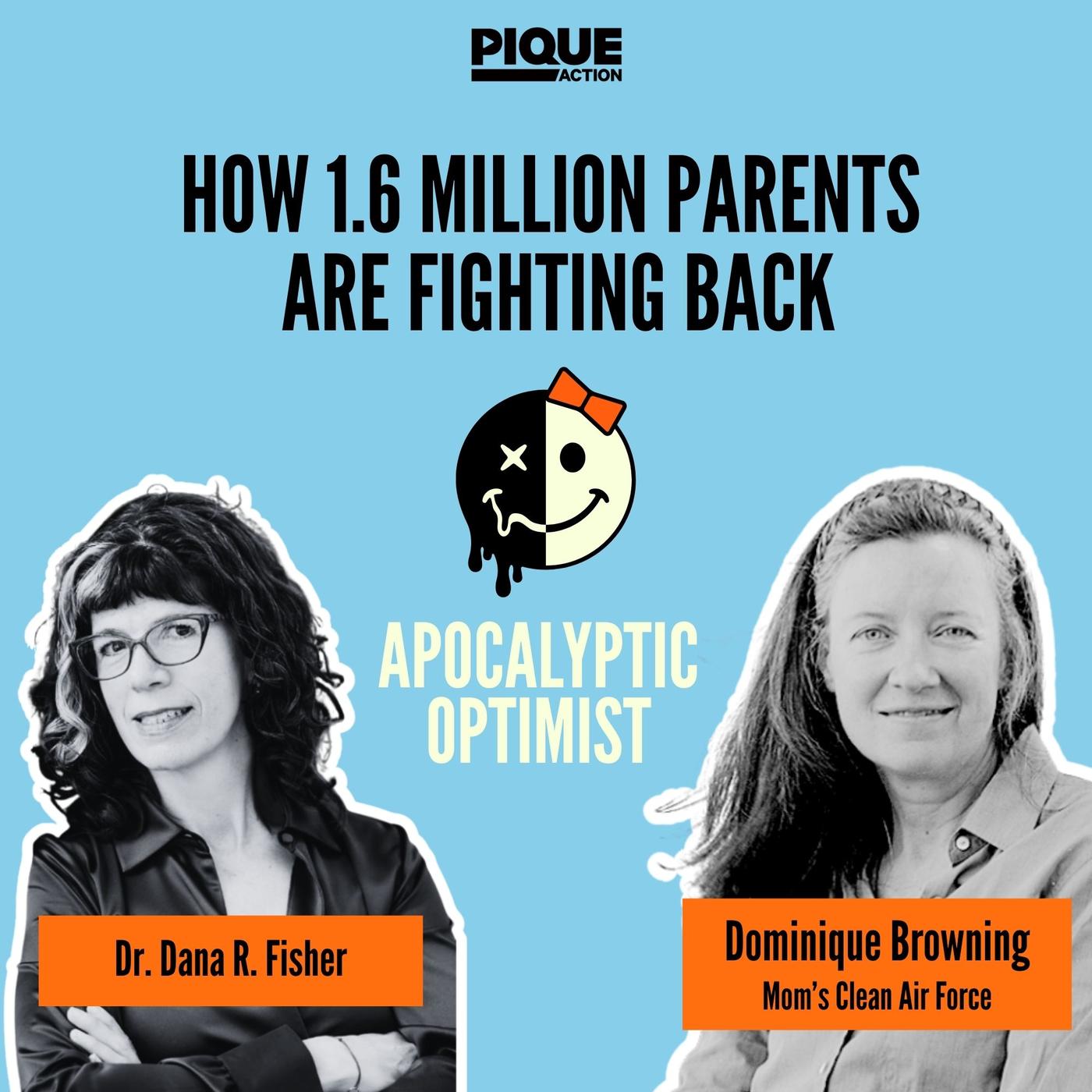
speaker-1: Dr. Dana Fisher. Welcome to the Apocalyptic Optimist Podcast. We'll talk about what's broken and how we, and yes, even you, can actually fix it. Welcome back to the Apocalyptic Optimist Podcast, real talk about what's broken and how we fix it. I'm Dana Fisher. Today I'm speaking with Dominic Browning, an editor who left Condonest and a publishing career to start Mom's Clean Air Force, which now commands a ground troop of over 1.6 million parents across the United States. Dominic is a master of translating existential planetary threats into the language of love, parenting, and civic action. Thank you so much for joining me today.
speaker-0: Thank you for having me. It's an honor.
speaker-1: Today, what I want to do is talk about how we are dealing with this disdruction of the federal guardrails that exist and the climate action that has come from the federal level. We have entered a deeply hostile regulatory landscape. And I want to talk with you about how you're helping to support parents and everybody else and helping us think through how we're going to continue to push forward. But before we do that, I was hoping you could just start by telling us a little bit about. your personal journey. How did you go from working in publishing to starting Moms Clean Air Force and ending up building this amazing group of one point six million parents from across the United States?
speaker-0: Sure. ⁓ well, as you said, I had a career in publishing. I've always been interested in science. And even in my newsweek days, we covered ⁓ climate change and big planetary problems. And at House and Garden, I had Bill McKibben ⁓ writing a column for us about how he was going green. He and his wife were going green in their house. ⁓ so The thing is, it was a problem that I always thought was so enormous that the government would handle it, you know, the big scale. ⁓ and then I decided to leave the publishing business after my job left me. ⁓ a magazine was folded. And I had been at Esquire and Newsweek and Texas Monthly. I'd done a lot of different kinds of magazines and ⁓ newspaper consulting. And I thought, you know, like I really care about this problem. My children are grown and out of the house, but I still want to take care of them. So maybe ⁓ maybe the science area is an area to get into. And I was blogging at the time I wrote a about losing my job and curling up in fetal position. And as one does. And 15 years ago, blogging was a new thing and there was a whole group
speaker-1: As one does.
speaker-0: A self-described mommy bloggers out there. And these were women who were very concerned about their children's health. And they talked about what they could buy, you know, BPA free baby bottles, air filters to clean the air, that kind of thing. And I thought, wait a minute, if we can harness that kind of energy to big system change, that could be a game changer. And because that's what we need to do, right? We can't buy our way out of this problem. So ⁓ that was the big beginning. Yeah, yeah. So that was the beginning of mom's clean air force. And I found some like minded women, mothers, ⁓ who gave me the seed money to get going.
speaker-1: That's amazing. And now you we're talking, I know you are celebrating an anniversary, right?
speaker-0: We are fifteen years on all to this ⁓ to next month and ⁓ and that's very thank you. Thank you. I'll take it.
speaker-1: Exciting. Well, it's so it's ⁓ it's an interesting time to be celebrating fifteen years, given what we have going on in our country and around the world. ⁓ one of the things that you did when you s when you launched Mom's Clean Air Force is you talked about redirecting attention from the polar bears to the people. And can you tell us a little bit about how you push to move the national conversation in that way?
speaker-0: Yes, although I will now add an asterisk to say that I feel very sorry for the polar bears and all creatures who are suffering. However, fifteen years ago, the conversation was happening at a level that made you feel it was very far away, you know, happening in remote places that wouldn't impact people. And again, back to those mommy bloggers, I wanted to say, no, this is not only impacting. Everybody is impacting us right now because the data was already coming in. And because of my magazine background, one of the skills I've owned over the years is just talking about things in a direct way, right? Without the jargon. And ⁓ and because I don't have expertise, right? I I'm much more oriented towards talking to regular people. And
speaker-1: Yeah.
speaker-0: That's what we started to do. We just started to explain to people why they needed to care about this and why now. Waxman Markey, which was the only time we've ever had a climate bill ⁓ get anywhere near the finish line, Waxman Markey had just failed in a stunning reversal. Everyone was in depression about this and not seeing a way forward.
speaker-1: I wanna just cut in here to say that the Waxman Markey bill passed the House of Representatives right after Barack Obama right before right after he became elected president and came into office for his first term, just to contextualize this historically.
speaker-0: Yeah, exactly. And to further contextualize it, ⁓ you know, there was a feeling that we all need to rally around getting this deal across. But unfortunately, nobody thought about how to rally people, the citizens, to tell people why we cared and why we needed to bring pressure on our lawmakers. ⁓ and so that that's really ⁓ in the heart of what we're doing is like trying to get laws, trying to get EPA protections.
speaker-1: Yeah, no, ⁓ and it's it's more important now, even than it was back then, unfortunately. I mean, one of the things that ⁓ that you all have been talking about a bunch is the ways that the EPA is basically turning its back on protecting us in terms of our environmental quality, in terms of our health. And I was wondering if you could ⁓ talk a little bit about how you're anchoring yourself. and communicating how to do that to the one point six million members of Moms Clean Air Force, given what's going on at the national level.
speaker-0: That's the apocalyptic part, right?
speaker-1: Yeah, we start we start there. So there here we are. We're in the apocalyptic part. So we're gonna go down and then we will come up again.
speaker-0: Yes, that's fine. I I am an angry optimist, I will say. so the apocalyptic part is what is going on at the environmental protection agency whose mission is to protect human health and the environment. That what we are seeing is a wholesale corruption of that mission, a stripping away of protections for all of us from air pollution. Water issues, chemical, toxic chemicals, and of course climate mitigation. So ⁓ it's a mess. Essentially the entire administration
speaker-1: Seems
speaker-0: Devoted to the idea of gutting the Clean Air Act and ⁓ also gutting protections that are very popular with people. People understand air pollution, which is why we started talking about climate pollution. And I would get these letters from scientists who were saying it's not climate pollution, it's climate emissions. And I would say, yeah, but people don't understand emissions, but they understand pollution. This is an EPA that is essentially saying we're walking away from this spy. There's nothing there to see. It's not happening. It's always been happening. We're right back where we were. And and then on simple things like pollution issues, they're walking away. So it's a disgrace what's happening. they are in the pockets of the fossil fuel industry. And ⁓ and explicitly so, I'm not being paranoid. Trump has said donate to my campaign and I will pave the way asphalt for you to get what you want to get in terms of lightening up your regulatory burden, which is a protection for us.
speaker-1: Right, exactly. I mean, and no, you're absolutely not being paranoid here because it's been very clear and there's been tons of research that's been documenting the ways that the money that went in through contributions to the Trump campaign has actually yielded fruit for the fossil fuel industry. But what I wanted to know is is there a message that you are sharing with your members right now? I mean, I saw all of these parents got involved because they care about their kids, they care about their kids' health, they care about The air quality in their communities. So what do you tell them?
speaker-0: My message is we are playing a long game. We cannot go silent. We don't have the luxury of giving up or walking away from this fight. We have to brace lawmakers for the opportunities ahead where we will be able to roll back the rollbacks, so to speak. ⁓ but we also need to send signals to state lawmakers and governors and mayors to say, hey. We are counting on you to pick up where the federal government is abandoning us.
speaker-1: Perfect. So so are you working specifically at other scales of governance? Like is there a specific state level strategy that you can share with us? Or and if so, is it coordinating across states or is each state doing something specific to the way that the state is made up?
speaker-0: Great question. Okay, now we're gonna get to the optimism part. and So I well, you know what? Don't you feel like life now is just like constantly toggling back and forth between one and the other? Yeah. Just when I think it can't get worse, it gets worse. And then I hear about an amazing thing that happened where our group of moms shut down an ⁓ so-called advanced recycling plant or an AI data center. So ⁓ yes, we are working at state level and ⁓ at the mayoral level and ⁓ Data centers, AI data centers, is a very good example ⁓ of that kind of work. And so is this enormous effort that the chemistry industry is putting forward called advanced recycling, which is really burning plastic to get rid of the visuals of the plastic problems. And when you burn plastic, when you incinerate plastics, especially with our very weak incinerator. rules that we have in this country, you create some of the most toxic air pollution known to humankind. So we do not want them to get away with building these incinerators, ⁓ even under the greenwashing label of advanced recycling, and putting them in our communities and not regulating, not enforcing, not monitoring, you know, all the things they're trying to do. And ⁓ and we're seeing results. People are ⁓ communities are banding together with caregivers at the heart of it. And we've seen shutdowns or stoppage in Ohio, Colorado, in North Carolina, in Pennsylvania. And same on the data center front. Our moms have been involved in stopping build-out in Wisconsin. And now in Colorado, there's a moratorium for a year while we scramble to catch up. With how can we do this without impacting communities negatively?
speaker-1: That's amazing. And that is very optimistic. I was I I wanted to pivot. I hope hopefully this isn't shifting too much back into the apocalypse, but I did want to talk because I'm I'm a huge fan. I mean, so I'm a mom and my kids go to school. Well, one of my kids still goes to school here in our public schools. And we were involved in the big ⁓ push for electric school buses, which I know that mom's clean air force played a huge role in helping to. get communities to be able to adopt and take advantage of these benefits that were were provided by the federal government. And I was wondering if you could talk a little bit about how you've been pivoting to protect and work to to retain these advances that we've seen in communities there. Before we talk more about the the successes that you were just outlining, which are fantastic as well.
speaker-0: That is a story of success. I mean, first that we got the funding from the federal government to support the school buses, and that that funding got into communities. Now, ⁓ some communities have responded and picked it up and gotten their buses up and running. Others have gotten snarled in what is now this backwash of funding not being released. the school buses are a very good example of. How things can work when there's federal funding coordinated at the local level. Because ⁓ you know, again, in this country, every town is different. The people who lease school buses might be private companies, it might be the superintendent, it might be the mayor, who knows? It's different everywhere. But moms on the ground were able to help guide that. ⁓ diesel buses are really bad. For children to be in and for people around them to be breathing ⁓ their exhaust. And propane buses, natural gas, clean natural gas, as the industry calls it, better than diesel, but it's still not good. And school buses are a great way, any kind of public transportation, to electrify because you can charge on a regular schedule and ⁓ you can use the batteries as Backup ⁓ generators, you know, there's a lot of possibility. So that's a program that was extremely appealing to work on and now we're trying to get funding released and again, next time around, ⁓ get more funding.
speaker-1: Right. And so one question I had for you is we've we've spoken on the podcast before about the power of committing to doing political work within your community. And I feel like Mom's Clean Air Force is a really great example of a group that works at the federal level, but then also coordinates actions that are taking place within communities with people who live in those communities. I was I was hoping you could tell us a little more about how you coordinate. from the national level down to the local folks who are working on these different campaigns for moms in the communities themselves. How do you how do you do that?
speaker-0: Sure. ⁓ we have organizers in about a dozen states. and ⁓ these are our core representatives of Moms Clean Air Force and they are the way that we get across information. They each are living in places which we used to call purple, right? Where there's a possibility of change, ⁓ bipartisan change. But people need to feel the wind at their back. And ⁓ so we choose ⁓ carefully where we can work. And we don't go to places where things seem to be going in the right direction, although now that's all up in the air too. and usually things like advanced recycling or AI data centers, those are fights that have a national profile. But must be expressed at the community level. And it's not just about stopping things, it's also about forcing system change. So we don't want to just stop a data center because they will just pack up and roll off to another town that might not be organized. What we want to do is say to these companies, no, you can't come in and drain the water or dirty our air. or throw formaldehyde ⁓ into our communities, ⁓ there are better ways to do this. And that's that's the point. And that's the point we're trying to get across. That's the point we need to make federally, and it's the point people need to see in their communities because it's at the community level that you're breathing air pollution.
speaker-1: Absolutely. Yeah. I mean, I think really embedding the fight within the community and within the struggles that are going on in the communities can be so much more effective and can ⁓ obviously leverage the concerns of people in the communities rather than parachuting in or getting people to do stuff only online. And one question I had that to follow up with that is can you give an example of some type of systemic change that you all have witnessed or have been part of getting to? over the years and I realize that right now it's it's a good time to look back at some of the successes maybe.
speaker-0: Because all of the successes are now being attacked. So yeah, ⁓ a a good one is mercury regulations. So when we started moms, as we were saying, post whack post-failed federal legislation, right? I thought, wait a minute, I wanted to tackle climate change, but we're never gonna get another climate bill, or at least not for a decade or more. ⁓ and then somebody explained to me that. Actually, if you get coal plant pollution, mercury pollution under control, you can cut a huge amount of carbon, which is a climate pollutant. So, and not only that, you can stop contaminating food with mercury that our children are eating. And I remember when I was pregnant, so 40 years ago, more than 40 years ago. My doctor did at that time say, don't eat tuna fish, don't eat large fatty fish because they have too much mercury. But I never really thought about how the mercury got there. I kind of thought it was just there. I never understood until I started this work that that mercury comes from coal-fired power plant exhaust. And it rains down into the water and by it converts and goes up the food chain. And what we know now that we didn't even know 20 years ago is there Isn't really a hard blood brain barrier or a hard placental barrier. What you eat, what you take in when you're just you are that's going to the fetal brain. And mercury is attracted, if you want to put it that way, to fat, fatty tissue. And the only fatty tissue in the fetus is in the developing brain. And mercury is a Potent neurotoxin and it disrupts that architecture. Incredibly to me, there had been a 15-year fight to strengthen mercury protections. And it wasn't getting anywhere. So we jumped into that wholeheartedly because it just had everything I wanted ⁓ as a way of messaging that we can make a difference. And we pulled together a a diverse coalition and all the moms and We did get EPA to pass stronger mercury protections, which were then again strengthened. So that's the kind of thing. Another is methane regulations. Methane is even worse than carbon in the short run as a climate forcer. And we have fought tooth and nail to get methane protections, because along with methane, when that's ⁓ fracked ⁓ all these volatile organic compounds that are very dangerous to our health. So you can talk about climate pollutants without ever talking about climate change. And those are supposed to be durable changes, durable wins. And they haven't won yet with these rollbacks. You know, we will keep fighting and ⁓ and we'll get them back.
speaker-1: Right. I mean and and with the redirection to some local level struggles, are you finding that there were opportunities to push back there to make sure to to hold the line maybe in places where you feel like the federal level is is trying to or is weakening? We could say it that way maybe. I mean is there an ex
speaker-0: Yeah. ⁓ A lot of examples of that ⁓ in the AI data center world. ⁓ you know, because again, these guys are and I say guys advisedly, they are ⁓ putting diesel turbines, gas turbines on wheels and calling them mobile sources, which aren't regulated so that they can just pollute because it's cheaper. And ⁓ so stopping these. projects is an incredibly important win because it it's important for the community and it sends a signal to the industry that you cannot come in and assault people with your development. ⁓ so
speaker-1: Yeah, and the data center struggle, I think, is a particularly interesting one because we've seen that data centers have become increasingly unpopular across the country and across the red-blue divide, if you want to think of it that way. ⁓ I was wondering if you could talk a little bit about if there are places where moms is forging new and interesting coalitions in this struggle at all. Have you found yourselves working with folks that you didn't expect to see, or is it really more individuals coming out as parents?
speaker-0: No, I think it's both. I think ⁓ for example, ⁓ the work that we've done in Wisconsin, which I would say is the sort of a red blue area, that was extremely vivid example of people coming together to ask questions and demand protections. and you know, our moms were there. It was one of our moms who catalyzed ⁓ these efforts. ⁓ and then our job is to keep going so that they don't just pick up and move elsewhere.
speaker-1: Right, right. How do you do that?
speaker-0: Well, here's the other thing about Bombs Clean Air Force. We show up day after day after day, month after month. And as you know, anybody who has been involved in changing laws and changing regulations, it's tedious. It's long. You can't like just have a protest and then leave and wait, you know, the it's the actual work of writing the laws, drafting the laws, criticizing them all of you just day after day. And in a community, it's working with either the mayor or your utility board or however it's set up where you live. ⁓ and just showing up and having conversation and explaining what it is we're looking for. We're not attacking artificial intelligence, which would be crazy. ⁓ And it's been with us for quite a long time. Right. Well, I the people who are creating this need to be thinking very deeply and hard than they are about what they're unleashing on the world. ⁓ that's a whole other conversation, right?
speaker-1: Yeah. Just put let's just put that one to the
speaker-0: Yeah, we can't we I mean there is, there is. ⁓ but anyway, ⁓ so so that's what we're doing is we're having conversations with people who have their fingers on the levers to ⁓ write the laws. ⁓ and like moratoria are very incredi ⁓ useful because no nobody has in place the regulations to protect
speaker-1: Lot to unpack there.
speaker-0: communities from the kind of pollution we're seeing and the potential devastation we're seeing. So th people have to scramble to catch up to this new kind of build out.
speaker-1: Well, that actually brings us to another question I wanted to ask. So one of the things that ⁓ mom's Clean Air Force is famous for, at least in my opinion, is these amazing lobby weeks slash play in for climate action, where you bring in folks from across the country to lobby representatives here. Well, I'm so I'm in Washington DC. I should say that. So here in Washington DC. To actually you you have these meetings on the hill, everybody's wearing their red shirts. I'm wearing my red shirt in solidarity today. and it doesn't it doesn't have your logo, but but that's yeah
speaker-0: It is ⁓
speaker-1: You've got this sign right behind you. ⁓ but so I was curious if you could talk us through how these lobby days work and how frequent are they and you know and if you're seeing them changing in the current moment.
speaker-0: They're incredibly important. big splashy multi-state lobby days ⁓ we do probably once a year. smaller ones where we don't even call them lobby days because we're not necessarily lobbying for a particular rule or law. We want our presence felt on the hill to say we are caregivers who care about our children's future and you need to be aware of us. And ⁓ I love the image of these intimidating white marble halls of the Senate and ⁓ the moms in the red t-shirts and the kids in their red t-shirts going in to see the people who they have hired to make represent them in Washington, DC.
speaker-1: Right. And so ⁓ I mean, they were they're amazing and I always see these images of all the moms afterwards standing on the stairs of the Congress, which is always really an impressive image. But so so so speaking about today, so do you know when your next lobby day is gonna happen?
speaker-0: Just been involved ⁓ on an effort by the American Chemistry Council to weaken toxic chemical rules. ⁓ We passed a law strengthening the process whereby chemicals are approved before they're put on the market. ⁓ And now In this administration, they want to make the that law weaker. So more chemicals. And the buzzword is always the regulatory burden, right? And you know, all the fossil people, they're all talking about the regulatory burden while they're making gazillions of dollars in profits. ⁓ so we are telling our lawmakers that is not acceptable.
speaker-1: So when you go to ⁓ the Hill, I know one of the things that you all have talked about is presenting yourselves more to not just to criticize, but also to show support for folks who are on your side and and who are providing a mouthpiece for the concerns of moms and caregivers. Can you talk a little bit about that and how that works?
speaker-0: Yeah. ⁓ we like to say we are mom partisan. ⁓ right. We we are supporting anybody, Republican, independent, democrat, who is on the side of protecting children's health and the stability of our planet. ⁓ so ⁓ yeah. We remember to say thank you, which is something You'd be surprised how many people don't say thank you when somebody has made a tough vote or stood up ⁓ to powerful, rich forces. So we say thank you for hard votes. We say don't do this for votes that might be going the wrong way. ⁓ and lawmakers need to know that people care. That's key. Right. If they don't know that we care about climate pollution or air pollution or toxic chemicals, there's nothing in it for them to tackle the problem.
speaker-1: For sure. I mean, and I was just curious if now with the highly polarizing moment that we're living in, as you do a lobby day or you bring moms and caregivers to Washington, DC, do you do anything differently in terms of preparing people who've never maybe spoken to their elected official before? Or do you follow the same model?
speaker-0: You know, it's it's pretty much the same model because ⁓ again, the architecture of those buildings ⁓ in Washington DC is meant to be incredibly intimidating, even though these are the people's places, right? And I will never forget one of the first ⁓ fly-ins that I did with a group of mothers, people hesitated on the threshold at the top of the stairs. And hung back and said, is this legal? Are we allowed to come here? And it was a great reminder to me of how effective the barriers are, the barriers to communication. So yeah, we still talk a lot about not only is it legal, you as a citizen have a right to tell your lawmaker what you think and what you want and what you care about. And ⁓ and and we're here with you. And ⁓ So in that way it has not changed because that feeling of intimidation is still there. The other thing, of course, now is that things are much more polarized. And in Washington, DC, you have the spectacle of many more people with guns on the streets, right? So it's
speaker-1: We are currently facing a surge of of ⁓ federal agents. So we are seeing lots and lots of guns.
speaker-0: Okay. That's scary.
speaker-1: ⁓ yeah. I mean it's very scary. I just was saw a friend of mine was downtown yesterday. ⁓ he went to the reflecting pool because there is a bit of drama at the reflecting pool right now, as you may have heard. Sure is. And he actually captured on his camera this child who was just going to splash. You know, he went over to splash at the reflecting pool, and this National Guards person came over with their like big gun and tried to tell him this must this kid must have been, I don't know, four or five. telling me he wasn't allowed to touch the water and you know, scared scared the pants off of this kid. And it was just a you know, it was a really kind of brought, you know, home to me how much things have changed in Washington, DC. Because I have to say, I mean we we I don't really go downtown as much as I did before because it's very threatening. There's lots of armed, you know, soldiers. ⁓ I don't go, my family used to go downtown all the time to go to the museums to go take advantage. There's so much amazing green open space and so many activities here in our nation's capital that we usually take advantage of. But for example, July 4th is coming and instead of it being a celebration of America and our history and our democracy, it has been recast as a ⁓ you know, as a festival in honor of our president, which makes it about one person's personality rather than it being about America and our history, particularly on the two hundred and fiftieth anniversary. So we're gonna go we're gonna go visit my dad and get out of town.
speaker-0: Very good idea. But you know, what you're describing is a profound change. ⁓ this Pushing a fear into all of our lives is a very, very effective way to control people. and and it's terrible, ⁓ really terrible. But they want us to be afraid, right?
speaker-1: For sure. So so what do you tell caregivers to tell you know, to make them feel less afraid and more comfortable pushing back?
speaker-0: I think people still feel safe in the halls of Congress. ⁓ we haven't had an outdoor play-in. We used to do it on a lawn ⁓ near the Capitol building. we stopped after the riots, ⁓ after the Trump riots. And ⁓ we've done them inside where we can control security more. ⁓ and inside federal buildings, I think. People do feel safer and we're safer in numbers. but we're not blind to how much things have changed. It's sad.
speaker-1: It's very sad. I mean, one of the things that my research documents, and a lot of social scientists who study social movements like me have documented is the way that anger is a really great motivator for getting people to feel more comfortable and effective and engaged. And so one of the things that I've documented with people whom I've studied out at these pro-democracy protests and demonstrations is the degree to which we're seeing anger as a real motivator and ⁓ an emotion that brings people together, even though, you know, in a lot of ways as women, we're frequently told, you know, don't be angry, don't be shrill. But being angry in some ways can help us feel more comfortable. Where I mean it certainly is better than feeling afraid, in my opinion. And it seems to work, at least that the research shows it does.
speaker-0: Yeah. because you need an outlet for that anger too. That's why I say I am an angry optimist. I I do feel both angry and stunned at how cynical and corrupt things have become. and that anger and that feeling of protectiveness ⁓ towards my grandchild is very I call it a a very sustainable form of energy actually. ⁓ but you know we've also done our work from a place of love and I think that's even more important ⁓ than anger.
speaker-1: No, absolutely. And that's a very good reminder. Right, for sure. Do you ever go to agencies and talk to people when you do your clients? Yeah.
speaker-0: Yes, we did a lot of visits with EPA over the years. and ⁓ and that's why it's shocking to see what's happening at EPA now because this is really radical and no Republican administrator, EPA administrator has been as ⁓ reckless about the Clean Air Act and wanting to just basically gut it. This is unprecedented.
speaker-1: Absolutely. Yeah. No. ⁓ in fact under Republican presidents is when we've had some of our most substantial environmental policies passed.
speaker-0: Well look, Richard Nixon is the person who gave us ⁓ the Clean Air Act. So ⁓
speaker-1: Exactly. So just a slight pivot here. I know that ⁓ you all have talked some about extreme heat and schools and classrooms in the context of extreme heat. So we are ⁓ I guess we're we're in the summer now. We're in the summer. We're in kind of the early days of summer. We've already seen some heat waves. There's currently a heat wave that is overwhelming your Europe right now. And ⁓ And we are expecting, you know, with El Nino now that everything's gonna be even hotter. And so I was wondering if you've been talking with and working with moms about what is expected and how to make our schools safe. And how do you rally one point six million members to get involved in this before we are in the middle of El Nino and the school year starts again? I know for some schools in some parts of the country they start again in August, which is a very hot time of the year already.
speaker-0: Right. And all parents in all communities have to demand air conditioning and you know and et cetera. And of course then there's the electricity ramp up, but all schools should have solar panels on them. so yes, you know, we're always looking for ways to talk about the impacts of a changing climate. ways that people feel in their lives every single day. And hate is definitely when everybody knows things are changing, whether they're Republican, Democrat, rural, urban, everybody is talking about that. Weather patterns are changing, aim patterns are changing, and the heat is extreme. And and the record is very straightforward. ⁓ so not only do we talk about how to stay safe, But we also remind people, look, this is going to get worse. This is I I do not let people talk about a new normal because the whole point is there is no new normal. There will not be a normal. This is not plateau. It gets worse.
speaker-1: And so in once you talk about that, then what do you tell people they should be doing? I mean, what's the if if everybody is trying to have one thing that they can feel like they can do in their lives, what would you tell them to do?
speaker-0: What everybody needs to do is think about the long term and just pick up the phone and call your senator's local office. Don't bother to call DC, call the state office and tell that person answering the phone, I'm outraged that we are rolling back EPA. Where is your oversight? You're a lawmaker. Why are you letting EPA do this? Why are you letting the Secretary of Energy do this? Stop. We need Calling elected officials is huge and it would make a difference.
speaker-1: So I know that you said that most of the places where you work, ⁓ across the country is you you identified purple areas. Do you have different advice for people who live in a blue area or a red area versus those who live in the purple areas where maybe their electeds are more open to different perspectives? Or is it the same message?
speaker-0: You know, it's an interesting question now compared to six months ago, because look what's just happened in New York State, right? With climate laws. There's a lot of confusion and a ⁓ lot of conflict among Democrats alone about talking about climate change, right? There's this whole movement of climate hushing because it won't get you elected. Well, so we're saying the same thing, everybody has to care. And yeah. Do whatever it takes to get yourself elected and change the laws, but we're not gonna help you get elected and then ignore us.
speaker-1: So then are you telling people not to talk about climate while they're getting elected or are you do you have a position on that or
speaker-0: Yeah, we're talking we're telling people you have to talk about it because people do care. They care about air pollution, they care about climate pollution. Is it their number one concern? Not yet. By the time it's everyone's number one concern, it will be too late. Because there will be too much death and destruction happening. So and I get that, you know, I'm I have a job. Doing this, but people care about their paychecks, they care about their mortgages or their rents, they care about their children's ⁓ medical bills, they care about school, they have a lot of concerns. I mean, right now everyone's talking about affordability for very good reason. But that doesn't mean they don't care about climate. we need to know that a new generation of leaders is going to understand that this is a concern.
speaker-1: Absolutely. ⁓ so shifting slightly, 'cause I know we're gonna run out of time here, do you have advice to people who don't see themselves as, you know, traditional activists or protesters but have concerns as parents? Is there a message that you tell them versus somebody who's like, I'm riled up and I wanna call my elected? Do you have a different message for people who might be, you know, new to politics but feel like they have to do something?
speaker-0: Yeah, ⁓ and it's an important question because everybody does have a different sort of personality gait ⁓ and comfort level. we talk about naptime activism. We have petitions and those count. They count for the historical record and they count that a lawmaker is hearing from constituents, we're not happy about this, or yay, go do more. ⁓ and that's as simple as sitting at your computer and pressing a button and sending a petition. A phone call is a very private thing and it's a nice person, probably your local college student who is answering the phones and taking the message and writing down, We got a call about that AI data center and you know that kind of thing. So You know, those are things you don't have to be in the streets, you don't have to be in a huge group of people. There are a lot of things that can be done. What you can't do is be paralyzed by despair or stick your head in the tar sands.
speaker-1: In the tar sands. In in whatever sands you have near you. Whatever sands ⁓ and so do you have is does moms have a message? We have a midterm election coming up in November, and I know you're nonpartisan, but do you have a message about the election and what people and caregivers should be doing across the country?
speaker-0: Sure, because there are Republican officials who care about the environment for they care about and they know that the climate is changing and they need to hear from their constituents. You need to express your concern for the way things are going.
speaker-1: Yeah. So ⁓ so since we're running out of time, I wanted to take to to shift here to what we do at the end. To wrap things up, we do what we call a quick lightning round. So the rules are a little different. ⁓ what's gonna happen is I'm gonna name a few concepts and you're just gonna tell me today if you are feeling apocalyptic or optimistic about each one. We not for discussion, just like a quick kind of gut feeling about them. Today. Okay? You can say both. We've had some people say neutral, but you know
speaker-0: Or both. She's not neutral about anything. Okay.
speaker-1: Outstanding The Future of the Clean Air.
speaker-0: Optimistic.
speaker-1: Very nice. The endangerment finding in the Clean Air Act.
speaker-0: Optimistic.
speaker-1: State level climate litigation.
speaker-0: Pessimistic. Apocalypse.
speaker-1: Electric school buses.
speaker-0: Optimistic.
speaker-1: Community led methane tracking.
speaker-0: hopefully it won't be necessary because we will have countrywide ⁓ satellite tracking.
speaker-1: Hopefully. Corporate accountability.
speaker-0: Apocalyptic.
speaker-1: And finally, the power of parents and caregivers.
speaker-0: Completely and one hundred percent optimistic.
speaker-1: Outstanding. We always like to end on an optimistic note. ⁓ so I just want to say thank you so much for sharing how you translate and empower caregivers and their concerns from their communities and for their children into political power and political action. Happy anniversary. And I really appreciate your taking time to join the Apo Apocalyptic Optimist podcast.
speaker-0: Thank you. Thank you so much for having me.
speaker-1: Thank you for listening to this episode. I hope you're feeling a little less apocalyptic and a little more optimistic now. I'm Dr. Dana Fisher and I'll see you next time. If you like this episode, like, subscribe, and even pass it to a friend. Thanks.
speaker-1: Dr. Dana Fisher. Welcome to the Apocalyptic Optimist Podcast. We'll talk about what's broken and how we, and yes, even you, can actually fix it. Welcome back to the Apocalyptic Optimist Podcast, real talk about what's broken and how we fix it. I'm Dana Fisher. Today I'm speaking with Dominic Browning, an editor who left Condonest and a publishing career to start Mom's Clean Air Force, which now commands a ground troop of over 1.6 million parents across the United States. Dominic is a master of translating existential planetary threats into the language of love, parenting, and civic action. Thank you so much for joining me today.
speaker-0: Thank you for having me. It's an honor.
speaker-1: Today, what I want to do is talk about how we are dealing with this disdruction of the federal guardrails that exist and the climate action that has come from the federal level. We have entered a deeply hostile regulatory landscape. And I want to talk with you about how you're helping to support parents and everybody else and helping us think through how we're going to continue to push forward. But before we do that, I was hoping you could just start by telling us a little bit about. your personal journey. How did you go from working in publishing to starting Moms Clean Air Force and ending up building this amazing group of one point six million parents from across the United States?
speaker-0: Sure. ⁓ well, as you said, I had a career in publishing. I've always been interested in science. And even in my newsweek days, we covered ⁓ climate change and big planetary problems. And at House and Garden, I had Bill McKibben ⁓ writing a column for us about how he was going green. He and his wife were going green in their house. ⁓ so The thing is, it was a problem that I always thought was so enormous that the government would handle it, you know, the big scale. ⁓ and then I decided to leave the publishing business after my job left me. ⁓ a magazine was folded. And I had been at Esquire and Newsweek and Texas Monthly. I'd done a lot of different kinds of magazines and ⁓ newspaper consulting. And I thought, you know, like I really care about this problem. My children are grown and out of the house, but I still want to take care of them. So maybe ⁓ maybe the science area is an area to get into. And I was blogging at the time I wrote a about losing my job and curling up in fetal position. And as one does. And 15 years ago, blogging was a new thing and there was a whole group
speaker-1: As one does.
speaker-0: A self-described mommy bloggers out there. And these were women who were very concerned about their children's health. And they talked about what they could buy, you know, BPA free baby bottles, air filters to clean the air, that kind of thing. And I thought, wait a minute, if we can harness that kind of energy to big system change, that could be a game changer. And because that's what we need to do, right? We can't buy our way out of this problem. So ⁓ that was the big beginning. Yeah, yeah. So that was the beginning of mom's clean air force. And I found some like minded women, mothers, ⁓ who gave me the seed money to get going.
speaker-1: That's amazing. And now you we're talking, I know you are celebrating an anniversary, right?
speaker-0: We are fifteen years on all to this ⁓ to next month and ⁓ and that's very thank you. Thank you. I'll take it.
speaker-1: Exciting. Well, it's so it's ⁓ it's an interesting time to be celebrating fifteen years, given what we have going on in our country and around the world. ⁓ one of the things that you did when you s when you launched Mom's Clean Air Force is you talked about redirecting attention from the polar bears to the people. And can you tell us a little bit about how you push to move the national conversation in that way?
speaker-0: Yes, although I will now add an asterisk to say that I feel very sorry for the polar bears and all creatures who are suffering. However, fifteen years ago, the conversation was happening at a level that made you feel it was very far away, you know, happening in remote places that wouldn't impact people. And again, back to those mommy bloggers, I wanted to say, no, this is not only impacting. Everybody is impacting us right now because the data was already coming in. And because of my magazine background, one of the skills I've owned over the years is just talking about things in a direct way, right? Without the jargon. And ⁓ and because I don't have expertise, right? I I'm much more oriented towards talking to regular people. And
speaker-1: Yeah.
speaker-0: That's what we started to do. We just started to explain to people why they needed to care about this and why now. Waxman Markey, which was the only time we've ever had a climate bill ⁓ get anywhere near the finish line, Waxman Markey had just failed in a stunning reversal. Everyone was in depression about this and not seeing a way forward.
speaker-1: I wanna just cut in here to say that the Waxman Markey bill passed the House of Representatives right after Barack Obama right before right after he became elected president and came into office for his first term, just to contextualize this historically.
speaker-0: Yeah, exactly. And to further contextualize it, ⁓ you know, there was a feeling that we all need to rally around getting this deal across. But unfortunately, nobody thought about how to rally people, the citizens, to tell people why we cared and why we needed to bring pressure on our lawmakers. ⁓ and so that that's really ⁓ in the heart of what we're doing is like trying to get laws, trying to get EPA protections.
speaker-1: Yeah, no, ⁓ and it's it's more important now, even than it was back then, unfortunately. I mean, one of the things that ⁓ that you all have been talking about a bunch is the ways that the EPA is basically turning its back on protecting us in terms of our environmental quality, in terms of our health. And I was wondering if you could ⁓ talk a little bit about how you're anchoring yourself. and communicating how to do that to the one point six million members of Moms Clean Air Force, given what's going on at the national level.
speaker-0: That's the apocalyptic part, right?
speaker-1: Yeah, we start we start there. So there here we are. We're in the apocalyptic part. So we're gonna go down and then we will come up again.
speaker-0: Yes, that's fine. I I am an angry optimist, I will say. so the apocalyptic part is what is going on at the environmental protection agency whose mission is to protect human health and the environment. That what we are seeing is a wholesale corruption of that mission, a stripping away of protections for all of us from air pollution. Water issues, chemical, toxic chemicals, and of course climate mitigation. So ⁓ it's a mess. Essentially the entire administration
speaker-1: Seems
speaker-0: Devoted to the idea of gutting the Clean Air Act and ⁓ also gutting protections that are very popular with people. People understand air pollution, which is why we started talking about climate pollution. And I would get these letters from scientists who were saying it's not climate pollution, it's climate emissions. And I would say, yeah, but people don't understand emissions, but they understand pollution. This is an EPA that is essentially saying we're walking away from this spy. There's nothing there to see. It's not happening. It's always been happening. We're right back where we were. And and then on simple things like pollution issues, they're walking away. So it's a disgrace what's happening. they are in the pockets of the fossil fuel industry. And ⁓ and explicitly so, I'm not being paranoid. Trump has said donate to my campaign and I will pave the way asphalt for you to get what you want to get in terms of lightening up your regulatory burden, which is a protection for us.
speaker-1: Right, exactly. I mean, and no, you're absolutely not being paranoid here because it's been very clear and there's been tons of research that's been documenting the ways that the money that went in through contributions to the Trump campaign has actually yielded fruit for the fossil fuel industry. But what I wanted to know is is there a message that you are sharing with your members right now? I mean, I saw all of these parents got involved because they care about their kids, they care about their kids' health, they care about The air quality in their communities. So what do you tell them?
speaker-0: My message is we are playing a long game. We cannot go silent. We don't have the luxury of giving up or walking away from this fight. We have to brace lawmakers for the opportunities ahead where we will be able to roll back the rollbacks, so to speak. ⁓ but we also need to send signals to state lawmakers and governors and mayors to say, hey. We are counting on you to pick up where the federal government is abandoning us.
speaker-1: Perfect. So so are you working specifically at other scales of governance? Like is there a specific state level strategy that you can share with us? Or and if so, is it coordinating across states or is each state doing something specific to the way that the state is made up?
speaker-0: Great question. Okay, now we're gonna get to the optimism part. and So I well, you know what? Don't you feel like life now is just like constantly toggling back and forth between one and the other? Yeah. Just when I think it can't get worse, it gets worse. And then I hear about an amazing thing that happened where our group of moms shut down an ⁓ so-called advanced recycling plant or an AI data center. So ⁓ yes, we are working at state level and ⁓ at the mayoral level and ⁓ Data centers, AI data centers, is a very good example ⁓ of that kind of work. And so is this enormous effort that the chemistry industry is putting forward called advanced recycling, which is really burning plastic to get rid of the visuals of the plastic problems. And when you burn plastic, when you incinerate plastics, especially with our very weak incinerator. rules that we have in this country, you create some of the most toxic air pollution known to humankind. So we do not want them to get away with building these incinerators, ⁓ even under the greenwashing label of advanced recycling, and putting them in our communities and not regulating, not enforcing, not monitoring, you know, all the things they're trying to do. And ⁓ and we're seeing results. People are ⁓ communities are banding together with caregivers at the heart of it. And we've seen shutdowns or stoppage in Ohio, Colorado, in North Carolina, in Pennsylvania. And same on the data center front. Our moms have been involved in stopping build-out in Wisconsin. And now in Colorado, there's a moratorium for a year while we scramble to catch up. With how can we do this without impacting communities negatively?
speaker-1: That's amazing. And that is very optimistic. I was I I wanted to pivot. I hope hopefully this isn't shifting too much back into the apocalypse, but I did want to talk because I'm I'm a huge fan. I mean, so I'm a mom and my kids go to school. Well, one of my kids still goes to school here in our public schools. And we were involved in the big ⁓ push for electric school buses, which I know that mom's clean air force played a huge role in helping to. get communities to be able to adopt and take advantage of these benefits that were were provided by the federal government. And I was wondering if you could talk a little bit about how you've been pivoting to protect and work to to retain these advances that we've seen in communities there. Before we talk more about the the successes that you were just outlining, which are fantastic as well.
speaker-0: That is a story of success. I mean, first that we got the funding from the federal government to support the school buses, and that that funding got into communities. Now, ⁓ some communities have responded and picked it up and gotten their buses up and running. Others have gotten snarled in what is now this backwash of funding not being released. the school buses are a very good example of. How things can work when there's federal funding coordinated at the local level. Because ⁓ you know, again, in this country, every town is different. The people who lease school buses might be private companies, it might be the superintendent, it might be the mayor, who knows? It's different everywhere. But moms on the ground were able to help guide that. ⁓ diesel buses are really bad. For children to be in and for people around them to be breathing ⁓ their exhaust. And propane buses, natural gas, clean natural gas, as the industry calls it, better than diesel, but it's still not good. And school buses are a great way, any kind of public transportation, to electrify because you can charge on a regular schedule and ⁓ you can use the batteries as Backup ⁓ generators, you know, there's a lot of possibility. So that's a program that was extremely appealing to work on and now we're trying to get funding released and again, next time around, ⁓ get more funding.
speaker-1: Right. And so one question I had for you is we've we've spoken on the podcast before about the power of committing to doing political work within your community. And I feel like Mom's Clean Air Force is a really great example of a group that works at the federal level, but then also coordinates actions that are taking place within communities with people who live in those communities. I was I was hoping you could tell us a little more about how you coordinate. from the national level down to the local folks who are working on these different campaigns for moms in the communities themselves. How do you how do you do that?
speaker-0: Sure. ⁓ we have organizers in about a dozen states. and ⁓ these are our core representatives of Moms Clean Air Force and they are the way that we get across information. They each are living in places which we used to call purple, right? Where there's a possibility of change, ⁓ bipartisan change. But people need to feel the wind at their back. And ⁓ so we choose ⁓ carefully where we can work. And we don't go to places where things seem to be going in the right direction, although now that's all up in the air too. and usually things like advanced recycling or AI data centers, those are fights that have a national profile. But must be expressed at the community level. And it's not just about stopping things, it's also about forcing system change. So we don't want to just stop a data center because they will just pack up and roll off to another town that might not be organized. What we want to do is say to these companies, no, you can't come in and drain the water or dirty our air. or throw formaldehyde ⁓ into our communities, ⁓ there are better ways to do this. And that's that's the point. And that's the point we're trying to get across. That's the point we need to make federally, and it's the point people need to see in their communities because it's at the community level that you're breathing air pollution.
speaker-1: Absolutely. Yeah. I mean, I think really embedding the fight within the community and within the struggles that are going on in the communities can be so much more effective and can ⁓ obviously leverage the concerns of people in the communities rather than parachuting in or getting people to do stuff only online. And one question I had that to follow up with that is can you give an example of some type of systemic change that you all have witnessed or have been part of getting to? over the years and I realize that right now it's it's a good time to look back at some of the successes maybe.
speaker-0: Because all of the successes are now being attacked. So yeah, ⁓ a a good one is mercury regulations. So when we started moms, as we were saying, post whack post-failed federal legislation, right? I thought, wait a minute, I wanted to tackle climate change, but we're never gonna get another climate bill, or at least not for a decade or more. ⁓ and then somebody explained to me that. Actually, if you get coal plant pollution, mercury pollution under control, you can cut a huge amount of carbon, which is a climate pollutant. So, and not only that, you can stop contaminating food with mercury that our children are eating. And I remember when I was pregnant, so 40 years ago, more than 40 years ago. My doctor did at that time say, don't eat tuna fish, don't eat large fatty fish because they have too much mercury. But I never really thought about how the mercury got there. I kind of thought it was just there. I never understood until I started this work that that mercury comes from coal-fired power plant exhaust. And it rains down into the water and by it converts and goes up the food chain. And what we know now that we didn't even know 20 years ago is there Isn't really a hard blood brain barrier or a hard placental barrier. What you eat, what you take in when you're just you are that's going to the fetal brain. And mercury is attracted, if you want to put it that way, to fat, fatty tissue. And the only fatty tissue in the fetus is in the developing brain. And mercury is a Potent neurotoxin and it disrupts that architecture. Incredibly to me, there had been a 15-year fight to strengthen mercury protections. And it wasn't getting anywhere. So we jumped into that wholeheartedly because it just had everything I wanted ⁓ as a way of messaging that we can make a difference. And we pulled together a a diverse coalition and all the moms and We did get EPA to pass stronger mercury protections, which were then again strengthened. So that's the kind of thing. Another is methane regulations. Methane is even worse than carbon in the short run as a climate forcer. And we have fought tooth and nail to get methane protections, because along with methane, when that's ⁓ fracked ⁓ all these volatile organic compounds that are very dangerous to our health. So you can talk about climate pollutants without ever talking about climate change. And those are supposed to be durable changes, durable wins. And they haven't won yet with these rollbacks. You know, we will keep fighting and ⁓ and we'll get them back.
speaker-1: Right. I mean and and with the redirection to some local level struggles, are you finding that there were opportunities to push back there to make sure to to hold the line maybe in places where you feel like the federal level is is trying to or is weakening? We could say it that way maybe. I mean is there an ex
speaker-0: Yeah. ⁓ A lot of examples of that ⁓ in the AI data center world. ⁓ you know, because again, these guys are and I say guys advisedly, they are ⁓ putting diesel turbines, gas turbines on wheels and calling them mobile sources, which aren't regulated so that they can just pollute because it's cheaper. And ⁓ so stopping these. projects is an incredibly important win because it it's important for the community and it sends a signal to the industry that you cannot come in and assault people with your development. ⁓ so
speaker-1: Yeah, and the data center struggle, I think, is a particularly interesting one because we've seen that data centers have become increasingly unpopular across the country and across the red-blue divide, if you want to think of it that way. ⁓ I was wondering if you could talk a little bit about if there are places where moms is forging new and interesting coalitions in this struggle at all. Have you found yourselves working with folks that you didn't expect to see, or is it really more individuals coming out as parents?
speaker-0: No, I think it's both. I think ⁓ for example, ⁓ the work that we've done in Wisconsin, which I would say is the sort of a red blue area, that was extremely vivid example of people coming together to ask questions and demand protections. and you know, our moms were there. It was one of our moms who catalyzed ⁓ these efforts. ⁓ and then our job is to keep going so that they don't just pick up and move elsewhere.
speaker-1: Right, right. How do you do that?
speaker-0: Well, here's the other thing about Bombs Clean Air Force. We show up day after day after day, month after month. And as you know, anybody who has been involved in changing laws and changing regulations, it's tedious. It's long. You can't like just have a protest and then leave and wait, you know, the it's the actual work of writing the laws, drafting the laws, criticizing them all of you just day after day. And in a community, it's working with either the mayor or your utility board or however it's set up where you live. ⁓ and just showing up and having conversation and explaining what it is we're looking for. We're not attacking artificial intelligence, which would be crazy. ⁓ And it's been with us for quite a long time. Right. Well, I the people who are creating this need to be thinking very deeply and hard than they are about what they're unleashing on the world. ⁓ that's a whole other conversation, right?
speaker-1: Yeah. Just put let's just put that one to the
speaker-0: Yeah, we can't we I mean there is, there is. ⁓ but anyway, ⁓ so so that's what we're doing is we're having conversations with people who have their fingers on the levers to ⁓ write the laws. ⁓ and like moratoria are very incredi ⁓ useful because no nobody has in place the regulations to protect
speaker-1: Lot to unpack there.
speaker-0: communities from the kind of pollution we're seeing and the potential devastation we're seeing. So th people have to scramble to catch up to this new kind of build out.
speaker-1: Well, that actually brings us to another question I wanted to ask. So one of the things that ⁓ mom's Clean Air Force is famous for, at least in my opinion, is these amazing lobby weeks slash play in for climate action, where you bring in folks from across the country to lobby representatives here. Well, I'm so I'm in Washington DC. I should say that. So here in Washington DC. To actually you you have these meetings on the hill, everybody's wearing their red shirts. I'm wearing my red shirt in solidarity today. and it doesn't it doesn't have your logo, but but that's yeah
speaker-0: It is ⁓
speaker-1: You've got this sign right behind you. ⁓ but so I was curious if you could talk us through how these lobby days work and how frequent are they and you know and if you're seeing them changing in the current moment.
speaker-0: They're incredibly important. big splashy multi-state lobby days ⁓ we do probably once a year. smaller ones where we don't even call them lobby days because we're not necessarily lobbying for a particular rule or law. We want our presence felt on the hill to say we are caregivers who care about our children's future and you need to be aware of us. And ⁓ I love the image of these intimidating white marble halls of the Senate and ⁓ the moms in the red t-shirts and the kids in their red t-shirts going in to see the people who they have hired to make represent them in Washington, DC.
speaker-1: Right. And so ⁓ I mean, they were they're amazing and I always see these images of all the moms afterwards standing on the stairs of the Congress, which is always really an impressive image. But so so so speaking about today, so do you know when your next lobby day is gonna happen?
speaker-0: Just been involved ⁓ on an effort by the American Chemistry Council to weaken toxic chemical rules. ⁓ We passed a law strengthening the process whereby chemicals are approved before they're put on the market. ⁓ And now In this administration, they want to make the that law weaker. So more chemicals. And the buzzword is always the regulatory burden, right? And you know, all the fossil people, they're all talking about the regulatory burden while they're making gazillions of dollars in profits. ⁓ so we are telling our lawmakers that is not acceptable.
speaker-1: So when you go to ⁓ the Hill, I know one of the things that you all have talked about is presenting yourselves more to not just to criticize, but also to show support for folks who are on your side and and who are providing a mouthpiece for the concerns of moms and caregivers. Can you talk a little bit about that and how that works?
speaker-0: Yeah. ⁓ we like to say we are mom partisan. ⁓ right. We we are supporting anybody, Republican, independent, democrat, who is on the side of protecting children's health and the stability of our planet. ⁓ so ⁓ yeah. We remember to say thank you, which is something You'd be surprised how many people don't say thank you when somebody has made a tough vote or stood up ⁓ to powerful, rich forces. So we say thank you for hard votes. We say don't do this for votes that might be going the wrong way. ⁓ and lawmakers need to know that people care. That's key. Right. If they don't know that we care about climate pollution or air pollution or toxic chemicals, there's nothing in it for them to tackle the problem.
speaker-1: For sure. I mean, and I was just curious if now with the highly polarizing moment that we're living in, as you do a lobby day or you bring moms and caregivers to Washington, DC, do you do anything differently in terms of preparing people who've never maybe spoken to their elected official before? Or do you follow the same model?
speaker-0: You know, it's it's pretty much the same model because ⁓ again, the architecture of those buildings ⁓ in Washington DC is meant to be incredibly intimidating, even though these are the people's places, right? And I will never forget one of the first ⁓ fly-ins that I did with a group of mothers, people hesitated on the threshold at the top of the stairs. And hung back and said, is this legal? Are we allowed to come here? And it was a great reminder to me of how effective the barriers are, the barriers to communication. So yeah, we still talk a lot about not only is it legal, you as a citizen have a right to tell your lawmaker what you think and what you want and what you care about. And ⁓ and and we're here with you. And ⁓ So in that way it has not changed because that feeling of intimidation is still there. The other thing, of course, now is that things are much more polarized. And in Washington, DC, you have the spectacle of many more people with guns on the streets, right? So it's
speaker-1: We are currently facing a surge of of ⁓ federal agents. So we are seeing lots and lots of guns.
speaker-0: Okay. That's scary.
speaker-1: ⁓ yeah. I mean it's very scary. I just was saw a friend of mine was downtown yesterday. ⁓ he went to the reflecting pool because there is a bit of drama at the reflecting pool right now, as you may have heard. Sure is. And he actually captured on his camera this child who was just going to splash. You know, he went over to splash at the reflecting pool, and this National Guards person came over with their like big gun and tried to tell him this must this kid must have been, I don't know, four or five. telling me he wasn't allowed to touch the water and you know, scared scared the pants off of this kid. And it was just a you know, it was a really kind of brought, you know, home to me how much things have changed in Washington, DC. Because I have to say, I mean we we I don't really go downtown as much as I did before because it's very threatening. There's lots of armed, you know, soldiers. ⁓ I don't go, my family used to go downtown all the time to go to the museums to go take advantage. There's so much amazing green open space and so many activities here in our nation's capital that we usually take advantage of. But for example, July 4th is coming and instead of it being a celebration of America and our history and our democracy, it has been recast as a ⁓ you know, as a festival in honor of our president, which makes it about one person's personality rather than it being about America and our history, particularly on the two hundred and fiftieth anniversary. So we're gonna go we're gonna go visit my dad and get out of town.
speaker-0: Very good idea. But you know, what you're describing is a profound change. ⁓ this Pushing a fear into all of our lives is a very, very effective way to control people. and and it's terrible, ⁓ really terrible. But they want us to be afraid, right?
speaker-1: For sure. So so what do you tell caregivers to tell you know, to make them feel less afraid and more comfortable pushing back?
speaker-0: I think people still feel safe in the halls of Congress. ⁓ we haven't had an outdoor play-in. We used to do it on a lawn ⁓ near the Capitol building. we stopped after the riots, ⁓ after the Trump riots. And ⁓ we've done them inside where we can control security more. ⁓ and inside federal buildings, I think. People do feel safer and we're safer in numbers. but we're not blind to how much things have changed. It's sad.
speaker-1: It's very sad. I mean, one of the things that my research documents, and a lot of social scientists who study social movements like me have documented is the way that anger is a really great motivator for getting people to feel more comfortable and effective and engaged. And so one of the things that I've documented with people whom I've studied out at these pro-democracy protests and demonstrations is the degree to which we're seeing anger as a real motivator and ⁓ an emotion that brings people together, even though, you know, in a lot of ways as women, we're frequently told, you know, don't be angry, don't be shrill. But being angry in some ways can help us feel more comfortable. Where I mean it certainly is better than feeling afraid, in my opinion. And it seems to work, at least that the research shows it does.
speaker-0: Yeah. because you need an outlet for that anger too. That's why I say I am an angry optimist. I I do feel both angry and stunned at how cynical and corrupt things have become. and that anger and that feeling of protectiveness ⁓ towards my grandchild is very I call it a a very sustainable form of energy actually. ⁓ but you know we've also done our work from a place of love and I think that's even more important ⁓ than anger.
speaker-1: No, absolutely. And that's a very good reminder. Right, for sure. Do you ever go to agencies and talk to people when you do your clients? Yeah.
speaker-0: Yes, we did a lot of visits with EPA over the years. and ⁓ and that's why it's shocking to see what's happening at EPA now because this is really radical and no Republican administrator, EPA administrator has been as ⁓ reckless about the Clean Air Act and wanting to just basically gut it. This is unprecedented.
speaker-1: Absolutely. Yeah. No. ⁓ in fact under Republican presidents is when we've had some of our most substantial environmental policies passed.
speaker-0: Well look, Richard Nixon is the person who gave us ⁓ the Clean Air Act. So ⁓
speaker-1: Exactly. So just a slight pivot here. I know that ⁓ you all have talked some about extreme heat and schools and classrooms in the context of extreme heat. So we are ⁓ I guess we're we're in the summer now. We're in the summer. We're in kind of the early days of summer. We've already seen some heat waves. There's currently a heat wave that is overwhelming your Europe right now. And ⁓ And we are expecting, you know, with El Nino now that everything's gonna be even hotter. And so I was wondering if you've been talking with and working with moms about what is expected and how to make our schools safe. And how do you rally one point six million members to get involved in this before we are in the middle of El Nino and the school year starts again? I know for some schools in some parts of the country they start again in August, which is a very hot time of the year already.
speaker-0: Right. And all parents in all communities have to demand air conditioning and you know and et cetera. And of course then there's the electricity ramp up, but all schools should have solar panels on them. so yes, you know, we're always looking for ways to talk about the impacts of a changing climate. ways that people feel in their lives every single day. And hate is definitely when everybody knows things are changing, whether they're Republican, Democrat, rural, urban, everybody is talking about that. Weather patterns are changing, aim patterns are changing, and the heat is extreme. And and the record is very straightforward. ⁓ so not only do we talk about how to stay safe, But we also remind people, look, this is going to get worse. This is I I do not let people talk about a new normal because the whole point is there is no new normal. There will not be a normal. This is not plateau. It gets worse.
speaker-1: And so in once you talk about that, then what do you tell people they should be doing? I mean, what's the if if everybody is trying to have one thing that they can feel like they can do in their lives, what would you tell them to do?
speaker-0: What everybody needs to do is think about the long term and just pick up the phone and call your senator's local office. Don't bother to call DC, call the state office and tell that person answering the phone, I'm outraged that we are rolling back EPA. Where is your oversight? You're a lawmaker. Why are you letting EPA do this? Why are you letting the Secretary of Energy do this? Stop. We need Calling elected officials is huge and it would make a difference.
speaker-1: So I know that you said that most of the places where you work, ⁓ across the country is you you identified purple areas. Do you have different advice for people who live in a blue area or a red area versus those who live in the purple areas where maybe their electeds are more open to different perspectives? Or is it the same message?
speaker-0: You know, it's an interesting question now compared to six months ago, because look what's just happened in New York State, right? With climate laws. There's a lot of confusion and a ⁓ lot of conflict among Democrats alone about talking about climate change, right? There's this whole movement of climate hushing because it won't get you elected. Well, so we're saying the same thing, everybody has to care. And yeah. Do whatever it takes to get yourself elected and change the laws, but we're not gonna help you get elected and then ignore us.
speaker-1: So then are you telling people not to talk about climate while they're getting elected or are you do you have a position on that or
speaker-0: Yeah, we're talking we're telling people you have to talk about it because people do care. They care about air pollution, they care about climate pollution. Is it their number one concern? Not yet. By the time it's everyone's number one concern, it will be too late. Because there will be too much death and destruction happening. So and I get that, you know, I'm I have a job. Doing this, but people care about their paychecks, they care about their mortgages or their rents, they care about their children's ⁓ medical bills, they care about school, they have a lot of concerns. I mean, right now everyone's talking about affordability for very good reason. But that doesn't mean they don't care about climate. we need to know that a new generation of leaders is going to understand that this is a concern.
speaker-1: Absolutely. ⁓ so shifting slightly, 'cause I know we're gonna run out of time here, do you have advice to people who don't see themselves as, you know, traditional activists or protesters but have concerns as parents? Is there a message that you tell them versus somebody who's like, I'm riled up and I wanna call my elected? Do you have a different message for people who might be, you know, new to politics but feel like they have to do something?
speaker-0: Yeah, ⁓ and it's an important question because everybody does have a different sort of personality gait ⁓ and comfort level. we talk about naptime activism. We have petitions and those count. They count for the historical record and they count that a lawmaker is hearing from constituents, we're not happy about this, or yay, go do more. ⁓ and that's as simple as sitting at your computer and pressing a button and sending a petition. A phone call is a very private thing and it's a nice person, probably your local college student who is answering the phones and taking the message and writing down, We got a call about that AI data center and you know that kind of thing. So You know, those are things you don't have to be in the streets, you don't have to be in a huge group of people. There are a lot of things that can be done. What you can't do is be paralyzed by despair or stick your head in the tar sands.
speaker-1: In the tar sands. In in whatever sands you have near you. Whatever sands ⁓ and so do you have is does moms have a message? We have a midterm election coming up in November, and I know you're nonpartisan, but do you have a message about the election and what people and caregivers should be doing across the country?
speaker-0: Sure, because there are Republican officials who care about the environment for they care about and they know that the climate is changing and they need to hear from their constituents. You need to express your concern for the way things are going.
speaker-1: Yeah. So ⁓ so since we're running out of time, I wanted to take to to shift here to what we do at the end. To wrap things up, we do what we call a quick lightning round. So the rules are a little different. ⁓ what's gonna happen is I'm gonna name a few concepts and you're just gonna tell me today if you are feeling apocalyptic or optimistic about each one. We not for discussion, just like a quick kind of gut feeling about them. Today. Okay? You can say both. We've had some people say neutral, but you know
speaker-0: Or both. She's not neutral about anything. Okay.
speaker-1: Outstanding The Future of the Clean Air.
speaker-0: Optimistic.
speaker-1: Very nice. The endangerment finding in the Clean Air Act.
speaker-0: Optimistic.
speaker-1: State level climate litigation.
speaker-0: Pessimistic. Apocalypse.
speaker-1: Electric school buses.
speaker-0: Optimistic.
speaker-1: Community led methane tracking.
speaker-0: hopefully it won't be necessary because we will have countrywide ⁓ satellite tracking.
speaker-1: Hopefully. Corporate accountability.
speaker-0: Apocalyptic.
speaker-1: And finally, the power of parents and caregivers.
speaker-0: Completely and one hundred percent optimistic.
speaker-1: Outstanding. We always like to end on an optimistic note. ⁓ so I just want to say thank you so much for sharing how you translate and empower caregivers and their concerns from their communities and for their children into political power and political action. Happy anniversary. And I really appreciate your taking time to join the Apo Apocalyptic Optimist podcast.
speaker-0: Thank you. Thank you so much for having me.
speaker-1: Thank you for listening to this episode. I hope you're feeling a little less apocalyptic and a little more optimistic now. I'm Dr. Dana Fisher and I'll see you next time. If you like this episode, like, subscribe, and even pass it to a friend. Thanks.
