

WEBVTT
00:00:00.160 --> 00:00:10.080
Welcome back to another episode of a platform for modern finance where technology leaders in financial services get peer-level insights to help them modernize without losing control.
00:00:13.119 --> 00:00:19.519
Today's conversation is all about AI for the workforce, turning context into a competitive advantage.
00:00:19.679 --> 00:00:22.719
I'm joined today by three expert guests.
00:00:22.879 --> 00:00:28.480
We've got Justin Billig, the CEO and co-founder of Tensure, a regular staple on the show.
00:00:28.879 --> 00:00:31.600
He is joined today by a newcomer to the podcast.
00:00:31.760 --> 00:00:32.799
You haven't met him yet.
00:00:32.960 --> 00:00:39.840
Dan Rye is partner and CTO at Tensure with more than 20 years of engineering leadership behind him.
00:00:40.000 --> 00:00:47.359
He guides global delivery teams and the organizational change that comes with platform engineering and agentic AI adoption.
00:00:47.600 --> 00:00:56.880
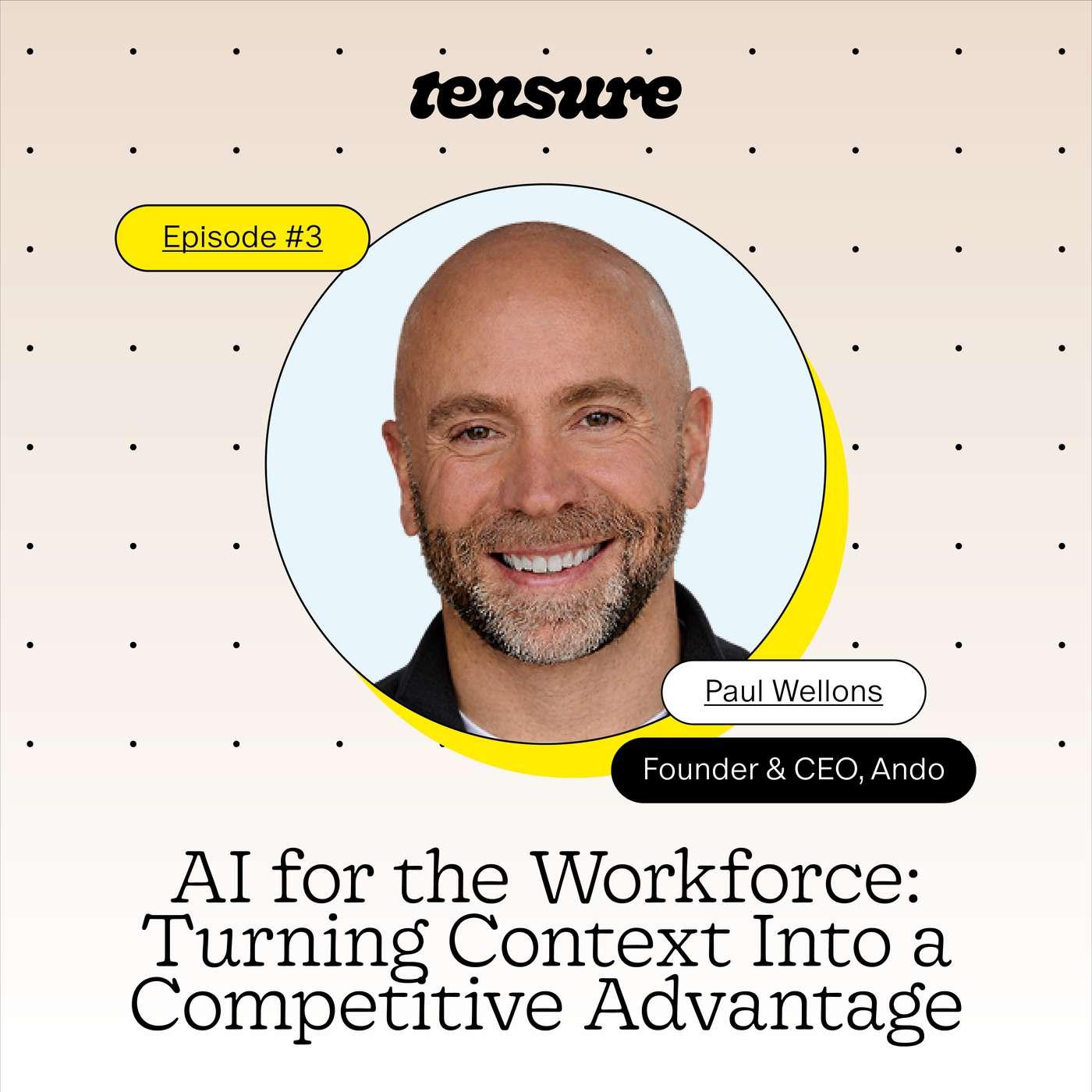
Today, Justin, Dan, and I are talking with our featured guest, Paul Wellens, founder of Ando, about a different side of the AI conversation.
00:00:57.039 --> 00:01:07.760
What happens when we use AI to not simply replace work or accelerate software development, but to give the people doing the work better information, better tools, and more agency.
00:01:08.400 --> 00:01:11.439
Dan, Justin, uh, thank you guys for joining me on the mic today.
00:01:11.519 --> 00:01:12.400
It's great to have you guys.
00:01:12.640 --> 00:01:12.799
Yeah.
00:01:12.879 --> 00:01:13.519
Thanks for having us.
00:01:13.599 --> 00:01:13.760
Yep.
00:01:13.920 --> 00:01:16.400
And Paul, uh, thank you so much for joining us.
00:01:16.560 --> 00:01:24.640
For folks who aren't familiar with you and your work at Ando, without further ado, give us a little bit of context on your background for today's conversation.
00:01:25.200 --> 00:01:26.239
Hey, well, I appreciate it.
00:01:26.400 --> 00:01:27.519
Thank you for including me today.
00:01:27.760 --> 00:01:40.000
You know, this um this problem is something that when I started looking at um how we could um build a build the next generation of frontline workforces, I was leaning into my experience.
00:01:40.079 --> 00:01:45.359
And um I have spent half my career in frontline industries and half my career uh in technology.
00:01:45.519 --> 00:01:55.040
I got my start early with Pizza Hut and um was uh in labor analytics at Pizza Hut, uh, moved to Panera, early operator at Panera, even before Panera was Panera, St.
00:01:55.120 --> 00:01:58.159
Louis Bread Company at the time, uh, and as they were expanding beyond St.
00:01:58.319 --> 00:02:16.800
Louis uh into other markets, uh I joined and uh was there early from early 14 stores to scale into the several hundred of stores and then uh moved to a Panera brands company, Einstein Noah, where I led NOAA's and West Coast, but also then moved to channel.
00:02:17.199 --> 00:02:24.560
And the one thing I kept noticing across all those operations is that labor is a supply chain and we've not perfected it yet.
00:02:24.639 --> 00:02:29.759
So when um building Ando, um I kept leaning into how could we solve that?
00:02:29.919 --> 00:02:39.840
So um we're rooted in both bringing the uh technology that we have today around AI, but also to um around making solutions that just have never existed before in the labor space.
00:02:40.159 --> 00:02:44.719
I love to hear more about your work, and we're gonna get into that in today's conversation.
00:02:44.879 --> 00:02:49.919
I think the best place to start is what we alluded to just a minute or so ago, Paul.
00:02:50.159 --> 00:02:53.199
At least from my perspective, you guys can correct me if I'm wrong.
00:02:53.439 --> 00:03:06.080
Most of the conversation around AI today is about enterprise productivity, replacing people and replacing jobs, or helping engineers build software faster, which is a great thing we've talked about on the show.
00:03:06.159 --> 00:03:08.240
Um, but you've been focused on something different.
00:03:08.400 --> 00:03:10.639
As you mentioned, AI for frontline workers.
00:03:10.800 --> 00:03:12.639
Why is this important right now?
00:03:12.800 --> 00:03:18.240
And then we're gonna get into why this applies to various industries and the lessons we can learn from it.
00:03:18.400 --> 00:03:22.479
But it was a problem you felt compelled enough to uh to try and solve.
00:03:22.639 --> 00:03:23.199
Why is that?
00:03:23.280 --> 00:03:27.199
What are the things converging that you saw in the market today?
00:03:28.639 --> 00:03:41.199
I mean, as I think about it, most AI conversations, at least what we're hearing now, um, both in press, but also too just across industries, are starts with enterprise productivity and how AI is replacing work, right?
00:03:41.840 --> 00:03:54.560
Um, I think the bigger missed opportunity is giving frontline workers, which are tens of millions of frontline workers in the US alone, um, and their managers access to intelligence that they've never had before.
00:03:54.800 --> 00:04:00.400
Um, ando is applying AI to both sides of the platform, both sides of the labor equation, I should say.
00:04:00.560 --> 00:04:11.360
Um, the business demand for work uh and the workers' availability are both areas in which AI can be applied, um, and also to preferences and capabilities and goals.
00:04:11.840 --> 00:04:16.480
And as we view it, labor from in my sense, um, labor is not inventory.
00:04:16.560 --> 00:04:22.319
It's like human dynamic that's constrained, preference uh driven, and constantly changing.
00:04:22.800 --> 00:04:28.399
Um, the manager has lived this context in their head, but managers are not data analysts.
00:04:28.560 --> 00:04:34.240
Managers are often doing CYA scheduling, are often copying last week's schedule this week because there's just a limited amount of time, right?
00:04:34.720 --> 00:04:53.680
But with AI and how we apply it to business, um, I think that there's an opportunity to both not only help managers create the most optimal schedule to get the highest return on investment, but also to at the same time not extract value from the frontline workforce, but add value to the frontline workforce.
00:04:54.000 --> 00:05:02.240
We see workers all the time who right now are looking at their peers and their friends across industries like Uber or DoorDash, and they're selecting work that fits their lives.
00:05:02.319 --> 00:05:08.720
And our frontline workforces that are W-2 employees are looking for some of that exact same benefit in their work.
00:05:08.800 --> 00:05:11.199
And frankly, that's just not has not been available.
00:05:11.360 --> 00:05:22.879
And um, prior to Ando, and Ando is leaning into this space, is how to create preference-based work that is both optimized for the frontline workers' needs, but also that solves the enterprise's pain points around labor.
00:05:24.079 --> 00:05:29.199
As a great comparison between the the Ubers and the Lyfts and the DoorDashes, right?
00:05:29.279 --> 00:05:33.040
Uh, versus the experience for frontline W-2 workers.
00:05:33.360 --> 00:05:42.240
Dan, your work, as we mentioned at the top, uh, is often with organizations adopting platform engineering and increasingly agentic AI.
00:05:42.480 --> 00:05:53.120
What do you think are some of the changes that are happening when AI stops being just a tool that people use and start taking on pieces of the work itself?
00:05:53.279 --> 00:05:56.240
We've seen that definitely in your context.
00:05:56.399 --> 00:05:59.759
Talk about it uh a little bit in previous episodes of the show.
00:06:00.000 --> 00:06:12.879
Curious, as you're coming to it from um kind of a different perspective than Paul, uh, have you react to what he's saying there and what you're seeing in this intersection between people and agents these days?
00:06:13.199 --> 00:06:19.759
Yeah, I think it comes down to we were asking the question, uh, are people using these tools well?
00:06:20.079 --> 00:06:25.839
And I think that's sort of shifting now to um do the tools have the right context?
00:06:26.000 --> 00:06:28.160
Do they have the right rails?
00:06:28.480 --> 00:06:38.480
Um, are they uh set up in a way that uh we know who's responsible for the output that the tools are creating?
00:06:38.639 --> 00:06:43.360
Uh accountability still matters and and the tool itself is not going to be held accountable.
00:06:43.519 --> 00:06:45.040
Individuals are gonna be held accountable.
00:06:45.199 --> 00:06:46.399
So what how does that fall?
00:06:46.560 --> 00:06:48.480
Where does that what does that look like?
00:06:48.720 --> 00:06:53.279
Um And similar to what Paul was saying, context is everything.
00:06:53.360 --> 00:07:02.000
And so um getting information out of people's heads and into the tools is sort of the key to success on these things.
00:07:02.399 --> 00:07:12.639
Yeah, I think the advancement in the context windows uh in for the LLMs is something we've talked about, has been um a big change in what the tools are are capable of.
00:07:13.120 --> 00:07:15.680
Um and we need to keep that in mind.
00:07:15.839 --> 00:07:35.839
Um, Justin, anything you want to add to kind of that context piece is that's kind of been uh a recurring theme um the last few conversations, because it seems like even in just in recent months, the conversation around context, whether we're using AI for frontline workers, software development in financial services is an important one.
00:07:36.000 --> 00:07:38.000
We don't want to just kind of blaze past.
00:07:38.240 --> 00:07:38.399
Yeah.
00:07:38.480 --> 00:07:47.839
I mean, theoretically, every every worker becomes almost a manager of all of these other workers for them with their agents.
00:07:48.000 --> 00:08:04.800
And so I've said this a couple of times now is that the the team members who understand their business, understand their business's goals, understand their business's metrics, and are able to explain what the business is trying to accomplish are going to be the ones that are are more successful, are more impactful.
00:08:04.959 --> 00:08:14.959
And even, you know, in the in frontline workers, there was a point in time where, you know, I did my job and I my job is over and I go home and I don't really have to think about or worry about anything.
00:08:15.040 --> 00:08:22.000
And now there's an opportunity as a frontline worker, if you think about even in the in the finance space, a bank teller, right?
00:08:22.160 --> 00:08:25.920
How can I how can I impact our customers even more?
00:08:26.079 --> 00:08:27.920
How can I impact our business even more?
00:08:28.160 --> 00:08:36.559
And diving in and owning the fact that like I'm a frontline worker, but I'm the face of the business to all of the customers.
00:08:36.799 --> 00:08:40.480
And and that's that is a great opportunity for you.
00:08:40.960 --> 00:08:44.320
Uh and and a tool like And is going to be able to help with them like that.
00:08:45.120 --> 00:08:47.919
Oftentimes those frontline workers have the most context.
00:08:48.000 --> 00:08:51.120
They're at least the most recent, relevant context.
00:08:51.200 --> 00:09:00.879
And so that uh combined with the AI tools that can really thrive when we give them the proper context, it's an important intersection.
00:09:01.120 --> 00:09:20.320
Um, Paul, I I've heard it, uh I've heard you argue that businesses have optimized almost every part of their operations, um, while labor remains comparatively difficult to see, to manage, what's going on with shifts, placements, preferences, conflicts and schedules, all of those sorts of things.
00:09:20.480 --> 00:09:26.799
Why do you think that's the case that you know technology really hasn't solved the labor problem as of yet?
00:09:27.120 --> 00:09:31.120
Well, first of all, let's just agree that frontline labor is a last broken supply chain.
00:09:31.200 --> 00:09:35.519
When you look at areas for businesses to uh invest technology, they've done that.
00:09:35.600 --> 00:09:37.200
They've done that in inventory, for example.
00:09:37.279 --> 00:09:40.799
We've optimized inventory down to the last poppy seed, down to the last pepperoni.
00:09:40.879 --> 00:09:43.919
We've optimized retail inventory down to the last t-shirt.
00:09:44.080 --> 00:09:52.480
Site selection, when you're building new restaurants or retail, we know that down to the last square inch, the revenue per square inch that could that can be applied.
00:09:52.639 --> 00:09:58.559
Um, whether it be uh maintenance or any part of the business, um, AI has taken a place in that.
00:09:58.639 --> 00:10:02.720
And yet it's still missing in um labor.
00:10:03.360 --> 00:10:15.039
Matter of fact, technology is missing in labor, and there's constraints that no matter how great the scheduler may be or how great the engagement um profile, the business is still dealing with um pain points that are out of their control.
00:10:15.440 --> 00:10:22.000
I often talk about restaurants that are, you know, just great restaurants, concepts that um we all go to and we like.
00:10:22.080 --> 00:10:27.919
I mean, we can think of a you know, the largest burrito chain, for example, or the largest pizza chains in the US.
00:10:28.159 --> 00:10:34.159
They're dealing with turnover right now that hovers 150% on a good day, on a good year.
00:10:34.320 --> 00:10:47.039
I talked to a CEO last week, oh, about three weeks ago, I should say, of a major burrito chain, and they had 169% hourly turnover last year, and they were celebrating 169% hourly turnover.
00:10:47.840 --> 00:10:57.360
I mean, if you think about it, they had a they have a hundred and I think this company had 111,000 hourly employees to keep the doors open, they had to hire over 200,000 people last year.
00:10:57.519 --> 00:11:02.799
I mean, that's just astronomical um expenditure, churn pain on the business.
00:11:02.960 --> 00:11:05.679
And you have to really understand what's like the root behind that.
00:11:05.840 --> 00:11:09.679
And by the way, just a little side note, that's one of the better performers in the industry.
00:11:09.759 --> 00:11:14.960
You have some restaurant companies that are hover 200 or greater percent turnover, right?
00:11:15.360 --> 00:11:17.360
In in some extreme cases, 300%.
00:11:17.919 --> 00:11:21.440
In those cases, you go to this restaurant, you work four months, and you turn over.
00:11:21.759 --> 00:11:24.720
I mean, so much ingrained knowledge is lost in that moment, right?
00:11:24.799 --> 00:11:30.960
But even on a, let's just say a good, the average uh for industry that's hovers between 125 to 150 percent.
00:11:31.440 --> 00:11:45.120
I mean, that's a significant pain point for enterprise, um, whether it be the cost of turnover, um, and both uh Gallup as well as the National Restaurant Association have put that just under$6,000 per turnover.
00:11:45.360 --> 00:11:52.320
You start applying that$6,000 to the numbers we're talking about in industry, it's a real significant pain point.
00:11:52.720 --> 00:11:56.000
Granted, it's not all the direct cost.
00:11:56.080 --> 00:12:06.159
I mean, half of that's in productivity loss, knowledge loss, but there are direct costs related to recruiting, interviewing, hiring, uniforms, trainings, the list goes on of costs.
00:12:06.240 --> 00:12:08.799
They just go out the window when you turn people over that fast.
00:12:09.120 --> 00:12:14.320
And so that's why I keep going back to I think it's the last broken supply chain because we cannot see labor.
00:12:14.480 --> 00:12:16.320
And there's really an opportunity to do that now.
00:12:16.480 --> 00:12:28.240
There's a way that we can with technology, now in a moment that we couldn't have done just a few years ago, really begin to see inventory labor as an inventory moment that can be graphed, can be seen, and applied.
00:12:28.399 --> 00:12:30.879
And again, that's what Endo is bringing to market.
00:12:31.120 --> 00:12:39.200
Yeah, and we're gonna talk a little bit about how AI can become the the co-pilot and eventually, you know, the agent that can help with a lot of this work.
00:12:39.360 --> 00:12:51.679
I I think it would make sense though, Paul, to ask you a little bit about you talked about this reality with labor, where there's the potential application of AI to solve the labor problem a bit and the impacts on the business.
00:12:51.840 --> 00:13:00.639
But then the current state of things also has uh an impact on uh lack of visibility for the manager and the frontline worker as well.
00:13:00.799 --> 00:13:06.559
Tell us a little bit about some of those ripple effects downward, if you will, based on the current state of things.
00:13:06.960 --> 00:13:08.799
Well, I mean, it's it's understandable.
00:13:08.960 --> 00:13:12.320
Um, a restaurant manager only sees the labor inside their walls.
00:13:12.399 --> 00:13:14.080
They don't see labor outside their walls.
00:13:14.240 --> 00:13:20.080
And we're dealing with real life constraints that aren't restaurant or aren't retail or not frontline um related.
00:13:20.799 --> 00:13:27.120
First, I often go back to we're seeing the highest level of multi-employment in BLS data, Bureau of Labor Statistics data.
00:13:27.279 --> 00:13:30.639
We're seeing the highest level of multi-employment that we've ever seen.
00:13:30.799 --> 00:13:37.600
And it's the fastest clip, fastest growth of multi-employment um since uh COVID has occurred the last five years.
00:13:37.759 --> 00:13:38.960
What is multi-employment?
00:13:39.039 --> 00:13:51.840
It's the worker who cannot make ends meet on the first job, and they're choosing a second, third, fourth um uh method of uh income for both economic stability, but also to in ways to fit work around their life.
00:13:52.320 --> 00:13:55.279
And so that is a real pain point for industry.
00:13:55.360 --> 00:13:57.200
And we like, what is the reason for that?
00:13:57.440 --> 00:14:04.960
Well, listen, I just I have a lot of opinions about this around why we um keep workers at 30 hours, not 40.
00:14:05.120 --> 00:14:15.360
Most work frontline workforces hover 30 or below, and that's really related to the pain points around above 30 hours, you become uh eligible for benefits, and there's not benefits.
00:14:15.440 --> 00:14:18.080
It's a it's a it's a cyclical problem.
00:14:18.480 --> 00:14:21.759
There's not benefits for a worker who turns over two or three times a year.
00:14:21.840 --> 00:14:23.360
There's just not packages for that, right?
00:14:23.440 --> 00:14:36.639
And so these are self-created problems that workers have to have a second job because they cannot make ends meet because 30 hours businesses or it in large part society wants these frontline workers to be protected.
00:14:36.720 --> 00:14:38.399
They just don't have that opportunity.
00:14:38.639 --> 00:14:49.759
So we both know a worker who's earning, in some cases, minimum wage, and and when you look really across industry and restaurants,$11 to$14 an hour across the US.
00:14:49.919 --> 00:14:55.840
When you apply that on 30 hours, I mean, think about take-home pay is, and this is you know just shocking.
00:14:56.000 --> 00:15:00.879
Take home pay for this workforce on one job is$250 to$300 a week.
00:15:01.039 --> 00:15:03.360
Like, like what do you even do with that?
00:15:03.679 --> 00:15:09.120
And so in that case, um, this worker is effectively forced for a second, a third, or fourth job.
00:15:09.200 --> 00:15:12.320
And that creates a lot of friction across multiple schedules.
00:15:12.639 --> 00:15:15.840
And that is part and parcel uh what we see around churn.
00:15:16.080 --> 00:15:28.399
So again, Ando is in that place to help bring friction-free scheduling across multiple employers that is preference-based, but it's only been available with the technology we have today and the technologies that we're leaning in with Tensure to develop.
00:15:28.879 --> 00:15:29.759
Yeah, absolutely.
00:15:30.080 --> 00:16:07.679
I think I think it's interesting too because you know, the technology space and the finance space has historically been insulated from that problem because we have very high skilled, you know, there's a lot of personal investment made through education, through training, and then I'm this really high-skilled output worker, very high skilled knowledge worker, and AI is changing that paradigm even in the sort of knowledge worker space, such that uh developing software, the the the entry point, the skill entry point is gonna is gonna lower pretty significantly because you know AI can build software now and AI is developing it.
00:16:07.840 --> 00:16:14.960
And you know, if I can sort of steer steer the steer the AI train in in the right direction, I'm gonna at least get close enough to the mark.
00:16:15.279 --> 00:16:21.600
And I think there's an element of the of the knowledge workforce in which it'll be akin to building a car.
00:16:21.840 --> 00:16:25.120
And I know you used a car metaphor last week, but I'm gonna use another one, right?
00:16:25.279 --> 00:16:34.240
You have very high skilled engineers who design the car, and then you know, you have maybe a lower bar of skill for people who are building it on the on the front line.
00:16:34.480 --> 00:16:42.559
And the I see in the future software becoming that fashion where you don't have to have as much specialized training to build a technology solution.
00:16:42.799 --> 00:16:54.000
And what's gonna happen is uh enterprises who have historically not had labor challenges of like high turnover, uh they're gonna start seeing that and they're gonna have to address it as well.
00:16:54.240 --> 00:16:55.919
I think that's a really good point, Justin.
00:16:56.080 --> 00:17:00.879
There's uh some comparisons there that uh are a thread worth pulling on.
00:17:01.120 --> 00:17:17.279
The other comparison I was curious to get Dan's perspective is you work with a lot of technology orgs, um, they can have the same problem we talked about earlier, where knowledge exists, but it's only between the ears of um that manager or that team member.
00:17:17.519 --> 00:17:30.720
Um what are you seeing uh similar to what um Paul was talking about in the fragmented uh context across people, teams, tools, processes, all of that, Dan?
00:17:30.960 --> 00:17:40.960
Um what was kind of rolling around in your head as Paul was talking about that for the frontline folks, um, for the tech leaders, thinking about what this means uh for their orgs as well.
00:17:42.000 --> 00:17:50.960
Yeah, I mean, Paul was talking sort of job satisfaction, right, for those frontline workers and um software engineering orgs kind of have a similar problem.
00:17:51.039 --> 00:17:59.279
And like it used to be sort of brain drain, and that still exists around like there's just so many different things they need to keep track of.
00:17:59.519 --> 00:18:02.720
And um, it's just they're they're very spread.
00:18:02.880 --> 00:18:11.680
Um, but now there's the addition of using AI tools, maybe the parts of the job they used to like they'd have they're not really doing anymore.
00:18:11.839 --> 00:18:22.160
And um, it can be really tough from a job satisfaction perspective and just, you know, can cause employee retention problems as well, similar to what Paul was talking about.
00:18:22.400 --> 00:18:38.640
That knowledge that that you're talking about, it exists in those people, um, it exists in their conversations that they have with their coworkers, whether those be in um meetings that um a lot of organizations now are recording, transcribing, um, getting AI notes from.
00:18:38.799 --> 00:18:43.519
Um, it could be in their Slack conversations, their Teams conversations, email.
00:18:44.079 --> 00:18:56.400
And um now with a really strong platform that's taking all that information in, you can sort of start to organize that and give that context to the tools and the people doing the work.
00:18:56.640 --> 00:19:02.400
Um and I like to tell engineers, you know, you uh this is a unique opportunity right now.
00:19:02.559 --> 00:19:05.920
We're still shaping what it looks like to work with these tools.
00:19:06.160 --> 00:19:08.799
And um, don't be the victim, you know.
00:19:08.960 --> 00:19:13.519
Um, take the opportunity to shape it into what you want out of it.
00:19:13.680 --> 00:19:18.640
Um, you get to choose the work that you keep and the work that you hand off.
00:19:18.880 --> 00:19:21.599
And this is, you know, it won't always be that way.
00:19:21.920 --> 00:19:29.599
So take the opportunity right now and pick the pieces that you really enjoy and then let AI handle the parts that you don't.
00:19:30.000 --> 00:19:31.039
I really love that, Dan.
00:19:31.279 --> 00:19:38.160
That's much more empowering message than, you know, either AI is going to kill us or at very least AI is going to take all of our jobs, right?
00:19:38.319 --> 00:19:43.119
And I think that that's um uh hopefully more the reality that we're going to see.
00:19:43.279 --> 00:19:52.640
Uh Paul, I've heard you describe AI as a co-pilot for both the manager and the employee, um, especially frontline workers as you work with a lot.
00:19:52.799 --> 00:20:11.119
Um, what does that look like in practice as we continue to the conversation and our path towards more uses of agentic AI, not just kind of our chat interactions that we've all had, knowledge worker, frontline worker, um, whatever the case may be for the last few years?
00:20:11.440 --> 00:20:14.720
And that's a really good question because we talk a lot about copilot, right?
00:20:14.799 --> 00:20:23.839
That's a that's an industry as we're leaning into what copilot is, but um, you know, a copilot for many people is just someone to help you uh along your journey, right?
00:20:24.079 --> 00:20:29.200
Give you clearer uh uh analytics to uh the best outcome possible.
00:20:29.440 --> 00:20:32.160
So I like to take co-pilot, but really take it another layer.
00:20:32.240 --> 00:20:40.880
And then the way I think about it is I think analyst first, then advisor, and then agent in that order, right?
00:20:41.039 --> 00:20:46.319
The first generation um as um uh analyst tells you like what happened.
00:20:46.400 --> 00:20:49.279
Like what's happened in the past, we analyze the business.
00:20:49.519 --> 00:20:51.200
The next tells you what you should do.
00:20:51.359 --> 00:20:52.319
This is the advisor.
00:20:52.400 --> 00:20:55.920
This is taking past information uh and helping you manage forward.
00:20:56.160 --> 00:21:07.279
But eventually, um, I think it can help us execute parts of the decisions, both for in our case, ando, uh both for enterprise but also for the employee, help decisions within the boundaries you set.
00:21:07.440 --> 00:21:15.119
And those boundaries we call preferences, um preferences about based on business rules or employee decisions or where to work, what roles they like.
00:21:15.359 --> 00:21:33.759
If we can use those boundaries and keep inside that, that co-pilot really becomes helps you, helps the um user, whether it be frontline business or in this case, uh hourly employee frontline workforces, have the best information they can to make the best decisions and in some cases even automate those decisions.
00:21:33.920 --> 00:21:43.440
Uh, when you begin to have uh close the trust gap, that just isn't uh uh clearly apparent and you know, when somebody's starting new technology, there's a lot of trust gap in that space.
00:21:43.599 --> 00:21:49.200
But when you begin to see it deliver the right decisions over and over again, um, you begin to lean in and trust it.
00:21:49.279 --> 00:21:55.920
So the way I look at it, we're speaking of context, is like every decision that's generated is context, right?
00:21:56.079 --> 00:21:59.119
It generates more context, it's a compounding learning loop.
00:21:59.519 --> 00:22:01.680
Um What did demand actually look like?
00:22:01.839 --> 00:22:04.319
Uh which recommendations did the manager accept?
00:22:04.400 --> 00:22:05.279
Which ones did they not?
00:22:05.440 --> 00:22:07.119
That learning loop that we're taking in.
00:22:07.440 --> 00:22:09.599
Which which shifts did the worker prefer?
00:22:09.759 --> 00:22:12.400
That's like really important context.
00:22:12.640 --> 00:22:16.319
Why did the worker cross your location to go to another location?
00:22:16.400 --> 00:22:18.880
Like, why are they not working in the one nearest their home?
00:22:19.119 --> 00:22:25.599
That's even in that data is such rich information for the business and also for the worker.
00:22:25.839 --> 00:22:29.599
And in all that, which created the better outcomes?
00:22:29.920 --> 00:22:33.039
And when you can think about the outcomes, there's where the trust happens.
00:22:33.119 --> 00:22:46.240
When you see the trust repeated over and over again because the outcomes fit the need, the system becomes more useful as it learns how the business or the user, the frontline employee uses and operates with the product.
00:22:46.480 --> 00:22:53.440
And hopefully those decisions are not only ROI driven for enterprise, but they're ROI driven for the frontline employee who's using it too.
00:22:53.680 --> 00:23:02.319
Dan, I'm curious what your thoughts are about Paul's breakdown there from uh AI starting as analyst, then moving to advisor and then agent.
00:23:02.480 --> 00:23:08.160
Do you see a similar path for the technology teams, for the engineering teams that you're working with?
00:23:08.559 --> 00:23:10.640
Justin smiling and nodding next to you.
00:23:10.720 --> 00:23:12.960
So I'll let you guys both speak to this one.
00:23:13.279 --> 00:23:18.319
Yeah, uh at Tenture, we have a maturity model that pretty much aligns with what Paul was saying.
00:23:18.400 --> 00:23:23.440
And so that first stage, that analyst stage, it's kind of what we call it consumption.
00:23:23.519 --> 00:23:28.720
You know, you're using AI as a search tool, you're um asking questions, getting answers.
00:23:28.880 --> 00:23:31.519
It's uh, you know, very much that analyst.
00:23:31.680 --> 00:23:36.400
And then uh moving from there, it's into collaboration and that's that co-pilot.
00:23:36.480 --> 00:23:43.759
Like you're sort of you're working alongside, um, you're, you know, you've got that guide, you can ask for expertise, you can be the expert.
00:23:43.839 --> 00:23:46.319
It's kind of a shared collaborative effort.
00:23:46.480 --> 00:23:51.359
Um, and then moving into that level three, um, we call it automation.
00:23:51.519 --> 00:24:05.359
And so that agentic level of where you're starting to now automate workflows, you're um starting to hand off tasks, do some delegation, um, and you know, really leverage the power that is there.
00:24:05.680 --> 00:24:09.519
Um, and and it becomes multiplicative at that point, right?
00:24:09.599 --> 00:24:14.559
Like you're really getting uh that burst of efficiency from the team.
00:24:14.799 --> 00:24:15.680
Yeah, absolutely.
00:24:15.920 --> 00:24:39.680
Justina, anything you wanted to add there, especially from the executive perspective, as you think about uh a lot of the organizations that Tensure is working with, um, what they should have in mind as their organization moves up that maturity model to more agentic use cases of AI, because there is the impact to the frontline or the knowledge worker, the middle management.
00:24:39.839 --> 00:24:49.519
Executives need to have their own perspective and looking ahead for their teams on what it's going to mean to get to that next level of maturity.
00:24:49.680 --> 00:24:53.039
What are uh what thoughts would you share for some executives there?
00:24:53.359 --> 00:24:55.039
Yeah, I think it's a lot of risk.
00:24:55.200 --> 00:24:56.880
What's your risk tolerance?
00:24:57.039 --> 00:25:04.240
You know, um, it's not capability because you know, these tools can do a lot of things and a lot of things quickly.
00:25:04.400 --> 00:25:18.319
And one of the one of the conversations I was having with one of our team members the other day about writing software and sort of letting soft letting AI agents push software out into the real world so that your customers are consuming it without a human touching it.
00:25:18.480 --> 00:25:25.839
And the thing I said is you can react to that so quickly if it if it doesn't do something correct, like you can react to it so quickly and fix it so fast.
00:25:26.400 --> 00:25:29.359
Why, why wouldn't you be moving at that clip?
00:25:29.839 --> 00:25:37.599
Um obviously every organization has a different risk tolerance in the finance world, financial services, you know, it's it's it's super highly regulated.
00:25:37.680 --> 00:25:45.039
It's decision models, decision trees, you know, who's uh who's authorizing this, what's our risk profile for this scenario?
00:25:45.359 --> 00:25:51.440
And so it's a it's a little bit different, but that's where the the platform becomes the guardrails of risk.
00:25:52.160 --> 00:25:56.160
Are you are you running in are you running in in the lanes that you're supposed to be running?
00:25:56.559 --> 00:26:04.880
And so the really the question becomes it's not whether AI can do it, it's how comfortable are you as an organization letting AI do it for you.
00:26:05.200 --> 00:26:12.400
And I think different different parts of organizations have different comfort levels, different verticals have different comfort levels.
00:26:12.480 --> 00:26:23.119
And I think when when we start allowing ourselves that level of freedom, it it's gonna be an interesting space in the in the enterprise.
00:26:23.920 --> 00:26:25.039
Yeah, absolutely.
00:26:25.200 --> 00:26:31.359
Um, you guys, Paul mentioned earlier that every decision is additional context.
00:26:31.440 --> 00:26:35.039
It's additional data that that feeds that learning loop.
00:26:35.279 --> 00:26:52.319
Dan, I'm curious in your work with uh engineering orgs, um, where's that parallel or what are some of the things you're seeing in where platforms are helping with that constant learning loop, with that intake of kind of encoding organizational knowledge?
00:26:52.480 --> 00:26:53.839
What's kind of happening there?
00:26:53.920 --> 00:26:58.400
And what's the opportunity to accelerate that constant learning loop?
00:26:58.720 --> 00:27:12.640
Yeah, I think there's a good build on what Justin was saying uh around just being okay with automating certain things and sort of that comfortability there, as well as a tie-in to directly some of the work we're doing with Ando.
00:27:13.039 --> 00:27:17.680
Um so you know, our our team with Ando is able to move really fast.
00:27:17.759 --> 00:27:22.160
Um, but that's that's causing some challenges in various places, right?
00:27:22.400 --> 00:27:27.759
So um, you know these tools have moved, moved the bottleneck, right?
00:27:27.839 --> 00:27:36.240
So engineering used to be the bottleneck, and at this point, it's now deciding what work the team is going to do and then deciding if that work is good on the other end.
00:27:36.319 --> 00:27:39.920
So the bottlenecks have moved to both ends of the engineering pipeline.
00:27:40.319 --> 00:27:46.640
And for you know, the working with the Ando team, it's it's just sort of increasing that comfortability.
00:27:46.720 --> 00:27:53.200
Uh are like how comfortable are we with saying this is good and we're gonna get it out there and we're gonna learn?
00:27:53.440 --> 00:28:08.880
It's all those agile methodologies that we've been using in software engineering for for a decade now, um, they really matter more than ever because um iteration, tight iteration loops, smaller teams, all that stuff um is important.
00:28:09.519 --> 00:28:23.759
And sort of uh, you know, having having a human in the loop that matters, like, but you get getting it to the user, getting it out there and getting feedback fast is is more achievable than ever.
00:28:23.920 --> 00:28:31.759
And so just sort of getting it out there, reacting to it, and then the change to react to it is now the next day.
00:28:31.920 --> 00:28:34.000
It's not, you know, next sprint.
00:28:34.160 --> 00:28:42.240
And so being able to adapt and move that quickly through the development process is is where the power, I think, really lies.
00:28:42.480 --> 00:28:48.960
And just getting getting teams and organizations comfortable with that pace is the current challenge.
00:28:49.279 --> 00:29:01.119
Paul, you were kind of nodding along as uh Dan was talking about your your work together between Ando and Tensure and that that past uh that fast feedback loop there um and that iterative process.
00:29:01.359 --> 00:29:07.599
You're also working with your customers at at Ando to get used to that fast feedback loop.
00:29:07.680 --> 00:29:28.079
What are what's some maybe some advice for folks that are kind of adjusting to this new uh pace of um, you know, not only using AI to ship software faster, but to work in the business um and get things done at management, frontline level, all the folks that are being impacted by this.
00:29:29.359 --> 00:29:35.119
You know, I I was nodding because we're living the real world of what Dan was just addressing today.
00:29:35.279 --> 00:29:46.400
I mean, this is technology is moving so fast that I I mean, just two or three years ago, you would see, for example, QA um wait on engineering to deliver.
00:29:46.559 --> 00:29:52.880
Right now, QA is stacked up because engineering development is happening so fast that QA cannot get through it fast enough.
00:29:52.960 --> 00:29:59.599
So, like this is a perfect example of how does technology move so fast and at the same time, how do you ship really good technology?
00:29:59.759 --> 00:30:05.920
Because you've got to, no matter how much AI, and AI is not all your QA, you've got to really test it across your platform.
00:30:06.079 --> 00:30:07.599
Does it connect right to the back end?
00:30:07.680 --> 00:30:08.799
Is the architecture correct?
00:30:08.960 --> 00:30:11.119
All of those moments that are occurring in technology.
00:30:11.279 --> 00:30:16.160
So I think that is a critical moment that we spend time working on uh as well.
00:30:16.400 --> 00:30:22.880
But also, two, I think that there is a really important piece that I'm noticing now that I've never noticed.
00:30:22.960 --> 00:30:30.319
And I've spent, you know, after I worked in the uh restaurant industry, I moved to technology and I've been in technology now for over 12 or 13 years.
00:30:30.400 --> 00:30:39.599
And one of the things that I've seen is as we were developing products, um, there were teams that were gathering in conference rooms and we were thinking deep through logic.
00:30:39.759 --> 00:30:41.039
What was the customer saying?
00:30:41.119 --> 00:30:45.039
What was the pain point we were solving, applying logic around the room.
00:30:45.119 --> 00:30:47.039
Let's think about this, think about this.
00:30:47.839 --> 00:30:55.440
Um, that now that is a missing piece because now one engineer is building what 10 or 12 were doing just three years ago.
00:30:55.599 --> 00:31:08.319
And that logic is so critically important because now you instead of a team of 10 or 12 thinking about what could happen, what's wrong with this, what's right with this, what's the customer really asking uh when they explain their pain points?
00:31:08.559 --> 00:31:22.240
Um, that to me, that really investing in the upstream logic uh collectively as a team is something that uh any business that's moving fast with AI has got to uh slow down and make sure that you're building the right things.
00:31:22.400 --> 00:31:25.920
We just listen, being truthful here, we're guilty as everybody.
00:31:26.000 --> 00:31:34.240
Like we've shipped products that um wasn't needed or didn't answer the customer's need pain point in the right way because of how fast it moves.
00:31:34.559 --> 00:31:38.960
And so that listening to customer moment has never been more critical than now.
00:31:39.039 --> 00:31:57.839
And adapting that information um of what their what their pain point is and adapting technology solutions for that um has got to be rooted in good logic that uh solves pain not only for one side of the equation, in in the case of Ando, but also to um again, not extracting value from the workforce, adding value to the frontline workforce.
00:31:58.559 --> 00:32:11.200
Paul, I mean, if I think for you and and and where where you guys sit in the market too, you know, impacting a worker whose job necessarily isn't a technology-focused job, right?
00:32:11.279 --> 00:32:14.079
Like my job isn't to create technology, my job is to consume it.
00:32:14.160 --> 00:32:23.920
So if you think like that quick serve restaurant user worker, the the bank teller, the speed at which we can move can actually be a detriment to them and how they service the customer.
00:32:24.000 --> 00:32:28.720
Because if they're constantly having to learn, constantly have to change, they become frustrated, and I don't want to use this thing, right?
00:32:28.799 --> 00:32:37.519
And and so then now they spend more time adjusting to change of technology than they do servicing the customers.
00:32:37.680 --> 00:32:43.039
And so I'd imagine you're probably thinking about that fairly often as well as you're building out your product.
00:32:43.920 --> 00:32:44.559
100%.
00:32:44.960 --> 00:32:54.880
I mean, we can have a discussion around um the frontline workers are somehow less able to benefit from the sophisticated technology of today.
00:32:54.960 --> 00:32:57.519
Like we're it's not being built for frontline workforces.
00:32:57.599 --> 00:33:00.480
But I would argue that in many ways they need it more, right?
00:33:00.640 --> 00:33:17.200
Yeah, their income, their schedule, their transportation, their family needs, their commitments, um, career opportunities are, you know, just for God's sakes, just a day to self, like the things that we all need that we take for take for granted that the frontline worker doesn't always have access to that.
00:33:17.440 --> 00:33:31.200
And so they those things all depend upon um, I guess a set of fragmented decisions that historically have had um very little help now, they've had very little help navigating, very little help navigating.
00:33:31.920 --> 00:33:39.279
Now that we can do that, now that we can be a part of that, showing that value to the frontline workforces is so that they also have the information.
00:33:39.519 --> 00:33:45.839
This isn't ando is not going to succeed by being an intelligence suite for workforce uh for enterprise alone.
00:33:46.000 --> 00:33:48.880
We've got to be intelligence suite for the frontline workforce.
00:33:49.119 --> 00:33:51.839
Where is the job that I can optimize my earning opportunity?
00:33:52.000 --> 00:33:54.319
Where are the opportunities that meet my family demands?
00:33:54.480 --> 00:33:57.039
Where are the things, where are the career aspirations?
00:33:57.119 --> 00:34:03.359
If I have these career aspirations, what are the jobs and roles I need to take to aspire to achieve those things?
00:34:03.680 --> 00:34:06.400
That now is available that's never been available before.
00:34:06.559 --> 00:34:11.760
But it's we again, we have to lean in and build trust in the frontline workforce to lean in on the technology to use it.
00:34:12.559 --> 00:34:43.760
Yeah, Paul, I like some of the features you all are working on from the perspective of, you know, uh presenting shift availability to, you know, and and taking into account their their schedule, um, their preferences, their location, their, you know, just their work history, their experience, taking all that into account and then presenting to them the optimal shifts that fit their requirements versus the the old way of, you know, them just desperately needing more hours and having to go and find those shifts and ask for help.
00:34:43.920 --> 00:34:54.960
Um and then also if you're on the other end of that where something comes up and you can't cover a shift, being able to shift swap and get other folks uh in an organization to take over one of your shifts.
00:34:55.039 --> 00:35:01.039
Um, just all those features that you're building out for users has been uh really impressive from my perspective.
00:35:01.119 --> 00:35:08.079
And I'm excited for when Ando really gets that market saturation and they're truly helping these frontline workers in that way.
00:35:08.400 --> 00:35:09.360
I agree with you.
00:35:09.599 --> 00:35:31.679
That's uh part and parcel why you why we're so aligned and why we're working so deeply with tensure, but addressing those pain points for the frontline workforce that you just addressed, like those, that to me is is the um the um persistent and and verified data suite that the frontline worker needs to um to optimize their work.
00:35:32.159 --> 00:35:36.559
I also too want to lean in on like the frontline workforce.
00:35:36.880 --> 00:35:39.840
There's been a broken contract historically with the frontline workforce.
00:35:39.920 --> 00:35:46.960
And we see it in when you're hired as a frontline worker, you effectively give your whole schedule to your enterprise, to your employer or manager, right?
00:35:47.039 --> 00:35:49.440
You give your whole schedule in your assigned work.
00:35:49.760 --> 00:35:51.440
That doesn't that no longer fits.
00:35:51.599 --> 00:36:04.960
That doesn't fit in a multi-employment place, that doesn't fit with preferences, that doesn't fit generationally, who sees work in a different way than we would have seen frontline work when we, I suspect everybody here at some point in time had an hourly job early in your career and and maybe still now, right?
00:36:05.039 --> 00:36:09.679
But in that role, um that is a giving your whole life over.
00:36:09.840 --> 00:36:11.119
That no longer fits.
00:36:11.440 --> 00:36:17.199
The paradigm shift here is how to create valuable, meaningful work under preference-based.
00:36:17.280 --> 00:36:19.599
And how does that impact enterprise?
00:36:19.760 --> 00:36:44.239
And how does enterprise have some of the benefits with W-2 workforces that are stable and repeatable, that arrive every day, that know the business, know the store, know small things about you know um where to break down boxes in the back room and where the little nuances about an individual store that are that uh transient or gig worker cannot uh cannot achieve, that only through repeated shifts do you learn.
00:36:44.480 --> 00:37:03.519
But in that space, is how does that worker um have the work that is both meeting the economic security that they need, but also to leaning into that flexibility and also I'll just reiterate preference based around the roles they like and the days and times that fit their life.
00:37:03.679 --> 00:37:11.920
We've never seen that we're seeing now that um that broken contract, I would argue, has causing enterprise to hoard employees.
00:37:12.079 --> 00:37:17.760
And when I say hoard employees, meaning I'm compromising decisions as a general manager every single day.
00:37:18.000 --> 00:37:25.119
I'm giving Dan hours that I don't need really need to give Dan, but only as the only way that I can secure Dan from not quitting me.
00:37:25.519 --> 00:37:35.039
Or I'm also doing the other end of that is I um I don't I don't have Dan when I need, and I'm giving I'm forcing Dan into hours that don't fit Dan's life.
00:37:35.280 --> 00:37:41.280
That in part and parcel is a real reason that we're seeing churn at such high levels, as I started this conversation out earlier.
00:37:41.519 --> 00:38:10.239
We're seeing that because of the hoarding experience that I continue to refer to as hoarding, but the lack of flexibility the enterprise has with the workforce, and that when you can create an environment where you have availability to workers when they're available and when they want to work, not only is the work better and the output is better, but the residual benefits around lower return, worker satisfaction, happiness, economic security for the workforce, there's win in every direction.
00:38:10.480 --> 00:38:13.199
And again, that's where Ando is centered.
00:38:13.599 --> 00:38:16.559
Yeah, I think Tincher's mission is to create freedom.
00:38:16.639 --> 00:38:19.519
And and I hear that in what you're saying there, Paul.
00:38:19.679 --> 00:38:32.639
Like you you all are trying to create that freedom and flexibility for those frontline workers in the same way that Tinture's goal is to create freedom for our clients like Ando, for our employees, um, and and for our communities.
00:38:32.719 --> 00:38:37.679
I I've got a post-it note on my desk in front, you know, just below my monitor that says freedom and flexibility.
00:38:37.760 --> 00:38:39.199
And that's just a constant reminder.
00:38:39.599 --> 00:38:40.960
That's what we're trying to do.
00:38:41.119 --> 00:38:55.039
Um, and you know, that that takes lots of different shapes, but you know, creating a platform where that worker knowledge is accessible in the same way that Ando is creating a platform for that worker knowledge and to be accessible.
00:38:55.119 --> 00:38:58.159
Um, we we're very well aligned, I think, as organizations there.
00:38:58.480 --> 00:38:59.599
I love that you guys.
00:38:59.760 --> 00:39:26.239
Um, Dan, one of the things I was gonna uh kind of continuing to pull on this thread that you picked up um from Paul's the way that we get to that freedom and flexibility is getting that um not only those preferences, but those contexts, those decision points um out of that's trapped between the ears of uh a manager, a frontline worker, or an engineering leader or an engineer themselves.
00:39:26.480 --> 00:39:36.639
Um what what are some of those things as Paul was kind of describing the, you know, where the broken down boxes go in the store, those sorts of things, or this preference about someone's shift.
00:39:36.800 --> 00:39:50.719
What's kind of that that list that you see that are common for engineering teams of that context we need to get uh untrapped, freed from between the ears of um uh the people within the the technology orgs?
00:39:51.280 --> 00:40:08.480
Yeah, the the common refrain is, you know, um someone has a question, whether it be a product member, uh engineer, QA, whatever, there's a question about um how does this work or why do we do it this way, or um what API endpoints or what services are available.
00:40:08.559 --> 00:40:11.519
And and some of those things are documented, some of them aren't aren't.
00:40:11.679 --> 00:40:14.559
Uh there's a good chance that question was asked before, though.
00:40:14.719 --> 00:40:25.280
And so um you know, an easy thing there is just to give an agent access to all of that context, all those previous conversations and starting there, right?
00:40:25.440 --> 00:40:40.719
If you just instead of going to the people who are going to bounce you around and you sort of ping-pong till you find the actual person with the knowledge, um, just asking that agent, like just ask the agent the question, it likely already has the context if you've built that platform and you've got that platform in place.
00:40:40.880 --> 00:40:43.840
Um, I think that's there's a lot of power in that.
00:40:44.000 --> 00:40:53.199
Um, and a good example with working with Ando, Ando uh saw some some team turnover while while we've been working with them and that context left their team.
00:40:53.360 --> 00:41:08.159
And so, you know, having uh access to conversations, to history, to uh the code, the commit logs, all that stuff, which is hard to sort of get into your own brain and answer the question yourself.
00:41:08.320 --> 00:41:12.800
It's easier just to ask around until you find someone who already knows that answer.
00:41:12.960 --> 00:41:19.119
Um, the agents and the platform that you can build uh give you access to that information just right at your fingertips.
00:41:19.280 --> 00:41:22.480
So that can be you know transformational for organizations.
00:41:22.800 --> 00:41:24.079
Yeah, those are great examples.
00:41:24.159 --> 00:41:30.719
And I love uh, you know, that practical recent story that you've got, you know, just on the tip of your tongue there, Dan.
00:41:30.880 --> 00:41:37.199
Um, Paul, so we're talking a little bit about maybe where technology is kind of surprising us of something it's capable of.
00:41:37.360 --> 00:41:46.320
We're used to just, okay, we go to Teams or we go to Slack and we ask this question or we look in documentation as opposed to, oh, wait, we have an agent that that knows that.
00:41:46.480 --> 00:42:02.480
Um how do you think that that shift is uh going to play out for organizations with frontline workers where maybe they're surprised by what agents can eventually do once they get to that um you know third tier of the maturity model we were talking about earlier?
00:42:02.800 --> 00:42:27.280
You know, I like the um the trap between ears um uh angle to this because it's really and truly what where Ando specializes, that constant compounding learning loop, if you will, that is knowledge that is both um inherent or ingrained in the manager, but also the employees, that we are able to keep all of that knowledge um and compound and use it over time.
00:42:27.360 --> 00:42:39.199
Well, when we um initialize our services with a new company, um I want to think that we're really good as a kickoff because we have market perspective that is a valuable input for enterprise.
00:42:39.440 --> 00:42:53.760
But as we get in and start building our predicted demand on future uh throughput in 15-minute increments, whether it be customer or revenue or tickets or however we're measuring throughput for a business, um, and we begin to look at that over 15-minute increments.
00:42:53.840 --> 00:42:58.880
With every single shift we learn, with every single revenue dollar that comes in the door, we learn.
00:42:58.960 --> 00:43:09.199
And that constant learning loop creates a moment of um, as I started this conversation off, is creates a data analyst for uh enterprise, but it's really lean in more than that, right?
00:43:09.280 --> 00:43:18.079
It's leaning in on who can handle a rush, which of your employees can handle the rush better, what's the group of employees that drives the most ROI for the business?
00:43:18.239 --> 00:43:22.400
When you put person A, person B, and person C together, magic occurs.
00:43:22.639 --> 00:43:27.840
That is not always easily available to the manager to see that um when they're building schedules.
00:43:28.000 --> 00:43:29.039
But Ando sees that.
00:43:29.199 --> 00:43:36.880
Andle sees the in uh information that's three layers deep that allows a manager to make better informed decisions.
00:43:37.119 --> 00:43:41.280
Um, who hates closing or what happens when it rains, or when there's a local event?
00:43:41.360 --> 00:43:43.840
And one of the things that when we started out, I like to tell this story.
00:43:44.000 --> 00:43:52.000
When we started out uh in New Orleans, we were um when we talk about trial by fire, uh, and this is back when Ando was clipboard days.
00:43:52.079 --> 00:43:53.440
So this is early, early, early.
00:43:53.599 --> 00:43:59.840
We were doing schedules and learning uh in New Orleans with a few customers, and it was during both Super Bowl and Taylor Switch.
00:44:00.079 --> 00:44:00.239
With.
00:44:00.400 --> 00:44:00.800
Oh wow.
00:44:01.039 --> 00:44:03.760
And we equated those as two big massive events.
00:44:03.840 --> 00:44:08.480
And what I can tell you is Taylor Swift on restaurants is 3X what Super Bowl was.
00:44:08.880 --> 00:44:09.920
But we didn't know it.
00:44:10.639 --> 00:44:12.880
Our early stages of AI didn't know that, right?
00:44:12.960 --> 00:44:17.679
But now we know impact that nuance like that that is transferable.
00:44:17.840 --> 00:44:20.079
But what happens when construction happens?
00:44:20.239 --> 00:44:21.039
Like these are small.
00:44:21.360 --> 00:44:23.280
What happens when the parking lot's resurfaced?
00:44:23.519 --> 00:44:26.480
Those are impacts on the business that the business doesn't know how to react to.
00:44:26.800 --> 00:44:30.559
But we have it not only for that one business, but contextualized across the industry.
00:44:30.960 --> 00:44:36.559
AI can make that knowledge persistent, accessible, increasingly actionable.
00:44:36.960 --> 00:44:38.800
And in that there is the value of Ando.
00:44:40.000 --> 00:44:59.519
It it all you know in the opposite way that I was saying that like the skill the skill level is uh decreasing for building software, you're essentially increasing the skill ceiling for workers that that historically may have not been looked at as someone who has a high skill ceiling.
00:44:59.760 --> 00:45:11.039
And so now having access to data, having access to decisions, having access to to insight is going to make them more impactful to your business in every way, shape, and form.
00:45:11.199 --> 00:45:29.760
And if I think of that in the space of the finance world, you know, your your your tellers, your wealth advisors, you know, the people who are interacting with your customers every day, their skill ceiling now in increases and they become extraordinarily more valuable to your customers.
00:45:30.800 --> 00:45:41.519
Which I I love that we're talking about that value going up the organization and coming down and impacting those frontline uh workers throughout this conversation, you guys.
00:45:41.679 --> 00:45:59.599
Um, one of the things that's been kind of evident to me hearing the three of you speak is that we've got the um the information that's been trapped between the ears, that that context that then becomes so important to the maturity towards agentic AI.
00:45:59.760 --> 00:46:11.599
But then um leveraging agentic AI, Dan, you've mentioned it a few times, where the platform comes in to support that work, um, just as importantly as the context that we started with.
00:46:11.760 --> 00:46:26.880
How do you see those working together and the importance of the platform in order to uh get the most out of this move up the maturity curve that you mentioned earlier towards leveraging agentic AI in so many different ways, as we've talked about in the last 45 minutes?
00:46:27.280 --> 00:46:28.559
Yeah, there's a lot of factors.
00:46:28.719 --> 00:46:31.440
I think adoption is maybe one of the big risks.
00:46:31.519 --> 00:46:37.519
And so with any of these tools, you know, um uh we'll use AEndo as an example.
00:46:37.679 --> 00:46:42.880
If it's if it goes out into the workforce, but the workforce doesn't use it, then it's not valuable, right?
00:46:43.039 --> 00:46:52.000
And but um it it in itself contains the value, but if it's not used, that value is not accessible, it's not unlocked, it's not, it's not seen.
00:46:52.239 --> 00:46:56.000
So adoption is the is the primary challenge.
00:46:56.159 --> 00:46:57.920
That's true for platform engineering as well.
00:46:58.079 --> 00:47:06.960
If you build the platform, but the engineers aren't using it or that you're not connecting the agents to it in the right way, um, adoption will be the failure point.
00:47:07.119 --> 00:47:13.920
And so uh there's like an organizational change management sort of exercise to go through.
00:47:14.159 --> 00:47:24.960
And um, you know, I think that's you know, most uh companies in Ando shoes are solving the go-to-market strategy and and and that's something they have to work on as well.
00:47:25.119 --> 00:47:29.519
But um, once they're in market, they have to solve the adoption strategy as well.
00:47:29.840 --> 00:47:42.960
And um it's it's really a lot of hand holding and showing people that the old way is is not as good as the new way, and sort of you know, just giving sort of proof and examples in that.
00:47:43.119 --> 00:47:51.679
Um making the new way the easy path is sort of uh I think this one of the secrets to success there.
00:47:51.840 --> 00:47:54.239
Um it needs to feel easier and less friction.
00:47:54.320 --> 00:48:00.000
You know, um we're all sort of creatures of habit, but the path of least resistance still will win.
00:48:00.159 --> 00:48:09.920
And so if the new path is less resistance than the old path, uh I think you'll have a better chance there at picking ground and and winning adoption.
00:48:10.159 --> 00:48:11.119
Yeah, such a great point.
00:48:11.280 --> 00:48:20.559
Justin, I'm curious what's in your mind for the technology executives thinking about that adoption of Dan was talking about the old way versus the new way, right?
00:48:20.719 --> 00:48:29.760
Um, in your Tensure and the team there, you're helping uh technology orgs adopt uh the new way with platform engineering.
00:48:29.920 --> 00:48:41.360
It's becoming more important, not less, with uh agentic AI and everything we're talking about here, but there's that adoption curve that has to be um managed internally.
00:48:41.760 --> 00:48:53.920
Um, what are some of the things you think are important for um technology executives to think about with their team as they're adopting um that move towards leveraging a platform more frequently?
00:48:54.320 --> 00:49:12.559
I think the the platform itself becomes one of the most important things in the organization because you know, you you know, as as a technology executive, you theoretically now have uh uh access to nearly unlimited workforce with agents.
00:49:12.800 --> 00:49:21.760
You can deploy them and they can start building software, and they don't have the the emotional sort of break, right?
00:49:21.840 --> 00:49:26.400
I'm a new, I'm a new team member and I don't want to look silly in front of everyone or I don't really know what to do.
00:49:26.559 --> 00:49:30.559
And agents are just gonna go out and they're gonna try and do it, they're gonna try and solve the problem.
00:49:30.800 --> 00:49:32.559
And and at the end, they're gonna be like, I'm done.
00:49:32.639 --> 00:49:34.639
I did it and I did it the best, the best.
00:49:34.719 --> 00:49:37.199
It's the best thing that I've ever done ever.
00:49:37.440 --> 00:49:54.239
And so having that platform and the guardrails and you know, API observability API and observability and permissions and and those things it become more important, um, you know, because the more autonomy you give AI, the more important that foundation of the platform is going to be.
00:49:54.480 --> 00:49:59.840
And so um, I think we as technology executives need to understand that that's coming.
00:50:00.079 --> 00:50:11.039
And it's here whether you have organizationally enabled it uh or not, because you know, your your team members are using AI, your team members are using agents.
00:50:11.119 --> 00:50:16.639
They're they're doing it whether you have have agreed to it or not, but it's it's kind of happening.
00:50:16.800 --> 00:50:26.800
And so I think um acknowledging that as reality and building towards it is gonna be a very important thing for for executives.
00:50:27.119 --> 00:50:27.760
Absolutely.
00:50:28.079 --> 00:50:53.760
Dan, as much as we've talked about context uh being so important as we move towards uh leveraging more agentic AI across industries and especially within engineering teams, uh, the other thing we've talked about a lot on the show, especially for highly regulated industries like financial services, fintech, insurance, uh, folks like that, um, is moving fast without losing control.
00:50:53.920 --> 00:51:11.199
And so, with the importance of the platform, uh, as Justin was just talking about, increasing, what is your recommendation for technology leaders and how to build guardrails into their platform without recreating some of the ticket-driven bureaucracy that we're trying to eliminate?
00:51:11.360 --> 00:51:17.280
Because we don't want to just kind of come full circle there, um, especially for folks in those highly regulated industries.
00:51:17.440 --> 00:51:20.719
What are your thoughts there around the right use of guardrails?
00:51:20.880 --> 00:51:23.199
I guess is the the way I'd want to put it.
00:51:23.679 --> 00:51:29.920
Yeah, I think uh one of the keys that that most organizations aren't starting with is risk assessment.
00:51:30.159 --> 00:51:35.760
So um each you should have multiple different sets of guardrails, not just one set of guardrails.
00:51:36.000 --> 00:51:43.039
And so um these different paths that you're gonna go down with any of these automated, you know, these automation workflows.
00:51:43.199 --> 00:51:46.480
Um one of the early steps should be a risk assessment.
00:51:46.639 --> 00:51:48.480
What, you know, how risky is this thing?
00:51:48.639 --> 00:51:53.840
Is it, you know, uh, is does the data like if the data was public, would it matter to us?
00:51:54.000 --> 00:52:00.159
You know, these are the kind of questions you should be asking early in the workflow and then applying the appropriate guardrails to that.
00:52:00.320 --> 00:52:06.480
And, you know, the more risky ones are gonna have more different human and loop sort of checkpoints, and the less risky ones will have less.
00:52:06.639 --> 00:52:13.679
And um, it's really a matter of uh just working through that assessment.
00:52:13.760 --> 00:52:15.599
You can automate a lot of that assessment.
00:52:15.679 --> 00:52:24.480
Um, and and again, once you've signaled that it's a riskier one, then then bring in a final approver uh in the in that to make those decisions.
00:52:24.719 --> 00:52:39.679
But getting those um the rules and governance in place to so that you can move fast and move fast knowing that you're not putting the company at risk, you're not putting your data at risk, you're not putting your employees, your um, your customers at risk.
00:52:40.960 --> 00:52:41.440
Absolutely.
00:52:41.599 --> 00:52:52.000
I think managing that risk and taking uh advantage of the opportunity, it is that balancing act that is so often the core of every episode here on a platform for modern finance.
00:52:52.079 --> 00:53:03.199
So if you've made it this far into this episode, you've enjoyed this one um with Paul, um, Dan, Justin, and I, make sure you subscribe, uh, hit follow, hit subscribe wherever you're watching or listening.
00:53:03.440 --> 00:53:33.920
Going back to that opportunity piece, Paul, I'd love to ask you uh any examples or things that you've seen uh are now possible, um, especially for the benefit to the frontline worker when AI has enough context uh to help um not only the organization, but the frontline worker uh achieve some benefits and see some value out of this shift as well, kind of coming back to that value up the chain and down the chain that we were talking about earlier.
00:53:34.400 --> 00:53:45.920
You know, I've when you look at the um existing condition of the workforce, and particularly wrapped as it wraps around churn, I mean that that um the workforce isn't static, right?
00:53:46.079 --> 00:53:48.960
The work um software is static, workforces are not, right?
00:53:49.039 --> 00:53:58.400
When you look at um just in food service restaurants alone, there's 14 million workers, um, but there's 17 million plus separations per year, right?
00:53:58.480 --> 00:53:59.840
That's a significant turnover.
00:54:00.000 --> 00:54:11.760
And so the industry continuously builds, rebuilds itself, and while workers um remains this fixed roster with few people coming in, few people leaving every year.
00:54:11.920 --> 00:54:16.400
But the question is is how do you how do you uh effectively manage that model, right?
00:54:16.960 --> 00:54:24.559
Um, if Ando understands demand, we understand available and we can help understand uh available labor capacity.
00:54:24.719 --> 00:54:29.119
I think that there's a place where we continuously match the two, learn from every interaction.
00:54:29.280 --> 00:54:35.039
And this is um, you know, a restaurant, if you think about it, really doesn't have a workforce.
00:54:35.119 --> 00:54:37.920
It has a constantly changing pool of labor capacity.
00:54:38.800 --> 00:54:44.719
And in that environment, where is um where is the restaurant manager who's struggling in that space?
00:54:44.960 --> 00:54:50.559
They look at their they look at their restaurant and they say, I have this, I have 25 or 50 employees, right?
00:54:50.639 --> 00:54:51.360
That's what I see.
00:54:51.519 --> 00:54:57.840
But tomorrow, three are not available, two quit, four more want hours, somebody picks up a second job.
00:54:58.079 --> 00:55:03.519
The list goes on of pain points that a manager is dealing with, and the roster is effectively a database artifact.
00:55:03.760 --> 00:55:21.760
And whereas that really leans into if you think about labor capacity, it's a it's an economic reality that we've got to look at legacy work workforce technology that manages rosters but doesn't manage capacity.
00:55:21.840 --> 00:55:26.719
And so if you can manage capacity, then you effectively improve execution in the restaurant.
00:55:26.880 --> 00:55:32.719
The worker side is also important as you bring out the worker side that's dealing with the um high churn.
00:55:33.199 --> 00:55:47.280
But every time a worker leaves, the worker loses reputation, they lose verified experience, um, they lose their reliability, if you will, like they're demonstrated reliability, um, proof of skills.
00:55:47.440 --> 00:55:48.880
I can go on the down the list.
00:55:48.960 --> 00:55:50.880
They lose accumulated professional identity.
00:55:50.960 --> 00:55:53.280
All of those are lost at every churn.
00:55:53.360 --> 00:55:55.519
And we spoke about earlier about how bad churn is.
00:55:55.679 --> 00:56:07.840
There's an opportunity to capture that and that verified professional identity for the workforce that allows both the restaurant and the industry to both keep that knowledge in, but particularly keep the dignity for the frontline worker.
00:56:08.000 --> 00:56:11.280
That all of that historical isn't lost.
00:56:11.519 --> 00:56:14.800
I don't want to say that we're creating frontline with LinkedIn for frontline.
00:56:15.039 --> 00:56:16.320
That's not what Ando is.
00:56:16.480 --> 00:56:24.960
But there is a professional identity that we want the worker to maintain through their multiple jobs or when they change and grow.
00:56:25.119 --> 00:56:26.480
How can Ando do that?
00:56:26.559 --> 00:56:29.280
How can we take that professional identity with every shift?
00:56:29.360 --> 00:56:30.559
My identity grows.
00:56:30.719 --> 00:56:37.039
If I've been a barista and I've worked 500 shifts, when I go to work today, my professional identity would have me at 501.
00:56:37.360 --> 00:56:43.119
But if I quit previously, if I in the world previous to Ando, when I quit, all of that's lost.
00:56:43.360 --> 00:56:48.480
The only thing left is attesting that somebody somewhere may give you a reference that you've done it.
00:56:48.880 --> 00:57:01.599
How does all of that data, that's so much rich data, not just the number of shifts, but when I wanted to work, where I wanted to work, the work I like to do, how does that maintain and help you grow your career, know your worth, know your value?
00:57:01.760 --> 00:57:07.280
Um, there again, part of why Tensure is helping us build the products we're building is leaning in on that data suite.
00:57:07.760 --> 00:57:09.039
Yeah, absolutely.
00:57:09.199 --> 00:57:11.199
Uh a few final questions for each of you.
00:57:11.360 --> 00:57:20.400
Dan, I'd love to come to you and ask, you know, what's one assumption that you think technology leaders have about AI adoption that might be wrong?
00:57:20.480 --> 00:57:28.719
Uh, maybe there's more opportunity, or maybe there's um, well, I'll let you just speak to it rather than make some assumptions myself about my assumption question.
00:57:28.800 --> 00:57:33.039
Um, what's one of those in your experience working with technology leaders these days?
00:57:33.440 --> 00:57:41.280
Yeah, I think it's just that it can be bolted on that the processes don't have to change and the the ways of doing things don't have to change.
00:57:41.440 --> 00:57:45.760
We'll just keep doing everything the same way we've done it before, but we now have this AI piece in here.
00:57:45.920 --> 00:57:49.599
Maybe it replaced a particular role or or something along those lines.
00:57:49.840 --> 00:57:59.039
I think that the biggest opportunity for improvement here is not introducing the tool, but changing the process to take best advantage of the tool.
00:57:59.199 --> 00:58:08.559
And so, you know, for software delivery, that looks like uh, you know, smaller teams, uh, smaller teams are better than bigger teams.
00:58:08.639 --> 00:58:16.559
Uh just it you're able to move so much faster that um uh coordinating the work across a larger team actually slows everyone down.
00:58:16.719 --> 00:58:27.599
And so I think you know, once you get past, you know, three members of a team, the next person you add is 50% as effective as they would be if it was a separate team with you know another three-person team.
00:58:27.760 --> 00:58:38.079
So just changing the way that we think and the way that we used to work to match the new reality of the tools and the pace at which we can move.
00:58:39.360 --> 00:58:42.639
Justin, I'll I'll bring it over to you to round us out.
00:58:42.800 --> 00:58:49.679
I'm curious for again the kind of the executive layer that you're always bringing that perspective into these conversations.
00:58:49.920 --> 00:58:57.199
If an executive is thinking about their organization genuinely becoming AI ready, where do you think they start?
00:58:57.360 --> 00:58:59.199
Where do you think they get things out of order?
00:58:59.360 --> 00:59:03.440
This might be a kind of agree or disagree with some of the things that Dan was just saying.
00:59:03.599 --> 00:59:15.840
Uh, I think I know where you go, but um round it out there because I think whether you're in financial services, you're in retail, you're in hospitality, um uh executives are thinking about this.
00:59:15.920 --> 00:59:20.480
How do I become genuinely AI ready, not treated as a bullet on, as Dan was just saying?
00:59:20.639 --> 00:59:24.719
Um, but where do they need to start um down that path?
00:59:24.960 --> 00:59:26.400
Yeah, I think Dan said it best right.
00:59:26.480 --> 00:59:27.280
Start with the work.
00:59:27.440 --> 00:59:28.880
What's the work that's being done?
00:59:29.039 --> 00:59:31.199
What's the work that you want to accomplish?
00:59:31.360 --> 00:59:36.079
Um, you know, and and be okay to change how work was before.
00:59:36.239 --> 00:59:43.039
Uh I often said this, you know, previously, you know, you think about like giant ERP implementations or those types of things.
00:59:43.119 --> 00:59:54.960
And there's an element of like, we need the we need the tools and the process and the technology to conform to our business, but our business also needs to change to how those things are going to impact our business.
00:59:55.119 --> 01:00:00.719
And so if we're just trying to sort of shoehorn them into how we're doing things, we're gonna lose the advantage.
01:00:00.880 --> 01:00:02.800
And so what's the work that we're doing?
01:00:02.960 --> 01:00:04.480
What's the work we want to accomplish?
01:00:04.719 --> 01:00:07.280
What is the skill sets of the team and people I have?
01:00:07.440 --> 01:00:10.880
You know, those are the types of things that we need to be asking, right?
01:00:11.119 --> 01:00:15.280
Don't don't start by just asking, like, where can I inject AI?
01:00:15.440 --> 01:00:20.639
Start by asking the question of like, where where can intelligence make the most impact?
01:00:21.440 --> 01:00:23.199
How can it change the work, right?
01:00:23.360 --> 01:00:25.119
How can we do more of the best things?
01:00:25.280 --> 01:00:30.320
How can we do less of the things or do the things faster that are taking too much time?
01:00:30.400 --> 01:00:45.840
I think starting with the work to be done, whether that's from a frontline worker or in an engineering org or within the financial services teams and large organizations that are so often listening to the show, I think that is a great spot to round it out.
01:00:46.000 --> 01:00:56.880
Again, if you've been listening uh to us uh for a while and it's your first time tuning in to a platform for modern finance, you enjoyed today's conversation with Justin Billig, Dan Rye, and Paul Wellens.
01:00:57.039 --> 01:00:59.119
Uh, connect with the three of them on LinkedIn.
01:00:59.280 --> 01:01:01.920
Very easy to find there to continue the conversation.
01:01:02.159 --> 01:01:11.039
If you're not yet subscribed, uh hit subscribe on YouTube or follow on Apple or whatever platform you are currently listening to this podcast.
01:01:11.199 --> 01:01:12.719
So thank you so much for listening.
01:01:12.800 --> 01:01:16.639
And a big thank you uh to Paul for joining us as our guest today.
01:01:16.719 --> 01:01:20.639
This has been a great conversation, so much to bring from it across industries.
01:01:20.800 --> 01:01:22.639
Paul, thank you for being our guest today.
01:01:22.719 --> 01:01:23.599
We really appreciate it.
01:01:23.840 --> 01:01:24.079
Great.
01:01:24.159 --> 01:01:25.679
It's a pleasure to be here and thank you as well.
01:01:25.840 --> 01:01:27.119
All right, guys, that wraps it up.
01:01:27.199 --> 01:01:31.599
Make sure you subscribe to catch more episodes here on a platform for modern finance.
