

OM DENNE EPISODE
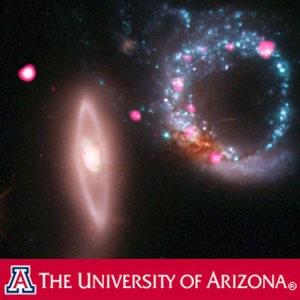
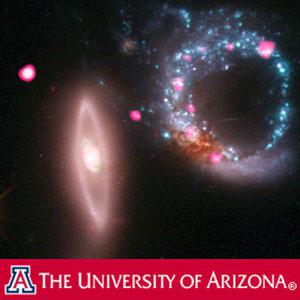
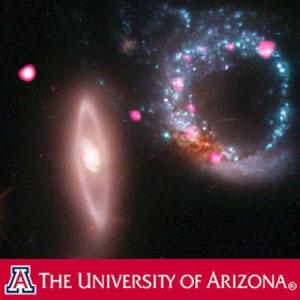
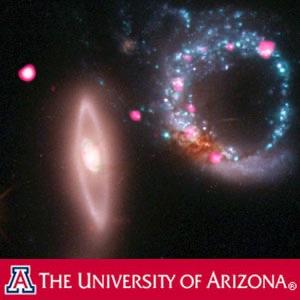
Transcript: Galaxies in close proximity are called interacting galaxies. Interacting galaxies might be gravitationally bound to each other, or they may simply be passing on trajectories through the universe that bring them close together. Interacting galaxies are affected by each other’s gravity. Tidal forces can act to cause mass or gas to flow towards the centers, and gas can pass from one galaxy to the other. There’s good evidence that interacting galaxies show increased incidence of nuclear activity as manifested by Seyfert nuclei, radio emission, or x-ray emission. Thus interaction is a trigger for nuclear activity.
Engelsk
USA
UDSKRIFT 🔗
Are you the producer of this podcast?
Add a podcast transcript
Need Audio-to-Text?
Transcribe with Listen411 in Just 60 Seconds
SØG BLANDT TIDLIGERE EPISODER
Søg efter gamle afsnit af 21. Deep Space and High-Energy Phenomena.
ANDRE EPISODE I DENNE PODCAST
Transcript: The fact that quasars are at large distances and have huge luminosities depends on the cosmological interpretation of their redshift. There are some crucial distinctions between galaxies and quasars as far as redshift goes. For galaxies they follow a Hubble relation where distance ind…
Transcript: In the 1940s Grote Reber used amateur astronomy radio equipment in his backyard to discover the first cosmic sources of radio radiation. The first three sources he discovered were in the constellation of Sagittarius from the center of our own galaxy, and the constellation Cassiopeia fr…
Transcript: Astronomers at Caltech became interested in the newly accurate radio positions of strong sources in the sky. They focused in particular on two sources, 3C48 and 3C273 which appeared to be associated with bluish stars. Since normal stars like the Sun do not emit strong radio waves this…
Transcript: Quasars were mysterious when they were first discovered in the 1960s. But careful work showed that the quasar is surrounded by nebulosity, and eventually spectroscopy of the nebulosity showed that it was the light of stars in a normal galaxy. Thus quasar stands for quasi-stellar objec…
Ansvarsfraskrivelse: Podcasten og kunstværket, der er indlejret på denne side, er fra Dr. Christopher D. Impey, Professor, Astronomy, som tilhører dens ejer og ikke er tilknyttet eller godkendt af Listen Notes, Inc.
REDIG
Tak fordi du hjælper med at holde podcast-databasen opdateret.
