
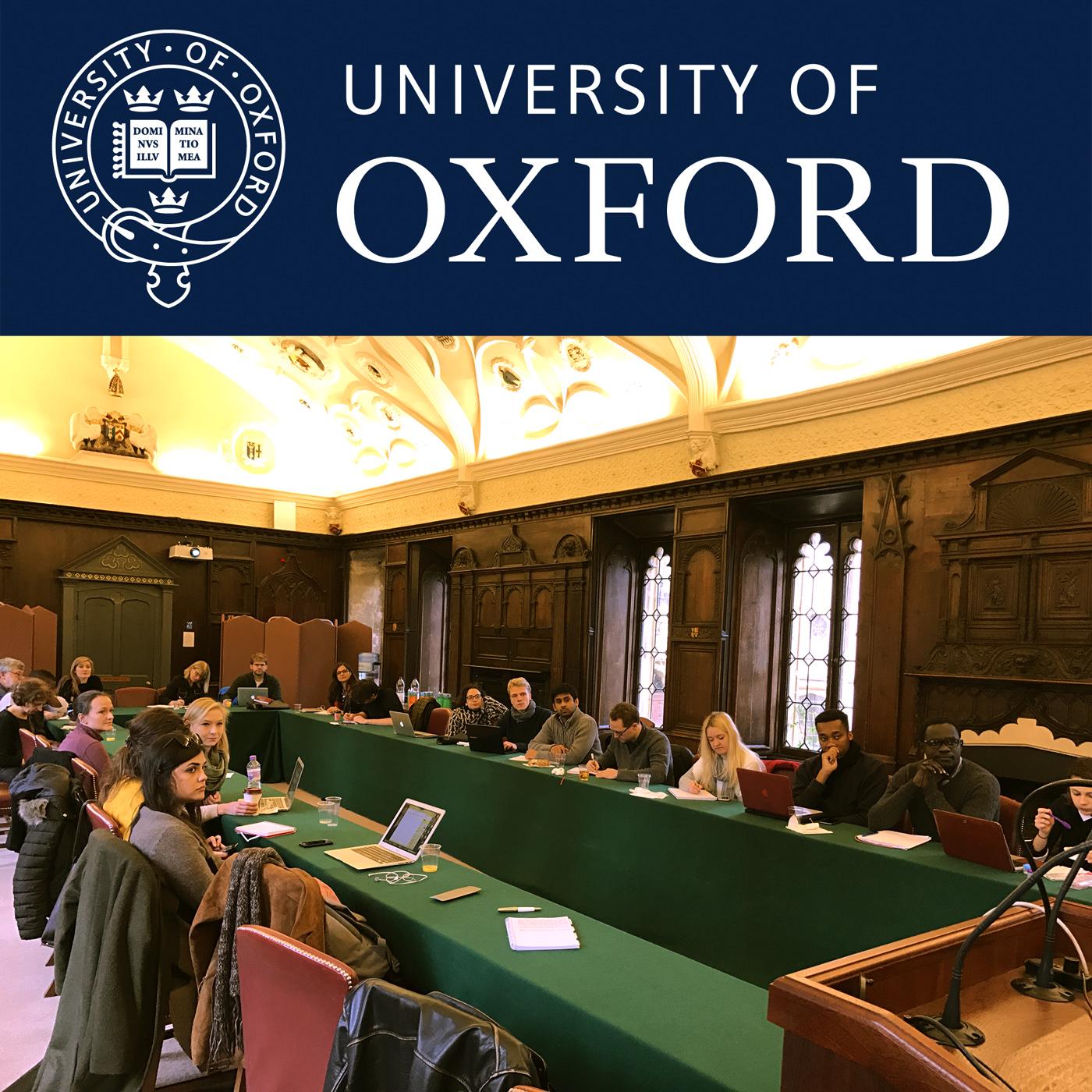
ABOUT THIS PODCAST 🔗
Lectures on international law issues by eminent scholars, practitioners and judges of national and international courts. The lecture series is brought to you by the Public International Law Discussion Group, part of the Law Faculty of the University of Oxford, and is supported by the British Branch of the International Law Association and Oxford University Press. Further details of this series can be found on the Public International Law at Oxford website.
.
.
Update frequency:
every 16 days
Average audio length:
44 minutes
English
United Kingdom
54 episodes
since Oct. 21, 2016
episodic
LATEST EPISODE 🔗
What explains the rise of investor-state arbitration? To the extent that investor-state arbitration had founding fathers, what were their motivations, what constraints did they have, what was their thinking? Using documents from the American, British, German, and Swiss archives, this talk will revi…
SEARCH PAST EPISODES
Search past episodes of Public International Law Discussion Group (Part II).
PREVIOUS EPISODES 🔗
Investment treaties are often said to have two principal effects for the states that enter into them. First, it is asserted that investment treaties act to increase levels of foreign investment in host states. Second, it is said that investment treaties have a positive effect on national governance…
This talk will examine the legal nature of due diligence, namely whether it is a free-standing obligation under customary international law or a standard by which compliance with specific obligations may be assessed. It will be shown that there is a significant number of common elements in the ana…
Even though UN Security Council resolutions may have major consequences for the disputes and states concerned, some of the resolutions are ambiguous in their meaning. This raises questions about the appropriate means of interpreting Security Council resolutions. In the process of interpreting Secur…
Oceans are increasingly under pressure; be it for the multiplication and diversification of economic activities performed at sea, for the consequences of climate change, or for the deterioration of their environmental health. Several international bodies and a plethora of international instruments …
This talk will consider the regulation of corporations for the human rights impacts of their activities. It will include the role of legislation, industry sectors and civil society, as well as courts, in regulation of the actions of corporations that abuse human rights. It will use the framework of…
Following a difficult and protracted process, in 2014 the UNGA adopted Resolution 68/268 which set out to strengthen the UN human rights treaty body system. It mandated a further review in 2020. The proposals which are emerging for that review have the potential to radically change the nature of th…
War does not escape the transformations global governance has experienced in the past decades. The research presented identifies a move from a binary War-Peace framework to a global security governance, characterized by techno-managerial normative assemblages aiming at taming risk.Core to the proje…
The presentation will discuss the approaches to writing such reference works (based on the speaker's experience with the Update of the ICRC Commentaries to the 1949 Conventions, and the Max Planck Encyclopedia of International Procedural Law). The presentation will discuss the approaches to writin…
Since the 24 June 2016, the politics of Brexit – in both the UK and the EU – has driven the negotiations and discussion surrounding the UK's departure from the EU. It is the international legal framework, however, that has framed those negotiations and will shape the UK's future trading relationsh…
Disclaimer: The podcast and artwork embedded on this page are from Oxford University, which is the property of its owner and not affiliated with or endorsed by Listen Notes, Inc.
PODCAST SEARCH ENGINE
You can use our website to search 3,834,647 podcasts and 197,305,122 episodes by people, places, or topics.

An investment in knowledge pays the best interest, so I listen to podcasts.
‐ Benjamin "Llamacorn" Franklin
SEARCH PAST EPISODES
Search past episodes of Public International Law Discussion Group (Part II).
CLAIM THIS PODCAST
Why to claim podcasts?
If you are a podcaster, the best way to manage your podcasts on Listen Notes is by claiming your Listen Notes
podcast pages.
It is a great, free way to engage the podcast community and increase the visibility of your podcasts.
After claiming your Listen Notes podcast pages, you will be able to:
✓
Manually refresh the RSS feed to sync up
✓
Get a verified badge (
✓
) alongside with your podcast name on Listen Notes
✓
Post classified ads for sponsorship,
guests, co-hosts,
cross-promotion...
✓
Respond to listener comments on Listen Notes
✓
Use speech-to-text techniques to transcribe your show and
edit transcripts
✓
Improve the presence of your podcasts, e.g., self-service
podcaster interview...
✓
If you share your Listen Notes page and at-mention @ListenNotes
on X (formerly Twitter),
our official X (formerly Twitter) account will retweet to promote
your show to our followers.
Coming soon:
◯ Self-service promotion on Listen Notes
◯ Track your podcast stats on Listen
Notes, e.g., listens, page
views...
◯ Manage episodes
EDIT
Thank you for helping to keep the podcast database up to date.
