WEBVTT
00:00:00.780 -->
00:00:12.779Upstanding happens one act, one moment, one strength at a time, and standing up changes everything. This is the Upstander Ripple Effect.
00:00:12.779 -->
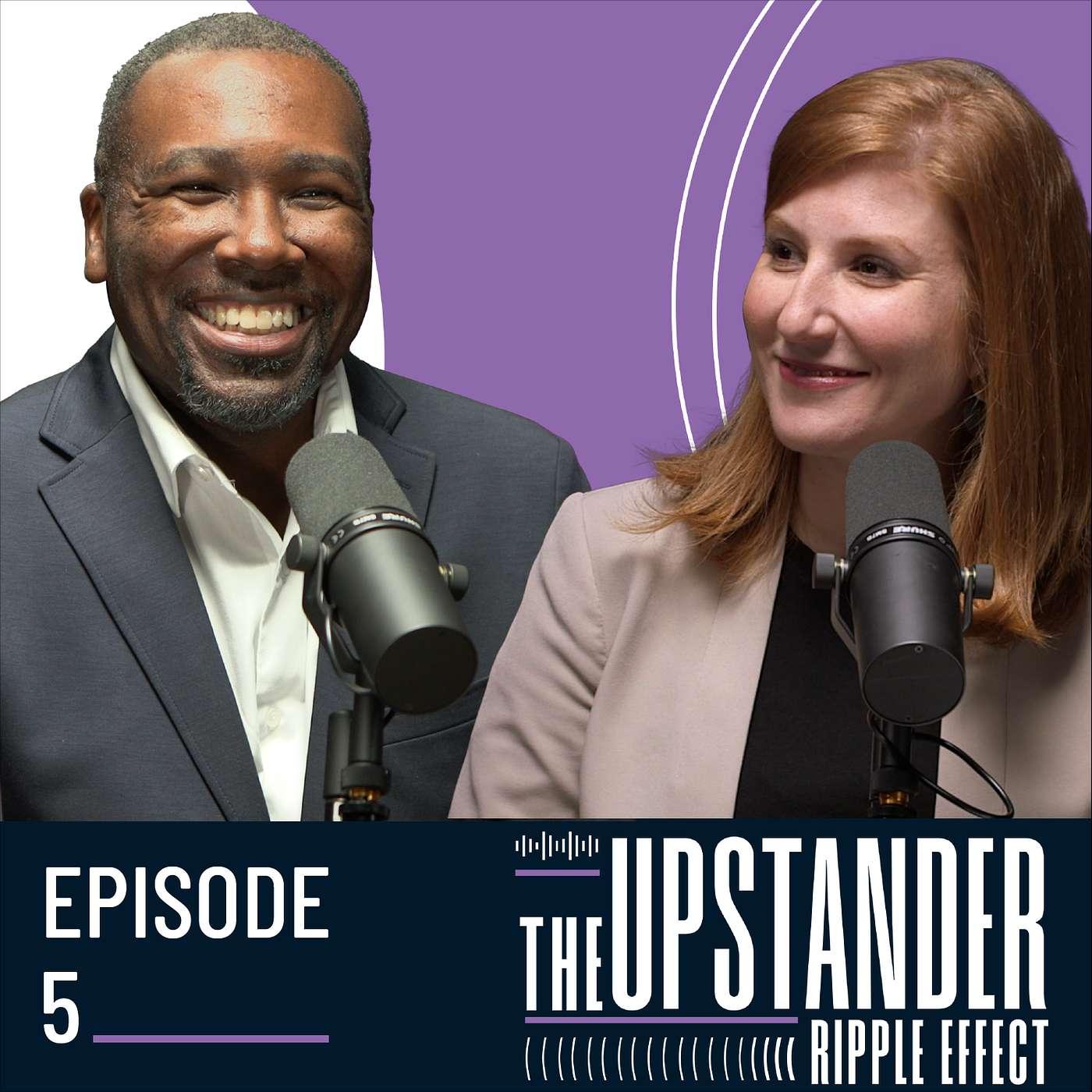
00:00:19.800Hello everyone, and welcome to episode five in season two of the Upstander Ripple Effect podcast. I'm Jackie Congedo
00:00:19.800 -->
00:02:03.840and I'm Kevin Aldridge, and today we have a really timely conversation about interconnectedness. And no better time to have this conversation than at the time that we're recording it, which is right in between two commemorative holidays, or days of days of commemoration, really, that being Dr Martin Luther King Day and International Holocaust Remembrance Day towards the end of the end of the month in January. And it is an interesting time to think about how these two days are established to remember and honor separate histories, but in so many ways, separate histories that are so interconnected, that have so many shared themes and shared lessons and sort of instructions, shared instructions for us today. So there's no better person timing and people around the table to have this conversation with than the incredible Dan Hurley, who is such a community treasure here in Cincinnati, we were talking, I could probably spend most of the podcast talking about all of Dan's amazing endeavors over the course of his career, careers, but suffice it to say, he's an outstanding human being, a civic leader, an author, a historian who has been involved with the Holocaust and Humanity Center since its inception, who's been involved with the Freedom Center since its inception, and whose many people may not know, although hopefully more people do know now, whose own family history is actually at the intersection of these two histories. So with that, I want to welcome Dan.
00:02:03.840 -->
00:02:04.739Glad to be here.
00:02:04.739 -->
00:02:35.337Would love to just have you share you know you have shared your family story, your dad's story, primarily in a number of different forums. Of course, we've had Dan on our Hear My Story interview series so you can, you can listen if you're interested in the full episode of that. We'll have that in the show notes. And also, Dan recently published this incredible book, "Crossing Borders, Expanding Boundaries," which is about your Dad's experience during the during the war. But I'm hoping you can just briefly bring us up to speed.
00:02:35.395 -->
00:02:40.400For those who are new to this story, about about the core elements of your dad's story.
00:02:40.400 -->
00:03:18.311Really glad to. This is a story that I really didn't know. My father rarely talked about his World War Two experience. I knew he'd been in the war. Actually, the one thing I sort of knew was that he had been at Dachau because in the early days of the Holocaust Humanity Center, when was it Hebrew Union, I mentioned to my mother that I was involved with this group. And she said,"Well, you know, your father was at Dachau, and he wrote a letter about it." And I said, "He did?
00:03:13.816 -->
00:03:50.454Can you pull it out? Can you find it?" She said sure. She gave it to me. I said, "Can I give a copy of this to the Holocaust Humanity Center?" which I did, and over the years, different people have used it in education programs, but I knew nothing else about it until I my mother died in 2013 she left a body of letters, which turned out to be 720, letters and two diaries. And literally, reading these letters is how I learned about my father's experience.
00:03:50.528 -->
00:05:38.720And the short point is especially for this conversation, he gets sent to officers candidate school. He was drafted, gets sent to officers candidate school, becomes an officer, and is assigned in January of 1944 to a newly forming company of quartermaster truck company, which, when he arrives there, he had been stationed in Louisville before that. When he arrived at it, he raced back to my mother, and he said, "I had no idea this is an all colored troop." Now it was an all colored troop in terms of the enlisted men, the 130 plus enlisted men, but there were five white officers. Two of those were Jewish, including the captain. The Jewish captain. He had had no experience with of any substance - he grew up in Northern Kentucky - any real interaction with African Americans in any sort of meaningful way. Practically, as far as I can tell, no experience with people who are Jewish. And so this is just sort of forcing him to expand his boundaries and think differently. And there's all sorts of things that take place, including one of the soldiers in uniform being shot and killed because he sat in the wrong seat on a Durham city bus and set off a race riot, which shocked my father, and in the letter after that, he wrote to my mother and said, "Before we go to Europe, we ought to send 5 million people, 5 million men, to the south to wipe the south out. They don't understand democracy here... this place.
00:05:34.449 -->
00:06:24.199Should I never want to come back? If I ever get out of the south, I never want to come back." So then they get sent to Europe, and they end up as liberators at Dachau, and because they were with Patton's Army, and they ended up in Munich. And of course, Dachau is just 11 miles outside of Munich, and my father had some pretty amazing insights. My father was very articulate. He was a lawyer by training and was very opinionated, so it's interesting to see how he reacted during those years in the Army, but it's also because I grew up in his house. It's also been very instructive and enlightening to see how he processed that later.
00:06:24.199 -->
00:06:27.079And didn't share a lot of it until you...
00:06:27.079 -->
00:06:47.685Didn't share hardly any of it. He never shared. I even while he was still alive now, he died in 1977 of a heart attack. He was only 62 years old. I think if he had lived a little bit longer to the time when the United States started to celebrate the 40th and 50th anniversary. 50th anniversaries of Pearl Harbor and World War Two and all that kind of stuff.
00:06:47.744 -->
00:07:05.579You know, a lot my experience as a reporter was that's when a lot of World War Two vets were willing to start telling their story. And maybe he would have at that point, but up to at the time he died, he wouldn't. I knew more about from just side comments my mother made occasionally about his war experience.
00:07:05.639 -->
00:07:06.480Wow,
00:07:06.480 -->
00:07:30.439Dan, what would you say in observing your father and thinking about how you observed your father growing up and now knowing about his experiences there in the war, how would you say that from what you've observed that impacted him or impacted his thoughts about things here in the United States and and how things eventually unfolded with civil rights and all of those different things?
00:07:30.560 -->
00:07:38.810Very complex, and you have to read the last chapter, which is my reflection.
00:07:34.225 -->
00:08:10.142It's not about the war experience, my reflection on all that and what I think happened because I lived at home through college, I went to Xavier University, and so from 1964 to 1968 were the years that I was coming to face issues of race, anti-war movement, Vietnam, I was maturing, and my father and I were fighting all the time. We were disagreeing about anything.
00:08:04.810 -->
00:08:41.059He never once said to me during that whole time when he would be objecting to the what we call the civil rights movement. Now, he never once said to me, Well, now, Dan, during World War Two, I served with a company of 130 plus African Americans. And it taking what he said in the letters, they were very good people, but poorly educated in America, it treated them very badly. But he never shared that.
00:08:41.143 -->
00:10:11.643If he's a and he could have then said, and here's what I took away from that. Now, would I have been willing, as a 19, 20 year old to have really listened? Who knows. But the point was, he didn't see any reason to bring that up. And the interesting thing is, to me, I think you have to come to grips with the fact that for white Americans, World War Two was defeating the enemy, however, it was defined in the case of Hitler and Nazism, or the Pacific Theater in Japan, and then getting that war over with, and then going home and picking up your life and living the American life. For African Americans who were drafted, and at first, remember the first two and a half years America's involvement in the war, the army didn't want African Americans, period, and took only a few reluctantly, and for African Americans, once they started to be drafted, they had a different question. Why should I fight for a country who treats me in the way it does through Jim Crow segregation? Which, it, you know, has so many parallels to what existed in Nazi Germany.
00:10:06.475 -->
00:10:11.643And they're not just accidental.
00:10:11.725 -->
00:10:45.809They were intentional. Hitler had studied what the United States did and how it - delegations. He sent delegations. Here it was. And so African Americans had to say, What am I supposed to do? And there's a famous letter to the Pittsburgh Courier early after Pearl Harbor, saying, Well, should we fight in this war? And within a couple of weeks, the courier comes back with this image of the Double V campaign.
00:10:45.893 -->
00:11:06.393We should fight but for Victory in Europe on the Pacific, but then we will come home and fight for victory over Jim Crow in the United States. So African Americans were entering the war with a very different mindset.
00:11:01.393 -->
00:12:26.059So here's my father with this truck company. Medgar Evers was in a truck company, and number of others were in trucking companies, because 80% of all African Americans served in the quartermaster by the way, because it was they were behind the lines technically, and they weren't seen as brave enough to be in front line units for the most part. So they that that's a whole nother set of stories. But the... Medgar Evers comes home and others and they become very quickly, almost immediately, engaged in fighting Jim Crow and become the close confidants of Martin Luther King, once he emerges as the spokesperson, one of the key spokespersons, if not the key spoke. He those become his assistants, putting the whole thing together. And so the rooted in the war against Nazism is not just the defeating the terrible views of racial views of the Nazis, but also we're going to come home and we're going to live out a different story in America. But that was a very difficult thing to do.
00:12:26.059 -->
00:12:28.700It was defeating the whole construct of racial supremacy
00:12:28.700 -->
00:12:29.299Absolutely.
00:12:29.360 -->
00:13:11.270So you know the way you asked this question to begin with? As it turns out, as I was working on this book, and I didn't even know I started out not writing a book, just going to write something for my my siblings and our grandchildren. I didn't think anybody be interested in this, but when I got into it, I found it was the intersection of the racist views of Nazi Germany intertwine with the racism of America played out differently in two different places, but in both cases, these are intertwined, and it's very difficult to pull those apart.
00:13:11.347 -->
00:13:58.480And my father saw the irony at times, so one of the stories he writes about twice towards the end of the war, German soldiers were, were surrendering because they didn't want to. They didn't want for the Soviets to catch up with them. They want to surrender to the American troops. So they in the mornings, they'd come out of the woods, surrender to American troops in his company. And my father twice pointed out the irony that German Nazi troops, a few SS being guarded by, as he put it, American colored boys, under the direction of a Jewish captain, Sherman Horowitz. And wasn't that didn't that say something.
00:13:58.539 -->
00:14:14.759So the fact that that didn't take any hinds..., you know, wasn't hindsight, that he was no clear and present in the moment. It was, I guess irony is, is a word for it, but also just sort of the, it's almost like the, I don't know, poetic justice of that in some ways.
00:14:15.059 -->
00:15:19.679Yeah, I think what captures my attention or imagination, whichever is the right word out of that scenario, is really the irony, and I think, and this will lead into a question I want to ask you as a historian, just about the role and the importance of history and just our general ignorance of which, I mean, I think you laying that out there sort of explains one African Americans complex history with America and sort of love of country versus how I think white Americans often view that. And there is, there is this sense of, as said, oftentimes to African Americans, hey, we're. You ought to be grateful to be here. And you know, this country is just so great when it hasn't historically really been that yet African Americans have fought for, died for this country, whether it's in the Civil War or, you know, in World War Two or
00:15:19.679 -->
00:15:20.279many of the armed conflicts,
00:15:20.279 -->
00:15:49.504yeah, and really it's, it's always been fighting for America to live up to the ideals that it is espoused pretty much for everybody but them. And I think that what I'm intrigued by is and why I asked you about your dad was, what do you think the disconnect is there between someone who can observe, you know, injustices, but then when you come back, it's, it's there in front of you, and you can see the irony.
00:15:49.576 -->
00:16:01.980But when you come back to where it is, where it is in your face every day, to then not be a part of that, right from it, yeah, yeah. How do you how do you separate from that?
00:16:02.519 -->
00:16:34.178So much as a historian, you can kind of fall into the idea of you can, if you can just sort of identify and line up all of the key experiences a person had, maybe a person you don't know, you're trying to do a biography. And if you just line all those things up, you sort of think, well, then you've got, sort of the key to the answer. What you don't know is, how did they see it?
00:16:29.623 -->
00:16:39.120Did they embrace it? Did they allow it to touch their heart, or did they compartmentalize it?
00:16:39.198 -->
00:16:43.059And all of us want to compartmentalize things. For
00:16:43.059 -->
00:16:43.960self preservation,
00:16:43.960 -->
00:17:33.633self preservation, for psychic health, for there's all sorts of reasons. It doesn't have to be. You know that it's terrible that my father and millions of other white Americans came home and didn't really understand the connection between but that is what happens, and I think it's we all have engaged in it. And I guess that's why the title of the book, "Crossing Borders," which is kind of obvious in a war situation, but, "Expanding Boundaries," that what the war forced my father to do was find ways to connect with people he never would have connected with.
00:17:28.205 -->
00:17:58.595And now for me, the other lesson of that is I've been lucky in the sense that I've had opportunities to connect with all sorts of people going all the way back to undergraduate school. Rabbi Goldman offered a course on American Judaism, and I took it. It wasn't a credit course, but I signed up for it.
00:17:53.586 -->
00:18:12.119That is the first time I was ever in Plum Street temple. I still remember entering Plum Street temple or and over the years, I've gotten to know a lot of people, Gary Zola, who's everywhere.
00:18:12.179 -->
00:18:15.659I was just with him this morning, actually.
00:18:16.200 -->
00:19:18.540But also for me, I think about pushing myself out into the civil rights movement, developing African American friends, and then after 911 getting connected to the Muslim community, Islamic community in this city, particularly at in West Chester, at the Islamic Center of Cincinnati, I made sure that the all eight years of that I was in charge of Leadership Cincinnati, that we would spend our two day we would start our two day session on inclusive leadership at the mosque. And every year it sometimes it happened that day, sometimes it took two months before I heard the story. But every year, somebody said to me,"Dan, I got to that parking lot and I was afraid to go in, because I'd never met a Muslim before, and I was frightened.
00:19:13.671 -->
00:20:09.599Well, those people have become friends of mine and that congregation invited me to be the emcee for their 20th anniversary. I was bowled over." Shakila Ahmad is just one of my heroes. So the point is different. People find ways of expanding their boundaries, challenging themselves. One thing is, you can retreat and never even do that. That's really dangerous. The other thing is, you can do it, but that not make much of it, not let it really touch you, touch your heart. Both of those are problems. You've got to you've got to put. Yourself out and see people, meet people, get to know people as human beings who have see the world through a different way.
00:20:09.660 -->
00:20:34.549Yeah, you know what's fascinating about what you just said? And I hear this often, and I'm off, I'm often wondering when you said, people are afraid to interact. And it makes me wonder, what is that fear based in? And I think that a lot of times that fear is based in differences that have been used by different people to make us afraid of each other.
00:20:34.619 -->
00:22:16.019And as I was thinking about the King holiday. Yeah, as I was thinking about the King holiday and everything that we've got going on in our country and around the world, and I was thinking about this notion of justice, right? The dependence on the execution of justice requires that we see each other as equal, the same. If we do not see each other as equal as the same, then justice is not equal, because if I see the criminal as lesser than me, then he doesn't necessarily have the right to the same justice system, the same processes, the same whatever. We can just do whatever, because he and I are not the same, regardless of whether I don't commit a crime, and he does, I somehow see him as not equal to or lesser than me, therefore, whatever happens to him or her in the execution of what I perceive as justice is okay. And I think that right now, one of the dangerous things that we're dealing with in our country with with immigration, whether you think open borders are okay or not, I think what we're seeing right now in the way some of this is being executed is because we don't see some people as equal. That the way that law enforcement and authorities are going about circumventing people's rights and doing certain things is okay because the ends justify the means, because they're not the same as us, whether that's they're not American, they're not this, that or the other, so they're not subject to the same justice.
00:22:16.019 -->
00:22:38.480I think there's a couple of things there. One is Americans still need to constantly grapple with the revolutionary statement all men, who was in 21st Century, all men and women. But it was meant that way for Thomas Jefferson, even though he didn't treat women the same way, much less African Americans,
00:22:38.900 -->
00:22:39.920that people are
00:22:40.039 -->
00:23:55.779all people, but all people are created equal. That statement is revolutionary in human history, absolutely revolutionary. And we forget how challenging that really is. And the other thing is, you mentioned in what we're facing right now the way we treat illegal immigrants, but anybody who's connected with them, like protesters or legal immigration immigrants or Native Americans, for goodness sakes, they're othered. And no matter what we may say in theory, we're treating them as if they're not equal. And the way they're carrying that out, in my mind, is is not just the ends and the means, the means which is cruelty. Cruelty is embedded in the way that we're carrying this out. And that is to make the point that these people are lesser. It is not just an accident that it's difficult to arrest people. Oh no, they want it that way. They want masks.
00:23:52.000 -->
00:24:01.619They want tear gas. They want conflict. They want confusion.
00:23:56.019 -->
00:24:10.019They want an excuse the to call in the military. That's this is all part of a plan, and it is grounded in these people are not equal.
00:24:10.859 -->
00:24:20.102I think you know, the the slippery slope of any of these histories, right?
00:24:14.660 -->
00:25:06.917Is, is, I this is to your point, when we stop seeing people as human, and that so often there's like a whirlpool effect that happens because fear fuels dehumanization. Fuels fear, fuels dehumanity, and so you know, it in that dynamic, otherwise good people can start to justify to themselves their treatment of others, because, because the zeitgeist rights, like the the story that has been written about who these people are, you know, allows for, or in their mind, allows for them to say, well, you know, yes, it might be terrible, but, but there's justification for this.
00:25:07.005 -->
00:26:42.797But we must do, you know? I mean, you can, you can copy and paste that through any number of chapters of history where, you know, episodes of, you know, horrific persecution or systemic persecution have taken hold. I'm thinking about I was, I was in the Auschwitz exhibition today, as I am in many days actually, now that it's here in town and and I think part of what it does so effectively is help us understand that that, you know, in an environment of fear that's weaponized and trafficked and an isolation, you know, these conditions, if we're not really intentional, if we're not acting in from a place of sort of extraordinary, radical humanity and insistence on that the default as human beings, we are hardwired to fall victim to that fear and to participate or stand by. So, you know, I think that at least being able to look at that from sort of 50,000 feet and a little bit removed from the from the moment of it allows us to examine it, not necessarily with judgment, which sometimes isn't helpful, but to say this is what happens to humanity in these conditions.
00:26:37.442 -->
00:26:52.903This is, this is the default, if we're not deliberate about resisting these forces that we all good, bad and different.
00:26:47.893 -->
00:27:03.960Will, you know, are likely to make these choices, but again, 30 years from now, will write, write about and say, What in the world were they thinking, right?
00:27:04.259 -->
00:27:23.863Well, you know, what I always think about is in every you know, when I was a kid, you know, you grow up in textbooks, and you, you you see these black and white photos of these people who are screaming and yelling at at children who are trying to integrate schools.
00:27:19.586 -->
00:28:50.500And you look at those folks, and you say in that moment in time, they knew they were right. They weren't thinking about, yeah, 50 or 60 years later, that we would be looking back in history and judging them for for how they are in that moment. And I think one of the things that we do a disservice is when we paint those individuals purely as monsters, right? It's easy for you to separate yourself from that, because, yeah, you don't see yourself as a monster. So I think in looking at the humanity of how does someone, which is kind of where I was getting at to the point about asking Dan about about his dad, it really is a mental exercise to kind of figure out, how does one get to that point, culturally, intellectually, thoughtfully, where they can stand there and yell these things or take these positions and feel like they're right, like there are a whole lot of people in America right now who feel like they're right and justified in some of the actions. And I always challenge people to say, hey, if you're in a history book 50 years from now, 50, 60, years from now, you know, how is a student going to judge you, like I judge those people, you know, in those black and white photos, because you have to do some sort of mental heart exercise to kind of understand, you know, is there humanity in in the positions that I'm taking, and is
00:28:50.500 -->
00:29:58.044there a chance that I'm wrong? Is there a chance that I'm wrong about this? Is there a chance that, like, what would it require of me to double click on that as an individual and say, you know, maybe, maybe my righteousness isn't so founded, right? I mean, I'm thinking about the curators who were here when they opened the exhibition, the Auschwitz exhibition, and one of them said something that really stuck with me. He said, "I'm not worried about the people who are explicitly hateful. I'm worried about the people who will [and I'm paraphrasing and probably getting it wrong, but the essence of it was] I'm worried about the people who will stop at nothing to prove their moral righteousness." And I think that, you know, yes, there, there are people who I think want to be hateful for the sake of being hateful, and consider themselves to be that way. But most of us, and where hate gets dangerous at scale is when it's normalized, when it's when it's integrated in a way that's part of systems and, and, you know, just part of our day to day.
00:29:54.239 -->
00:30:24.674And, and this is, you know, this is what happened in the 30s and 40s. This is, in so many ways, what we're still struggling with in this country. And you know, how can we, how can we use these opportunities to look at history, not to say, Wow, that really makes me feel doubled down in my insistence that they're the bad guys over there, but instead to say, what is, what is this history show me in the mirror, what? What is the lesson for me in this history?
00:30:24.737 -->
00:30:34.279And I think, I think that's a much harder question to ask and to answer. Like, I mean, your dad, your dad struggled. I'm sure struggled with it, probably
00:30:34.279 -->
00:31:30.739Doing history is not a neutral thing. I think lots of people think doing history is going back and lining up a bunch of facts, and if you just get them in the right order, you've got the story told. That's not what it's about. It's about what's the underlying framework that you create to put those incidents and people inside. So for me, the critical moment, critical period, isn't so much the Civil War, it comes 30 years later when we come to legally and intellectually reinterpret that story to create the whole mythology around the Lost Cause of the South, about the inferiority the how do we write out the 13th, 14th and 15th amendments? How do we say that?
00:31:30.824 -->
00:32:09.059Yes, those are in there, but here's what they mean. They don't mean that these people are truly equal, and so Plessy versus Ferguson is just sort of a culmination of that changing history. So how you tell people the stories, not just how you tell your children the stories, how you tell other adults what the story of America is, or the story of Germany or whatever really makes a difference and and that is the responsibility that we all have well,
00:32:09.240 -->
00:32:53.559and that's what we're fighting against today. I mean, there, there are concerted efforts to over this battle of who is going to tell the truth about the history of what America is. I mean when you when you see the battles that you have about, you know, trying to erase certain things from textbooks or ban certain books, or say, tell teachers the way that they can treat or teach classes and universities and things of that nature. That's all an effort among some to write history in the way in which they want to, and not challenging us to look at the real history, even the ugly parts. It's to just say how great America is and always has been, even if that's not
00:32:53.559 -->
00:33:13.680the truth. Well, we see that being challenged with the Smithsonian. You know, there's a popular place the American American History Museum at the Smithsonian Washington, the African American Museum.
00:33:07.619 -->
00:33:43.660This is in the crosshairs of the people who want to rewrite the story. And this is the 250th anniversary people are going to try to think about the story of America, and we have to be very cautious what we're doing this year and what we're saying about who we are and who who we are and who we want to be. Even the best of situations isn't where we want to end. We want our children and our grandchildren to have even a better understanding of America,
00:33:43.779 -->
00:35:06.239yeah, yeah. I think also, you know, the piece, and I Gosh, time flies when you are having interesting conversations, the piece, I think that, you know, maybe I'd like to end on, is that I think it's, it's important to challenge ourselves as we think about the answer to that question, with the idea of, you know, holding the history we have been through that we don't want to repeat, that we want to learn from the current realities and the things that are in just in our world today, in our lives today, that are that are keeping many of us up at night and asking ourselves the really hard question, which is not, which is not how to fight against but How to envision and pursue what we want to see. And I think, I think that, you know, just looking at some of these amazing pieces that we really didn't have much time to get into, that our producer pulled around the legacy of Dr King and of the Holocaust this month. You know.
00:34:56.199 -->
00:35:39.199So, Dr King, I think was, was we like to think about him as sort of a, you know, whitewashed, clean cut, easy to support. You know, he was the pacifist, right? And he was, he had radical ideas in his time. I mean, what he was doing was, was not necessarily accepted as you know, the you know, the the appropriate, institutionalized way to go about things at the time. And still, what I find so inspiring is him. About him is that he talked about the dream.
00:35:39.920 -->
00:35:51.639He talked about the vision of what could be as caught up as he was in the fight, in the day to day and in the deep injustices.
00:35:52.719 -->
00:36:15.480He talked about what was possible. He called upon us in our greater humanity, right to rise to that challenge and that kind of like moral inspiring, moral leadership, you know, is, I think, so sorely needed today.
00:36:10.679 -->
00:36:41.800I think about it also in our in our survivors, you know, who came, I've said this so many times on this podcast, who came out of the one of the darkest chapters in human history, and had every reason to continue to talk about fighting against, fighting against. And instead, they built an institution that talks about, what are we pursuing, what are we what are we creating together? How do we, how do we envision? Have the audacity to envision what's possible and then realize
00:36:41.800 -->
00:37:43.179The only thing I would say about that these articles that we all read together, yes, there was an article by Ben Jealous, the former leader of the NAACP. And he points out, it's not just the dream, though. That's not what that's not exactly what got Martin Luther King in trouble, made him dangerous, but his commitment that individually and collectively, we need to organize, to act, to realize it, to realize, to put that dream into effect. Now, he had his way non-violence. He believed in non-violence and but the point was, it was a non-violence with an edge in the sense that he wasn't going to sit passively and quietly by he was going to organize, and that's what really threatened people. Not just the dream threatened people, but also his willing to put it, put his life on the line in the front row of those marches. How many times have we seen those marches?
00:37:44.860 -->
00:39:57.340Yeah, I think, I think the version of King that we have now is, is a highly sanitized, I think, more palatable version. I mean, King was a disruptor, and many people viewed him in that regard. You know, we won't... We romanticize him. Now, I wish people then had regarded King as we try to regard him. Now maybe the country would be a whole lot differently. And I think people like to sort of be here, yeah, yeah, absolutely. And I think we like to cherry pick, you know, the nicer parts of what Dr King said, the unity and the dream and all of that sounds great and it makes us feel good, and we kind of conveniently ignore the parts that that Dan talks about and some of his other parts about, you know, how certain parts of our society are content to say, "Hey, sit back and wait." You know, which a lot of that mentality, I think, still persists, you know, to this day, and a lot of different in a lot of different areas. And I think you know, what we have to continue to challenge ourselves on are to look at those more uncomfortable parts of what you know, Dr King said, and what challenges us, because that is where, that's where the real, reality of the problems that we, that we struggle with in in this country, still to this day, kind of, kind of are, and I understand the dream aspects, and I think absolutely that is a motivating factor. I think in all of our lives, you know, the dreams are what propel us, what encourage us to get up in the morning. And whether you whether it's starting a new business, and your belief that that business can emerge into something so you get up and you make the donuts every day, or do what it is you deal with the rude customers, because you have a belief that this thing, that there's something greater on the horizon, if you just stick with it. So absolutely, dreams are a big part of it, but it is the making of the donuts. It is the organizing. It is the hard work of making the business churn that gets you to the dream. So we can't just talk about the dream without, without the without the hard work that makes it possible.
00:39:58.300 -->
00:40:18.211A hundred percent... it's, it's, it's. Is the kind of thing that one falls flat without the other, either way you look at it. And so, so, yeah, to the you know, the legacy of Dr King, the legacy of the survivors who came here and and have continue, their legacies continue to lead us.
00:40:18.282 -->
00:40:41.559It's, it's so inspiring, and in the dark, cold of January, it's a refreshing reminder that that we are more resilient and capable of addressing some of the hardest things than we think we are, and that that that's possible if we're willing to do the work. So thank you for joining us for what has been an all too short conversation.
00:40:41.619 -->
00:40:43.599Thank you for inviting me. This has been great.
00:40:43.599 -->
00:40:59.800No, this is great, Dan and and we need to encourage people in the spirit of Dr King and many others that sitting around the table coming bringing different perspectives and life experiences around the same table is really important.
00:40:59.800 -->
00:41:38.300It's the only way we move forward, you know, it's, I'll just dip right back into one of these pieces, which is talking about not just the, you know, that it's the right thing to do, but it's, it's a necessity. Yeah, it's, if we're going to figure out how to move forward, this is a critical necessity. And Dr King understood that. He understood the diversity of the coalition was inherent to its strength so totally. If you want to learn more about Dan's family's incredible story, his dad's story, and all of the lessons that he's learned and that you can learn from that story, you should pick up a copy of"Crossing Borders, Expanding Boundaries," which you can get at Joseph Beth or on Amazon.
00:41:38.300 -->
00:41:39.260It's on Amazon.
00:41:39.260 -->
00:41:41.679Yes, no excuses.
00:41:39.260 -->
00:42:30.139That's right, easy to find, none, and we'll have to have you back on, be sure to check out the long form interview about about your dad's story. On, on, Hear My Story. And again, we'll have that in the show notes. But for now, we will see you back next time. Thank you again for being with us. The Upstander Ripple Effect is a production of the Nancy & David Wolf Holocaust& Humanity Center. The Center's mission is to ensure that the lessons of the Holocaust inspire action today. This series is part of the Cynthia & Harold Guttman Family Center for Storytelling. Visit us in person at historic Union Terminal in Cincinnati, Ohio, or online anytime at Holocaustandhumanity.org the Managing Producer is Anne Thompson. Technical Producer is Robert Mills, and Technical Director is Josh Emerson. Select music is via Kick Lee, and this is recorded at Technical Consulting Partners studios in Cincinnati, Ohio.