
এই এপিসোড সম্বন্ধে
Good empirical safety research is heavily bottlenecked on thinking more clearly. This post shares a few frames and tips I found useful, illustrated with concrete examples.
I spent the better part of 2026 in empirical AI safety research apprenticeships. I was mentored by Alex Turner and Alex Cloud as part of MATS 9 Team Shard, where my collaborator and I worked on finetuning-based misalignment auditing. I then interned at Redwood Research, managed by Aryan Bhatt, where I worked on sabotage capability evaluations.
These thoughts are indebted to my mentors, collaborators, friends, and colleagues, but they are not direct reflections of their views.
Thank you to Alex Cloud, Alex Turner, Aryan Bhatt, Jeremy Huff, and especially to Keshav Shenoy for feedback on the piece.
Better models of the problem speed up empirical iteration
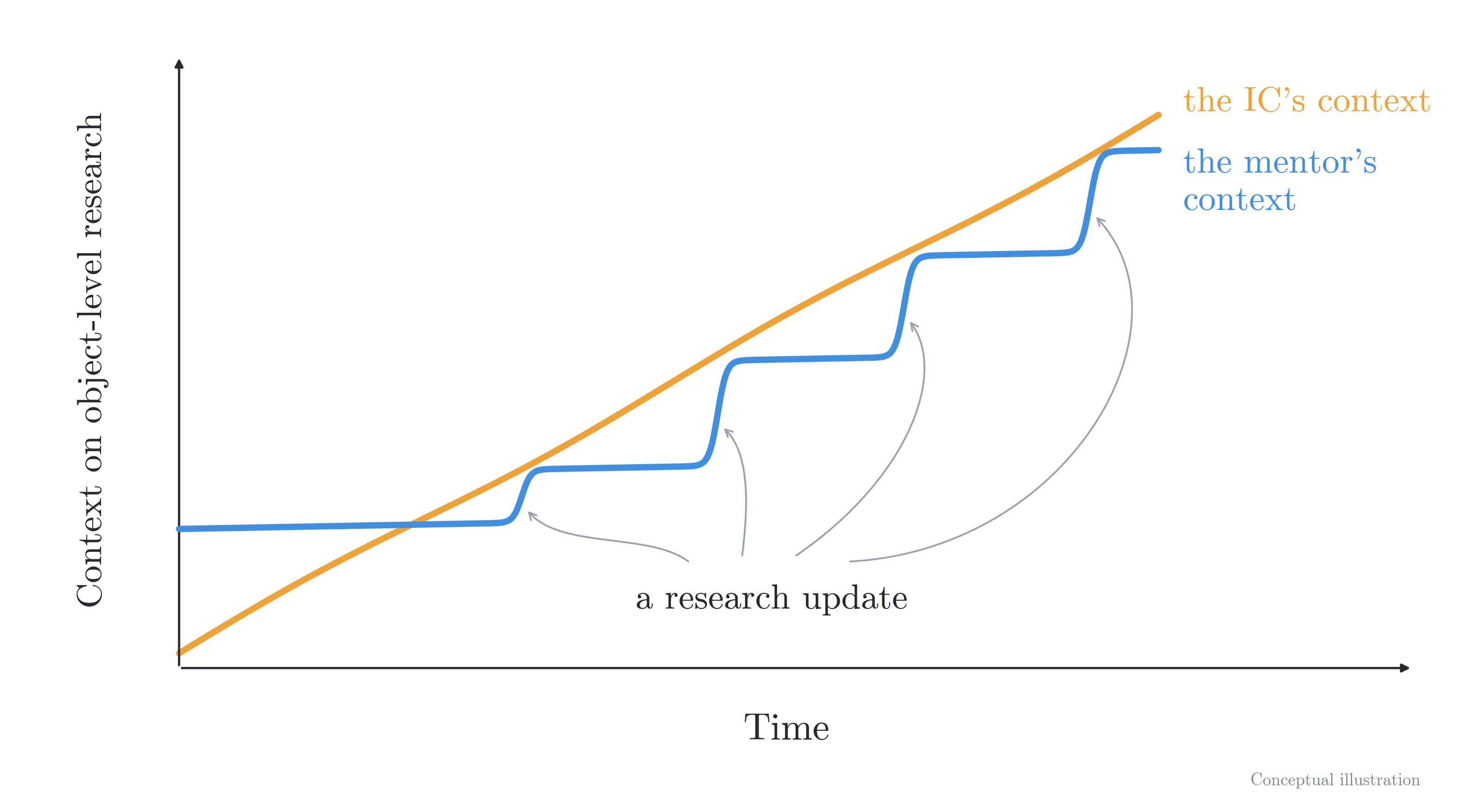
Fast iteration is one of the key virtues of an empirical safety researcher. At first, I didn't find it obvious what that meant or how I should get better at this skill. I imagined a sprinter, doing one looped motion at a far quicker pace than everyone else. I now think that's the wrong mental picture, and going fast is more like being an efficient grappler–agile, strategic [...]
---
Outline:
(01:00) Better models of the problem speed up empirical iteration
(02:26) Develop predictive models and update them
(04:05) Update with uncertainty in mind
(05:51) Predict senior researchers' research takes
(07:34) Use metacognitive strategies to make predicting and updating habitual
[... 9 more sections]
---
First published:
October 12th, 2026
Source:
https://www.lesswrong.com/posts/Q4rcvgjbgjTwmn8Xa/research-lessons-i-learned-at-mats-and-redwood
---
Narrated by TYPE III AUDIO.
---
I spent the better part of 2026 in empirical AI safety research apprenticeships. I was mentored by Alex Turner and Alex Cloud as part of MATS 9 Team Shard, where my collaborator and I worked on finetuning-based misalignment auditing. I then interned at Redwood Research, managed by Aryan Bhatt, where I worked on sabotage capability evaluations.
These thoughts are indebted to my mentors, collaborators, friends, and colleagues, but they are not direct reflections of their views.
Thank you to Alex Cloud, Alex Turner, Aryan Bhatt, Jeremy Huff, and especially to Keshav Shenoy for feedback on the piece.
Better models of the problem speed up empirical iteration
Fast iteration is one of the key virtues of an empirical safety researcher. At first, I didn't find it obvious what that meant or how I should get better at this skill. I imagined a sprinter, doing one looped motion at a far quicker pace than everyone else. I now think that's the wrong mental picture, and going fast is more like being an efficient grappler–agile, strategic [...]
---
Outline:
(01:00) Better models of the problem speed up empirical iteration
(02:26) Develop predictive models and update them
(04:05) Update with uncertainty in mind
(05:51) Predict senior researchers' research takes
(07:34) Use metacognitive strategies to make predicting and updating habitual
[... 9 more sections]
---
First published:
October 12th, 2026
Source:
https://www.lesswrong.com/posts/Q4rcvgjbgjTwmn8Xa/research-lessons-i-learned-at-mats-and-redwood
---
Narrated by TYPE III AUDIO.
---
Images from the article:
Apple Podcasts and Spotify do not show images in the episode description. Try Pocket Casts, or another podcast app.
Apple Podcasts and Spotify do not show images in the episode description. Try Pocket Casts, or another podcast app.
ইংরেজি
মার্কিন যুক্তরাষ্ট্র
এই এপিসোডটিতে
প্রতিলিপি 🔗
Are you the producer of this podcast?
Add a podcast transcript
Need Audio-to-Text?
Transcribe with Listen411 in Just 60 Seconds
অতীতের এপিসোডগুলি অনুসন্ধান করুন
LessWrong (Curated & Popular) এর অতীতের এপিসোডগুলি অনুসন্ধান করুন।
এই পডকাস্টের অন্যান্য পর্বগুলি৷

Robin Hanson didn't invent the idea of a martingale process. The lilim say that Ville in 1939 gave the term its mathematical meaning and Doob turned it into the modern theory. But to state this is not to realize that your own probability assignments over time ought to form a martingale in your…
By Alex Turner, Amber Scorah, and Karl Koch. Op-ed written for Fortune. Giving independent evaluators “employee-like access” is “a great idea”, OpenAI CEO Sam Altman said on September 12th. Two weeks later, OpenAI president Greg Brockman signed the White House Accord on Super Intelligence which out…
Tl;dr: The frontier AI companies’ implicit alignment plans center on rushing towards RSI with something like current models. This plan is (at best) contentious, and many believe it will have catastrophic consequences. Nonetheless, it is the track we are on. It is therefore important to collect evid…
TL;DR: This document provides an overview of publicly available evidence regarding the monitoring practices of internally deployed agents within frontier AI companies (focusing on OAI, Anthropic, and GDM). This is intended as a reference for factual claims about monitoring practices. In general, th…
দাবি পরিত্যাগ: এই পৃষ্ঠায় এম্বেড করা পডকাস্ট এবং আর্টওয়ার্ক LessWrong থেকে এসেছে, যা এর মালিকের সম্পত্তি এবং Listen Notes, Inc দ্বারা অনুমোদিত বা অনুমোদিত নয়৷
সম্পাদনা
পডকাস্ট ডেটাবেস আপ টু ডেট রাখতে সাহায্য করার জন্য আপনাকে ধন্যবাদ।