


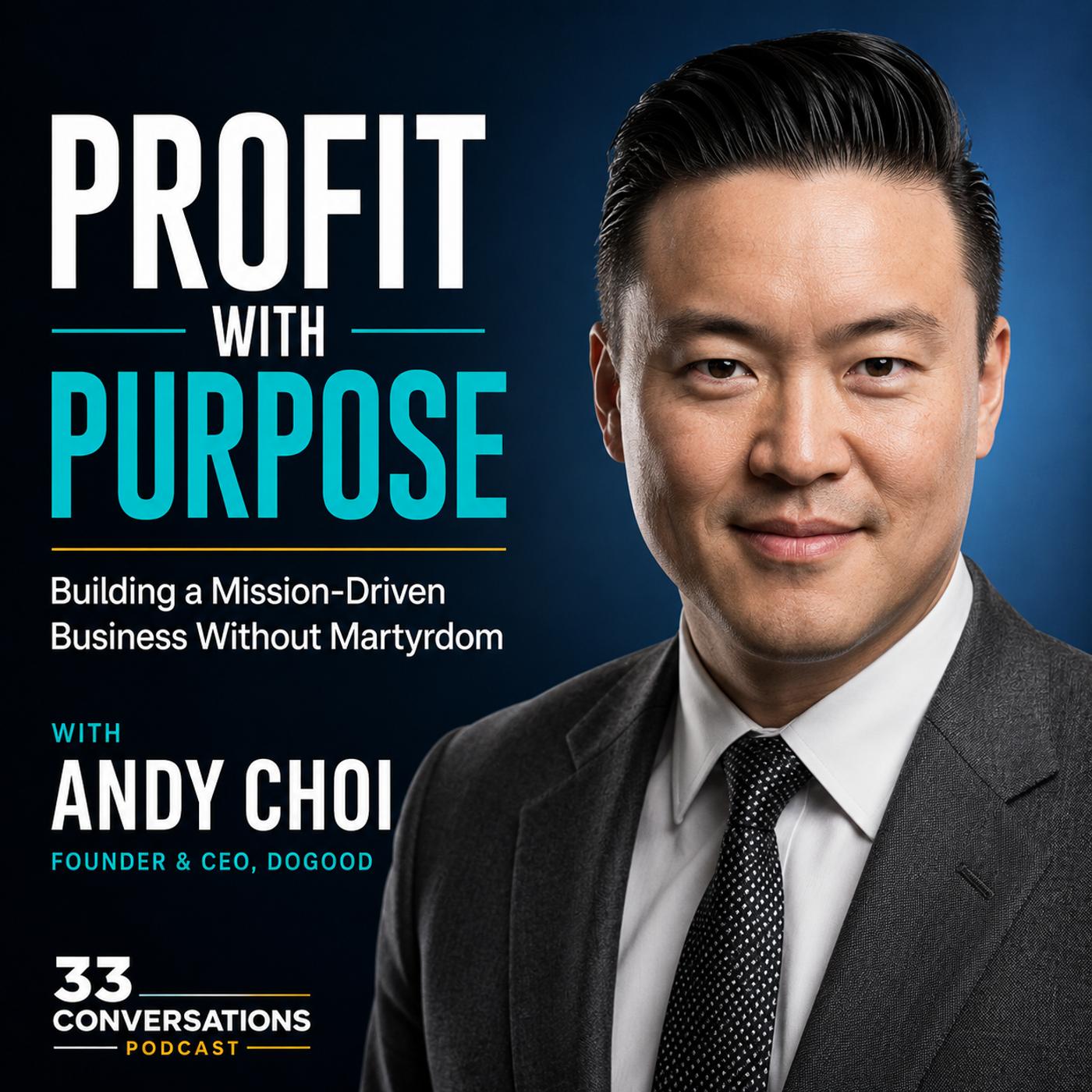
Michael Abney: Hello and welcome back to 33 Conversations Podcast. I'm your host Michael Abeney and today I'm joined by Andy. Andy is the founder and CEO at DoGood. We're exploring today what it really means to build something that serves without losing yourself in the process. Andy, welcome to the pod. How are you doing today?
Andy Choi: Hey Michael, thanks for having me. I'm doing great.
Michael Abney: It is my pleasure. I'm really excited to have this conversation. you built inside of systems that reward growth, scale, and profit. And at some point along the way, something in you started to ask different questions, not how are you gonna win the game, but whether the game itself is aligned with what you are actually believing. Now you're building something that sits right in the middle of that tension that I think a lot of us feel between profit and purpose, between structure and surface. So this is a perfect place to start off with asking you our first question, which is what transformation are you going through right now in the middle of what you're building?
Andy Choi: Yeah, I mean, as the founder and CEO of Doogate, our mission is profit with purpose. And I think the transformation that I'm going through on a daily basis is really swimming upstream against what the capitalistic market, ⁓ what that embodies and what it is. I am a capitalist by nature, meaning that, I believe in the economic system of capitalism, ⁓ Rewards, incentives. ⁓ But I don't it's a means ⁓ to an end,
Michael Abney: Mm-hmm.
Andy Choi: It's not, it was never meant to be just about ⁓ and you know, self-serving, it was meant to ⁓ drive human flourishing, a marketplace, it was meant to serve others. ⁓ And I think that transformation me is a daily struggle because we live in a world that really rewards, ⁓ profit and gain at, at any expense. ⁓ And ⁓ I think there's something terribly broken in that system.
Michael Abney: Yeah, it's becoming day more and more evident about that brokenness. And ⁓ was thinking about it, ⁓ I was really present to what I was told growing up about how it was and the how the sectors really weren't. ⁓ anywhere connected and there were two different things. It's almost like you had to make a choice and there were only two that you could make, that ⁓ I talk to you, ⁓ my God, you're making another choice. You're like literally creating something. gave me goosebumps when I was thinking about it about the power of not accepting what is been given to us as the way it's supposed to be how you're actually shifting in real time. that's excites me the most about today's conversation. I'm wondering like in your journey of this, where have you noticed resistance or things that you've had to let go to be where you're at today in this middle you you're creating a new lane. ⁓
Andy Choi: Yeah, no and to your point it's you know, we participate in a society that has a lot of misconceptions and brokenness and I think ⁓ to answer question is to how do I reframe myself and kind of break these chains of ⁓ Just just to be honest, and for me, ⁓ it's really ⁓ being a system where you know, like hey like It was really this, remember like it's like Wolf of Wall Street, you, pick money and you know, you're wildly successful ⁓ or you become tree hugging hippie that's poor and suffers, ⁓ right? ⁓ that kind of old school model,
Michael Abney: Yeah. ⁓ Totally. It's true. It's how that it was positioned like even ⁓ having the energy side to myself and ⁓ being that community for 30 years. It's amazing how many people think that that's part of being energetic or human is to be. ⁓ I don't want money That story is about money and what you're bringing to the table is it can be both kids. It could be, you know, maybe something we haven't even thought of before about how we relate to money service and what we're building today because that's my been my focus for the last two years is ⁓ a pulse of what's happening in real time and it's changing and evolving in just such a beautiful way. I'm so glad we're here having this conversation today. ⁓
Andy Choi: Yeah, I mean... Just to add to that, I just want to be very clear here. I don't believe in that, I was born and raised in the San Francisco Bay area. I now live in New York City. I like nice things, I like to travel. I like to eat out. I enjoy the finer things of life. It doesn't define me, but now that I want to do good, I have to be poor and suffer. I just don't believe in that, you you look at the most basic things from a societal standpoint, point is, you know, when we give ⁓ philanthropic dollars or a donation and to an organization, when we find out that that the CEO of that organization is making too much money, we're society's up in arms, Like they're like, what the hell? Like that person is doing, ⁓ should be poor and suffer and they shouldn't. ⁓ in the marketplace, if they choose to leave that company and go work at a Google or I don't know, an Exxon, whatever company, and they make millions of dollars, we don't, we don't have any.
Michael Abney: Yes!
Andy Choi: We don't have any problem with that and then they can just donate so then we're rewarding them to in a capitalistic system rather than participating in solving some of the biggest problems in the world Like you know me like the economics should back out like and it's like why aren't we paying? You know the most talented people in the world to solve the biggest problems in the world like hunger or whatever it might be and that's one example of a broken system and one example of how I was in this system and
Michael Abney: Yes.
Andy Choi: and you know, participating in it. Because I had those same things, the most practical is me as a Christian, when I go to church, ⁓ when I find out that the is making a salary and how much are they making? that can be relatable to anybody, We have this false belief that you're doing good, you to be poor and suffer, In order to ⁓ be a true servant, ⁓ I just don't believe in that system, ⁓
Michael Abney: Mm-hmm.
Andy Choi: much of what we're building and what we're trying to do in regards to having these conversations as well, is really change the narrative or at least at the very least challenge that narrative.
Michael Abney: I mean, there's all you can find evidence of anything at any given point, but there seems to be there is, the preacher with the big church there's also, there's conversation about how it should be agreement about how we can structure things or have it work in what talking about here, making it work from a different perspective where we got more choices than just the one or two that we were given ⁓ where does this come I guess this ⁓ because I could feel this coming from within you so ⁓ where did this cut did this drive come from that you have this perspective that you're now shaping the world with ⁓ because then it just happen it's had to come from somewhere do you are you aware of that connection like what's driving you right now
Andy Choi: Yeah Yeah, I mean, there's so much to it, And it wasn't like a singular thing, like most in life, it was a journey, we're shaped ⁓ and molded by truths and decisions that make over time. Not just, ⁓ yes, of course there are pivotal moments. ⁓ but for me personally, ⁓ like faith is the foundation of my right? Like it's the driving force. ⁓ that said, like I grew up in very poor house, my father was a pastor. he was, so I essentially grew up in a nonprofit home, And you we, he would, we lived that, It was like be poor and suffer to do good and serve your community. And as, they were both my, both my parents were immigrants from Korea and they built the church, in the eighties where they served a local Korean immigrant community, right? And during that time, it was really like, that's all you had, you know, that community as, you know, immigrants in a new country. And when I think about that all of those things shaped me right and I again my my brother oldest brother, the youngest of three, was disabled, had a really tough childhood, was born with cerebral palsy, and being exposed to immigrant parents with a child in need, with special needs, it was just really shaped me. But ultimately, for me and my journey, I was always just a hustler. I started my first company when I was 14. I was like, well, if we're poor, I need to do something. something about this, right? Like, cause I don't want to be poor, right? Like the whole American dream thing. ⁓ like I couldn't find a job. So I started my own company and I did painting on address numbers of the curb of the streets. I, I grew that business to like 21 employees. ⁓ I expanded it to three cities and that kind of really set my path towards entrepreneurship. And long story short, I've had about seven different startups, some successful, some really difficult learning experiences and expensive. But ultimately, just had this idea that I was gonna make a shit ton of money and then I'll give back. Right? Like, you know, I've always had this conviction to give back, but it was like, again, my approach to it was very from a societal standpoint where society, again, like the Bill Gates, you make your billions of dollars and then you create your foundation and you give back. Right. Like, and I was pretty much like, whether it was conscious or subconscious, like that was a journey and that was the mindset that I've had. And about seven years ago, like I had this really kind of big God moment where God convicted me, where it was like,
Michael Abney: Yes, yes.
Andy Choi: hey, what you spend your time on should reflect your values and should reflect the kingdom. And my values is that I believe that we are meant to make the world a better place that human flourishing is at the center of it. Right. And my what I spend all my time and effort on is building companies and work. Right. It's where I find deep joy and it's I love what I do. I love the hustle. I love, you know, whatever you want to call it. And that's where it really put me on this journey of like, all right, what does that look like? How does it, you how is my posture? How is my approach going to be different? you know, and here I am seven years like into it and like building this company. But it's been ⁓ through that process. It's just been a journey of like, you know, figuring things out, right? Like what are and really working on myself and asking the difficult questions of like, what what do I need to change? What do I need to kind of constantly work on? And and these conversations.
Michael Abney: What were those beginning things when you went from hustle, epiphany, moving in a different timeline, different direction with where you were taking, because that hustle, that energy of the hustle, that hustle is a word that we label it with, but you still have that energy that used to be labeled hustle, but it's now something different. What do you call it now? It can't be hustle.
Andy Choi: I mean, it definitely is, but it's different. There's much more deeper meaning and purpose. Oftentimes, think hustle, especially when I was younger, I can only speak from my lens, hustle was very transactional. It was like...
Michael Abney: Yeah.
Andy Choi: you know, waking up early in the morning so I can achieve X, Y, Z, right? Like, and it was like, all right, I'm gonna do this. I'm gonna do A to get B, right? And to your point, like, hustle looks very different for me now. I'm trying to think of the right word, but essentially it's like my Y drives me so much deeper than just a transaction. Right? Like, and the result is no longer the mission. It's the process. That is a very different approach to Kwonkwo hustle. Right? Like Simon Sinek talks about it a lot. Like you start with the why and it's like what he calls the infinite game, which I think ultimately is like the ultimate hustle. Right? Like what's the infinite game? Right? He articulated beautifully. And I very much agree with that approach. It's like, it's the process of becoming and
Michael Abney: Yeah.
Andy Choi: rather than the result itself. I'm, I not the savior of this world. okay, then how I'm, ⁓ how I'm participating in ⁓ to shape it in any way or form and within the context my life and my and impact. ⁓ I hope that that reach and impact is great ⁓ and has a massive magnitude, but ⁓ it, if it doesn't, it doesn't change what I'm going be doing and what I believe today. Endless journey, and I think ultimately that is the difference right where ⁓ ⁓ I was younger and like my pursuit from a capitalistic standpoint was so Transactional it was like i'm going to do whatever it takes to make x amount of money or get x whatever xyz result I think now that hustle is like ⁓ am I shaping? ⁓ how am I being formed myself through this process, right? ⁓ whether you call it sanctification growing as a servant-based leader ⁓ my team ⁓ how am I
Michael Abney: you
Andy Choi: being shaped and then two, it's like how am I participating in something rather than being just focused so much on the outcome that I'm not focused on the journey itself. I hope that answers your question.
Michael Abney: does and it also like this is so you're bringing all this to the nonprofit space mixing it all up I'm sure you have like peer group of other non like we all connect with each other what has been the feedback or have you other people feel the same way is this something that you see can grow or do you how do you see yourself inside of what you're doing not just for yourself but you know This is infectious. we're all looking for solutions. We're all looking for, ⁓ okay, get it. It's breaking down. Things are changing at a rapid rate. I don't understand everything, but ⁓ I am getting even me. Like I want to know what's next. I want to start thinking about solutions. I don't want to look at them. I've looked at the problem long enough. I want to start talking with people that are ready to build other things that are like for the, for ⁓ emerging and I get to do that every day which is really really cool but it's really awesome to see like somebody that actually has that that faith ⁓ that's added to it that it's not just about a dollar or a number or a metrics you're talking about impact and outcomes and I'm just curious like how that's landing with your peer group and is can you see that reflected back in you know what are what are you hearing
Andy Choi: Yeah. I mean, there's so much to that. I'm gonna answer that question in a few different ways. One, ⁓ I do not like working in a nonprofit space, which is kind of a shocker, right? Like, ⁓ it's just a very broken system. ⁓ my peers, people that are in the nonprofit or social impact space, they will, the vast majority will kind of support the statement here where it's like, again, the word nonprofit is detrimental. to the industry itself. Again, it's so broken, right? Like everyone's like giving has been fixed at about 2 % GDP the last 40 plus years that has been tracked. You look at living wages to like salaries within a nonprofit, like everyone's like just trying to survive. I don't wanna take away from the reality of Maslow's hierarchy of need. We need to survive. Like we have bills, like people have kids. You need to have clothes on your back and obviously like those those pressures do not go away and you know money and financial things Always tends to be the number one struggle bus right that everyone is on right like and that is the reality of the situation So then it's not like you're just because you're in a nonprofit space or the social impact space You feel warm and fuzzy all the time, right? That's just not that's not the reality right? It's work. It's real work that matters ⁓ and I think
Michael Abney: Yeah.
Andy Choi: like for me having not been in that space, always being an entrepreneur, coming, you know, being in tech growing up in Silicon Valley in that space, making the shift to understand a non-profit space was just, it's still so painful, right? Like, you know, I come from tech, I wanted everything yesterday. Everything's data driven. The non-profit space just does not work like that. You know, it takes like two weeks to get an email response, right? Like, it's not...
Michael Abney: Mm-hmm. Mm-hmm.
Andy Choi: It's not how I operate. It's not how I run a business. But again, it's reflective of a systemic problem within the industry itself. So. That said it's like yes, those are my peers, but also that's not the space I want to play in that's not the space I want to build it's a space that I want to serve and help heal from the inside out But like we're trying to do things differently and it's hard to do that if you're in the mess itself Right, like you have to kind of remove yourself and and do things differently Or you're just you get stuck within the you know, you get stuck within the system itself and you become you know a victim to what that system is, right? ⁓
Michael Abney: How do you keep yourself out of that though? How do you keep yourself out of that?
Andy Choi: Yeah. So then again, I think like for us, it's like, how do we bridge the gap between profit and purpose? Right. Like for me then it's like where I, the space that we're participating in creating is like really in the capitalistic market. Right. Again, I believe in capitalism. is a system that is, that has worked too well, if anything, right. Like, ⁓ you know, profit and gains, like all of those things. So then it's like, how do we bridge the gap between the nonprofit and the for-profit? Because for us, we're not trying to add to the problems or compete within the mess of that problem, we're trying to make the pie bigger. So some basic things is that nonprofits, if giving has been fixed at about 2 % GDP, everyone's fighting over the same piece of pie. They're going after the same donors, they're applying for the same grants, so it creates a very unhealthy competition ecosystem that is very scarcity driven, again, scarcity mindsets, all of those things. It's like, all right, when we look at that problem from a systemic level, how do we make the pie bigger? There's no shortage of resources and wealth in the for-profit market. this back to your question. It's like how do we bridge that gap? What does profit and purpose look like? Not from a figurative standpoint but from an actual practical like executable standpoint right? And you know that includes like people right? Like you know I there's so many young people that I meet with that says that say to me like literally I would love to do what you're doing or work in your industry. I just can't afford to do that. Right? Like, and they genuinely mean that. Like, they would love to do it, but they just can't afford it. If you have an offer from some major tech company that's offering you, you know, hundreds of thousands of dollars, and then you have this nonprofit that's giving you like a fraction of that, like, it's really difficult to like make that choice and sacrifice. It actually is more effective and beneficial if you pick the corporate job and just donate, which is again, a part of the broken.
Michael Abney: Well, that's model that we've been giving because based off of what you said at the beginning, like we were taught to stack and know, rack and at the end of the day, then you give back and like, I'm telling you, it doesn't work that way. I mean, you know, it doesn't work that way. It doesn't, it does not work that way because you end up and you, you give them back, but you're like, I've given my whole life to different organizations, but it was money and some things on time and now I'm more community based. But when I was in the grind of it, no.
Andy Choi: Exactly.
Michael Abney: you're a thousand percent in that, in that mode because you're so busy doing that, that you're not really connected to the thing that you're actually trying to support or there was no bridge at all back then. And now having to talk about this, ⁓ like hearing you, it begs the question of how do you shift those, the context cause context is decisive.
Andy Choi: Exactly.
Michael Abney: And there may be not be one good what the context is what what what the guy said? I can't go because I can't afford it so Somewhere at the top of this bubble that we all live in there has to be another conversation that says we've got to redefine that which is what you're having but I'm curious about at what point does that actually shift and start okay now I'm building with this messaging to it's almost gotta have some marketing to it to be effective to where it could be what's the word I'm looking for is enrollable. Like create something that something is enrollable to something. It's like, yeah, I wanna be a part of that. And even open the door to the conversation that we're all really at the end of the day when we look for solutions, if we're not really conscious.
Andy Choi: Yeah, of course. Mm.
Michael Abney: and have that deep faith and trust, which it's hard to do in the world, but like if you don't, you're, it causes a disconnect and you lose your touch with, there's something coming through us that's new. That means that we don't have anything to relate it to in the past, which makes us really super uncomfortable. And that's the. Like that's what you were making me think whenever you were talking about this space that you were creating and the uncomfortability of having these different types of conversations. But at some point it has to gel into a movement where like I get what you're doing. I think it's amazing. That's why I couldn't wait to have you on the pod to talk about this. It's going to take, you know, a tipping point of people that are in that space to really generate that. but it takes one ripple to start that effect. I'm curious about other companies that are nonprofits, thinking of everybody as one entity, how do they really move from that space of trying to do good to actually connecting to actually doing the good?
Andy Choi: Yeah, mean, great, great stuff, great question. We are defined by our actions, not our intentions. I genuinely believe that everyone wants to do good, right? Like, but there is a massive gap between our intention and our action. And that's where, again, you know, one of the beauties of capitalism is that you give economic incentives and people are willing to do what they don't want to do to get that incentive. We're so and that's based on human needs, like value systems, all of those different things. So again, the idea of profit with purpose was really figuring out like, you know, figuring out systems that allow.
Michael Abney: Boom.
Andy Choi: it to like human nature is human nature. We're designed and built in a certain way. It's like we're not as complicated as we are. We're pretty simple and straightforward, right? Like we, we need to build systems that are again, just really like stuff that already works. It's not, there's not solving rocket science, right? Like it's pretty basic. And, ⁓ but to your point, it's timing is everything. Right timing is everything and there's I believe there's a shift that's happening in in the marketplace right now So to answer your question in regards to enrollment what I believe in is that like with ai and this generation gen z over 78 percent say that they do not Want to associate themselves with a brand or product that's not that does not reflect their values Right. So, you know, we've already seen this shift happening in the marketplace lifestyle brands or or like it's no longer about the product, but what the product represents, right? So we've seen this shift happening already and what that ultimately comes down to, what is the ultimate system of value? It's belief, it's serving, it's humanity, it's serving humanity, right? And I think in a gentic world where machines are gonna do the vast majority of everything that we don't need to do that's quote, unquote work or grunt work for humans, our biggest value as humans then is to be human. And I think this is a full circle moment of like technology is advancing so rapidly, right? Like, and obviously we know all of the buzzwords and like kind of the fears and things, but I also see the beauty and opportunity in that is that like, this is a full circle moment where our humanity is the most valuable thing. And I think our humanity in practice, right? Is servitude, being able to serve others to do good.
Michael Abney: Yeah. Yeah. Yeah.
Andy Choi: is the most human thing that we can do. It's the most valuable thing that we can do, right? And that enrollment, again, timing is the market shifting, right? Like you have the arguments of like this AI utopia, you have the arguments of like this AI doom. I, know, obviously like most things, it's like you're somewhere in the middle there, but I think the beauty and the opportunity for enrollment is that this market is shifting. The younger generation who are going to be creating this marketplace and also the biggest transfer of wealth happening. So this is not just some theoretical things like look at all of the data, the things there's this massive shift happening in the marketplace and this younger generation is more primed than ever to say that like, hey, giving back, doing good, like value system based marketplace, like they are primed to lead that. And what we're trying to do is create enough of a wedge and a kind of a launch platform to really allow that to thrive and happen as quickly and as impactful as possible because again, the future is here. I'm going to stop there before I go on a tangent, I hope that answers your question.
Michael Abney: No. Yeah. Yeah, and in doing so, I'm enrolled, you know, I'm enrolled in that, that you're right, it's going to take ⁓ a conversation, it's going to take something that's actually, you know, the something that it is taking is what's actually happening right now. Is that, is like, you know, like,
Andy Choi: Amen to that.
Michael Abney: All of the things that we're perceiving unconsciously that we don't even know how we're perceiving that thing that we're all carrying around with us. It's within all of us that little ⁓ and we all know it and but like how are we going to be on the other side of it or as we go through it? I think it's extraordinary just to even have the conversation and ⁓ get your perspective of.
Andy Choi: Yep.
Michael Abney: A, you're handling this just amazing. Most people crack under this, this is an enormous amount of pressure and I think you actually are using it to harness your movement, which is really cool. Somehow you're a stay, it's your faith, isn't it? It's your faith. Yeah.
Andy Choi: Absolutely, right? Because I see opportunity, right? And for me as a believer, I don't believe that God is absent from any of this, right? At the center of it, God wants human beings to flourish and thrive from a place of love, right? Not suffer, right? Which is the fundamental belief in everything that I'm describing and talking about, right? And whether whoever's listening to this, whether or a believer or not, that's something we can all agree upon. Human flourishing should be at the center of everything, Like love, it sounds super corny and cheesy, but what is human flourishing? It's to love people, right? It's to serve people. again, whatever your belief systems are, I think that's one thing that we can always agree upon, right?
Michael Abney: Yeah. Yeah. Yeah. Thank you for bringing this conversation, like, you know, making it real. It's one thing to have a concept of something and hypothesize about something, but it's actually different to actually speak with somebody and talk about what you're doing in real time. It's a real, it's a real shift. I love, I love all the openness that I've now feeling in my mind.
Andy Choi: Yeah.
Michael Abney: you're creating and how this could be merging into something that we can't even see yet, but we're in the right direction. We're understanding that the value that we used to place on the things that we created. doesn't hold water anymore. It's us. It's us. That's the value. And I think that that's really what we're all kind of scratching around is that our systems were based off of all the things that we can create instead of the creator that was creating it and the in the thing that's creating it through us, whatever we call that thing that's irrelevant. It's just that we we we can see each other as like, yeah, that thing that's coming through you. It's coming through me. I don't give a shit about what we call it, but like I can feel the energy of it. And that's the most important part at the center.
Andy Choi: Yeah. at.
Michael Abney: and the energy of it. I can feel it. So yes, and I do have goosebumps again. we're on a good roll. ⁓ Yeah, so I want to continue this conversation at some point in the future because it just feels open looped, and the producer in me wants to have a close, but the reality is I'm gonna just enjoy that you're in the world, and I know that. Yeah.
Andy Choi: I love that.
Michael Abney: That's my takeaway for today. Are you ready for your closing question? Okay, so what's still one place in your life, because we're all evolving, that you know that something needs to shift and you've just been waiting for the right conditions to do it?
Andy Choi: I am, let's go. Yeah, mean, one, think it's the daily struggles are the things that create the biggest shift. It's the little things that we do continuously that really move, you know, and shape our life. And I call it the rhythm of life, right? One of the things that is top of mind for me right now is that ⁓ I want my yeses to be greater and stronger than my nos. I want my yeses to be the thing that pulls me rather than I'm being shaped by all the things I say no to. And just to give some context to that, like as I get older and I think just in society itself, like we're taught, like you look at all of these books, it's like, say no to things, know, protect your time, protect your priorities. ⁓ and that is a natural inclination. And, ⁓ at when I see older people, like, like if you look at the chart of loneliness, like people, the time that you spend with other people, it goes down drastically as you age, right? And a lot of that is shaped by like, I'm not going to see you or I don't have time or I'm too lazy or whatever. All these nos really shape our life. know, as, as a, you know, as a startup, as an entrepreneur, I'm constantly having to say no to things in order to hyper-focus and do things and build a company with goals in mind. But I'm like, man, I don't want like, you know, I'm constantly just playing defense. Like, my life is being shaped by all the things I'm like, like, deprioritizing or saying no to. I don't want that. I want my life to be shaped and pulled by my yeses, by my conviction, by my desire to love, to love God and love people. That to me is the strongest thing that's a motivator in my life. That gives me joy in my life, purpose and reason, not the no's, right? The no's just come naturally when my yeses are so deep convictions or such a priority that like it's like, ⁓ no, like this other thing is so valuable and so precious to me, like, and I'm drawn to it. And it's like playing defense just feels natural. Right? ⁓ Because yeah, we there's only so many hours in a day. There's only so many people I can see. So then it's like, how do we carve out time and space? And I don't want that to be driven by my nose. I want that to be driven by my yeses. And as my life gets fuller, building this company and just the demands of everything, I don't want to lose touch of that. And I feel very grateful to have that perspective. And it's something I've been praying about and meditating on. And I hope that other people can get some value out of that.
Michael Abney: without doubt, without a doubt. Thank you for sharing all of it. yeah, I love where my brain's at right now. ⁓ It's a beautiful thing. And thank you for bringing all the NYC realness with all of the background noise. I couldn't have put that in there any better. I really got the feel for it. So that's really cool. An extra bonus on today's show. I love it. So appreciate it. And we're going to continue the conversation. This is incredible. ⁓ But thank you for being here and sharing your wisdom with all of our listeners. I appreciate it.
Andy Choi: Yeah. Thank you. Thank you so much, Michael. I appreciate the time.
Michael Abney: You are so welcome. Remember guys, there's a moment where building stops being about proving something and starts being about honoring something. And that shift isn't loud. It's not always visible, but it changes everything about how we move through life, build our worlds, build our businesses and build our lives and the relationships that we have. But today, maybe is the day to just start having a new conversation and a new perception about yourself, about changing the context about how you look at your life and how you value yourself. Remember, there is no right way. There's just one conscious choice after another. And we will see you all on the next one. Bye everyone.
Andy Choi: Bye everyone.
Andy Choi: Hey Michael, thanks for having me. I'm doing great.
Michael Abney: It is my pleasure. I'm really excited to have this conversation. you built inside of systems that reward growth, scale, and profit. And at some point along the way, something in you started to ask different questions, not how are you gonna win the game, but whether the game itself is aligned with what you are actually believing. Now you're building something that sits right in the middle of that tension that I think a lot of us feel between profit and purpose, between structure and surface. So this is a perfect place to start off with asking you our first question, which is what transformation are you going through right now in the middle of what you're building?
Andy Choi: Yeah, I mean, as the founder and CEO of Doogate, our mission is profit with purpose. And I think the transformation that I'm going through on a daily basis is really swimming upstream against what the capitalistic market, ⁓ what that embodies and what it is. I am a capitalist by nature, meaning that, I believe in the economic system of capitalism, ⁓ Rewards, incentives. ⁓ But I don't it's a means ⁓ to an end,
Michael Abney: Mm-hmm.
Andy Choi: It's not, it was never meant to be just about ⁓ and you know, self-serving, it was meant to ⁓ drive human flourishing, a marketplace, it was meant to serve others. ⁓ And I think that transformation me is a daily struggle because we live in a world that really rewards, ⁓ profit and gain at, at any expense. ⁓ And ⁓ I think there's something terribly broken in that system.
Michael Abney: Yeah, it's becoming day more and more evident about that brokenness. And ⁓ was thinking about it, ⁓ I was really present to what I was told growing up about how it was and the how the sectors really weren't. ⁓ anywhere connected and there were two different things. It's almost like you had to make a choice and there were only two that you could make, that ⁓ I talk to you, ⁓ my God, you're making another choice. You're like literally creating something. gave me goosebumps when I was thinking about it about the power of not accepting what is been given to us as the way it's supposed to be how you're actually shifting in real time. that's excites me the most about today's conversation. I'm wondering like in your journey of this, where have you noticed resistance or things that you've had to let go to be where you're at today in this middle you you're creating a new lane. ⁓
Andy Choi: Yeah, no and to your point it's you know, we participate in a society that has a lot of misconceptions and brokenness and I think ⁓ to answer question is to how do I reframe myself and kind of break these chains of ⁓ Just just to be honest, and for me, ⁓ it's really ⁓ being a system where you know, like hey like It was really this, remember like it's like Wolf of Wall Street, you, pick money and you know, you're wildly successful ⁓ or you become tree hugging hippie that's poor and suffers, ⁓ right? ⁓ that kind of old school model,
Michael Abney: Yeah. ⁓ Totally. It's true. It's how that it was positioned like even ⁓ having the energy side to myself and ⁓ being that community for 30 years. It's amazing how many people think that that's part of being energetic or human is to be. ⁓ I don't want money That story is about money and what you're bringing to the table is it can be both kids. It could be, you know, maybe something we haven't even thought of before about how we relate to money service and what we're building today because that's my been my focus for the last two years is ⁓ a pulse of what's happening in real time and it's changing and evolving in just such a beautiful way. I'm so glad we're here having this conversation today. ⁓
Andy Choi: Yeah, I mean... Just to add to that, I just want to be very clear here. I don't believe in that, I was born and raised in the San Francisco Bay area. I now live in New York City. I like nice things, I like to travel. I like to eat out. I enjoy the finer things of life. It doesn't define me, but now that I want to do good, I have to be poor and suffer. I just don't believe in that, you you look at the most basic things from a societal standpoint, point is, you know, when we give ⁓ philanthropic dollars or a donation and to an organization, when we find out that that the CEO of that organization is making too much money, we're society's up in arms, Like they're like, what the hell? Like that person is doing, ⁓ should be poor and suffer and they shouldn't. ⁓ in the marketplace, if they choose to leave that company and go work at a Google or I don't know, an Exxon, whatever company, and they make millions of dollars, we don't, we don't have any.
Michael Abney: Yes!
Andy Choi: We don't have any problem with that and then they can just donate so then we're rewarding them to in a capitalistic system rather than participating in solving some of the biggest problems in the world Like you know me like the economics should back out like and it's like why aren't we paying? You know the most talented people in the world to solve the biggest problems in the world like hunger or whatever it might be and that's one example of a broken system and one example of how I was in this system and
Michael Abney: Yes.
Andy Choi: and you know, participating in it. Because I had those same things, the most practical is me as a Christian, when I go to church, ⁓ when I find out that the is making a salary and how much are they making? that can be relatable to anybody, We have this false belief that you're doing good, you to be poor and suffer, In order to ⁓ be a true servant, ⁓ I just don't believe in that system, ⁓
Michael Abney: Mm-hmm.
Andy Choi: much of what we're building and what we're trying to do in regards to having these conversations as well, is really change the narrative or at least at the very least challenge that narrative.
Michael Abney: I mean, there's all you can find evidence of anything at any given point, but there seems to be there is, the preacher with the big church there's also, there's conversation about how it should be agreement about how we can structure things or have it work in what talking about here, making it work from a different perspective where we got more choices than just the one or two that we were given ⁓ where does this come I guess this ⁓ because I could feel this coming from within you so ⁓ where did this cut did this drive come from that you have this perspective that you're now shaping the world with ⁓ because then it just happen it's had to come from somewhere do you are you aware of that connection like what's driving you right now
Andy Choi: Yeah Yeah, I mean, there's so much to it, And it wasn't like a singular thing, like most in life, it was a journey, we're shaped ⁓ and molded by truths and decisions that make over time. Not just, ⁓ yes, of course there are pivotal moments. ⁓ but for me personally, ⁓ like faith is the foundation of my right? Like it's the driving force. ⁓ that said, like I grew up in very poor house, my father was a pastor. he was, so I essentially grew up in a nonprofit home, And you we, he would, we lived that, It was like be poor and suffer to do good and serve your community. And as, they were both my, both my parents were immigrants from Korea and they built the church, in the eighties where they served a local Korean immigrant community, right? And during that time, it was really like, that's all you had, you know, that community as, you know, immigrants in a new country. And when I think about that all of those things shaped me right and I again my my brother oldest brother, the youngest of three, was disabled, had a really tough childhood, was born with cerebral palsy, and being exposed to immigrant parents with a child in need, with special needs, it was just really shaped me. But ultimately, for me and my journey, I was always just a hustler. I started my first company when I was 14. I was like, well, if we're poor, I need to do something. something about this, right? Like, cause I don't want to be poor, right? Like the whole American dream thing. ⁓ like I couldn't find a job. So I started my own company and I did painting on address numbers of the curb of the streets. I, I grew that business to like 21 employees. ⁓ I expanded it to three cities and that kind of really set my path towards entrepreneurship. And long story short, I've had about seven different startups, some successful, some really difficult learning experiences and expensive. But ultimately, just had this idea that I was gonna make a shit ton of money and then I'll give back. Right? Like, you know, I've always had this conviction to give back, but it was like, again, my approach to it was very from a societal standpoint where society, again, like the Bill Gates, you make your billions of dollars and then you create your foundation and you give back. Right. Like, and I was pretty much like, whether it was conscious or subconscious, like that was a journey and that was the mindset that I've had. And about seven years ago, like I had this really kind of big God moment where God convicted me, where it was like,
Michael Abney: Yes, yes.
Andy Choi: hey, what you spend your time on should reflect your values and should reflect the kingdom. And my values is that I believe that we are meant to make the world a better place that human flourishing is at the center of it. Right. And my what I spend all my time and effort on is building companies and work. Right. It's where I find deep joy and it's I love what I do. I love the hustle. I love, you know, whatever you want to call it. And that's where it really put me on this journey of like, all right, what does that look like? How does it, you how is my posture? How is my approach going to be different? you know, and here I am seven years like into it and like building this company. But it's been ⁓ through that process. It's just been a journey of like, you know, figuring things out, right? Like what are and really working on myself and asking the difficult questions of like, what what do I need to change? What do I need to kind of constantly work on? And and these conversations.
Michael Abney: What were those beginning things when you went from hustle, epiphany, moving in a different timeline, different direction with where you were taking, because that hustle, that energy of the hustle, that hustle is a word that we label it with, but you still have that energy that used to be labeled hustle, but it's now something different. What do you call it now? It can't be hustle.
Andy Choi: I mean, it definitely is, but it's different. There's much more deeper meaning and purpose. Oftentimes, think hustle, especially when I was younger, I can only speak from my lens, hustle was very transactional. It was like...
Michael Abney: Yeah.
Andy Choi: you know, waking up early in the morning so I can achieve X, Y, Z, right? Like, and it was like, all right, I'm gonna do this. I'm gonna do A to get B, right? And to your point, like, hustle looks very different for me now. I'm trying to think of the right word, but essentially it's like my Y drives me so much deeper than just a transaction. Right? Like, and the result is no longer the mission. It's the process. That is a very different approach to Kwonkwo hustle. Right? Like Simon Sinek talks about it a lot. Like you start with the why and it's like what he calls the infinite game, which I think ultimately is like the ultimate hustle. Right? Like what's the infinite game? Right? He articulated beautifully. And I very much agree with that approach. It's like, it's the process of becoming and
Michael Abney: Yeah.
Andy Choi: rather than the result itself. I'm, I not the savior of this world. okay, then how I'm, ⁓ how I'm participating in ⁓ to shape it in any way or form and within the context my life and my and impact. ⁓ I hope that that reach and impact is great ⁓ and has a massive magnitude, but ⁓ it, if it doesn't, it doesn't change what I'm going be doing and what I believe today. Endless journey, and I think ultimately that is the difference right where ⁓ ⁓ I was younger and like my pursuit from a capitalistic standpoint was so Transactional it was like i'm going to do whatever it takes to make x amount of money or get x whatever xyz result I think now that hustle is like ⁓ am I shaping? ⁓ how am I being formed myself through this process, right? ⁓ whether you call it sanctification growing as a servant-based leader ⁓ my team ⁓ how am I
Michael Abney: you
Andy Choi: being shaped and then two, it's like how am I participating in something rather than being just focused so much on the outcome that I'm not focused on the journey itself. I hope that answers your question.
Michael Abney: does and it also like this is so you're bringing all this to the nonprofit space mixing it all up I'm sure you have like peer group of other non like we all connect with each other what has been the feedback or have you other people feel the same way is this something that you see can grow or do you how do you see yourself inside of what you're doing not just for yourself but you know This is infectious. we're all looking for solutions. We're all looking for, ⁓ okay, get it. It's breaking down. Things are changing at a rapid rate. I don't understand everything, but ⁓ I am getting even me. Like I want to know what's next. I want to start thinking about solutions. I don't want to look at them. I've looked at the problem long enough. I want to start talking with people that are ready to build other things that are like for the, for ⁓ emerging and I get to do that every day which is really really cool but it's really awesome to see like somebody that actually has that that faith ⁓ that's added to it that it's not just about a dollar or a number or a metrics you're talking about impact and outcomes and I'm just curious like how that's landing with your peer group and is can you see that reflected back in you know what are what are you hearing
Andy Choi: Yeah. I mean, there's so much to that. I'm gonna answer that question in a few different ways. One, ⁓ I do not like working in a nonprofit space, which is kind of a shocker, right? Like, ⁓ it's just a very broken system. ⁓ my peers, people that are in the nonprofit or social impact space, they will, the vast majority will kind of support the statement here where it's like, again, the word nonprofit is detrimental. to the industry itself. Again, it's so broken, right? Like everyone's like giving has been fixed at about 2 % GDP the last 40 plus years that has been tracked. You look at living wages to like salaries within a nonprofit, like everyone's like just trying to survive. I don't wanna take away from the reality of Maslow's hierarchy of need. We need to survive. Like we have bills, like people have kids. You need to have clothes on your back and obviously like those those pressures do not go away and you know money and financial things Always tends to be the number one struggle bus right that everyone is on right like and that is the reality of the situation So then it's not like you're just because you're in a nonprofit space or the social impact space You feel warm and fuzzy all the time, right? That's just not that's not the reality right? It's work. It's real work that matters ⁓ and I think
Michael Abney: Yeah.
Andy Choi: like for me having not been in that space, always being an entrepreneur, coming, you know, being in tech growing up in Silicon Valley in that space, making the shift to understand a non-profit space was just, it's still so painful, right? Like, you know, I come from tech, I wanted everything yesterday. Everything's data driven. The non-profit space just does not work like that. You know, it takes like two weeks to get an email response, right? Like, it's not...
Michael Abney: Mm-hmm. Mm-hmm.
Andy Choi: It's not how I operate. It's not how I run a business. But again, it's reflective of a systemic problem within the industry itself. So. That said it's like yes, those are my peers, but also that's not the space I want to play in that's not the space I want to build it's a space that I want to serve and help heal from the inside out But like we're trying to do things differently and it's hard to do that if you're in the mess itself Right, like you have to kind of remove yourself and and do things differently Or you're just you get stuck within the you know, you get stuck within the system itself and you become you know a victim to what that system is, right? ⁓
Michael Abney: How do you keep yourself out of that though? How do you keep yourself out of that?
Andy Choi: Yeah. So then again, I think like for us, it's like, how do we bridge the gap between profit and purpose? Right. Like for me then it's like where I, the space that we're participating in creating is like really in the capitalistic market. Right. Again, I believe in capitalism. is a system that is, that has worked too well, if anything, right. Like, ⁓ you know, profit and gains, like all of those things. So then it's like, how do we bridge the gap between the nonprofit and the for-profit? Because for us, we're not trying to add to the problems or compete within the mess of that problem, we're trying to make the pie bigger. So some basic things is that nonprofits, if giving has been fixed at about 2 % GDP, everyone's fighting over the same piece of pie. They're going after the same donors, they're applying for the same grants, so it creates a very unhealthy competition ecosystem that is very scarcity driven, again, scarcity mindsets, all of those things. It's like, all right, when we look at that problem from a systemic level, how do we make the pie bigger? There's no shortage of resources and wealth in the for-profit market. this back to your question. It's like how do we bridge that gap? What does profit and purpose look like? Not from a figurative standpoint but from an actual practical like executable standpoint right? And you know that includes like people right? Like you know I there's so many young people that I meet with that says that say to me like literally I would love to do what you're doing or work in your industry. I just can't afford to do that. Right? Like, and they genuinely mean that. Like, they would love to do it, but they just can't afford it. If you have an offer from some major tech company that's offering you, you know, hundreds of thousands of dollars, and then you have this nonprofit that's giving you like a fraction of that, like, it's really difficult to like make that choice and sacrifice. It actually is more effective and beneficial if you pick the corporate job and just donate, which is again, a part of the broken.
Michael Abney: Well, that's model that we've been giving because based off of what you said at the beginning, like we were taught to stack and know, rack and at the end of the day, then you give back and like, I'm telling you, it doesn't work that way. I mean, you know, it doesn't work that way. It doesn't, it does not work that way because you end up and you, you give them back, but you're like, I've given my whole life to different organizations, but it was money and some things on time and now I'm more community based. But when I was in the grind of it, no.
Andy Choi: Exactly.
Michael Abney: you're a thousand percent in that, in that mode because you're so busy doing that, that you're not really connected to the thing that you're actually trying to support or there was no bridge at all back then. And now having to talk about this, ⁓ like hearing you, it begs the question of how do you shift those, the context cause context is decisive.
Andy Choi: Exactly.
Michael Abney: And there may be not be one good what the context is what what what the guy said? I can't go because I can't afford it so Somewhere at the top of this bubble that we all live in there has to be another conversation that says we've got to redefine that which is what you're having but I'm curious about at what point does that actually shift and start okay now I'm building with this messaging to it's almost gotta have some marketing to it to be effective to where it could be what's the word I'm looking for is enrollable. Like create something that something is enrollable to something. It's like, yeah, I wanna be a part of that. And even open the door to the conversation that we're all really at the end of the day when we look for solutions, if we're not really conscious.
Andy Choi: Yeah, of course. Mm.
Michael Abney: and have that deep faith and trust, which it's hard to do in the world, but like if you don't, you're, it causes a disconnect and you lose your touch with, there's something coming through us that's new. That means that we don't have anything to relate it to in the past, which makes us really super uncomfortable. And that's the. Like that's what you were making me think whenever you were talking about this space that you were creating and the uncomfortability of having these different types of conversations. But at some point it has to gel into a movement where like I get what you're doing. I think it's amazing. That's why I couldn't wait to have you on the pod to talk about this. It's going to take, you know, a tipping point of people that are in that space to really generate that. but it takes one ripple to start that effect. I'm curious about other companies that are nonprofits, thinking of everybody as one entity, how do they really move from that space of trying to do good to actually connecting to actually doing the good?
Andy Choi: Yeah, mean, great, great stuff, great question. We are defined by our actions, not our intentions. I genuinely believe that everyone wants to do good, right? Like, but there is a massive gap between our intention and our action. And that's where, again, you know, one of the beauties of capitalism is that you give economic incentives and people are willing to do what they don't want to do to get that incentive. We're so and that's based on human needs, like value systems, all of those different things. So again, the idea of profit with purpose was really figuring out like, you know, figuring out systems that allow.
Michael Abney: Boom.
Andy Choi: it to like human nature is human nature. We're designed and built in a certain way. It's like we're not as complicated as we are. We're pretty simple and straightforward, right? Like we, we need to build systems that are again, just really like stuff that already works. It's not, there's not solving rocket science, right? Like it's pretty basic. And, ⁓ but to your point, it's timing is everything. Right timing is everything and there's I believe there's a shift that's happening in in the marketplace right now So to answer your question in regards to enrollment what I believe in is that like with ai and this generation gen z over 78 percent say that they do not Want to associate themselves with a brand or product that's not that does not reflect their values Right. So, you know, we've already seen this shift happening in the marketplace lifestyle brands or or like it's no longer about the product, but what the product represents, right? So we've seen this shift happening already and what that ultimately comes down to, what is the ultimate system of value? It's belief, it's serving, it's humanity, it's serving humanity, right? And I think in a gentic world where machines are gonna do the vast majority of everything that we don't need to do that's quote, unquote work or grunt work for humans, our biggest value as humans then is to be human. And I think this is a full circle moment of like technology is advancing so rapidly, right? Like, and obviously we know all of the buzzwords and like kind of the fears and things, but I also see the beauty and opportunity in that is that like, this is a full circle moment where our humanity is the most valuable thing. And I think our humanity in practice, right? Is servitude, being able to serve others to do good.
Michael Abney: Yeah. Yeah. Yeah.
Andy Choi: is the most human thing that we can do. It's the most valuable thing that we can do, right? And that enrollment, again, timing is the market shifting, right? Like you have the arguments of like this AI utopia, you have the arguments of like this AI doom. I, know, obviously like most things, it's like you're somewhere in the middle there, but I think the beauty and the opportunity for enrollment is that this market is shifting. The younger generation who are going to be creating this marketplace and also the biggest transfer of wealth happening. So this is not just some theoretical things like look at all of the data, the things there's this massive shift happening in the marketplace and this younger generation is more primed than ever to say that like, hey, giving back, doing good, like value system based marketplace, like they are primed to lead that. And what we're trying to do is create enough of a wedge and a kind of a launch platform to really allow that to thrive and happen as quickly and as impactful as possible because again, the future is here. I'm going to stop there before I go on a tangent, I hope that answers your question.
Michael Abney: No. Yeah. Yeah, and in doing so, I'm enrolled, you know, I'm enrolled in that, that you're right, it's going to take ⁓ a conversation, it's going to take something that's actually, you know, the something that it is taking is what's actually happening right now. Is that, is like, you know, like,
Andy Choi: Amen to that.
Michael Abney: All of the things that we're perceiving unconsciously that we don't even know how we're perceiving that thing that we're all carrying around with us. It's within all of us that little ⁓ and we all know it and but like how are we going to be on the other side of it or as we go through it? I think it's extraordinary just to even have the conversation and ⁓ get your perspective of.
Andy Choi: Yep.
Michael Abney: A, you're handling this just amazing. Most people crack under this, this is an enormous amount of pressure and I think you actually are using it to harness your movement, which is really cool. Somehow you're a stay, it's your faith, isn't it? It's your faith. Yeah.
Andy Choi: Absolutely, right? Because I see opportunity, right? And for me as a believer, I don't believe that God is absent from any of this, right? At the center of it, God wants human beings to flourish and thrive from a place of love, right? Not suffer, right? Which is the fundamental belief in everything that I'm describing and talking about, right? And whether whoever's listening to this, whether or a believer or not, that's something we can all agree upon. Human flourishing should be at the center of everything, Like love, it sounds super corny and cheesy, but what is human flourishing? It's to love people, right? It's to serve people. again, whatever your belief systems are, I think that's one thing that we can always agree upon, right?
Michael Abney: Yeah. Yeah. Yeah. Thank you for bringing this conversation, like, you know, making it real. It's one thing to have a concept of something and hypothesize about something, but it's actually different to actually speak with somebody and talk about what you're doing in real time. It's a real, it's a real shift. I love, I love all the openness that I've now feeling in my mind.
Andy Choi: Yeah.
Michael Abney: you're creating and how this could be merging into something that we can't even see yet, but we're in the right direction. We're understanding that the value that we used to place on the things that we created. doesn't hold water anymore. It's us. It's us. That's the value. And I think that that's really what we're all kind of scratching around is that our systems were based off of all the things that we can create instead of the creator that was creating it and the in the thing that's creating it through us, whatever we call that thing that's irrelevant. It's just that we we we can see each other as like, yeah, that thing that's coming through you. It's coming through me. I don't give a shit about what we call it, but like I can feel the energy of it. And that's the most important part at the center.
Andy Choi: Yeah. at.
Michael Abney: and the energy of it. I can feel it. So yes, and I do have goosebumps again. we're on a good roll. ⁓ Yeah, so I want to continue this conversation at some point in the future because it just feels open looped, and the producer in me wants to have a close, but the reality is I'm gonna just enjoy that you're in the world, and I know that. Yeah.
Andy Choi: I love that.
Michael Abney: That's my takeaway for today. Are you ready for your closing question? Okay, so what's still one place in your life, because we're all evolving, that you know that something needs to shift and you've just been waiting for the right conditions to do it?
Andy Choi: I am, let's go. Yeah, mean, one, think it's the daily struggles are the things that create the biggest shift. It's the little things that we do continuously that really move, you know, and shape our life. And I call it the rhythm of life, right? One of the things that is top of mind for me right now is that ⁓ I want my yeses to be greater and stronger than my nos. I want my yeses to be the thing that pulls me rather than I'm being shaped by all the things I say no to. And just to give some context to that, like as I get older and I think just in society itself, like we're taught, like you look at all of these books, it's like, say no to things, know, protect your time, protect your priorities. ⁓ and that is a natural inclination. And, ⁓ at when I see older people, like, like if you look at the chart of loneliness, like people, the time that you spend with other people, it goes down drastically as you age, right? And a lot of that is shaped by like, I'm not going to see you or I don't have time or I'm too lazy or whatever. All these nos really shape our life. know, as, as a, you know, as a startup, as an entrepreneur, I'm constantly having to say no to things in order to hyper-focus and do things and build a company with goals in mind. But I'm like, man, I don't want like, you know, I'm constantly just playing defense. Like, my life is being shaped by all the things I'm like, like, deprioritizing or saying no to. I don't want that. I want my life to be shaped and pulled by my yeses, by my conviction, by my desire to love, to love God and love people. That to me is the strongest thing that's a motivator in my life. That gives me joy in my life, purpose and reason, not the no's, right? The no's just come naturally when my yeses are so deep convictions or such a priority that like it's like, ⁓ no, like this other thing is so valuable and so precious to me, like, and I'm drawn to it. And it's like playing defense just feels natural. Right? ⁓ Because yeah, we there's only so many hours in a day. There's only so many people I can see. So then it's like, how do we carve out time and space? And I don't want that to be driven by my nose. I want that to be driven by my yeses. And as my life gets fuller, building this company and just the demands of everything, I don't want to lose touch of that. And I feel very grateful to have that perspective. And it's something I've been praying about and meditating on. And I hope that other people can get some value out of that.
Michael Abney: without doubt, without a doubt. Thank you for sharing all of it. yeah, I love where my brain's at right now. ⁓ It's a beautiful thing. And thank you for bringing all the NYC realness with all of the background noise. I couldn't have put that in there any better. I really got the feel for it. So that's really cool. An extra bonus on today's show. I love it. So appreciate it. And we're going to continue the conversation. This is incredible. ⁓ But thank you for being here and sharing your wisdom with all of our listeners. I appreciate it.
Andy Choi: Yeah. Thank you. Thank you so much, Michael. I appreciate the time.
Michael Abney: You are so welcome. Remember guys, there's a moment where building stops being about proving something and starts being about honoring something. And that shift isn't loud. It's not always visible, but it changes everything about how we move through life, build our worlds, build our businesses and build our lives and the relationships that we have. But today, maybe is the day to just start having a new conversation and a new perception about yourself, about changing the context about how you look at your life and how you value yourself. Remember, there is no right way. There's just one conscious choice after another. And we will see you all on the next one. Bye everyone.
Andy Choi: Bye everyone.
