


ОТНОСТНО ТОЗИ ЕПИЗОД
By Fr. Raymond J. de Souza
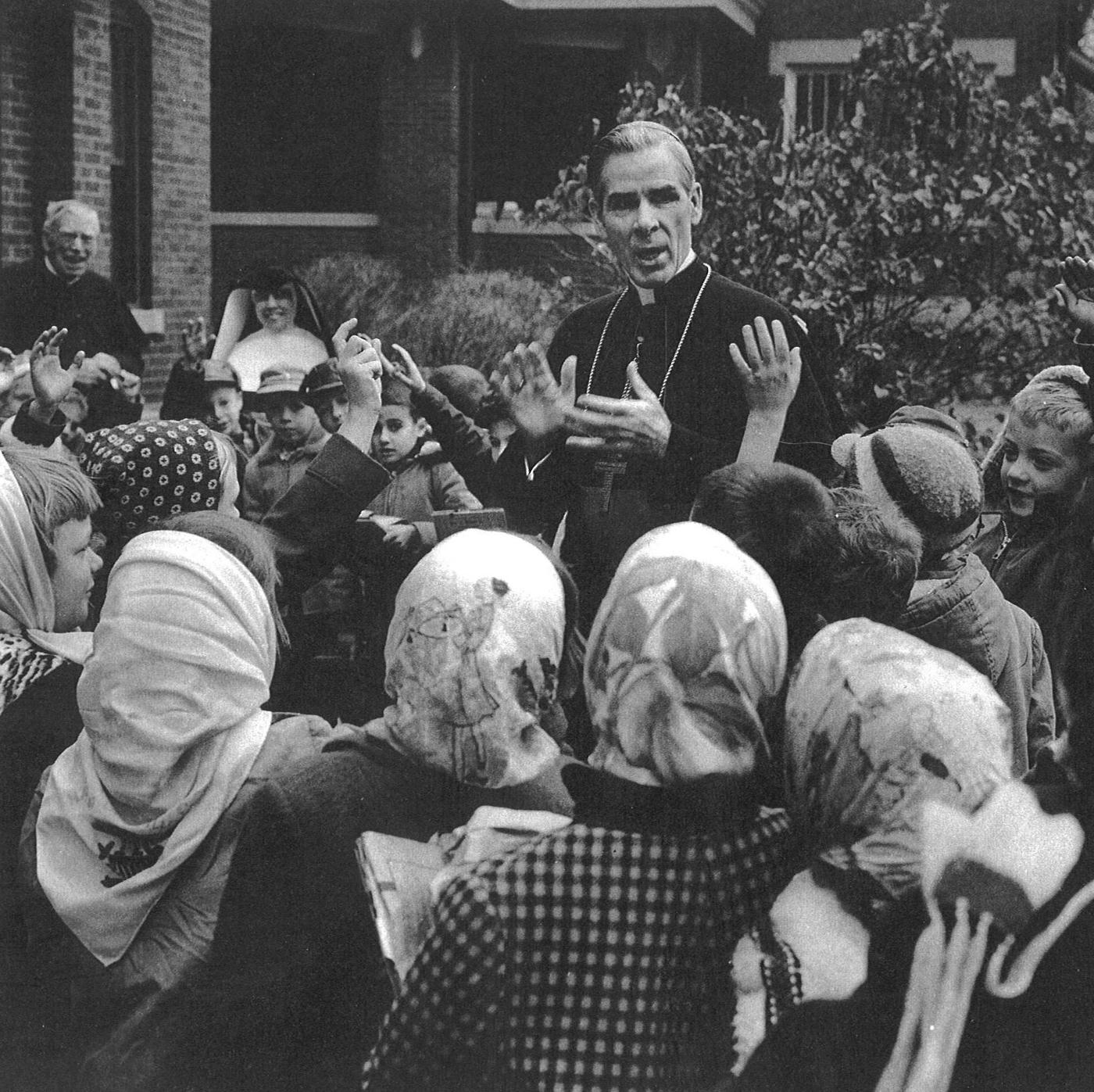
The saints are always greater, because the Gospel is always greater. Greater than our usual categories, our customary ways of thinking. Archbishop Fulton Sheen was just that, as his beatification in St. Louis on Thursday illustrated. The homily of papal legate Cardinal Luis Tagle emphasized Blessed Fulton as a man animated by a special love for the poor, and with a passion for alleviating poverty.
Fulton Sheen was many things, so many things could be said about him – and many, many things were said in recent days. He was the imaginative evangelist, the mesmerizing preacher, the television star, the brilliant teacher, the penetrating philosopher, the faithful Eucharistic disciple, the priest who intimately knew the sacrifice he offered. He was still more, as the Catholic faith is always more.
Consider just one example. In July 1967, from his cathedral pulpit in Rochester, Blessed Fulton was the first American bishop to call for a withdrawal of American forces from Vietnam. That America's most famous bishop was a staunch opponent of that calamitous war was the solvent to a potential stain on American Catholic history.
In October 1966, Sheen was appointed as bishop of Rochester, widely viewed as Cardinal Francis Spellman's way of banishing him from New York, the two famously having been at loggerheads.
In December 1966, Spellman told American troops in Vietnam – much to the dismay of the Vatican – that they "were holy crusaders. . .in Christ's war against the Vietcong and the people of North Vietnam."
It wasn't exactly akin to Patriarch Kirill's support today for Putin's war against Ukraine, but it was uncomfortably in that direction. Sheen, no longer serving under Spellman as an auxiliary bishop of New York, was a grand enough personage that he could rescue the Catholic Church from being understood as blessing the war. More than that, Sheen was a great enough character to know that one could be fervently anti-Communist and also condemn the lethal folly then unfolding.
Both conservative and progressive at the same time? Proudly orthodox in his teaching, Sheen himself said, upon his resignation as bishop of Rochester in 1969, "I move too fast, I'm a little too progressive." ("Progressive" then was not entirely the same as what that word implies today.)
Indeed, his rocky tenure in Rochester was marked by Sheen moving too fast on donating church land for low-cost housing and a tax he placed on new church construction to provide alms for the poor.
Cardinal Tagle, certainly aware that so much was known about Blessed Fulton – from the daily Holy Hour to the Marian devotion to celebrated preaching all over the world – chose to highlight Sheen's only speech at the Second Vatican Council, delivered on November 9,1964, quoting it at length. Sheen encouraged the Council fathers to manifest a preferential love for the poor.
"Put your finger on the 30th parallel, and run it around a globe," Tagle quoted Sheen's address. "What do you find? Practically all the prosperity is above the 30th parallel, and the greater part of the poverty is below. . . .As only a wounded Christ could convert a doubting Thomas, only a Church wounded by poverty can convert a doubting world."
The vast congregation in St. Louis applauded that line, and Tagle himself seemed a bit surprised that solidarity with the poor prompted that, adding "Wow!" The very Catholic assembly on hand also knew that the faith is always greater.
Blessed Fulton attracted so many to the Catholic faith because he was a model of so many different aspects that were attractive. What appeals? The aesthetics of sartorial splendour? The dimly lit confessional? Dramatic oratory? Silent prayer before the Blessed Sacrament? A passionate commitment to racial equality? Denunciation of Communism? The Holy Mass lavishly photographed by Yousuf Karsh? A soaring sermon at St. Patrick's? Preaching amidst the sunbaked savannah of the missions? A scholarly treatise? A simple reminde...
Английски
САЩ
В ТОЗИ ЕПИЗОД
ТРАНСКРИПЦИЯ 🔗
Are you the producer of this podcast?
Add a podcast transcript
Need Audio-to-Text?
Transcribe with Listen411 in Just 60 Seconds
ТЪРСЕНЕ на МИНАЛИ ЕПИЗОДИ
Търсене в минали епизоди на The Catholic Thing.
ДРУГИ ЕПИЗОДИ В ТОЗИ ПОДКАСТ

By Michael Pakaluk
I read Supreme Court Justice Samuel Alito's So Ordered: An Originalist's View of the Constitution, the Court, and Our Country backwards, chapter-wise, and I'd recommend you do the same. The end of the book tells us about Samuel Alito, the great-hearted man and patriot, while the …

By Robert Royal
Today is the Feast of the North American Martyrs, a group of French Jesuits and religious – Jean de Brébeuf, Isaac Jogues, Jean de Lalande, Antoine Daniel, Gabriel Lalemant, Charles Garnier, Noêl Chabanel, and Br. René Goupil. It's worth recalling each of them by name as a reminder …

By Francis X. Maier
Readers with a taste for history may remember the story of Millennium Challenge 2002 (MC02). For those who don't, it was a high-end military simulation from a couple of decades ago, run by the now defunct U.S. Joint Forces Command. Described as "the key to military transformatio…

By John M. Grondelski
This Sunday's Gospel showcases one of those teachings people can always quote and think they understand what Jesus meant – until you talk to them about it: "Render unto Caesar the things that are Caesar's, and unto God the things that are God's." (Matthew 22:21)
The context of…

By Steven Jonathan Rummelsburg
Few criticisms of modern education have aged as well as C.S. Lewis's 1943 The Abolition of Man. In "Men without Chests," Lewis explains, "we remove the organ and demand the function. We make men without chests and expect of them virtue and enterprise. . . .We castrate…
Опровержение: Подкастът и произведенията на изкуството, вградени на тази страница, са от The Catholic Thing, което е собственост на неговия собственик и не е свързано с или одобрено от Listen Notes, Inc.
РЕДАКТИРАНЕ
Благодарим Ви, че помогате да поддържаме базата данни за подкастове актуална.
