


ОТНОСТНО ТОЗИ ЕПИЗОД
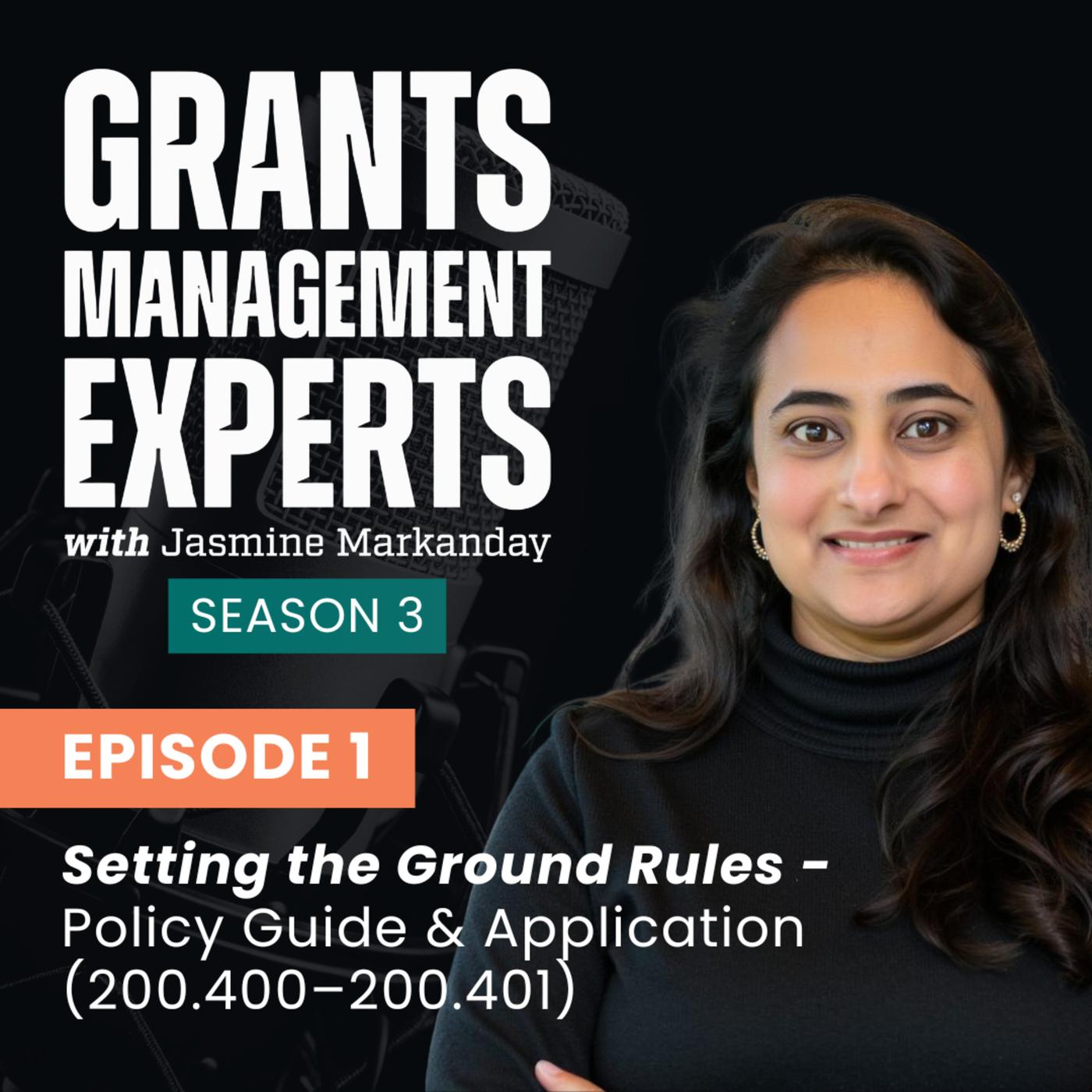
Welcome to Season 3 of Grants Management Experts!In this kickoff episode, I'm introducing the Uniform Guidance Subpart E, Cost Principles, starting with the foundational sections 200.400 (Policy Guide) and 200.401 (Application). These two sections are your compliance baseline, and they dictate exactly how you can and cannot spend your grant money.I'm breaking down who's actually responsible for grant administration, why consistency is the golden thread running through compliance, and why documentation can make or break whether a cost is deemed allowable.What You'll LearnWhy Sections 200.400 and 401 matter: I explain how these sections establish accountability and provide the framework for applying cost principles and how they apply to every organization receiving federal funds, not just grant managers.Who's really responsible: I make the case that managing a federal grant is not the responsibility of the federal agency or your auditor, it sits with your organization, and specifically with your organization's leadership, through a fiduciary duty that runs top to bottom.Sound management practices: I walk through why recipients and subrecipients must adhere to laws, regulations, and award terms, and must keep grant funds and organizational funds consistently and well documented.Students as trainees and employees: I cover how, for research awards, students supporting the work may be classified as trainees or employees depending on the role they perform and why that dual role must be recognized.No profit from federal grants: I explain that unless the award terms explicitly allow it, unspent funds on a fixed award (like $10,000 left over from a $50,000 award) must be returned to the federal agency, not kept as profit.Direct vs. indirect costs: I talk through why every organization is different, what's a direct cost for one organization may be indirect for another and how the Uniform Guidance gives me room for management judgment, as long as that judgment is reasonable, allowable, documented, and consistently applied.Application isn't one-size-fits-all: I break down how Section 200.401 acts as a gatekeeper, translating cost principles into practice based on your organization's nature, the specific grant's terms, and your own written policies and procedures.The golden rule of compliance: I share why consistency between your written policies, your actual practices, and your accounting records is what auditors look for and how it's often inconsistency, not just an unallowable cost, that leads to audit findings.Document, document, document: I remind you that "if it isn't documented, it didn't happen", and I take it one step further: if it's undocumented, it didn't happen, and the cost won't be believed as allowable.Key Quote"That responsibility of managing the grant does not sit with the federal agency... and it doesn't sit with your auditor. It sits with your organization and it really sits with your organization's leadership."Resources I Mentioned:2 CFR 200, Subpart E - Cost PrinciplesSection 200.400 (Policy Guide)Section 200.401 (Application) Connect with Jasmine & Markanday Consulting:Instagram: @markandayconsultingLinkedIn: @markandayconsultingWebsite: www.markanday.consultingIf you found this episode helpful, please subscribe, rate, and share it with your colleagues. Join me next time as I continue exploring important grants management topics. Until then, stay informed and stay compliant.Register for my Free Upcoming Live Training on August 19th | Time: 1:00 - 2:00 PM CST | Grant Management Essentials: Avoiding Costly Compliance Mistakes Before Your Next Audit here!
Английски
САЩ
ТРАНСКРИПЦИЯ 🔗
Are you the producer of this podcast?
Add a podcast transcript
Need Audio-to-Text?
Transcribe with Listen411 in Just 60 Seconds
ТЪРСЕНЕ на МИНАЛИ ЕПИЗОДИ
Търсене в минали епизоди на Grants Management Experts.
ДРУГИ ЕПИЗОДИ В ТОЗИ ПОДКАСТ
In this episode, Jasmine Markanday unpacks one of the most confusing compliance areas for grant recipients: how to correctly classify a partner as a subrecipient or a contractor under 2 CFR 200.331.
From avoiding costly audit findings to building monitoring plans, Jasmine walks through the rules, r…
In this episode, Jasmine Markanday breaks down a topic that often flies under the radar for grant recipients: intangible property under 2 CFR 200.315.From ownership rules to copyright rights, research data transparency, and public access obligations this episode is packed with need-to-know insights…
Are you navigating the world of grants or looking to step into a grant management role with clarity and confidence? Season 2 of Grants Management Experts is here to guide you through the ins and outs of grant compliance, policies, and procedures—without the overwhelm.
Hosted by Jasmine Markandey, a…
In this episode, Jasmine Markanday dives into one of the most fundamental yet confusing areas of federal grant compliance: understanding what costs are allowable under 2 CFR 200.403.
From budgeting to closeout, Jasmine breaks down the criteria that determine whether an expense can be charged to you…
In this episode, Jasmine dives into a detail that often gets overlooked at the end of a federal grant: what to do with leftover supplies. If your organization has a closet full of unused materials at closeout, this one’s for you. Learn what counts as a “supply” under 2 CFR, how new federal threshol…
Опровержение: Подкастът и произведенията на изкуството, вградени на тази страница, са от Jasmine Markanday, което е собственост на неговия собственик и не е свързано с или одобрено от Listen Notes, Inc.
РЕДАКТИРАНЕ
Благодарим Ви, че помогате да поддържаме базата данни за подкастове актуална.
