
Tara King Clark: Thank you to our alumni community for your continued engagement. You are what keep this community strong and thriving, especially our members. Membership and your alumni association matters. It empowers connections between our alumni and the academy to develop thriving and enduring relationships. It supports state-of-the-art and margin-of-excellence enhancements for the Corps of Cadets. And membership also comes with some pretty cool benefits. That was our conversation for today. Thank you for joining us here in Studio 1887. Please stick around for a few more minutes as I spotlight what your impact looks like in action here at the U.S. Coast Guard Academy. In a short closing segment, we're calling the Alumni Impact Interlude. Financial support from the Alumni Association is a game changer for the overall cadet experience. Learn more from the following cadet who is directly benefiting from your support. like access to professional development and certifications, unique connection opportunities to grow your network, discounts and savings when welcoming back the whole family for homecoming, and so much more. Your membership even supports projects like this podcast. So stay connected, stay up to date, and ensure that your ties to the Long Blue Line remain strong. Become a member today at cgaalumni.org slash 1887. If this conversation resonated with you, please subscribe, rate, and share with your network so these stories can continue to reach and connect our community. Until next time.
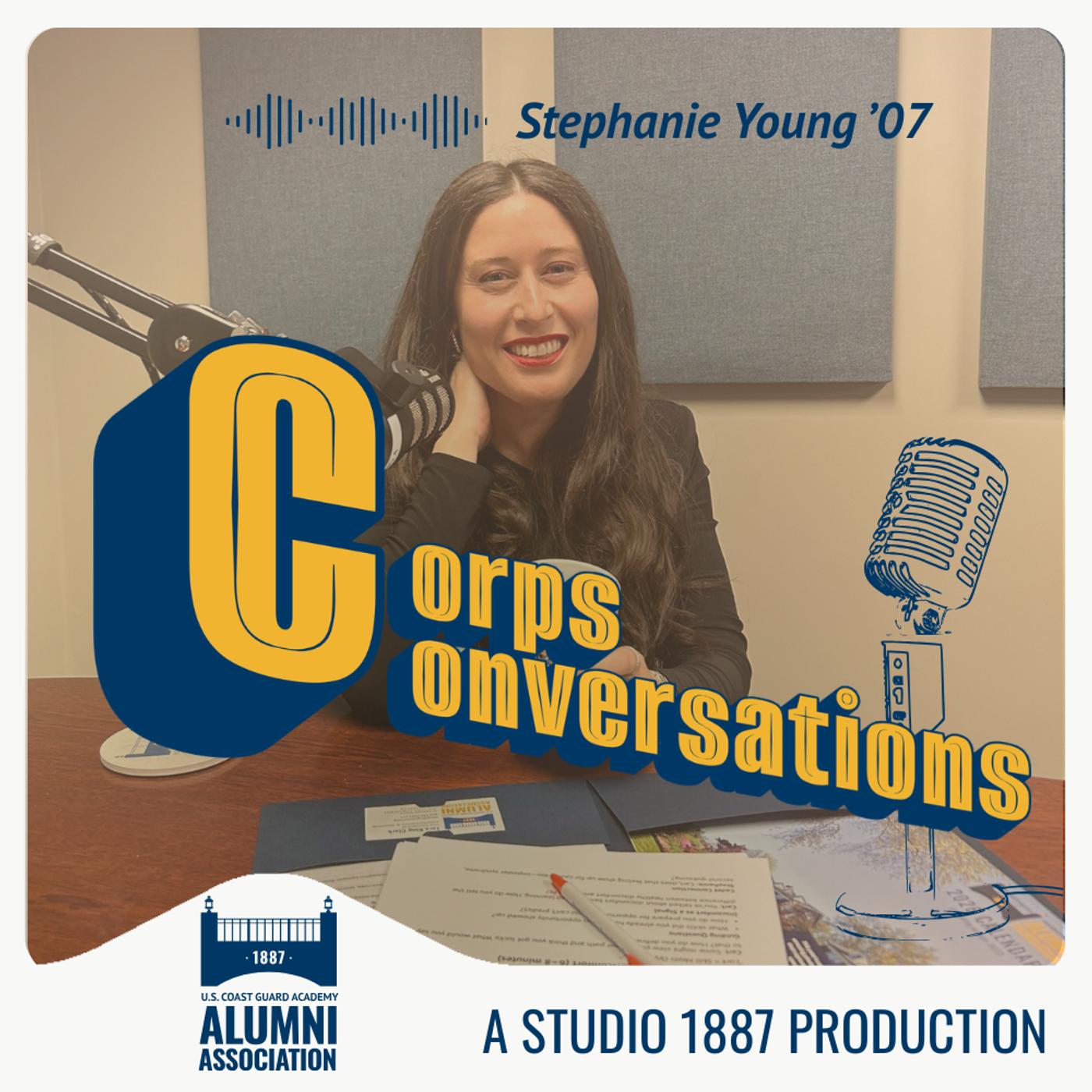
Sony Cam Link - Host View: Hello and welcome to Core Conversations, a podcast from the U.S. Coast Guard Academy Alumni Association. I'm first class Carl DiGiorgio here in studio 1887 at the Alumni Center. And I'm Tara King Clark, Vice President of Communications and Marketing for the Alumni Association. And I'm first class Aislinn Murray, glad to be here. Before we jump into today's episode, I want to take a couple of minutes and set the stage. So today we're joined by Stephanie Young from the class of 2007. whose career has been defined by stepping into roles that did not yet exist and building them from the ground up. And this episode really captures what core conversations is all about. Unscripted dialogue that goes beyond the resume. It's about how careers unfold, especially when the path isn't clearly defined. And from a cadet perspective, that's what makes this conversation so relevant. It's not just what she's done. It's how she's navigated uncertainty, figured things out in real time and kept moving forward. One theme you'll hear throughout, is the idea of being the first, whether that's in a role, an organization, or a moment of change, and what it takes to lead in that kind of environment.
In-person participant 1: this first class DiGiorgio you're listening the Core Conversations podcast, a podcast of the U.S. Coast Guard Academy Alumni Association. ⁓ I'm here in the Alumni Center's Studio 1887 with my co-host Tara King Clark, Vice President of Communications and Marketing. We're excited to welcome this episode's alumni guest, Stephanie Young from The great class of 2007.
Sony Cam Link - Host View: It's time for the Alumni Impact Interlude and today's topic is the Cadet, Pipe and Drum Corps. Last year, the Alumni Association received a planned gift from the estate of Commander Don Chapman. So before we get into the full conversation, we wanted to take a quick minute to pause and reflect. And I wanted to ask the two of you as the cadets, and Carl, you were in the room with Steph So what is one insight that stood out to you from this episode? And how do you feel like it connects to experience as a cadet or potentially what you're going to be facing when you enter the fleet in just a few short weeks? I think one of the things that class of 1948 that was used to fund the purchase of new drums for both the Cadet Regimental Band and the Academy's newest ensemble, the remarkable Cadet-led initiative, the Pipe and Drum Band, that has quickly become one of the most visible musical groups on campus. So today I'm joined by second class Eben Castleman, who's the drum major of this group. Eben, thanks for being here. ⁓ thanks for having me.
In-person participant 1: We're happy to have and ⁓ get to tell your story little bit. Yeah, it's really great to be here. It's a perfect Coast Guard day. It's ⁓ bitter cold and foggy. can't past the bridge. ⁓ It's perfect. ⁓ Perfect to back.
Sony Cam Link - Host View: stood out for me, what Stephanie said, was talking about chasing a role that makes you a little bit uncomfortable and pushes you a little bit. think a lot of times in the Coast Guard, especially, you don't necessarily know what you're getting into with a job. You have a job description, but it's like a one-sentence blurb about what your highest title is. And you don't really necessarily know what you're exactly gonna be doing until you're actually in the role and at the unit Yeah. So can you share with our listeners the origin of the pipe and drum corps here at CGA? Absolutely. So a few years ago, there was ⁓ a firsty who he played bagpipes. He's actually about to graduate, but well, he's a firsty now. He wasn't a firsty a few years ago. But he played bagpipes ⁓ he just kind of started playing with the regimental band and it slowly picked up from there. So my fourth class year, they actually kind of formed their own group separate from regimental band. started marching with the Corps for Reg reviews ⁓ my third class year started picking up, got uniforms, things like that and it's just slowly grown since then till now we're playing, ⁓ we went this year to like local Highland games performing with either like police pipe bands or things like that, other law enforcement and just community bands which has been really, really, really great to perform at more military events like the West Point Military Tattoo as well. ⁓ cool. ⁓ So now how pipes do you guys have? Yeah, Steph had a lot of really, I think, great points on that front. I'm excited for us to dive into it. Aislinn what about you? I agree with Carl, but another theme that I noticed was her experience with developing confidence over the course of her career so far. And she spoke a lot about different themes where she led with confidence through experience instead of going in thinking she knew everything. in the band? We have currently two folks who are like performance ready on pipes. But Dan Whalen, he's a second class as well, our pipe major. He's I think he has three or four people he's teaching to play right now because otherwise when he graduates, we'll lose a lot of ⁓ expertise. So we're trying to trying to keep the band going once we're gone. similar to what Carl just said. And I think that's super important. I feel like coming out of the Academy, we feel like we have to know all of the answers and we have to ⁓ know what it's like to be an ensign. They say the word, the phrase, fleet ready ensign all the time here. But the confidence really comes from when we step foot at our first unit and those first few weeks where we're learning about ourselves, learning about the unit, and understanding that confidence comes from those experiences. We don't have to show up and just know everything. So what has been some, as the drum major, what have been some of the most meaningful experiences that you've had We were, this past semester in the fall, we were asked to lead the march on of the Corps of Cadets at Secretaries' Cup, ⁓ which was a massive privilege. And we didn't realize at the time, but we were looking at ⁓ photos afterwards and there was this massive American flag behind us. And so there's this... thanks to the both of you for sharing your insights, ⁓ you know, I would say for me I think our alums are really gonna resonate with the ⁓ the journey that she was on and the transition part because I that was obviously something we wanted this podcast to bring to our alums was that transition from you know when you leave the Coast Guard and what does that look like so she has a lot of really ⁓ great points that she makes about that transition so super excited to dive into the episode but ⁓ Thank you both for sharing awesome beautiful photo of the whole band and all our kilts and all that looking looking real sharp and then behind us just the biggest American flag I've ever seen and it's it's a it's quite a picture so that was really cool getting to see afterwards because we didn't know we didn't know that was behind us yeah ⁓ that's so cool now did you pipe before you started or drum are you pipes or drums I'm so I'm the drum major so I I I joined the band playing bass drum because I was in regimental band I'm a trumpet player by trade but I And with that, let's get into today's conversation with Stephanie Young from the class of 2007. wanted a little change of pace from that because I play a lot of trumpet as it is. So I joined playing bass drum and then our drum major was graduating. So I took over for him. Started ⁓ last year. ⁓ And so use it's called a Mace. It's about a five-ish foot staff. ⁓ And it's used to kind of signal commands to the band where we're going to be marching, show cutoffs and things like that, what we're going to do with music.
In-person participant 1: We have a little thing we do here. It's called our one minute career recap. One minute, okay. So we're going to put you on the clock and in one minute we're going to have you walk us through your career. Okay. Coast Guard, into where you are now. Okay. Are you ready? Okay. My timer out. Okay. Well, from comms background, you should be accurate, clear, and consistent. I think I could do this. I probably would just say it was an amazing adventure, which gets me to about 10 seconds, but have to fill rest of the time. should probably say that my first job was at Sector Los Angeles Long Beach. I then went on to be the Coast Guard Social Media Officer at Headquarters. I then went on to serve as an analyst and social media officer in the Commandant's Advisory Group. While I was in DC, I was a White House military social aide. I then left the Coast Guard for Facebook, now Meta, where I worked on
Sony Cam Link - Host View: But then also typically Scottish style drum majors will flourish so they'll do tosses and spins and clips and things with the mace. So I've slowly been picking up some some pretty cool tricks and That's awesome. ⁓ and I think you know for most folks You know if they've been to a regimental review to hear the pipes with the review must really add something special ⁓
In-person participant 1: executive comms and I'm a business lead and CEO and CTO. How did I do? Nice, 20 seconds left. That's great. I should do good. New record. And we'll start off going into your career a little bit. Talk about your first role and your first billet. Okay. Going into sector LALB. Yep.
Sony Cam Link - Host View: What does it mean ⁓ to have this new equipment that's been supported by One of our cherished alums, It's been really, really great. When the band started, we were using some of Reg Band's old drums, and the drums Reg Band were using were already old, so these were pretty ⁓ rough. So with that money, we two new snare drums,
In-person participant 1: Yeah, I was part of one of the first groups to actually go out into, straight to a sector. What was interesting too was not only that we were the first class to come in and be sworn in as swabs, of Department of Homeland Security, and then graduate Department Homeland Security. So we were the first class to be fully through as Department of Homeland Security. Oh, wow, I didn't know that. Yeah, 2007. so that was, it was not only that interesting component.
Sony Cam Link - Host View: So we have two out of our three drummers on brand new, very nice ⁓ Scottish style pipe snares, And we were able to upgrade two of our tenor drums as well, ⁓ which have been really, really nice ⁓ for our players. we played Highland games ⁓ near near here about 40 minutes away in Milford ⁓ and ⁓ Just getting to to all these people from real like big pipe bands because we were very small in terms of pipe bands We're 15 20 pipers like very large groups.
In-person participant 1: it was that at that time we were undergoing sectorization and there was changes there. sectorization took a period of time to transition through the Coast Guard ⁓ and when we graduated I went straight to, they just slowly started letting people go to flight school direct. You know, I was talking to some of the faculty and there's so many choices available to cadets today that you can go straight to cyber programs and finance programs which I'm highly supportive of. But I went straight to a sector and it's really interesting because
Sony Cam Link - Host View: and just getting to see their excitement at seeing young people and then people in the Coast Guard involved in their hobby where most of these folks are a lot older was really, really, really cool getting to see that have some nicer equipment for performances like that where they're playing with really, really nice things. ⁓
In-person participant 1: There is something unique about an organization that has the history and the... ⁓ just kind of heritage that we have. But at the same time, there's this element of there's new things happening. And that's like kind of the Coast Guard that I jumped into, which is, you know, there's this new concept called the sector. And what does it mean to take pieces and components and bring it together? What does it mean for almost a new agency and a new department for the government itself, for military service? And how do all those components fit in? So I think
Sony Cam Link - Host View: Well, we hope to see you out in the community local sometime soon. But otherwise, if folks want to catch you, they can come to a ⁓ review. Absolutely. Awesome.
In-person participant 1: Part of that was like very early on, just understanding how to operate in autonomous environments and just work autonomously and ambiguity as well. I'm guessing like going into a new role like that, had to steam a little bit of your own path, right? Like make a lot of that role and define it a little bit. Yeah, and I think too that the Coast Guard was doing this alongside you, right? So was like other sectors were doing it, other people were doing it. You weren't in it alone per se.
Sony Cam Link - Host View: Thanks so much Eben, really appreciate you taking some time to share your experience in the pipe and drum and keep it up. Thank you, yeah, it was my pleasure.
In-person participant 1: I it's really cool, too, it's like there's like the relationship building pieces where you're like learning and establishing those relationships. We were in Los Angeles, Long Beach, which is, they like to say, the largest, most economically viable port complex. It's something you would memorize when you work with your stakeholders. Big interagency, huge interagency components. So there's like these things that are intangible that you're building, like relationships. There's things that are more specific, like doctrine and SOPs, where you take in prior search and rescue policies. or prior rate safety policies and kind of bridging them together in this kind of sector model. But then there's also these kinds of like really cool physicality of things, which is like building it. Like what did it mean to like stand up a command center and build a command center and be part of the first watch team group in that new space, like physical space. So I it was really cool because you could see the full spectrum of like the intangible to the actual physicality of it. And that was pretty unique. Do you feel like you have an advantage as an ensign? fresh out of college, not having sort of known what was before, do you think that provided some sort of an advantage to you? Or were you able to bring yourself to the role and offer new ideas, or were you just sort of viewing it all and coming together? Oh gosh, you know, I do think that's like the natural tension of like any, I think it's any ensign that goes out into the fleet no matter what unit they go to, right? Where it's like, you are fresh and you are energized and you are kind of ready to go and have your impact in the world and then there's this sentiment of like that's not how things are done here. So it could be a new place or it could be an existing place. could be the oldest cutter in the fleet or a new billet entirely. I think you're still gonna find resistance just because the palpable energy that you have coming out of this institution is just huge. It's hard to have that when you're like in the daily grind in the fleet. And it's the contrast. And it's a healthy contrast. It exists for a reason. I have a little bit of personal question. So I'm looking at doing sectors as well. I know a lot of people, float officers especially, would tell you that as an ensign you're supposed to go to a boat first. Like you need to get that foundational experience. Maybe what was going to have to of you going to a CDO job and going to a sector and do you think that you got the full experience as an ensign or do you think that maybe you would have liked to go to a boat and see what that life was like? Yeah, I do think you have experience on your way throughout your time as a cadet and I do think it's hard to take in all these inputs. Every alum, every member of the faculty, every cadet themselves, it's going to give you a different piece of advice. You have to do what's best for you. And you have to really lock in on what it is that you want to do, not what other people have done. I think you take those inputs and you figure out why intrinsically and internally for you, you want to make that choice. For me, it was a matter of wanting to do something that was different, wanting to do something that felt more challenging at the time. And I really was energized. I'm excited by this concept and this idea. I think it's hard. You're going to get lots of advice. I think it's good that you're getting personal advice on this podcast. I think that's great. My advice to you would be like, you've got to really look internally and inside for the reasons that you want to do it, not why other people did it. ⁓ you you talked a bit about ⁓ sectors renew and you were sort of the first ensign to go out there and ⁓ stand up the sector. ⁓ But next role was also sort of first. So tell us how you got from the sector to the next first. ⁓ So was actually the ⁓ Guard's social media officer, which was ⁓ Didn't exist before. But I had applied at the time for kind of a special assignment billet and none of them worked out. And there was this one that was a special assignment but it was in that slot of them but it wasn't a special assignment per se. It was just kind of this like stray headquarters billet that they didn't know really how to advertise or what to do with it. I had no communication background. I had no social media background. They're like, do you want this job? And I said, yeah. And so I took it. But it was at the time we were really just forming and storming and norming in the government space for using new mediums to communicate to the American public and the American taxpayer. And so it wasn't just the Coast Guard. It was everyone. was from the executive branch to on down. All government agencies were learning how to use these tools. At the time, was a very old school classic blog and there was a team of I think three or four of us and it was really interesting too because I worked with a civilian who had this kind of experience and background and that was something unique because in the Coast Guard you ⁓ early on in your career you're working out in the fleet with more active duty or reserve components and getting to learn from civilian experts so quickly was quite interesting but yeah it was was a lot of fun and we got to build out all of the suite of tools that I guess are still used today. So that's really interesting. So you created like the Coast Guard's first Facebook page and... We did. We had to create and launch Instagram. That was fun. We did YouTube and Twitter. Twitter was a lot of fun. We did even some of the very classic old school social flicker to hold all of our photos. Yeah, so it was a lot of fun. Yeah, that's so cool. So the creation of that role, you you kind of made it your own. mean, how did you, were you working, the fact that all of the other government agencies were trying to figure this out, like did you guys all have a little group that got together? yeah, we did. I think it's, we did what anyone in government does or anyone in the Coast Guard does when something new comes along and you need support and approvals. create an SOP, right? It's like very basic. We didn't reinvent anything new here. was like, how do you do, how do you build a blog post, know, build an SOP for it? How do you do a tweet? Build an SOP for it. know, nowadays it seems, it's just so integrated into the fabric of daily communications for agencies and for people themselves. But back then it was like, what does it take to upload a YouTube video? You know, you had to create an SOP for that. I have a lot of questions. Sorry, I'm like, you face resistance in this? Or was there a full sense from the top, like we have to embrace these technologies? Or were there elements that you were having to convince of like, no, we really do need to be in this space? was a mix of both. was definitely a mix of both. There was opportunities that came to us that were really ⁓ the perfect timing and ⁓ storm of events. ⁓ ⁓ I think actually Storm is like a perfect example to use here. It was like an unintentional pun because like for example like the Weather Channel had just launched like Coast Guard Alaska and it was TV show. It like how do we get the news out about the show and it was like we have social media tools like we could use and then you could use ours and so you're like kind of learning alongside professionals that did this for like marketing teams that did this you know so we were doing like live tweeting of the show or there was all these like incredible Coast Guard rescues and we were able to like feature them. on our social media that got major press coverage and major news coverage that wouldn't have before. We were sending out messaging that was quoted verbatim almost by the media. so the return on investment, ROI was pretty quick and pretty immediate. It was very visible ROI. So I think that these early quick wins got us the ability to keep building on the momentum. That's awesome. I'll move into the next question because the other important first for you was this the Commandants Advisory Group. So can you talk about ⁓ formation of that group? Because I think now it's just kind of a given. People just take it for granted like, it was always there, but it wasn't. Can you talk us through that? Yeah, in the military advisory groups have been there for some time. They've been known by many different names depending on what branch it was. There's ⁓ Chairman's Action Group. ⁓ do the commanders and mission group they call it the SIG, the strategic action group, there's like special study groups, all these things that came and they kind of populated out in the 90s. ⁓ It had been percolating through headquarters the idea for one around 2009 actually. They were proposing cuts and kind of like rank-blind, like think tanky, strategic counsel, like all these memos. If you're ever at headquarters there's lots of memos, lots of papers, lots of memos. ⁓ So this idea kind of was spinning around and then around the transition between 2010 and 2014 is when they had this transition team that a memo was pulled into that transition and I think it was like June of 2014 that they would hold a temporary CAD to like help launch the transition and then it become a permanent thing after that. And I at the time had done all of the Service's media and I was like, you know what is needed is the service chief's voice here. So we basically took like the same idea of hearing from a federal agency, a military service, and the people in our missions. It's like who better to tell that story than the person leading that and them having a voice. So we then had to, I came up with, you know, proposal for, we used at the time the framing of the right tool, the right level, the right audience and we just kind of flipped that from Coast Guard to the American public to like the service chief to the right to the right level audience. wrote a memo, ⁓ pulled into the memos of the CAG and pulled into memos of transition and from there they ⁓ of kicked off the Commandant's Advisory Group. It was very cool experience ⁓ from some of like ⁓ I think are the best minds in the Coast Guard and was awesome to be part of that. ⁓ So did you create the Commandant's Twitter feed? Yes, we had to do all the Facebook page, the Twitter, Instagram. You know it was really fun, had to create similar to the SOP, but this time it's like a little bit more personal, right? Because it's like a personal representation of them. And who was the Commandant at the time? The Commandant at time was Admiral Zukunft. Okay. And vice was Admiral Neffinger. So Admiral Zukunft was so willing to just learn and build a alongside us, which was so exciting. ⁓ And he really kind of gave us the full runway to just build out his voice and persona and leadership, personality and style came through. It was really cool. But yeah, we had to be like, if you said it in a speech, can we use that in a tweet? Or if you have an idea, can you write it down and post it? There was like, if you say it, if you write it, there was kind of an SOP around that. And there was approvals for photos and approvals for videos. And we got to some really progressive things with like, State of the Coast Guard address and live tweeting that. So it was a really exciting time. That's so great. It must be nice to have someone at the top just fully embrace it and you know provide you the guidance needed to do it the right way. it was so fun because he really really leaned into it and he really understood the impact that the tools would have and it was really it was really interesting to navigate because in between him and you there's like five people still and you just like have to convince the five people in the middle bit. Yes and how did you feel about doing that Yeah I think that Like I said, you create an SOP. give the framework, you give the guidance, same as any other thing. ⁓ You know, ⁓ the Commandant has a nightly binder and you can get quick steers and quick signals from them that way. And you have this kind of dialogue and kind of conversation. ⁓ So, you know, it starts off as boring SOP, as simple as that, black and white. ⁓ then it kind of comes in more into dialogue and conversation. ⁓ Can you talk a little bit about sitting in on some of those meetings with the Commandant's Advisory Group and maybe what that environment was like and the role you played in that? Yeah, struck by this because I just read something from ⁓ A former colleague of mine, she worked at Facebook at the time with me. She went on to be chief of staff. at Instacart, she wrote this essay and it was like, focus less on your role in the room and more about the room you're in. And that was like, yeah, I really found that really so simple but powerful as a reflection of my career. Because I think I wasn't the most senior. have the ⁓ highest title or command or authority. I never was in charge of anything really. But you got to be. in that space where you learned from people who had those titles and had that role and had that position and had that authority. And I think you learn how you want to do that when you get in that position. You learn how to develop those SOPs in a way that people would say yes, because you knew how they made decisions. You knew their mental model for thinking through problems and thinking through solutions. I think I love that idea of like focus. less about your highest title and more about the room that you're And I think that that hits at the heart of your question, just like what did it feel like? It's like you are constantly learning in all the best ways ⁓ at the highest levels of leadership. And I think that that was probably the biggest takeaway for me from that experience. ⁓ when you look back at these ⁓ experiences being in the room, ⁓ do feel like it was rehearsal for you ended up next? ⁓ ⁓ Yeah, ⁓ I think it was, ⁓ I do it was ⁓ part of, I like rehearsal because it was like and like no, was all real and very big and and ⁓ a huge part of my journey. Like absolutely, undoubtedly a huge part of my journey. So I would push back a little bit rehearsal, saying like it's not the private Like that was a prime time, that was the big time. But I did take away things from the fleet and from learning, that I learned in the Coast Guard, to like the private sector for sure. I think one of the things that stood out to me is navigating uncharted territory, right? Like what does it mean to create new offices and new spaces and new things? And that's a great thing to take into technological space, which is quite literally building the future every day. So I think navigating uncharted territory, which is a little fun little pun. ⁓ I think ⁓ I also like the idea of building for others, which is to say all of these things, you we talked about being in the command centers and building that and building social media and launching those and working through the commerce advisory group as a plank owner. It's not just enough that you built it. You also have to think what does it mean for the people that are going to come after you. And so building for others. you know, this idea of like, you're the first one in this role. It's like, well, you're the first one in this role, are you the last one in this role? And maybe that's okay, and maybe it continues, you don't know. So I think there's this idea of like, making things durable beyond you, and making it live on past you. ⁓ So that's something that I probably bring to mind. And then just embracing ambiguity, I think so often, ⁓ right, like, in the is you have such specific frameworks and guidance and rules and the SOPs that get things done. But I also think that even with all of that, there's still ambiguity. sometimes it's just a search rescue mission that you have to go out and execute. Sometimes it's an operation that you're working on with partners. those themselves are ambiguous. And even with all the structure and all the frameworks and some Sometimes the bureaucracy and the badness that comes with that, there's still ambiguity that you have to navigate. Now coming into these roles, you're the first person ⁓ to do a lot of these jobs, Yeah. So with that, there might be a little of ⁓ discomfort or growth. ⁓ Is that something that you're seeking in your career? Are you looking at jobs and going, ⁓ you know, I want to push myself. I want to go try something new. Or is that that just happens naturally? ⁓ I think for me, ⁓ And ⁓ The discomfort thing comes back to what's one of my favorite prompts. It's like, what's your ideal day? I ⁓ just want to wake up and I want to be given an impossible task. And I want to know that it's literally not humanly possible to achieve. And I just want to keep going all day working with amazing people who also have that same impossible task. ⁓ And we get to the end of the day and we haven't completed it, but we tried. And I think that that's kind of this idea of the discomfort that you want to live in. right where it's like the awesomeness and the awe that comes with like working alongside people that excite you on problems that excite you is probably like that sweet spot of discomfort that I think is like where I like to inhabit and where I like to be. I think you know there's bad kinds of discomfort right where it's like it feels draining and you're just stuck or the work isn't aligning with your values or your strengths. I think that that's the kind of discomfort that's unhealthy that you should avoid and if you start feeling that day to day, fine, week to week, fine. If it starts to become a pattern, you need to start considering a change, But kind of discomfort that's really healthy, ⁓ gives you a sense of purpose, sense of excitement, even though it's super hard super challenging, ⁓ I think that that's probably the spaces that ⁓ I like to inhabit but also I encourage other people to inhabit in their careers as well. Now when you go into a job like that, Are you the type of person that is like, I'm in this room, I'm going to take over. Or are you like, uh, I don't know. Am I supposed to be here? I think that's a plant. Because a lot of my prior bosses would probably say that I definitely thought I belonged in that room. I hope they're listening and I hope they think that that's the first one. You know, I think it's both. I think it's unfair to say, Carl, I'm super curious in your space and where you're at at the Academy, if people do you feel that they have imposter syndrome or is this kind of like gone out of fashion to talk about? What do you think? I definitely think it's still a thing here especially. Especially like a service academy in this environment. I think that you come to this place to be challenged and you surround yourself with so many awesome people that have done so many incredible things. You look at it and you go... I don't know, am I supposed to be here? Obviously the bottom line is yes, if somebody picked you to be here, you're supposed to be here. But I would definitely say it's a strong thing that's definitely still around. But I don't necessarily know that it shows up in the same way. I'd say especially now with my generation, it's a lot more, people are much more willing to step up if they see something. they're willing to say something versus I before I'd say people were a lot more defferent Yeah, I could see that. I think that's why I'm conflating it probably because I do see and I see in cadets even just walking into here, Carl, you were so comfortable and it's like if you put a bunch of podcast microphones in front of my face as a cadet with, you I would not be as confident and calm as you are right now. So don't think there's an imposter syndrome, but you're right. think you're right to say it's like kind of it shows up differently. probably in the next generation of cadets. ⁓ Yeah, think for me it's, I don't know, I think I I think if you go into it knowing like this is not ⁓ a ⁓ clear situation, like this is something that will change, I think will help you... ⁓ the ability to better navigate and feel like you belong there. Because it's like, guess what? No one knows what they're doing. ⁓ No one here is an expert in what's happening, right? In this moment in time, in this current space, ⁓ this is new for everyone. And so I think going in with that mentality kind of helps around that. Awesome. We talked a bit about, you know, someone might look at your career path and think, wow. lucky that you get have all these different and unique experiences that were sort of the first, but you know I think we talked a bit about luck isn't necessarily just being in the right place at the right time. How do you view that idea of luck and opportunity? Yeah I struggle with this a lot because I think luck is a very polarizing idea, right? Where it's like it's easy if you're successful to chop up everything you're doing to your yourself to your skills and what you've done. You devalue luck, right? And then conversely, it's like if you are not as successful as you'd like to be, you over-inflate luck and say that person is just lucky, right? I kind of tend to think it can be in between or not as polarizing. know, you were saying that luck is skill and opportunity. It's like often misattributed to like fake philosophers. don't know if someone in tier is listening to this, they'll look it up. It's like it's not actually ⁓ phrase that was actually attributed to anyone in particular, but I think it gets to the heart of like, you know, there are going to be circumstances and moments that meet you, right? And you need to meet that moment. And I think the way you meet that moment is like what are the skills that you bring, but the opportunity is the luck, right? Like in this moment in time, like the workforce will change with agentic workflows. And Carl gets to do that. Carl gets to navigate that future for the Coast Guard, for our country. And I think that, is he lucky? Sure, you know, right? Like it's that moment in time and it's up to him and his classmates and all the cadets here at the Academy to figure out what that means for the Coast Guard and for our country. Now, you have to have the skills to do that. You have to understand what that means for the mission and how we operate it and how we execute on those missions. I like to think of that way, right? I know that's why I'm saying luck is taboo, but it's like I was lucky to be at a time where the Coast Guard was just kind of proliferating social media. I was lucky to have a commandant who was open to those things. I was lucky to work at META at a time where we were transforming the way we did business as well. I'm lucky to be there now as we build the agentic workflows that... someday people will use. I was talking to my sister about this, like, it's so cheesy, it's lucky, ⁓ and I just couldn't get around it, ⁓ the skills to meet the opportunity, and ⁓ like, she's like, Stephanie, that like quite literally the point of the Coast Semper Paratus, always ready? And I was like, ⁓ you're right, like, ⁓ always ready, like you have to be ready to meet the opportunity and meet space and time. And so it was kind of funny, I was like trying to think of this like witty construct around it and she's like no you already have it it's just Semper Paratus I was like oh there you go that's it that's it so yeah it's just like you you're there these opportunities have been given to you are a matter of circumstance and a matter of happenstance and it's just up to you for what you bring to it to be ready for that opportunity. So that leads me into the next topic that we wanted to get to. you had mentioned an instance where someone kind of pulled you aside afterwards and they were like, oh, hey, you're a little bit of a bull in a china shop. And so I think that is such an interesting reference. talk us through that, because I think that gets to this heart of influence and selling an idea. And how do you do that in a way that gets people on board the idea rather than deterring them? Yeah, I'm not always great. at it which is why ⁓ the captain pulled me aside and said that. ⁓ So he was actually at the time ⁓ the head of the Commandant's Advisory Group and again we talked about the position that I was in is in rooms of very senior people. People who had three decades more experience than I did and sometimes the way you communicate isn't the right way it was just a pull aside to be like you need to understand how you're coming across. I was very mad and upset at the time when I heard that feedback. And I remember, it's great. It's like this huge beast, haphazardly knocking things over with no care, no regard for the environment around them. it's like no one wants to be called that. But I think I was so mad that I went and started Google searching the idiom. What does this even mean? And then I went on MythBusters and it was like, actually, you know that show MythBusters? like, actually, bulls don't hit anything in a china shop. They're delicate. They're very delicate and they actually knocked a few things over by very accidental, but it wasn't this intense beast charging through aisles of china knocking things over. ⁓ Yeah, so after I had a pity party for myself, Google searching, Mythbusters episodes. Yeah, I was trying to think more about this idea around it, which is like, at the time in the advisory group we were part of both trying to influence and change the Coast Guard to meet the moment that we were in. which means you have to break down policies and programs and processes that have existed for years. so, you know, this idea of like both saying challenging the status quo, challenging something that's more than two centuries old, but at the same time doing it in a way that brings people along with you and brings ⁓ their inputs, their concerns, their fears along with you is the important part. ⁓ And so I think at the time, you know, it's like the idea was like you're breaking trust, you're breaking people's relationships, right? The good things you want to break down are these like paradigms the paradigms of policies that don't make sense, And so it's more along the lines of finding a way to make the change but bringing people along. And again, I cannot say how exciting this moment is for the Cadets of the Academy because they're going to have to go out there and do that in full force right now with the way that ⁓ technological developments are changing once again, as always. But I think it's really exciting time to be in. I think it's funny too to tie that back to the Academy. I know that the way that people have been looking at things here, especially with incoming regimental staff and battalion staff for the summers, they're like reevaluating a lot of things. So last couple years, they've had this kind of tagline of just because we've done something in a certain way doesn't necessarily mean that it's the right way to do it or just because we've done something and it's the way it's been doesn't necessarily mean it's the best way to do something. So I know that interesting for a lot of our alumni listening, but some of the old traditions that have been in place for so long are being reevaluated. Why are we actually squaring meals as a fourth class? What are the pros and cons to that? Is it really benefiting a fourth class? Are they getting something tangible from it? Or maybe it's kind of just an old tradition that's been around for a while and maybe we've had it that way. for so long that. maybe we need to look at it again and reconsider things. Yeah. hope we get some heating in bounds on us. for more lists about that one. Discussion on that. discussion. No, I'm third generation service member. I love tradition. I love heritage. I could not be more excited about the anniversary of the US that's happening right now, 250 years, just all of the celebrations around that. like this is the best ever right so I love history and honoring that history from where we came from but I really do think that there is a time and place to challenge things and you're gonna see it you will see it the moment you step into the fleet you will see that there are things that need to be changed and you can be a bull in a china shop and go in and break things you can but you can do it in a way that brings people along with you and so I think Bring people along when you change a square meal policy. I love the way you reference that it's not, you know, when you're breaking it down, it's not the people you're breaking down. It's the policy and the procedure. I I that's such a real smart way to think about it. Cause yeah, that is, then you're not, it's not about the person. Yeah. Which is great. Awesome. So ⁓ you obviously in the Coast Guard. ⁓ do all that work and all that awesome stuff, developing social media, working for the Commandant. ⁓ then you look at your career and decide that, maybe want to go to the civilian world ⁓ and what's out there for me. Can you about that process and ⁓ your thinking that? ⁓ Yeah, I that people use the phrase transition and I think it's fine. It's like... ⁓ Anything outside the military is a transition for you. So it's like inherently any role you take on outside the Coast Guard will feel like a transition. ⁓ You could do nothing. You could do nothing after your time in service and it's a transition. So I like to think of it more as evolving your career, right? It's just saying what's next for me. ⁓ I think transition feels too much like a hard ⁓ context switch. or a hard shift. It's like you're not like running away and leaving all of that behind. You're taking that along with you. So evolving into the next part of your career. ⁓ You know, and I'm quite lucky. One of the things that sticks out to me is that the Chamber of Commerce does a lot of ⁓ data and reporting on veterans because they're mindful of helping support veterans and veterans hiring and veterans careers. And that they keep track of when someone transitions or evolves their career from the military into the private sector, 44 % of veterans change their job in the first 12 months for their first post-military role. So it's about half of people, for some reason or another, go to another thing after their first thing. I think it's attributed to a lot of things. One of the things that I think is like not finding the right fit for you. And it's just such a hard thing to navigate. So during my time of service, definitely learned that one of the single most important thing to me was the clarity and focus around a mission. And I mean that in a very serious sense of that I have to believe what I'm doing and I have to believe in the people that I'm working alongside. I do think when you have the opportunity to go into the private sector, there are going to be times where you can choose salary over the mission or you can choose the environment over the, like work remote, don't show up to the office, like be in pajamas all day, or you can choose the physicality. You go work the national parks and you hike all day, right? There's like so many different things that you could pick as the thing that will be your driving factor. And I think figuring out your driving factor will be ⁓ like ⁓ like thing for you to look into. And for me, again, that was the mission. And just understanding ⁓ whatever wanted to next it had to be big and it had to have impact like far beyond me. took advantage though of program that helps you do that. Yes, I attribute the success in dialing that in. You can do so many things. You can work with career coaches and there are some amazing alumni who are career coaches. You can work with job search, head hunters. So for me, I actually went to, in addition to TAPS, which everyone goes to when they are departing the service, went to this program put on by Deloitte, which is called CORE. It's actually run by a Coast Guard alum right now. I happened to stumble into it from networking and I was just trying to figure out what I wanted to do and I was having as many conversations as I could and they mentioned this program to me, someone in my network, and I applied for it. But it's just this really intensive three-day where you do real interviews back to back to back and then they your interview right there on the spot and they say here's what you did wrong here's what you did right. You interview and not just with coaches or mentors you're interviewing people in the industry in oil and gas in finance and business and private sector and consulting. So you're interviewing people who actually do interviews. So it was the back-to-back to back-to-back interviews and then the immediate debriefs that really helped to change your behaviors. ⁓ They do a bunch of exercises about finding your role, finding your fit, understanding industries that are out there. think too often the conversation of the post-military space is specific to military adjacent roles in contracting and consulting, and those could be a great fit for you, absolutely. ⁓ being in the CORE program really opens up your eyes to, there's ⁓ much, too much available actually. ⁓ And they have great programming. They bring in a Paralympic athlete, Navy Academy alum, Brad Snyder. comes in and he talks about his journey and it's really incredible. And so it's like both practical where they just run you through interviews and inspiring when they bring in people who have made ⁓ the change in their careers as well. I'll just put in a plug that Casey Gillkin '08 just wrote an article about this program in the December 25, January 26 Bulletin So if anyone's listening and they want to learn more about it, Casey just talked a lot about it because I think he's also an alum of that program and I think recently went back and was a guest Very cool. did see that. I did see that in the Bulletin. Yeah. I'm excited. So you do that CORE program, Yeah. And you move into Facebook, now Meta. Yeah. Can you talk about what your entry level role is there Yeah. So this is just classic, you know, you think you're leaving the ambiguity and the chaos and you're entering into a whole other space and it's exactly the same. Because I signed, I had done interviews and signed on in August and I was told them, you know, I had a commission. couldn't get rid of the commission until December. So I signed, I was coming to the company in August and then... ⁓ They gave me a call like in the fall. I'm like, uh, guess what? Your role doesn't exist anymore. The person that you're working for doesn't exist, is not here anymore. And we don't know what we're going to do with you, but we still want you. So I showed up. I had no role. I had no, no highest title, no place, no space. So again, I was like, here we go. Recreating, um, SOPs all over again, but we don't call them that there. What do they call them? Just doing the work. Okay. You have to create your scope, have to create your role, have to create role clarity, role scope. just building that out and I worked in executive communication and it was an easy map for people to do when you're leaving the military. They see a helicopter pilot, think you can only be a helicopter pilot. see you did finance, they only do finance. So it's an easy one for one fit. The corporate world has to get a lot better about translating I mean skills and for me I was lucky because it was comms at the time I since I was doing social media and done work in that space I was able to say I can write for people ⁓ so I had gotten in ⁓ a role in the executive communication ⁓ I met ⁓ our CTO at the time working for him and writing for him and then this opportunity came up to be a business need in the office of the CEO ⁓ it was the first time again so more ambiguity more ⁓ role, lack of role clarity, ⁓ but I had known that I wanted to do more than just comms. Like, I had come in knowing that I wanted kind of this breadth of, like, I really felt like I had so much more to give and so much more to offer than ⁓ communications, and so I took it on the, applied for the job, got the job, and then boy did I get breadth. Yeah, it's like, very different than, you know, the depth of comms expertise that you can get in just comms, so. Yeah, that took me on to the job as being a business lead. Can you break down what that business lead role is now? It's very similar to kind of like, it's hard, different companies call it different names, and you know, they even have them here in the military, right? So it's a blend of a chief of staff, aide de camp, you know, the executive assistant for the commandant, you know, it's a very senior role, whereas an executive assistant in private sector is more of an admin role. But it's this blend of chief of staff, of role, where you're basically looking across a leader's day. So it's based on the leader and their day. It's pretty, it's really dynamic. It could be like launching a big product or a big announcement. could be doing podcast interviews, supporting those for the Super Bowl, we did those last week. Or it could be, ⁓ you know, management meetings, product reviews, demos, board meetings. ⁓ So really each day, really each hour is quite different. very dynamic. Cheers. And you talk a little bit about who specifically you're working for. Yeah, so I worked as a business lead in the office of the CEO. So I worked with Mark, our chairman, founder, and CEO, which was really an amazing opportunity. And currently working to translate everything I learned. Again, it's all about evolving that moment in your career and building out the function for the CTO as well. So Andrew Bosworth is the CTO of Meta. So yeah, it's been a really amazing opportunity. almost every single piece that I've brought from the Coast Guard into this space that I have now, I've been utilizing. Whether again, it's bringing people along, creating new concepts, creating process, creating ideas, creating new teams, creating new roles. It's all there. Every single thing. Every single piece. one thing that's exciting, I talked about the mission. think ⁓ being part of a founder-led company like are. is incredible. And I think a lot of people will have that same experience when they work at a startup or when they get to know someone. If you are your own owner, your own business owner, it is your drive and your vision that has to set the tone daily. And there's just something so powerful about that. The fact that we do it for this long and at our scale is so remarkable. I, lucky is not the right framing, but it's like, You're just lucky. You're just lucky to be there. So for me, that is probably the most... like visceral reaction to my time working with ⁓ just not only the leaders of the company but the management team broadly is just the belief and sincerity in which they like go about the mission. What's mission of Facebook or Meta right now? you know if you were to define that mission and why it drives you... It's about the impact and the giving people the tools they have to build those connections to have that impact as well. It's changed the world for sure, right? So has the Coast Guard. Yeah, of course. That's what I'm saying. I'm very lucky to be part of organizations that have that magnitude of impact in people's lives, for sure. Can you talk a little bit about working with those high-level leaders and being in those rooms and maybe what you notice about them that makes them get to the position that they're in now? I mean, they're making high-level decisions on a daily basis. Totally. I think I would say the same thing to you, right? Like, imagine you, like you're saying, go right now, you brief an admiral, you brief a chase hall duty officer or even your company commander. How do you approach those meetings? How do you approach talking to them and engaging with them? Yeah, think the important thing, I mean, you have two minutes, three minutes to make an impression and they're going to form an opinion off that. So I think being concise and being very deliberate in the way you're conducting yourself is really important. it. ⁓ It's the limited time, the limited space that you have. to deliver the information in the way that you need to deliver it, that they can receive it. then that, so that you absolutely nailed it. So I think it's like any leader is gonna, I shouldn't say any leader, there are some that are gonna want like the 100 page memo with all the details and all the granularity of information. But for the most part, you know, the heuristic, I would like to think is, and the way you distilled it was perfect, Carl, is like, you have to consider their time and headspace. Like, where are they in that moment? What context do they need into a meeting? What context do they need out of a meeting? And when do they need that context and how much time do they need with that context? Some leaders, you walk and talk, you tell them right before you enter a room the information they need. We saw that a lot at the White House when you're like a meet and greet or a photo. You're working with heads of state. like, here's the person's name, here's the country, and then they leave and they come in. But sometimes you have a contentious decision that needs to be made or a hard policy requirement that's going to change. How much time does the Commandant need to look at a memo with that. So I think you're exactly right. I think the other heuristic that I heard from you is an understanding of clarity and conciseness. The other one I would add to that is what are they working on that you know, right? So what is the challenge of their day and how can you bring information to them to support that? So if you have to ask them to make a decision and you check with their trusted lieutenant and tell them like this is what so-and-so's opinion is. Do you agree? Get someone else's buy-in, bring it in there with them. So who else does that, who else has a point of view that that leader cares about is probably the heuristic there. And then I would say to don't underestimate bringing them along on a journey. When you're talking about with an update is you only have that one chance to talk to them and then that's kind of it, that's your impact. But a lot of times you'll see with your commanding officer if you're out afloat or at a sector or any unit is like when should you deliver them updates and briefs so when you do give them a final briefing it's not that it doesn't catch them by surprise so it's like here's the problem here's the situation I'm gonna come back to you in an hour with an update instead of holding it back and saying here's the problem five hours in and so those are kind of just a little bit like bring people along the journey Consider their headspace, ⁓ understand what POVs the leader cares about, then clarity and conciseness ⁓ there anything you wanted to share with us that we didn't get to? ⁓ I think this was great. I really loved hearing perspectives from Carl and just like where his classes at too. was probably most interested. I was really interested about the imposter syndrome which I had the aha moment where he's like it is happening and just different so I thought that that was really quite helpful and quite useful to hear about and it was really fun to vent about being called a bull in a china shop. and like how do you take what's considered you know constructive feedback or you know and and then learn from it and move past it because I think that's the skill we all need to learn as we advance This has been great. It's so interesting to hear about the journey and being the first. I think for the Alumni Association, our goal is to hope that we can get current cadets to listen, prospective cadets, our more recent grads. So I think you really hit on a lot of stuff that I think they could learn from. Great. Thank you Stephanie for coming, it's been awesome hearing your story and your wisdom you share with us. I wanted to thank everyone for listening to this episode of the Corps Conversations podcast by the Coast Guard Academy Alumni Association. Make sure you subscribe, share with a shipmate, and if you any more questions let us know in the comments. Thank you.
Sony Cam Link - Host View: Hello and welcome to Core Conversations, a podcast from the U.S. Coast Guard Academy Alumni Association. I'm first class Carl DiGiorgio here in studio 1887 at the Alumni Center. And I'm Tara King Clark, Vice President of Communications and Marketing for the Alumni Association. And I'm first class Aislinn Murray, glad to be here. Before we jump into today's episode, I want to take a couple of minutes and set the stage. So today we're joined by Stephanie Young from the class of 2007. whose career has been defined by stepping into roles that did not yet exist and building them from the ground up. And this episode really captures what core conversations is all about. Unscripted dialogue that goes beyond the resume. It's about how careers unfold, especially when the path isn't clearly defined. And from a cadet perspective, that's what makes this conversation so relevant. It's not just what she's done. It's how she's navigated uncertainty, figured things out in real time and kept moving forward. One theme you'll hear throughout, is the idea of being the first, whether that's in a role, an organization, or a moment of change, and what it takes to lead in that kind of environment.
In-person participant 1: this first class DiGiorgio you're listening the Core Conversations podcast, a podcast of the U.S. Coast Guard Academy Alumni Association. ⁓ I'm here in the Alumni Center's Studio 1887 with my co-host Tara King Clark, Vice President of Communications and Marketing. We're excited to welcome this episode's alumni guest, Stephanie Young from The great class of 2007.
Sony Cam Link - Host View: It's time for the Alumni Impact Interlude and today's topic is the Cadet, Pipe and Drum Corps. Last year, the Alumni Association received a planned gift from the estate of Commander Don Chapman. So before we get into the full conversation, we wanted to take a quick minute to pause and reflect. And I wanted to ask the two of you as the cadets, and Carl, you were in the room with Steph So what is one insight that stood out to you from this episode? And how do you feel like it connects to experience as a cadet or potentially what you're going to be facing when you enter the fleet in just a few short weeks? I think one of the things that class of 1948 that was used to fund the purchase of new drums for both the Cadet Regimental Band and the Academy's newest ensemble, the remarkable Cadet-led initiative, the Pipe and Drum Band, that has quickly become one of the most visible musical groups on campus. So today I'm joined by second class Eben Castleman, who's the drum major of this group. Eben, thanks for being here. ⁓ thanks for having me.
In-person participant 1: We're happy to have and ⁓ get to tell your story little bit. Yeah, it's really great to be here. It's a perfect Coast Guard day. It's ⁓ bitter cold and foggy. can't past the bridge. ⁓ It's perfect. ⁓ Perfect to back.
Sony Cam Link - Host View: stood out for me, what Stephanie said, was talking about chasing a role that makes you a little bit uncomfortable and pushes you a little bit. think a lot of times in the Coast Guard, especially, you don't necessarily know what you're getting into with a job. You have a job description, but it's like a one-sentence blurb about what your highest title is. And you don't really necessarily know what you're exactly gonna be doing until you're actually in the role and at the unit Yeah. So can you share with our listeners the origin of the pipe and drum corps here at CGA? Absolutely. So a few years ago, there was ⁓ a firsty who he played bagpipes. He's actually about to graduate, but well, he's a firsty now. He wasn't a firsty a few years ago. But he played bagpipes ⁓ he just kind of started playing with the regimental band and it slowly picked up from there. So my fourth class year, they actually kind of formed their own group separate from regimental band. started marching with the Corps for Reg reviews ⁓ my third class year started picking up, got uniforms, things like that and it's just slowly grown since then till now we're playing, ⁓ we went this year to like local Highland games performing with either like police pipe bands or things like that, other law enforcement and just community bands which has been really, really, really great to perform at more military events like the West Point Military Tattoo as well. ⁓ cool. ⁓ So now how pipes do you guys have? Yeah, Steph had a lot of really, I think, great points on that front. I'm excited for us to dive into it. Aislinn what about you? I agree with Carl, but another theme that I noticed was her experience with developing confidence over the course of her career so far. And she spoke a lot about different themes where she led with confidence through experience instead of going in thinking she knew everything. in the band? We have currently two folks who are like performance ready on pipes. But Dan Whalen, he's a second class as well, our pipe major. He's I think he has three or four people he's teaching to play right now because otherwise when he graduates, we'll lose a lot of ⁓ expertise. So we're trying to trying to keep the band going once we're gone. similar to what Carl just said. And I think that's super important. I feel like coming out of the Academy, we feel like we have to know all of the answers and we have to ⁓ know what it's like to be an ensign. They say the word, the phrase, fleet ready ensign all the time here. But the confidence really comes from when we step foot at our first unit and those first few weeks where we're learning about ourselves, learning about the unit, and understanding that confidence comes from those experiences. We don't have to show up and just know everything. So what has been some, as the drum major, what have been some of the most meaningful experiences that you've had We were, this past semester in the fall, we were asked to lead the march on of the Corps of Cadets at Secretaries' Cup, ⁓ which was a massive privilege. And we didn't realize at the time, but we were looking at ⁓ photos afterwards and there was this massive American flag behind us. And so there's this... thanks to the both of you for sharing your insights, ⁓ you know, I would say for me I think our alums are really gonna resonate with the ⁓ the journey that she was on and the transition part because I that was obviously something we wanted this podcast to bring to our alums was that transition from you know when you leave the Coast Guard and what does that look like so she has a lot of really ⁓ great points that she makes about that transition so super excited to dive into the episode but ⁓ Thank you both for sharing awesome beautiful photo of the whole band and all our kilts and all that looking looking real sharp and then behind us just the biggest American flag I've ever seen and it's it's a it's quite a picture so that was really cool getting to see afterwards because we didn't know we didn't know that was behind us yeah ⁓ that's so cool now did you pipe before you started or drum are you pipes or drums I'm so I'm the drum major so I I I joined the band playing bass drum because I was in regimental band I'm a trumpet player by trade but I And with that, let's get into today's conversation with Stephanie Young from the class of 2007. wanted a little change of pace from that because I play a lot of trumpet as it is. So I joined playing bass drum and then our drum major was graduating. So I took over for him. Started ⁓ last year. ⁓ And so use it's called a Mace. It's about a five-ish foot staff. ⁓ And it's used to kind of signal commands to the band where we're going to be marching, show cutoffs and things like that, what we're going to do with music.
In-person participant 1: We have a little thing we do here. It's called our one minute career recap. One minute, okay. So we're going to put you on the clock and in one minute we're going to have you walk us through your career. Okay. Coast Guard, into where you are now. Okay. Are you ready? Okay. My timer out. Okay. Well, from comms background, you should be accurate, clear, and consistent. I think I could do this. I probably would just say it was an amazing adventure, which gets me to about 10 seconds, but have to fill rest of the time. should probably say that my first job was at Sector Los Angeles Long Beach. I then went on to be the Coast Guard Social Media Officer at Headquarters. I then went on to serve as an analyst and social media officer in the Commandant's Advisory Group. While I was in DC, I was a White House military social aide. I then left the Coast Guard for Facebook, now Meta, where I worked on
Sony Cam Link - Host View: But then also typically Scottish style drum majors will flourish so they'll do tosses and spins and clips and things with the mace. So I've slowly been picking up some some pretty cool tricks and That's awesome. ⁓ and I think you know for most folks You know if they've been to a regimental review to hear the pipes with the review must really add something special ⁓
In-person participant 1: executive comms and I'm a business lead and CEO and CTO. How did I do? Nice, 20 seconds left. That's great. I should do good. New record. And we'll start off going into your career a little bit. Talk about your first role and your first billet. Okay. Going into sector LALB. Yep.
Sony Cam Link - Host View: What does it mean ⁓ to have this new equipment that's been supported by One of our cherished alums, It's been really, really great. When the band started, we were using some of Reg Band's old drums, and the drums Reg Band were using were already old, so these were pretty ⁓ rough. So with that money, we two new snare drums,
In-person participant 1: Yeah, I was part of one of the first groups to actually go out into, straight to a sector. What was interesting too was not only that we were the first class to come in and be sworn in as swabs, of Department of Homeland Security, and then graduate Department Homeland Security. So we were the first class to be fully through as Department of Homeland Security. Oh, wow, I didn't know that. Yeah, 2007. so that was, it was not only that interesting component.
Sony Cam Link - Host View: So we have two out of our three drummers on brand new, very nice ⁓ Scottish style pipe snares, And we were able to upgrade two of our tenor drums as well, ⁓ which have been really, really nice ⁓ for our players. we played Highland games ⁓ near near here about 40 minutes away in Milford ⁓ and ⁓ Just getting to to all these people from real like big pipe bands because we were very small in terms of pipe bands We're 15 20 pipers like very large groups.
In-person participant 1: it was that at that time we were undergoing sectorization and there was changes there. sectorization took a period of time to transition through the Coast Guard ⁓ and when we graduated I went straight to, they just slowly started letting people go to flight school direct. You know, I was talking to some of the faculty and there's so many choices available to cadets today that you can go straight to cyber programs and finance programs which I'm highly supportive of. But I went straight to a sector and it's really interesting because
Sony Cam Link - Host View: and just getting to see their excitement at seeing young people and then people in the Coast Guard involved in their hobby where most of these folks are a lot older was really, really, really cool getting to see that have some nicer equipment for performances like that where they're playing with really, really nice things. ⁓
In-person participant 1: There is something unique about an organization that has the history and the... ⁓ just kind of heritage that we have. But at the same time, there's this element of there's new things happening. And that's like kind of the Coast Guard that I jumped into, which is, you know, there's this new concept called the sector. And what does it mean to take pieces and components and bring it together? What does it mean for almost a new agency and a new department for the government itself, for military service? And how do all those components fit in? So I think
Sony Cam Link - Host View: Well, we hope to see you out in the community local sometime soon. But otherwise, if folks want to catch you, they can come to a ⁓ review. Absolutely. Awesome.
In-person participant 1: Part of that was like very early on, just understanding how to operate in autonomous environments and just work autonomously and ambiguity as well. I'm guessing like going into a new role like that, had to steam a little bit of your own path, right? Like make a lot of that role and define it a little bit. Yeah, and I think too that the Coast Guard was doing this alongside you, right? So was like other sectors were doing it, other people were doing it. You weren't in it alone per se.
Sony Cam Link - Host View: Thanks so much Eben, really appreciate you taking some time to share your experience in the pipe and drum and keep it up. Thank you, yeah, it was my pleasure.
In-person participant 1: I it's really cool, too, it's like there's like the relationship building pieces where you're like learning and establishing those relationships. We were in Los Angeles, Long Beach, which is, they like to say, the largest, most economically viable port complex. It's something you would memorize when you work with your stakeholders. Big interagency, huge interagency components. So there's like these things that are intangible that you're building, like relationships. There's things that are more specific, like doctrine and SOPs, where you take in prior search and rescue policies. or prior rate safety policies and kind of bridging them together in this kind of sector model. But then there's also these kinds of like really cool physicality of things, which is like building it. Like what did it mean to like stand up a command center and build a command center and be part of the first watch team group in that new space, like physical space. So I it was really cool because you could see the full spectrum of like the intangible to the actual physicality of it. And that was pretty unique. Do you feel like you have an advantage as an ensign? fresh out of college, not having sort of known what was before, do you think that provided some sort of an advantage to you? Or were you able to bring yourself to the role and offer new ideas, or were you just sort of viewing it all and coming together? Oh gosh, you know, I do think that's like the natural tension of like any, I think it's any ensign that goes out into the fleet no matter what unit they go to, right? Where it's like, you are fresh and you are energized and you are kind of ready to go and have your impact in the world and then there's this sentiment of like that's not how things are done here. So it could be a new place or it could be an existing place. could be the oldest cutter in the fleet or a new billet entirely. I think you're still gonna find resistance just because the palpable energy that you have coming out of this institution is just huge. It's hard to have that when you're like in the daily grind in the fleet. And it's the contrast. And it's a healthy contrast. It exists for a reason. I have a little bit of personal question. So I'm looking at doing sectors as well. I know a lot of people, float officers especially, would tell you that as an ensign you're supposed to go to a boat first. Like you need to get that foundational experience. Maybe what was going to have to of you going to a CDO job and going to a sector and do you think that you got the full experience as an ensign or do you think that maybe you would have liked to go to a boat and see what that life was like? Yeah, I do think you have experience on your way throughout your time as a cadet and I do think it's hard to take in all these inputs. Every alum, every member of the faculty, every cadet themselves, it's going to give you a different piece of advice. You have to do what's best for you. And you have to really lock in on what it is that you want to do, not what other people have done. I think you take those inputs and you figure out why intrinsically and internally for you, you want to make that choice. For me, it was a matter of wanting to do something that was different, wanting to do something that felt more challenging at the time. And I really was energized. I'm excited by this concept and this idea. I think it's hard. You're going to get lots of advice. I think it's good that you're getting personal advice on this podcast. I think that's great. My advice to you would be like, you've got to really look internally and inside for the reasons that you want to do it, not why other people did it. ⁓ you you talked a bit about ⁓ sectors renew and you were sort of the first ensign to go out there and ⁓ stand up the sector. ⁓ But next role was also sort of first. So tell us how you got from the sector to the next first. ⁓ So was actually the ⁓ Guard's social media officer, which was ⁓ Didn't exist before. But I had applied at the time for kind of a special assignment billet and none of them worked out. And there was this one that was a special assignment but it was in that slot of them but it wasn't a special assignment per se. It was just kind of this like stray headquarters billet that they didn't know really how to advertise or what to do with it. I had no communication background. I had no social media background. They're like, do you want this job? And I said, yeah. And so I took it. But it was at the time we were really just forming and storming and norming in the government space for using new mediums to communicate to the American public and the American taxpayer. And so it wasn't just the Coast Guard. It was everyone. was from the executive branch to on down. All government agencies were learning how to use these tools. At the time, was a very old school classic blog and there was a team of I think three or four of us and it was really interesting too because I worked with a civilian who had this kind of experience and background and that was something unique because in the Coast Guard you ⁓ early on in your career you're working out in the fleet with more active duty or reserve components and getting to learn from civilian experts so quickly was quite interesting but yeah it was was a lot of fun and we got to build out all of the suite of tools that I guess are still used today. So that's really interesting. So you created like the Coast Guard's first Facebook page and... We did. We had to create and launch Instagram. That was fun. We did YouTube and Twitter. Twitter was a lot of fun. We did even some of the very classic old school social flicker to hold all of our photos. Yeah, so it was a lot of fun. Yeah, that's so cool. So the creation of that role, you you kind of made it your own. mean, how did you, were you working, the fact that all of the other government agencies were trying to figure this out, like did you guys all have a little group that got together? yeah, we did. I think it's, we did what anyone in government does or anyone in the Coast Guard does when something new comes along and you need support and approvals. create an SOP, right? It's like very basic. We didn't reinvent anything new here. was like, how do you do, how do you build a blog post, know, build an SOP for it? How do you do a tweet? Build an SOP for it. know, nowadays it seems, it's just so integrated into the fabric of daily communications for agencies and for people themselves. But back then it was like, what does it take to upload a YouTube video? You know, you had to create an SOP for that. I have a lot of questions. Sorry, I'm like, you face resistance in this? Or was there a full sense from the top, like we have to embrace these technologies? Or were there elements that you were having to convince of like, no, we really do need to be in this space? was a mix of both. was definitely a mix of both. There was opportunities that came to us that were really ⁓ the perfect timing and ⁓ storm of events. ⁓ ⁓ I think actually Storm is like a perfect example to use here. It was like an unintentional pun because like for example like the Weather Channel had just launched like Coast Guard Alaska and it was TV show. It like how do we get the news out about the show and it was like we have social media tools like we could use and then you could use ours and so you're like kind of learning alongside professionals that did this for like marketing teams that did this you know so we were doing like live tweeting of the show or there was all these like incredible Coast Guard rescues and we were able to like feature them. on our social media that got major press coverage and major news coverage that wouldn't have before. We were sending out messaging that was quoted verbatim almost by the media. so the return on investment, ROI was pretty quick and pretty immediate. It was very visible ROI. So I think that these early quick wins got us the ability to keep building on the momentum. That's awesome. I'll move into the next question because the other important first for you was this the Commandants Advisory Group. So can you talk about ⁓ formation of that group? Because I think now it's just kind of a given. People just take it for granted like, it was always there, but it wasn't. Can you talk us through that? Yeah, in the military advisory groups have been there for some time. They've been known by many different names depending on what branch it was. There's ⁓ Chairman's Action Group. ⁓ do the commanders and mission group they call it the SIG, the strategic action group, there's like special study groups, all these things that came and they kind of populated out in the 90s. ⁓ It had been percolating through headquarters the idea for one around 2009 actually. They were proposing cuts and kind of like rank-blind, like think tanky, strategic counsel, like all these memos. If you're ever at headquarters there's lots of memos, lots of papers, lots of memos. ⁓ So this idea kind of was spinning around and then around the transition between 2010 and 2014 is when they had this transition team that a memo was pulled into that transition and I think it was like June of 2014 that they would hold a temporary CAD to like help launch the transition and then it become a permanent thing after that. And I at the time had done all of the Service's media and I was like, you know what is needed is the service chief's voice here. So we basically took like the same idea of hearing from a federal agency, a military service, and the people in our missions. It's like who better to tell that story than the person leading that and them having a voice. So we then had to, I came up with, you know, proposal for, we used at the time the framing of the right tool, the right level, the right audience and we just kind of flipped that from Coast Guard to the American public to like the service chief to the right to the right level audience. wrote a memo, ⁓ pulled into the memos of the CAG and pulled into memos of transition and from there they ⁓ of kicked off the Commandant's Advisory Group. It was very cool experience ⁓ from some of like ⁓ I think are the best minds in the Coast Guard and was awesome to be part of that. ⁓ So did you create the Commandant's Twitter feed? Yes, we had to do all the Facebook page, the Twitter, Instagram. You know it was really fun, had to create similar to the SOP, but this time it's like a little bit more personal, right? Because it's like a personal representation of them. And who was the Commandant at the time? The Commandant at time was Admiral Zukunft. Okay. And vice was Admiral Neffinger. So Admiral Zukunft was so willing to just learn and build a alongside us, which was so exciting. ⁓ And he really kind of gave us the full runway to just build out his voice and persona and leadership, personality and style came through. It was really cool. But yeah, we had to be like, if you said it in a speech, can we use that in a tweet? Or if you have an idea, can you write it down and post it? There was like, if you say it, if you write it, there was kind of an SOP around that. And there was approvals for photos and approvals for videos. And we got to some really progressive things with like, State of the Coast Guard address and live tweeting that. So it was a really exciting time. That's so great. It must be nice to have someone at the top just fully embrace it and you know provide you the guidance needed to do it the right way. it was so fun because he really really leaned into it and he really understood the impact that the tools would have and it was really it was really interesting to navigate because in between him and you there's like five people still and you just like have to convince the five people in the middle bit. Yes and how did you feel about doing that Yeah I think that Like I said, you create an SOP. give the framework, you give the guidance, same as any other thing. ⁓ You know, ⁓ the Commandant has a nightly binder and you can get quick steers and quick signals from them that way. And you have this kind of dialogue and kind of conversation. ⁓ So, you know, it starts off as boring SOP, as simple as that, black and white. ⁓ then it kind of comes in more into dialogue and conversation. ⁓ Can you talk a little bit about sitting in on some of those meetings with the Commandant's Advisory Group and maybe what that environment was like and the role you played in that? Yeah, struck by this because I just read something from ⁓ A former colleague of mine, she worked at Facebook at the time with me. She went on to be chief of staff. at Instacart, she wrote this essay and it was like, focus less on your role in the room and more about the room you're in. And that was like, yeah, I really found that really so simple but powerful as a reflection of my career. Because I think I wasn't the most senior. have the ⁓ highest title or command or authority. I never was in charge of anything really. But you got to be. in that space where you learned from people who had those titles and had that role and had that position and had that authority. And I think you learn how you want to do that when you get in that position. You learn how to develop those SOPs in a way that people would say yes, because you knew how they made decisions. You knew their mental model for thinking through problems and thinking through solutions. I think I love that idea of like focus. less about your highest title and more about the room that you're And I think that that hits at the heart of your question, just like what did it feel like? It's like you are constantly learning in all the best ways ⁓ at the highest levels of leadership. And I think that that was probably the biggest takeaway for me from that experience. ⁓ when you look back at these ⁓ experiences being in the room, ⁓ do feel like it was rehearsal for you ended up next? ⁓ ⁓ Yeah, ⁓ I think it was, ⁓ I do it was ⁓ part of, I like rehearsal because it was like and like no, was all real and very big and and ⁓ a huge part of my journey. Like absolutely, undoubtedly a huge part of my journey. So I would push back a little bit rehearsal, saying like it's not the private Like that was a prime time, that was the big time. But I did take away things from the fleet and from learning, that I learned in the Coast Guard, to like the private sector for sure. I think one of the things that stood out to me is navigating uncharted territory, right? Like what does it mean to create new offices and new spaces and new things? And that's a great thing to take into technological space, which is quite literally building the future every day. So I think navigating uncharted territory, which is a little fun little pun. ⁓ I think ⁓ I also like the idea of building for others, which is to say all of these things, you we talked about being in the command centers and building that and building social media and launching those and working through the commerce advisory group as a plank owner. It's not just enough that you built it. You also have to think what does it mean for the people that are going to come after you. And so building for others. you know, this idea of like, you're the first one in this role. It's like, well, you're the first one in this role, are you the last one in this role? And maybe that's okay, and maybe it continues, you don't know. So I think there's this idea of like, making things durable beyond you, and making it live on past you. ⁓ So that's something that I probably bring to mind. And then just embracing ambiguity, I think so often, ⁓ right, like, in the is you have such specific frameworks and guidance and rules and the SOPs that get things done. But I also think that even with all of that, there's still ambiguity. sometimes it's just a search rescue mission that you have to go out and execute. Sometimes it's an operation that you're working on with partners. those themselves are ambiguous. And even with all the structure and all the frameworks and some Sometimes the bureaucracy and the badness that comes with that, there's still ambiguity that you have to navigate. Now coming into these roles, you're the first person ⁓ to do a lot of these jobs, Yeah. So with that, there might be a little of ⁓ discomfort or growth. ⁓ Is that something that you're seeking in your career? Are you looking at jobs and going, ⁓ you know, I want to push myself. I want to go try something new. Or is that that just happens naturally? ⁓ I think for me, ⁓ And ⁓ The discomfort thing comes back to what's one of my favorite prompts. It's like, what's your ideal day? I ⁓ just want to wake up and I want to be given an impossible task. And I want to know that it's literally not humanly possible to achieve. And I just want to keep going all day working with amazing people who also have that same impossible task. ⁓ And we get to the end of the day and we haven't completed it, but we tried. And I think that that's kind of this idea of the discomfort that you want to live in. right where it's like the awesomeness and the awe that comes with like working alongside people that excite you on problems that excite you is probably like that sweet spot of discomfort that I think is like where I like to inhabit and where I like to be. I think you know there's bad kinds of discomfort right where it's like it feels draining and you're just stuck or the work isn't aligning with your values or your strengths. I think that that's the kind of discomfort that's unhealthy that you should avoid and if you start feeling that day to day, fine, week to week, fine. If it starts to become a pattern, you need to start considering a change, But kind of discomfort that's really healthy, ⁓ gives you a sense of purpose, sense of excitement, even though it's super hard super challenging, ⁓ I think that that's probably the spaces that ⁓ I like to inhabit but also I encourage other people to inhabit in their careers as well. Now when you go into a job like that, Are you the type of person that is like, I'm in this room, I'm going to take over. Or are you like, uh, I don't know. Am I supposed to be here? I think that's a plant. Because a lot of my prior bosses would probably say that I definitely thought I belonged in that room. I hope they're listening and I hope they think that that's the first one. You know, I think it's both. I think it's unfair to say, Carl, I'm super curious in your space and where you're at at the Academy, if people do you feel that they have imposter syndrome or is this kind of like gone out of fashion to talk about? What do you think? I definitely think it's still a thing here especially. Especially like a service academy in this environment. I think that you come to this place to be challenged and you surround yourself with so many awesome people that have done so many incredible things. You look at it and you go... I don't know, am I supposed to be here? Obviously the bottom line is yes, if somebody picked you to be here, you're supposed to be here. But I would definitely say it's a strong thing that's definitely still around. But I don't necessarily know that it shows up in the same way. I'd say especially now with my generation, it's a lot more, people are much more willing to step up if they see something. they're willing to say something versus I before I'd say people were a lot more defferent Yeah, I could see that. I think that's why I'm conflating it probably because I do see and I see in cadets even just walking into here, Carl, you were so comfortable and it's like if you put a bunch of podcast microphones in front of my face as a cadet with, you I would not be as confident and calm as you are right now. So don't think there's an imposter syndrome, but you're right. think you're right to say it's like kind of it shows up differently. probably in the next generation of cadets. ⁓ Yeah, think for me it's, I don't know, I think I I think if you go into it knowing like this is not ⁓ a ⁓ clear situation, like this is something that will change, I think will help you... ⁓ the ability to better navigate and feel like you belong there. Because it's like, guess what? No one knows what they're doing. ⁓ No one here is an expert in what's happening, right? In this moment in time, in this current space, ⁓ this is new for everyone. And so I think going in with that mentality kind of helps around that. Awesome. We talked a bit about, you know, someone might look at your career path and think, wow. lucky that you get have all these different and unique experiences that were sort of the first, but you know I think we talked a bit about luck isn't necessarily just being in the right place at the right time. How do you view that idea of luck and opportunity? Yeah I struggle with this a lot because I think luck is a very polarizing idea, right? Where it's like it's easy if you're successful to chop up everything you're doing to your yourself to your skills and what you've done. You devalue luck, right? And then conversely, it's like if you are not as successful as you'd like to be, you over-inflate luck and say that person is just lucky, right? I kind of tend to think it can be in between or not as polarizing. know, you were saying that luck is skill and opportunity. It's like often misattributed to like fake philosophers. don't know if someone in tier is listening to this, they'll look it up. It's like it's not actually ⁓ phrase that was actually attributed to anyone in particular, but I think it gets to the heart of like, you know, there are going to be circumstances and moments that meet you, right? And you need to meet that moment. And I think the way you meet that moment is like what are the skills that you bring, but the opportunity is the luck, right? Like in this moment in time, like the workforce will change with agentic workflows. And Carl gets to do that. Carl gets to navigate that future for the Coast Guard, for our country. And I think that, is he lucky? Sure, you know, right? Like it's that moment in time and it's up to him and his classmates and all the cadets here at the Academy to figure out what that means for the Coast Guard and for our country. Now, you have to have the skills to do that. You have to understand what that means for the mission and how we operate it and how we execute on those missions. I like to think of that way, right? I know that's why I'm saying luck is taboo, but it's like I was lucky to be at a time where the Coast Guard was just kind of proliferating social media. I was lucky to have a commandant who was open to those things. I was lucky to work at META at a time where we were transforming the way we did business as well. I'm lucky to be there now as we build the agentic workflows that... someday people will use. I was talking to my sister about this, like, it's so cheesy, it's lucky, ⁓ and I just couldn't get around it, ⁓ the skills to meet the opportunity, and ⁓ like, she's like, Stephanie, that like quite literally the point of the Coast Semper Paratus, always ready? And I was like, ⁓ you're right, like, ⁓ always ready, like you have to be ready to meet the opportunity and meet space and time. And so it was kind of funny, I was like trying to think of this like witty construct around it and she's like no you already have it it's just Semper Paratus I was like oh there you go that's it that's it so yeah it's just like you you're there these opportunities have been given to you are a matter of circumstance and a matter of happenstance and it's just up to you for what you bring to it to be ready for that opportunity. So that leads me into the next topic that we wanted to get to. you had mentioned an instance where someone kind of pulled you aside afterwards and they were like, oh, hey, you're a little bit of a bull in a china shop. And so I think that is such an interesting reference. talk us through that, because I think that gets to this heart of influence and selling an idea. And how do you do that in a way that gets people on board the idea rather than deterring them? Yeah, I'm not always great. at it which is why ⁓ the captain pulled me aside and said that. ⁓ So he was actually at the time ⁓ the head of the Commandant's Advisory Group and again we talked about the position that I was in is in rooms of very senior people. People who had three decades more experience than I did and sometimes the way you communicate isn't the right way it was just a pull aside to be like you need to understand how you're coming across. I was very mad and upset at the time when I heard that feedback. And I remember, it's great. It's like this huge beast, haphazardly knocking things over with no care, no regard for the environment around them. it's like no one wants to be called that. But I think I was so mad that I went and started Google searching the idiom. What does this even mean? And then I went on MythBusters and it was like, actually, you know that show MythBusters? like, actually, bulls don't hit anything in a china shop. They're delicate. They're very delicate and they actually knocked a few things over by very accidental, but it wasn't this intense beast charging through aisles of china knocking things over. ⁓ Yeah, so after I had a pity party for myself, Google searching, Mythbusters episodes. Yeah, I was trying to think more about this idea around it, which is like, at the time in the advisory group we were part of both trying to influence and change the Coast Guard to meet the moment that we were in. which means you have to break down policies and programs and processes that have existed for years. so, you know, this idea of like both saying challenging the status quo, challenging something that's more than two centuries old, but at the same time doing it in a way that brings people along with you and brings ⁓ their inputs, their concerns, their fears along with you is the important part. ⁓ And so I think at the time, you know, it's like the idea was like you're breaking trust, you're breaking people's relationships, right? The good things you want to break down are these like paradigms the paradigms of policies that don't make sense, And so it's more along the lines of finding a way to make the change but bringing people along. And again, I cannot say how exciting this moment is for the Cadets of the Academy because they're going to have to go out there and do that in full force right now with the way that ⁓ technological developments are changing once again, as always. But I think it's really exciting time to be in. I think it's funny too to tie that back to the Academy. I know that the way that people have been looking at things here, especially with incoming regimental staff and battalion staff for the summers, they're like reevaluating a lot of things. So last couple years, they've had this kind of tagline of just because we've done something in a certain way doesn't necessarily mean that it's the right way to do it or just because we've done something and it's the way it's been doesn't necessarily mean it's the best way to do something. So I know that interesting for a lot of our alumni listening, but some of the old traditions that have been in place for so long are being reevaluated. Why are we actually squaring meals as a fourth class? What are the pros and cons to that? Is it really benefiting a fourth class? Are they getting something tangible from it? Or maybe it's kind of just an old tradition that's been around for a while and maybe we've had it that way. for so long that. maybe we need to look at it again and reconsider things. Yeah. hope we get some heating in bounds on us. for more lists about that one. Discussion on that. discussion. No, I'm third generation service member. I love tradition. I love heritage. I could not be more excited about the anniversary of the US that's happening right now, 250 years, just all of the celebrations around that. like this is the best ever right so I love history and honoring that history from where we came from but I really do think that there is a time and place to challenge things and you're gonna see it you will see it the moment you step into the fleet you will see that there are things that need to be changed and you can be a bull in a china shop and go in and break things you can but you can do it in a way that brings people along with you and so I think Bring people along when you change a square meal policy. I love the way you reference that it's not, you know, when you're breaking it down, it's not the people you're breaking down. It's the policy and the procedure. I I that's such a real smart way to think about it. Cause yeah, that is, then you're not, it's not about the person. Yeah. Which is great. Awesome. So ⁓ you obviously in the Coast Guard. ⁓ do all that work and all that awesome stuff, developing social media, working for the Commandant. ⁓ then you look at your career and decide that, maybe want to go to the civilian world ⁓ and what's out there for me. Can you about that process and ⁓ your thinking that? ⁓ Yeah, I that people use the phrase transition and I think it's fine. It's like... ⁓ Anything outside the military is a transition for you. So it's like inherently any role you take on outside the Coast Guard will feel like a transition. ⁓ You could do nothing. You could do nothing after your time in service and it's a transition. So I like to think of it more as evolving your career, right? It's just saying what's next for me. ⁓ I think transition feels too much like a hard ⁓ context switch. or a hard shift. It's like you're not like running away and leaving all of that behind. You're taking that along with you. So evolving into the next part of your career. ⁓ You know, and I'm quite lucky. One of the things that sticks out to me is that the Chamber of Commerce does a lot of ⁓ data and reporting on veterans because they're mindful of helping support veterans and veterans hiring and veterans careers. And that they keep track of when someone transitions or evolves their career from the military into the private sector, 44 % of veterans change their job in the first 12 months for their first post-military role. So it's about half of people, for some reason or another, go to another thing after their first thing. I think it's attributed to a lot of things. One of the things that I think is like not finding the right fit for you. And it's just such a hard thing to navigate. So during my time of service, definitely learned that one of the single most important thing to me was the clarity and focus around a mission. And I mean that in a very serious sense of that I have to believe what I'm doing and I have to believe in the people that I'm working alongside. I do think when you have the opportunity to go into the private sector, there are going to be times where you can choose salary over the mission or you can choose the environment over the, like work remote, don't show up to the office, like be in pajamas all day, or you can choose the physicality. You go work the national parks and you hike all day, right? There's like so many different things that you could pick as the thing that will be your driving factor. And I think figuring out your driving factor will be ⁓ like ⁓ like thing for you to look into. And for me, again, that was the mission. And just understanding ⁓ whatever wanted to next it had to be big and it had to have impact like far beyond me. took advantage though of program that helps you do that. Yes, I attribute the success in dialing that in. You can do so many things. You can work with career coaches and there are some amazing alumni who are career coaches. You can work with job search, head hunters. So for me, I actually went to, in addition to TAPS, which everyone goes to when they are departing the service, went to this program put on by Deloitte, which is called CORE. It's actually run by a Coast Guard alum right now. I happened to stumble into it from networking and I was just trying to figure out what I wanted to do and I was having as many conversations as I could and they mentioned this program to me, someone in my network, and I applied for it. But it's just this really intensive three-day where you do real interviews back to back to back and then they your interview right there on the spot and they say here's what you did wrong here's what you did right. You interview and not just with coaches or mentors you're interviewing people in the industry in oil and gas in finance and business and private sector and consulting. So you're interviewing people who actually do interviews. So it was the back-to-back to back-to-back interviews and then the immediate debriefs that really helped to change your behaviors. ⁓ They do a bunch of exercises about finding your role, finding your fit, understanding industries that are out there. think too often the conversation of the post-military space is specific to military adjacent roles in contracting and consulting, and those could be a great fit for you, absolutely. ⁓ being in the CORE program really opens up your eyes to, there's ⁓ much, too much available actually. ⁓ And they have great programming. They bring in a Paralympic athlete, Navy Academy alum, Brad Snyder. comes in and he talks about his journey and it's really incredible. And so it's like both practical where they just run you through interviews and inspiring when they bring in people who have made ⁓ the change in their careers as well. I'll just put in a plug that Casey Gillkin '08 just wrote an article about this program in the December 25, January 26 Bulletin So if anyone's listening and they want to learn more about it, Casey just talked a lot about it because I think he's also an alum of that program and I think recently went back and was a guest Very cool. did see that. I did see that in the Bulletin. Yeah. I'm excited. So you do that CORE program, Yeah. And you move into Facebook, now Meta. Yeah. Can you talk about what your entry level role is there Yeah. So this is just classic, you know, you think you're leaving the ambiguity and the chaos and you're entering into a whole other space and it's exactly the same. Because I signed, I had done interviews and signed on in August and I was told them, you know, I had a commission. couldn't get rid of the commission until December. So I signed, I was coming to the company in August and then... ⁓ They gave me a call like in the fall. I'm like, uh, guess what? Your role doesn't exist anymore. The person that you're working for doesn't exist, is not here anymore. And we don't know what we're going to do with you, but we still want you. So I showed up. I had no role. I had no, no highest title, no place, no space. So again, I was like, here we go. Recreating, um, SOPs all over again, but we don't call them that there. What do they call them? Just doing the work. Okay. You have to create your scope, have to create your role, have to create role clarity, role scope. just building that out and I worked in executive communication and it was an easy map for people to do when you're leaving the military. They see a helicopter pilot, think you can only be a helicopter pilot. see you did finance, they only do finance. So it's an easy one for one fit. The corporate world has to get a lot better about translating I mean skills and for me I was lucky because it was comms at the time I since I was doing social media and done work in that space I was able to say I can write for people ⁓ so I had gotten in ⁓ a role in the executive communication ⁓ I met ⁓ our CTO at the time working for him and writing for him and then this opportunity came up to be a business need in the office of the CEO ⁓ it was the first time again so more ambiguity more ⁓ role, lack of role clarity, ⁓ but I had known that I wanted to do more than just comms. Like, I had come in knowing that I wanted kind of this breadth of, like, I really felt like I had so much more to give and so much more to offer than ⁓ communications, and so I took it on the, applied for the job, got the job, and then boy did I get breadth. Yeah, it's like, very different than, you know, the depth of comms expertise that you can get in just comms, so. Yeah, that took me on to the job as being a business lead. Can you break down what that business lead role is now? It's very similar to kind of like, it's hard, different companies call it different names, and you know, they even have them here in the military, right? So it's a blend of a chief of staff, aide de camp, you know, the executive assistant for the commandant, you know, it's a very senior role, whereas an executive assistant in private sector is more of an admin role. But it's this blend of chief of staff, of role, where you're basically looking across a leader's day. So it's based on the leader and their day. It's pretty, it's really dynamic. It could be like launching a big product or a big announcement. could be doing podcast interviews, supporting those for the Super Bowl, we did those last week. Or it could be, ⁓ you know, management meetings, product reviews, demos, board meetings. ⁓ So really each day, really each hour is quite different. very dynamic. Cheers. And you talk a little bit about who specifically you're working for. Yeah, so I worked as a business lead in the office of the CEO. So I worked with Mark, our chairman, founder, and CEO, which was really an amazing opportunity. And currently working to translate everything I learned. Again, it's all about evolving that moment in your career and building out the function for the CTO as well. So Andrew Bosworth is the CTO of Meta. So yeah, it's been a really amazing opportunity. almost every single piece that I've brought from the Coast Guard into this space that I have now, I've been utilizing. Whether again, it's bringing people along, creating new concepts, creating process, creating ideas, creating new teams, creating new roles. It's all there. Every single thing. Every single piece. one thing that's exciting, I talked about the mission. think ⁓ being part of a founder-led company like are. is incredible. And I think a lot of people will have that same experience when they work at a startup or when they get to know someone. If you are your own owner, your own business owner, it is your drive and your vision that has to set the tone daily. And there's just something so powerful about that. The fact that we do it for this long and at our scale is so remarkable. I, lucky is not the right framing, but it's like, You're just lucky. You're just lucky to be there. So for me, that is probably the most... like visceral reaction to my time working with ⁓ just not only the leaders of the company but the management team broadly is just the belief and sincerity in which they like go about the mission. What's mission of Facebook or Meta right now? you know if you were to define that mission and why it drives you... It's about the impact and the giving people the tools they have to build those connections to have that impact as well. It's changed the world for sure, right? So has the Coast Guard. Yeah, of course. That's what I'm saying. I'm very lucky to be part of organizations that have that magnitude of impact in people's lives, for sure. Can you talk a little bit about working with those high-level leaders and being in those rooms and maybe what you notice about them that makes them get to the position that they're in now? I mean, they're making high-level decisions on a daily basis. Totally. I think I would say the same thing to you, right? Like, imagine you, like you're saying, go right now, you brief an admiral, you brief a chase hall duty officer or even your company commander. How do you approach those meetings? How do you approach talking to them and engaging with them? Yeah, think the important thing, I mean, you have two minutes, three minutes to make an impression and they're going to form an opinion off that. So I think being concise and being very deliberate in the way you're conducting yourself is really important. it. ⁓ It's the limited time, the limited space that you have. to deliver the information in the way that you need to deliver it, that they can receive it. then that, so that you absolutely nailed it. So I think it's like any leader is gonna, I shouldn't say any leader, there are some that are gonna want like the 100 page memo with all the details and all the granularity of information. But for the most part, you know, the heuristic, I would like to think is, and the way you distilled it was perfect, Carl, is like, you have to consider their time and headspace. Like, where are they in that moment? What context do they need into a meeting? What context do they need out of a meeting? And when do they need that context and how much time do they need with that context? Some leaders, you walk and talk, you tell them right before you enter a room the information they need. We saw that a lot at the White House when you're like a meet and greet or a photo. You're working with heads of state. like, here's the person's name, here's the country, and then they leave and they come in. But sometimes you have a contentious decision that needs to be made or a hard policy requirement that's going to change. How much time does the Commandant need to look at a memo with that. So I think you're exactly right. I think the other heuristic that I heard from you is an understanding of clarity and conciseness. The other one I would add to that is what are they working on that you know, right? So what is the challenge of their day and how can you bring information to them to support that? So if you have to ask them to make a decision and you check with their trusted lieutenant and tell them like this is what so-and-so's opinion is. Do you agree? Get someone else's buy-in, bring it in there with them. So who else does that, who else has a point of view that that leader cares about is probably the heuristic there. And then I would say to don't underestimate bringing them along on a journey. When you're talking about with an update is you only have that one chance to talk to them and then that's kind of it, that's your impact. But a lot of times you'll see with your commanding officer if you're out afloat or at a sector or any unit is like when should you deliver them updates and briefs so when you do give them a final briefing it's not that it doesn't catch them by surprise so it's like here's the problem here's the situation I'm gonna come back to you in an hour with an update instead of holding it back and saying here's the problem five hours in and so those are kind of just a little bit like bring people along the journey Consider their headspace, ⁓ understand what POVs the leader cares about, then clarity and conciseness ⁓ there anything you wanted to share with us that we didn't get to? ⁓ I think this was great. I really loved hearing perspectives from Carl and just like where his classes at too. was probably most interested. I was really interested about the imposter syndrome which I had the aha moment where he's like it is happening and just different so I thought that that was really quite helpful and quite useful to hear about and it was really fun to vent about being called a bull in a china shop. and like how do you take what's considered you know constructive feedback or you know and and then learn from it and move past it because I think that's the skill we all need to learn as we advance This has been great. It's so interesting to hear about the journey and being the first. I think for the Alumni Association, our goal is to hope that we can get current cadets to listen, prospective cadets, our more recent grads. So I think you really hit on a lot of stuff that I think they could learn from. Great. Thank you Stephanie for coming, it's been awesome hearing your story and your wisdom you share with us. I wanted to thank everyone for listening to this episode of the Corps Conversations podcast by the Coast Guard Academy Alumni Association. Make sure you subscribe, share with a shipmate, and if you any more questions let us know in the comments. Thank you.