

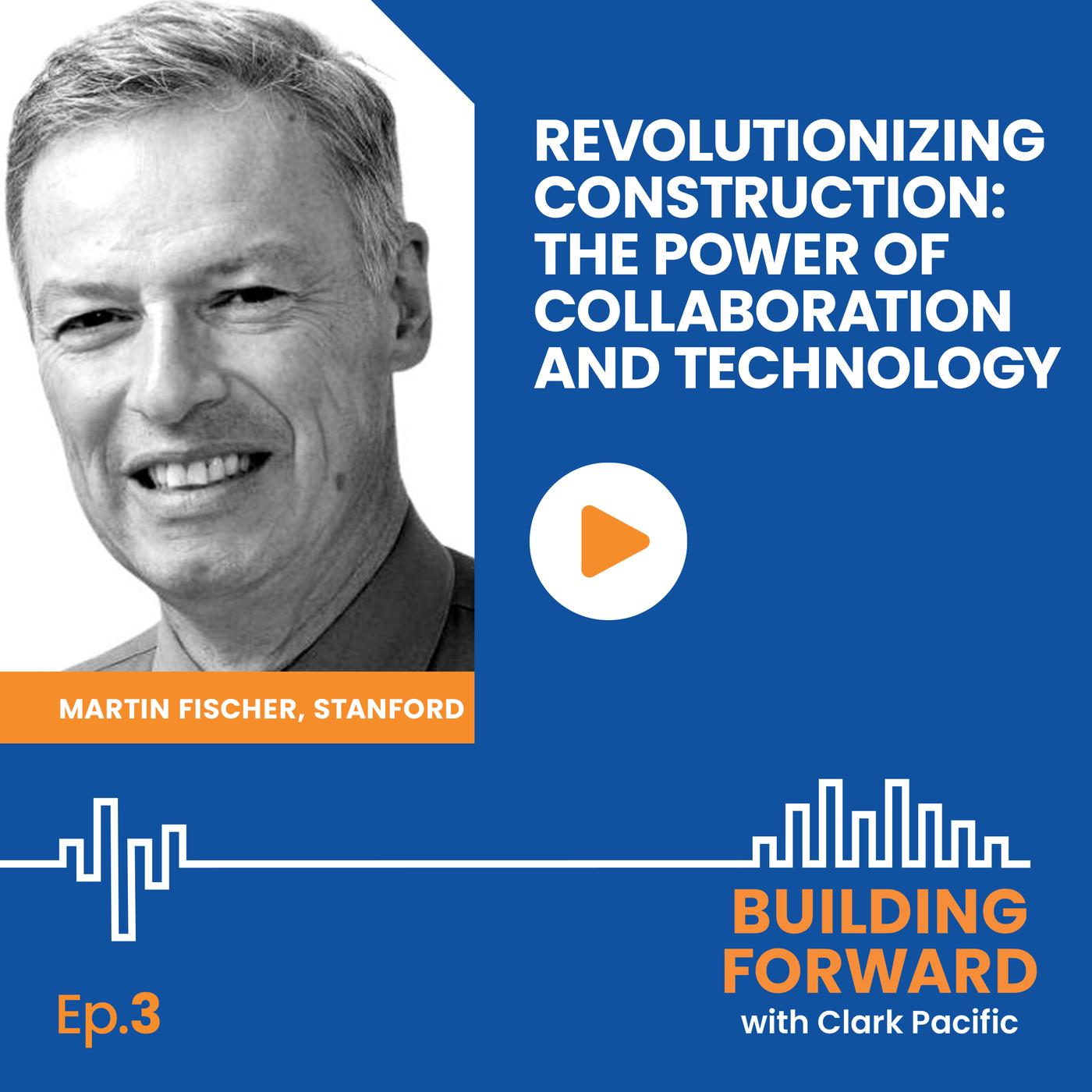
Doug Bevier: Welcome to Building Forward with Clark Pacific. I'm Doug Bevere and I'm here with Dan Delisle today and joined Professor Martin Fisher, Director of Stanford Center of Integrated Facility Engineering. Martin, great to have you here.
Martin Fischer: Thanks for having me. forward.
Doug Bevier: Yeah, I'm really interested in learning a little bit more about you and kind of what first drew you to study and collaboration in the built environment.
Martin Fischer: I guess the story starts when I was 11 year old boy in Switzerland and we building a house for ourselves and like every client, we had wishes than we had budget. So my younger sister and I, had to help out on the weekends to do a few tasks. So this one weekend I found myself on the upper floor of the building in Switzerland because of land expensive, know, buildings tend to have three levels. And... So I did the job and then I said, Dad, I'm done. Please come check it out. And he came over and said, okay, it looks okay, Martin, but you could have done a better job if you had used this particular tool. I said, yeah, I know. He looks at me like, Parzold, why the heck didn't you use the tool? I said, well, know, Dad, the tool was in the basement and I would have had to go down, you know, two levels, the tool, bring it up, set it up, you know. I said, too much trouble. I'll just muddle through. And to this, heard the following comment from my dad. He looks at me and says, Martin, you are an idiot if you're not using the best tool possible. And I guess I didn't want to be an idiot. So that really drew me into looking at methods that we use for designing, building things. And obviously then quickly you end up focused on production on the productivity, the quality, those production metrics. But that really was the genesis of it for getting into this a focus of my research.
Doug Bevier: story.
Dan Delisle: same Yeah, you know, so what problem would you say ⁓ trying to solve, Martin? You you're widely credited with developing really the ⁓ virtual and construction or VDC. In a couple sentences, what were you to solve? And maybe a two-part question, how would you explain what VDC is to, you know, any sort trade person or AEC professional?
Martin Fischer: And the problem I would want to solve is really the result of the fragmentation that we have in this industry. And understand we need some of that for specialization reasons and for fluctuations in market. But that doesn't mean we have to be happy with the way it is. We can still try to better methods that overcome those challenges. And that's really what motivates my work, ⁓ from working as an engineer in that particular time on large bridges. ⁓ with the VSL, I just saw the impact of fragmentation, of not thinking about design, I mean, design and construction in that case together. then having to do redesign or not as efficient a kind of construction as you could have. it, you know, as efficiency minded Swiss engineer that drove me crazy, I okay, there has to be a better way. And basically what I saw is, okay, we need to... have people need to be able to talk to each other and they need to be able to understand each other quickly. And so that got me into, you long time ago, digital modeling, 3D modeling, ⁓ 4D BIM, those technologies. I saw the power ⁓ of those when used well, not as a Hollywood BIM, but really as a core tool. that then led me to realize, okay, Let's just summarize it as BIM. a very cool, very, very powerful tool method that helps with information management communication. But of course, managing a project and managing the production of a project is bigger that. And so ⁓ that really some colleagues of and I to define VDC early this century as the combination of technologies that look at visualizing integrating, automating information collaboration methods and with attention to production processes, digital and physical. Because on a project you have to do all of those things. Yes, need, of course, people that pay particular attention to collaboration technologies or production processes. Absolutely. from a project management perspective, we need a holistic method that addresses all of those opportunities. And that really was the genesis of what we call VDC, virtual design and construction.
Doug Bevier: So you kind of hit on how V2C has evolved. But I would like to know, I since I've in construction, ⁓ and that's been for the past 12, 13 years, I've seen a huge in what we've internally at Clark Pacific have done and what it's allowed us to do on some of our major projects, like the Escondido Village there at Stanford, the Apple headquarters in Cupertino. ⁓ If weren't able to do 400 and 450 and those types of modeling and communicating with all the different designers across the world, those projects would not have been possible. You've been kind of through this VDC evolution for a lot longer than I have. Could you maybe some of the early days and some of the early challenges and then ⁓ how that has to where we're at today and kind of what you think the next evolution is going to be over maybe the next five years?
Martin Fischer: Yeah, I think in the days, the focus was really very much on the visualization power of those tools. And helped bring a team together, integrate a team better. You could have a structural engineer, architect, construction people, mechanical engineer, whoever had really a major role to play in shaping the project, be much more quick ⁓ understanding each other providing input and coming up with a good solution together. It was really summarized very nicely by a very crusty engineer, project manager at Walt Disney Imagineering the early days when we had a lot of fun applying methods on Disney projects. He basically said, wow, this really interesting. The problems we find together, we solve together. So it was an epiphany for him, but that's really was the idea. And it was just painful for me to see people stuck in sort of an old way of doing things. I have a problem, let me kick it over the wall and say, Dan, you figure this out. When together we could just figure it out like very, very quickly and much better. So we saw really project leveraging the power of the visualization that was enabled by these. early methods in the 90s and early 2000s. then ⁓ now over the last decade or so, we have seen more the that's associated with these models become useful. So you can many more options more or so that you can drive directly from those models, right? And you can get to the level of quality that, you know, was astounding on the Apple project. I mean, I think you guys really set a new benchmark from what I've seen in terms of what a company, you know, can produce with the kind of materials we need to use. And so what see now going forward, I think, yeah, this sort of complementing the visualization power of these tools the information and computing aspects that they offer. This really the evolution I've seen over the last decade or 15 years. And I think that'll continue. ⁓ And think the main area I see that continuing is, of we still have many improvements we can make in terms of what we design, the product, if you want to generalize the word there. But also, how we design and how we build. So I think we'll see a lot more of this kind of digital twins and other word that's used lately quite a lot, used not only for the product, but also for the process. And I think that will become excitingly powerful.
Doug Bevier: Yeah, absolutely. perspective, what I've seen is that when ⁓ think the delivery model of our projects have also shifted a lot over the last 10, 15 years. I think most jobs that we are engaged on, even this the smallest job to the most complex have been more of this design build aspect where there's a lot more shared risk, I think, from everybody involved, which also helps that communication between I think in the early ⁓ When I first started managing my own projects, we did a lot of the design, bid, build, and everybody was so protective of their own risks and wanting to, yeah, I mean, exactly right. Take a problem, just throw it over the fence and make it as easy on yourself. so having those, that level of communication where you work through a problem together wasn't necessarily the approach that was taken, which also I think back from just the quality or what virtual models allowed us to do and make jobs better. Um, so I've seen, I think the delivery models have evolved and then, people getting involved much earlier in the state of a project has allowed that acceleration. Um, and then I think once everybody saw the shared value and impact, it really started to move. And I think when we started making, uh, you know, when I started, when we first do it in modeling, was, you know, class detection. And then as a, as a manufacturer, we would take that model, reproduce everything else on another software.
Martin Fischer: Mm-hmm.
Doug Bevier: then go manufacture it. And you weren't actually using the model you collaborated on to manufacture the products. And you're like, that just blew my mind. And so today, where we've taken it is to, hey, you're taking that collaboration model, that's going right to shop tickets, whether that's us with precast parts or the glazers with systems and things of that nature. ⁓ then I think once everybody starts seeing the value, it's like cooking with fish right? It just starts to accelerate faster and faster, which I love. ⁓ I also. ⁓
Martin Fischer: Yeah. mean, I think we bring up a great couple of great points. The on risk because that's what they hear all the time. Like, Martin, but that sounds very risky. But my experience, like, you know, there's no more modern, newer approaches. But my experience is actually less risky because you are working together and you tackle risks. You can understand risks. You can tackle them much better. You have much better information. You can provide so much more value to our customers. At least that's what seen. the project teams that actually really use these methods well. And the other part that made me think of is kind of the demographics are changing quite a bit in terms of who we serve, but also who works for us. And if I look at the evolution of the students over the last, 15 years, they certainly expect more collaborative approaches. I mean, that's what they're used to from like everything they do in daily life. And then so when they come to a kind of traditional project in our field, that is clearly not the most efficient way and effective way in which you could build a great building, look at it as like, what the heck is this?
Doug Bevier: I couldn't agree with you more. think you're starting to see those students who, you know, this is a perfect segue into what we're going to be talking about here in a second. But you take those students who learned in that collaborative approach and now they're at positions at their firms or their manufacturers that they're the decision makers. I think some of those challenges when I first was coming in from a collaborative university into the work, was, you know, guys that were managing jobs that had been doing it the design bid way for so long. And then once you saw that, you know, I
Martin Fischer: Uh-huh.
Doug Bevier: I think what really helped us was getting such a complex job like Apple and saying there's no way we could have done it without this, which really then you got a taste of it and you realized the power behind it. If we didn't have that, I kind of wonder how long it would have taken to really grab onto it because we were managing jobs effectively the previous way, but we were managing effectively for us, not necessarily what was in the best interest of the project or for the client. But it is a perfect segue into talking about students, learning a little bit more about integrated facility engineering, your CIFE I was hoping you could maybe talk a little bit about the mission and how you connect academic research to real projects.
Martin Fischer: Yeah. So the mission is we want to invent the next of designing, building, operating our built environment. That's aspiration we have. Of course, it's not something we can just do on our own in our offices and labs here on the farm Stanford. And that's why we up center of actually my former professor set up this center in 1988. because it really has to be a collaborative effort between building owners, design companies, and construction companies and tech companies. All them have an important role to play. All of them bring a lot to the table. And when we are able to put ⁓ all this together with our network here at Stanford, with other ⁓ academic and then of course also the power of ⁓ our students, I would say we can really rock terms of the mission, in terms of inventing the next practice. And so there's a of things we do to make that One is we have done together, ⁓ of course, of is always together companies. We have been able to do sort of project level demonstrations. So the first demonstrations, yes, this technology or this method is ready or, you know, maybe less so. I'm starting, for example, in 93, we able to work with Dillingham Construction, know, here at the time, bringing ⁓ 4D modeling the San Mateo County Health Center project, which was undergoing full renovation extension while being operational. mean, you know, extending and rebuilding and a hospital while it's being used maybe one of the more complicated projects you can think of. And that's why it made sense even with the technology and the cost of the technology at the time to do that. And so we supported the project team ⁓ this method, this technology to the project, using it well, but also then documenting it so we could learn from it. And the time, third time would be faster. So we've had the privileged to work on many of those sort of, think typically first or very early. demonstrations not just in the lab, but actually on a project. recently, the application of LLMs, application of robotics, are some of more recent studies we've been able to do. mean, these are always by members. having this demonstration project, I think, is powerful in opening up eyes and to let us also update our teaching. And we can see, hey, we need to actually teach something different. What we often learn from that is we sometimes need new concepts. So then we have to kind of go a little bit deeper in the research and develop some new concepts. Like a few years back, what we called at the time, tri-constraint method for scheduling to beyond the single constraint of precedence relationships for critical path methods to have kinds of constraints considered more fully to create more realistic schedules that led to a startup Alice just as an illustration. So that is a second major part of what we do. third is developing professional education material like we have done for virtual design and construction certificate program. We've been able to teach about 5,000 professionals over the years and certify over 2,000 in all continents in all worlds. Or more a collaboration with the Project Production Institute on the modern construction program. really sort of all of the things we have already touched on a bit into a method of how we should do projects in the future, know, data-driven, focused on what can be industrialized, focus on autonomous systems, bringing autonomous systems like we see in many other sectors of industry to our and learning how to manage that. And finally, we have conferences for our that bring people together and sharing of experiences the Industrialized Construction Forum that's coming up in February.
Doug Bevier: You will.
Dan Delisle: You mentioned and AI. are you integrating LLMs and AI at SIFI?
Martin Fischer: mean, I people, companies are already using LLMs well, at least the good ones in terms of the text space, the things you can do with text. You know, and I think most people are these days. I mean, I find you still need to have your own brain. helps. It helps get better and make sense of the results. But So hopefully that continues. We have been able to use LLMs to gain insights a particular project. In that particular application, we wanted to understand beyond clash just create a buildable design and an operable design. And what we saw on projects is that there's still, much as I say it has improved over the last 10 or so years in terms of how we use these 3D models collaboratively to eye on our clashes and things more beautiful, we still see many late changes and sometimes a bit of chaos in ⁓ projects. And then we see complaints from the operators say, well, this doesn't work and so on. And so we've seen the challenges even a company, across many companies for projects. do you actually learn more systematically? And ⁓ that, typically there is not quite enough experience, there's not enough data on a project. So we've been able to use LLMs to look data from many projects and see what of actually come up and when would they best be addressed in a project so that going forward there can be more realistic. plan for the kind of issues that need to be dealt with at the given design phase based on the learning from many projects. And then with you can keep updated learning as situations et cetera. So going beyond the sort of anecdotal experiences of individual projects, which of course are important. I'm not saying they're not, but we can now complement thanks to LLMs with insights that are aggravated from many projects. that makes sense.
Dan Delisle: Yeah, thanks. You know, I think looking at what we do at Clark Pacific, I'm real interested to understand through your work with this team and you've been there for 25 years now doing this, at least, right?
Doug Bevier: You know.
Dan Delisle: You know, what can we do and what can we prioritize for Clark Pacific as an example in the industry? know, we do this, you know, this heavy focus on prefabrication and, you know, structural systems and insulated enclosure systems. And we deliver that at scale. And we're always looking at how to make construction more predictable.
Doug Bevier: As a designer, I'm a designer myself. We need to this savvy focus on re-application and structural systems and insulating things with your systems and to make that stable. And it's a time to construct more difficult or skillful or optimal, cost-effective.
Dan Delisle: more scalable, more optimized, cost effective, all of these things, as well as sustainable. What are some of the things that we would want to focus on from the work that you've done?
Doug Bevier: all of these things and technology. This is a development. What are some of the things that we are doing? So, for real, what have you done?
Martin Fischer: Mm-hmm. I would say things come to mind. So one is use where you reasonably decent data already on projects, which is, in my experience, typically around things like requests for information, submittals, I mean, the kind of things that all one of the platforms, don't know, Procore or CMIC, Autodesk, Construction some mix of which most companies using. So look at data across that data many projects, because that data is reasonably well organized. And at least we found. And LLMs can... ⁓ Yeah, you can teach them a little bit where of somebody called things slightly different and it means actually the same thing. I those are the things I find they're pretty, pretty good at. But see if see any more or less productive patterns or practices across projects, because difficult to see in one project. that's that's something I think that's feasible to do today. if necessary, hire one of our or else's university's student for the summer and give them this task. You don't have to tell them you have never done it and have them go it and see how difficult or hard it really is. But I think that an opportunity so we can get away from just sort of what you believe and what another person believes and arguing that versus, Fine, we have our beliefs, but here we also have actually some data across the last 10 projects or whatever the number would be. And that's one thing. The other thing going forward is just be more mindful, and I think you already are from what I about creating workflows that actually create data kind of almost as a side product. about how they are going. And of course, use quite a few machines. So that's in that sense easier to do than when mostly people do work. from information flows common environments, from your production data, I think really how a project unfolds through data-driven way will then allow you to use methods, automation at a ⁓ much scale than possible today. And so building these kind of data focused, data enabled workflows, where the data is hopefully ideally generated or close to automatically is what I would focus on quite significantly. And I think already are from what I know.
Doug Bevier: It's been a learning path sure. you we started kind of our inception, we were high end, very custom articulated facade jobs. And so a lot of that data was hard to take from one project to the next. But we've evolved as a country to more like a product based product based we've been able to, to really take that forward. And yeah, look at, you know, we're still beginning paths, but we're to do exactly you're describing. And For somebody who has hired some of your students at Stanford, they've all been very high achievers for us and have been helping push that ball forward. So whatever you guys are doing has really been working and definitely pushing Clark Pacific to the next generation how we're accelerating. hopefully, just we ⁓ helping us cogs and do all this stuff where we can hopefully give a better product to the client, but it's helping us scale. of the challenges find, though, is you get so much data out of it is how do you take that data and then take all that information and it down to what's really applicable or what's going to move the ⁓ the most. And I think that's where sometimes we can fall into this engineering paralysis of are looking at it and how do we get that most value if that makes sense.
Martin Fischer: Yeah, that's I'm glad you bring that up actually. I've probably over and for me data is important. And, and the but I've maybe over emphasized a little bit to the detriment of actually defining the objectives. What is it that you want out of it? And I think I see actually, at least as much as many challenges there in companies and projects as we're getting data. I see everybody's focused on data. But then when I asked the questions for a while, tell me now pretty precisely what is it that you really want to improve? Like, and why? Because if you don't tell me that, how could I know that you are looking at the right data or the right level of detail or, yeah, you need second by second data or maybe you need hour by hour data is good enough. That on what is you actually want to do. And that's, ⁓ found surprisingly, struggle with actually being able to put the finger on that. So, ⁓ That's, think, another key part is developing these, we call them in VDC lingo production metrics. know, things you can track hourly, weekly, daily, I mean, whatever cadence makes sense in terms of the control you need to have, you know, during design, fabrication and construction. That is maybe the next important thing to do. So... And there the good thing is that you have experiences in design, fabrication and on site. so you can actually, involved in three different types of production, right? And okay, on one hand, that's difficult. On the other hand, you have the chance of creating much better feedback loops, much better intervention points that make sense, that are more value adding for you and the client that others wouldn't have at all. you know, a little bit more limited in our scope on projects.
Doug Bevier: No, absolutely. As an engineer, most of us are engineers. We always love to jump into the details. And it's always hard to start taking a step back and kind of outlining what exactly you're trying to achieve out of it. In addition, I know we've talked a lot about how we're making our operations better, how we're kind of progressing that. But I come from the pre-construction side of things. And having that feedback for sales and has really helped ⁓ our risk. really saying, we can hit this, which means I can start lowering some of the contingencies and other things because we have this data that we can believe in time after time. And so I think, it's just making everything more efficient and that translates to the owner. So I'm excited to see what's possible in the future. know, Dan mentioned this, you've been doing this for a long time, Martin. I appreciate your time today, but I want to ask a couple of questions before we sign off here about You you personally, what keeps you so excited about this work doing after all these years? What keeps you motivated as you get out of bed at morning?
Martin Fischer: So it's really a comment that my wife made recently to me. She's photographer, spent time in the fashion industry, interior designing. So it's a little bit different angle. And she heard me in some Zoom meeting trying to justify why we have construction and management and pay attention to the built environment in some meeting. I forgot what it frankly,
Doug Bevier: sorry.
Martin Fischer: at Stanford, you know, we colleagues at Stanford who everybody clamoring for resources, right. And then, you know, the feeding was over. And then she comes over and looks at me like, what the heck is wrong with these people? Like the built environment is everything. Like without the built environment, but we got nothing. like we don't a life like we cannot live way we are living. what, what, does need any kind of conviction that we need to pay attention to? ⁓ the built environment, how it's working, how we make it, how we make it better, we update it, et cetera. mean, this is just like crazy that this is even discussed. So really the impact we have with our work society, on lives, on us as people on planet that really motivates me every day to find ways of making what we build better and how we build. And when I say build, I design, build, also use and update, cetera. I would say, yeah.
Dan Delisle: Professor, do you have a good example of that perhaps that you've seen and perhaps even, you if you could inspire additional change or ongoing change ⁓ into future looking past what you've already done, what would it be? Yeah, so do you see that is out there ⁓ inspirational? And then...
Doug Bevier: See you.
Dan Delisle: And then what do you see in the future as some major changes that you can squint your eyes and happening to the construction industry?
Martin Fischer: Hmm.
Doug Bevier: Thanks. ⁓
Martin Fischer: Now I've seen, luckily in my role, get to have the privilege of seeing many projects, many organizations around the world. And I mean, there's some truly inspiring performances by project teams or by companies. Like a colleague of mine, ⁓ Max Sweden able lower with three year, know, improvement effort was able to lower the cost of. what the company was building by 45%, really remarkable and half the time. So much better value to the communities they serve and the customers they serve. Or team that built the facilities for the 2019 Pan Am Games, which is just amazing in Peru. They designed built all of the Olympic level facilities in 16 months. I mean, it's ⁓ insane if think about it. So got inspired by, and then there's many more to mention, I I find very inspirational to see these examples around the world, you know, not just here in California, where we also, mean, I think, you know, the Apple campus was, I think, something see, you something to experience that you guys created, among many other projects. but also in, ⁓ in the world, in Lima, you know, across Sweden and many parts of the world. So I'm inspired by what the project teams are able to do through this mix of collaboration technology. And obviously it's still the people that make things happen, but when they use the methods and tools well, thoughtfully, it's amazing what can be achieved. It's just a little sad that this doesn't happen more often, but hopefully we get there. going forward, I think, I expect that we find actually better ways of integrating in terms of what we build, that we find better ways of connecting the digital and the built environment. They're still, I they're connected to some extent, but I could imagine, I hope there will be some very creative people that find innovative, fun ways of really better connecting the digital and built environment, physical and built, physical and digital environment. Because we are immersed in both every day, all the time. so I think we should find more innovative ways of making that possible, as well as understanding what people actually want to do with the built environment, whether that's in office spaces or at home or in public spaces or infrastructure, and more for that and building more for that and updating more for that, I think would be... ⁓ good thing to do I hope that will happen. And in terms of how we build, really building this kind of digital twin, very detailed digital twin of the production processes, digital and physical, will ⁓ help us the risks, innovative in ways that we seen so far.
Doug Bevier: I appreciate that and I think I'm optimistic. the changes have accelerated throughout the years as we're seeing more changes each year. So I'm optimistic see happens throughout my career and see where we get to before I decide to hang it up. But Martin, just want ⁓ to, on behalf of and the Carpacific family, just wanted to thank you. I enjoyed talking to you, it really insightful. For our listeners, I appreciate you turning in. And Martin, if there's any... any final resources or places folks to learn more about your program or how they may support it. This is your time to say that.
Martin Fischer: Yeah, I mean, we have worked for 37 years, 38 almost, with many companies around the world. And if I talked about sounds good, please join us. We need a diversity of backgrounds, opinions, ⁓ visions to really create future together. And if that's a little too to get involved in research. just come to of our events like the Industrialized Construction Forum on February 3rd. It'll a fun event where we look at the use of industrialized construction through the of design automation, ⁓ building different of structures like data centers and housing, but with a perspective as well. So we'll have speakers from the US, Europe, Latin America, Asia. So it'll be, I very interesting to see. where industrialized construction is in the different places and where it's going given the emerging requirements, expectations and technologies.
Doug Bevier: Thanks, Martin.
