
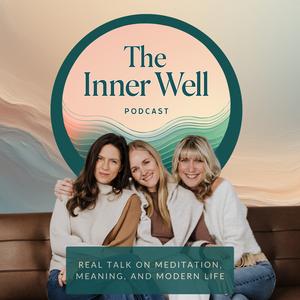

The Inner Well Podcast: We all contain a space within that when enlivened and nourished will support us with unwavering stability, expansion, and peace of mind. Join us each week as we dive into honest, grounded conversations about transcendental meditation, consciousness, and growth, and what it means to live an integrated life supported by a foundation of creativity and calm. This is the inner well. Hi everyone, welcome back to the inner well. I'm Megan. I'm Emily. I'm Danielle. And today we're gonna kick off with a topic that I think is very relevant to our society right now, just some of the things that we're struggling with at the human level. We're gonna talk about addiction and recovery. What does that journey look like and what is the root cause of addiction? You know, there's so many opinions out there about what causes addiction, why people struggle with it. I do think, and we can validate that there is a genetic component to this, but I also think that so much of it just has to do with the human experience. You know, there is a level of discomfort that can often come along with just our experience of being human, being in a world that we can't control, learning how to be okay when Our external circumstances don't work out the way that we want them to, and learning how to sit with that discomfort that results inside of us because of our inability to facilitate life exactly how we want it to be. And so I think that one of the things that is crucial to shed light on here is the fact that addiction often results from disconnection. Disconnection with community, disconnection with self, you know, a feeling like you're all alone on an island and the discomfort that arises from that in your nervous system because we are a species wired for connection. Yeah, that's so interesting. And you know, when I was researching this topic and thinking about things to talk about, I found this study ⁓ that was done by Johan Hari. It was actually sort of insights that he had around some really early 1970s. scientific studies ⁓ where they gave rats some drugs and what they noticed though was really interesting that the rats ⁓ when they were isolated went for the drugs and became addicted. But when the rats had community, they were put in a situation with other rats, they avoided the drugs and they went for water. And so what this showed was the opposite of addiction is not sobriety, it's community, it's connection. And exactly to that You know, a lot of that tendency, whether it's addiction to substances or to our phones or to any of these other things that we can use to even other people. Or people, right? How you know we can throw around this word addiction and feel very like, yes, we all probably have something that we could say is ⁓ you know, problematic in escapism for us, it's often due to that feeling of isolation and that lack of community. Which really brings us back to one of our previous episodes when we were talking about this epidemic of loneliness. So it only makes sense that kind of going hand in hand with that, there is an increase of challenges with addiction because if it's an effort to escape ⁓ to find some, even if it's momentary relief from the the pain that comes with that epidemic of loneliness. Yeah. And and I think an important piece, and you were kind of touching on this, is to really recognize that when we're talking about addiction, it's not necessarily just drugs and alcohol and substances, but it's anything, you know, whether it is external or behavioral, that we turn to for escape. And so, you know, that could be shopping addiction, that could be food addiction, that could be phone. Absolutely. The escapism, I don't think. any of us are immune to that. ⁓ but it's something that's interesting. You know, it's not that we're weak in those moments. We are living in a world that is designed to to get us. Right. To get that. To, you know, that infinite scroll that, you know, these companies, social media companies, advertisers know this. Yeah. And they are designing our experience on our phones in a way that we're outmatched. It's not that we're weak. It is Engineered. It's engineered. I I mean, I always think about that, you know, like the potato chips thing, right? Where you can't eat just one. They're designed to literally make you eat more and more and more and more. And that's that's my, you know, I I will go for the potato chips, but you know, that engineering, that it's like they have figured out how it's not just biological engineering, but it's this whole psychological engineering of these places we can escape to. And yeah, you know, I I find myself, it's like scrolling on the phone and then before I know it, I'm trying to buy these clothes is I think I need this outfit and this thing. And it's like this cycle where we kind of and it feels great to sort of turn off life for a minute and completely escape into this other world where suddenly whatever it is is gonna solve this problem, you're gonna buy these shoes and you know, so it's really easy to fall down that path. Yeah. I always call it fake fullness. My girlfriends and I always shopping on there. It's so true though. Cause it's like what I noticed as I see the outfit and then I picture what I want to be doing when I wear, and then your mind just gravitates off to this alternate reality where everything's going exactly the way you want it to, because you have that outfit. Yes. And it's just fake fullness. And really good. You know, I think that one of the other things that I can speak to. Personally, you know, my journey to TM was largely motivated by my addictive tendencies for my, you know, to create an experience of being able to handle my own dysregulation. Like I used to gravitate towards alcohol a lot when I was younger. When I was in corporate America, I was very stressed. And One of the things that actually motivated me to really become more regular with my practice and eventually take the journey down to teaching and everything else was I remember sitting on the floor one day after a really stressful day at work and I was having a glass of wine and I was in a space where I was like, okay, I really need to just stop turning to alcohol as a form of nervous system regulation. And I realized that I just couldn't not go for that glass of wine. I couldn't not lean into that. And I was just scrolling, you know, doing all the addictions all at once. And I came on this one thing on Facebook, and it was Anthony Hopkins talking. And I don't know that this was his original quote, but he gave a quote about the actual path of alcoholism. And he said, first the man takes a drink. Then The drink takes a drink. And then eventually the drink takes the man. I still have goosebumps that run all over my body when I say it. Because I was at that second place. I was like, ⁓ my God, I can't not do that. Means the drink is taken. And that means I am officially overshadowed by this. And it freaked me out enough to where I was like, I have got to do something. And You know, that relationship has always been a struggle with me. It run alcoholism runs rampant in my family. And I will attest personally to the fact that my capacity to manage that and even be able to drink socially at this point is entirely dependent on my capacity to move inward and find that space inside of me that doesn't need to reach out for anything. Yeah. It's powerful. And I think a lot of people can relate to that. I definitely can relate to that. You know, in AA in 12-step recovery, the 11th step is meditation, sought through prayer and meditation. It's a huge part of recovery. And a lot of people who come in to learn transcendental meditation come from that place of recovery. They are either in twelve-step or they recognize they need to do something, and TM might be a first step, an early step. Or it might be a step after years of sobriety, but it's that sort of missing piece that anchors them. And you know, there's a fantastic ⁓ documentary ⁓ about Bill Wilson, the founder of AA, who was taught TM by a wonderful guy, Lincoln Norton, TM teacher. And Bill Wilson had this experience after learning TM where he came out of that first meditation and said, This is what I've been talking about. This is that 11th step. So we teach a lot of people in recovery. And I often say it's my favorite person to teach simply because there is a lot of openness and a lot of transformation that can happen when we allow ourselves to be filled up by not something outside of ourselves, but by that inner well within. We reestablish that connection. I find students often say, and some of them are intentionally becoming coming. To learn TM because they've heard, you know, whether it was through 12 step and they're actively in that work, or there's just that recognition that I'm dependent on weed to help me fall asleep, or I can't access the creativity that I want to without some external substance. And I want to be able to ⁓ express myself fully without anything external. People find that often very quickly. The nervous system becomes regulated enough that there isn't that dependency or that even the even the craving. And I've even had people who didn't come for that reason at all and find, ⁓ I'm not wanting to go for that glass of wine at the end of the day to take the edge off. As our body becomes more balanced, there's this we're able to fully be ourselves and be aware of and really checked in with what I actually want versus those things that we're just going to as default behaviors ⁓ for that escape. I always say that too and I'm, you know, teaching or I'm talking in an intro, you know, I I always say there's no lifestyle change with TM. There's no requirement to give up anything. ⁓ however, people do naturally find that, that they're naturally maybe something that you're not as drawn to, and that you wake up one day and you don't reach for that glass of wine or you don't. I remember one woman came in after a couple months, she'd lost a whole bunch of weight because she realized, wow, I was filling myself, I was using food to, you know, self-medicate. And I just spontaneously, without any think thought of it, I just wasn't reaching for that anymore. So it's beautiful to see that, just natural balance. Yeah. It reminds me of I had some colleagues that were working with a medical doctor. Who shared this acronym that I loved? He had redefined meds as meditation, exercise, diet, sleep. ⁓ it's great. So good. Good. Which just is the foundation of our health and well-being. But he said meditation comes first because it creates that energy that we can actually show up in for our exercise and it creates the regulation that we can get good call quality sleep. It creates that self-awareness where we can make healthier choices about what we're putting into our body. ⁓ and it all goes hand in hand. I just really liked that. And what you were saying reminded me of that. ⁓ and I also just as we're having this conversation, thought of this ⁓ veteran that I taught after learning TM, he said, if the VA had given me this instead of pain medications 20 years ago, that would have saved me decades of addiction. And ⁓ all of the negative side effects that came along with that for his quality of life. He said even after the first couple meditations, he ⁓ noticed more reduction in his physical pain than he had through those decades of medications that he had ended up addicted to. Amazing. Yeah. And so much of what we're talking about, too, with addiction, again, it's like biology, right? This is never, of course, any kind of moral failing or any kind of weak will. And I think sometimes, even though we're all very comfortable with what addiction is and all of that, there can still perhaps be some misunderstanding that it's someone who's really just down and out. And one of the things that there has been interesting research on with TM is that it actually rewires the brain. So these these natural cravings, the the woman who suddenly isn't reaching for the cupcake or the the guy who's noticing his pain is sort of diminishing, is because the brain is rewiring, first of all, that craving ⁓ tendency. But also that sort of satiation. And I don't mean that in that fullness, it's but in that like spiritual fullness. And again, not spiritual, but in that sort of ⁓ whole body soul fullness. I think we'll we'll continue to talk about this again. This really interests me, but getting into more research on the brain and addiction and recovery. Well, and I think so much of it too has to do with being able to settle into your body. You know, a lot of times. The addiction serves a dis as a distraction from the discomfort. You know, cause the discomfort starts to rise and then the mind responds with, ⁓ I don't want to feel this. Okay, let me reach out and grab something to deter my attention, right? And then that's when we reach for You know, the food or the alcohol or the coffee or the cigarettes or something that creates an experience out here that satiates the mind into a space of, okay, I'm no longer focused on this, I'm focused on this out here. And then when we come, you know, it's that ability to settle into our body that makes us feel regulated. And you know, there's a story that I always like to share whenever I'm talking about that. And it's not a personal story that I came up with on my own. I'm not taking credit for this, but it's one that I came across and I think it does such a good job of describing how being able to have The you know whatever technique it is that you use, be it meditation, be it walking, be it whatever allows you to settle back into your body and hold space, can really have a pivotal change on your capacity to regulate without reaching out. And so, you know, the story talks about a young man who goes to a very wise elder. They're sitting under the tree. And he's talking about the challenges of the human experience. You know, I'm lonely, I'm depressed, I'm sad, I'm upset, I don't know where to go to find fullness. Is it my job? Is it my relationship? Is it this? And so the elder takes this opportunity to teach him a lesson on. The basic principles of expansion. And he says, okay, you take an eight-ounce glass of water and a container of salt. You take a handful of salt, put it in the water. And so, you know, he had the young man do this. Okay. He says, Okay, now drink. And so reluctantly the young man took a drink and made this awful face and spit it out. It's like, ⁓ my God, why would you have me drink this? This is awful. This is bitter. And then the elder says, Okay, now come with me. They leave the tree and they go to this lake. This was not far from where they were sitting, this beautiful, clean, pristine lake. And the elder says, Okay, I'm gonna give you the same, take that same handful of salt and I want you to put it in the water now. And so the young man, you know, okay, takes it, puts it in the lake, and the master says, Okay, now drink. Or the teacher says, Okay, now drink. And so the young man takes a drink and he takes another drink. And the elder says, Well, how does it taste? And he says, Well, you know, it tastes clean, it tastes refreshing, tastes nourishing. And then the elder said, Okay, here is your lesson. Expand your container, and the bitterness is not so easily felt. That is the power of inward momentum. When you can settle into yourself and actually hold that space inside of you that sustains fullness, that sustains regulation, that sustains space, contraction held in the midst of expansion, when that ex when that container expands, whatever you're perceiving, whatever discomfort you're being Challenge to deal with at that moment in time is always gonna feel more manageable when you have the space to hold it. Powerful. What a beautiful story. And I think, I mean, I love that it was a water analogy in this because that's what we were talking about with this podcast, the inner well. Yes. That source. I didn't even think about that. Yeah, perfect. Expanding our container, right? gaining that access to the depth of our true self. Sometimes it can seem like, how is this one technique powerful and relevant in so many different areas of life? It's because stress and pressure and dysregulation affects every area of our life. And so expanding that capacity the way that you described that or expanding the container is really what we're doing. By accessing and integrating each of our own inner wells. Well, we're excited to have more of these conversations this month with fascinating people on this topic. And we invite you as always to share your stories and share with us your questions, your comments. You can always DM us or tag us on Instagram just sharing your own stories. We want to hear from you. That's a wrap on today's episode of The Inner Well. Please subscribe and leave a review. Your support means the world and helps others find us. And if this conversation added something to your day, don't be shy. Share it with someone it might resonate with. Also, please follow us on social for more between episodes and send in your questions, your stories, or the topics you'd like to explore with us. We genuinely love hearing from you and this podcast exists because of you. So keep showing up for yourself and we'll see you next week.
معلومات عن هذه الحلقة
Addiction is one of the most challenging human experiences to move through largely because it can be so unbelievably overshadowing. It creates a perceived lack of control at the baseline of your human experience and this can be extremely anxiety provoking. So, what can a technique like TM offer to those on this journey? Being able to sustain space, choice point and nervous system regulation amidst the challenges that life throws our way can be a pivotal experience when it comes to regulating without reaching for something outside of yourself.
In this episode, your hosts discuss:
- The root cause of addiction
- Their own personal struggles with addiction in all forms
- What are the different types of addiction out there?
- Why is distraction itself a human tendency?
- What does sustaining expansion amidst contraction offer for the addictive paradigm?
How does a technique like TM help you sustain the choice point necessary to regulate without reaching out? - Why is looking outside of ourselves a natural tendency ingrained in the human experience?
- What are some tools we can use to regulate our nervous system so we don’t have to reach out?
- How has TM supported your hosts on their own personal struggles with addiction?
- How does expanding your container flip the script on addictive tendencies?
Dive in each week for real talk on meditation, meaning and modern life. And let us know what resonates with you. After all, this podcast was created with you in mind – to support the human condition by optimizing the human experience.
Watch, listen, and connect here: tm.org/theinnerwellpodcast
We'd love to hear your thoughts. Email: theinnerwellpodcast@gmail.com
Find your local TM Teacher: www.tm.org
Enjoyed this episode? Subscribe, leave a review, and share it with someone who might need it. Follow us on social and send us your questions, stories, and topic ideas — this podcast exists because of you.
الإنجليزية
الولايات المتحدة
النص 🔗
البحث في الحلقات الماضية
البحث في الحلقات السابقة من The Inner Well Podcast.
إخلاء المسؤولية: البودكاست والأعمال الفنية المضمنة في هذه الصفحة مأخوذة من The Inner Well، وهي مملوكة لمالكها وليست تابعة لشركة Listen Notes, Inc أو معتمدة منها.
تعديل
شكراً على مساعدتنا في الحفاظ على قاعدة بيانات البودكاست مُحدَّثة.
