
معلومات عن هذه الحلقة
Last time, we built Wizards who could survive long enough to become dangerous.
That was apparently a mistake.
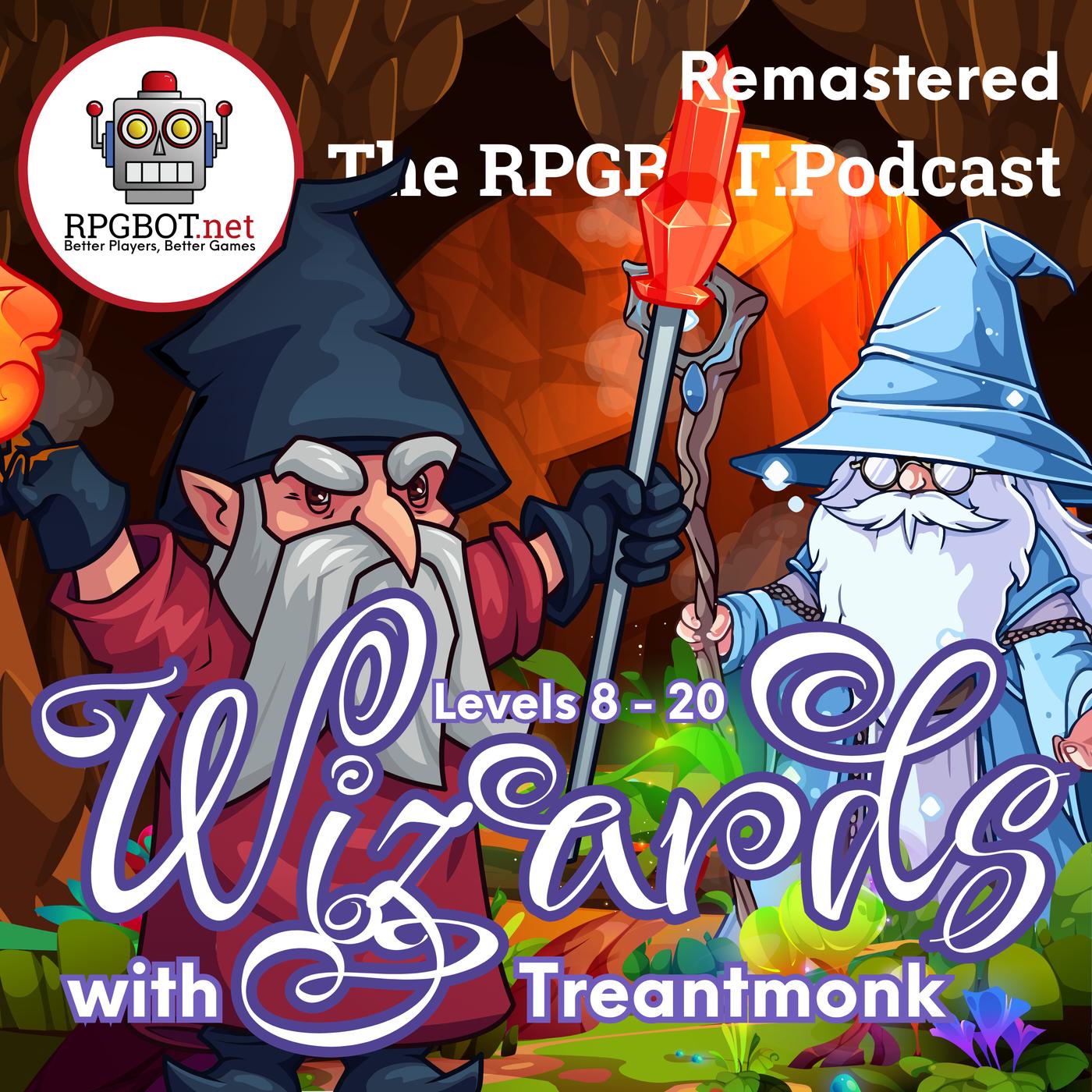
Treantmonk is back as we take our 2014 D&D 5e Wizard builds from level 8 all the way to 20, where spell selection stops being a question of how to win a fight and becomes a question of how creatively we would like to ruin reality.
Tyler is operating his floating spellbook like a magical Predator drone. Ash has discovered Bigby's Hand and immediately found exactly the wrong way to describe it. Randall continues turning Magic Missile into a personal philosophy. And Chris is here trying to explain responsible Wizard optimization while the rest of us draft spells specifically to hurt each other's feelings.
By the time we reach ninth-level spells, Wish almost goes undrafted.
That sentence alone should tell you how this episode goes.
Welcome back to the RPGBOT.Podcast. We made it to level 20, nobody died, and reality is now more of a suggestion than a rule.
- Treantmonk on YouTube
- Content from RPGBOT
Treantmonk returns for Part 2 and the conclusion of our 2014 D&D 5e Wizard optimization builds, picking up at level 8 and taking our Wizards all the way to level 20.
At this point, the training wheels are gone. Fifth-level spells bring Wall of Force, Bigby's Hand, Wall of Stone, and increasingly aggressive spell drafting. By sixth level, the choices get even nastier, and picking the right spell becomes almost as important as making sure someone else doesn't get it first. Contingency gets selected partly because it is useful and partly because denying Tyler something he wants is apparently a valid optimization strategy.
That pretty much sets the tone for the rest of the episode.
As our D&D 5e Wizard builds move into the high levels, each character leans harder into their particular brand of nonsense. Ash embraces illusions, confusion, and magical hands. Randall continues finding ways to make Magic Missile everybody else's problem. Treantmonk builds around control, restraint, and smart high-level Wizard spell selection. Tyler keeps sending his Manifest Mind into places he absolutely does not intend to visit personally.
Then we reach seventh, eighth, and ninth-level Wizard spells, where things get properly ridiculous. Maze, Sunburst, Demiplane, Foresight, Shapechange, Power Word Kill, Meteor Swarm, and Wish all enter the conversation as the builds start moving from battlefield control into reality control. And somehow Wish almost doesn't get picked.
We also get into one of the most interesting parts of high-level 5e Wizard optimization: Spell Mastery. Unlimited access to carefully chosen first and second-level spells opens up some disgusting combinations, especially when Shield, Web, Tasha's Mind Whip, Vortex Warp, Phantasmal Force, and other low-level favorites no longer need spell slots.
Finally, we hit level 20 and Signature Spells, where everyone chooses their third-level favorites and collectively realizes that the Wizard's actual capstone might not feel nearly as exciting as what they received two levels earlier.
After two episodes of ability scores, feats, subclasses, Wizard spell selection, optimization, and increasingly questionable tactical decisions, our Treantmonk Wizard builds are complete. The Wizards have reached level 20. The spellbooks are full.The laws of physics have filed a formal complaint.
Key Takeaways- High-level Wizard optimization is less about dealing more damage and more about having exactly the right tool when everything goes wrong.
- Spell selection gets increasingly competitive as the builds advance. There are plenty of good Wizard spells, but everyone starts wanting the same exceptional ones.
- Wall of Force remains exactly the kind of spell an optimized Wizard hates leaving on the table. If nobody else takes it, somebody eventually has to.
- Sixth-level spells show just how different optimized Wizards can become. Mental Prison, Contingency, Mass Suggestion, Disintegrate, and other options push each build further into its own playstyle.
- High-level D&D 5e Wizards stop merely controlling encounters and start controlling circumstances. Maze, Demiplane, Shapechange, Foresight, Wish, and similar spells fundamentally change what the party can accomplish.
- Wish is incredibly powerful, but the discussion with Treantmonk highlights the practical problem with having nearly every lower-level spell available on demand: you still need to remember those spells exist when you actually need them.
- Spell Mastery may be one of the strongest pieces of the entire Wizard class. Turning excellent first and second-level Wizard spells into effectively unlimited resources creates some absurd possibilities.
- Shield becomes even more ridiculous when you can cast it without spending spell slots, especially if Randall is nearby with Magic Missile and bad intentions.
- At level 20, Signature Spells are useful, but after getting Spell Mastery at level 18 they do not exactly feel like the grand finale of becoming one of the most powerful spellcasters in Dungeons & Dragons.
- The biggest lesson from the complete Treantmonk Wizard build is that there is no single correct way to optimize a 2014 D&D 5e Wizard. Control, illusions, damage, summons, utility, mobility, and general magical nonsense can all work if the spell choices support the character you actually want to play.
- And if all else fails, become a Wizard with a remote-controlled spellbook, hide around a corner, and make the dungeon somebody else's problem.
Welcome to the RPGBOT Podcast. If you love Dungeons & Dragons, Pathfinder, and tabletop RPGs, this is the podcast for you.
Support the show for free: Rate and review us on Apple Podcasts, Spotify, or any podcast app. It helps new listeners find the best RPG podcast for D&D and Pathfinder players.
Level up your experience: Join us on Patreon to unlock ad-free access to RPGBOT.net and the RPGBOT Podcast, chat with us and the community on the RPGBOT Discord, and jump into live-streamed RPG podcast recordings.
Support while you shop: Use our Amazon affiliate link at https://amzn.to/3NwElxQ and help us keep building tools and guides for the RPG community.
Meet the Hosts-
Tyler Kamstra – Master of mechanics, seeing the Pathfinder action economy like Neo in the Matrix.
-
Randall James – Lore buff and technologist, always ready to debate which Lord of the Rings edition reigns supreme.
-
Ash Ely – Resident cynic, chaos agent, and AI's worst nightmare, bringing pure table-flipping RPG podcast energy.
Join the RPGBOT team where fantasy roleplaying meets real strategy, sarcasm, and community chaos.
How to Find Us:
In-depth articles, guides, handbooks, reviews, news on Tabletop Role Playing at RPGBOT.net
Tyler Kamstra Ash Ely Randall James Producer Dan