

speaker-0: Hey PR fans, welcome back to a brand new episode of pending ratification. Keenan Gray, alongside my Irish friend, Maddie Mooney, who is just getting her outdoor season underway. You just got done racing at Hayward Phil at the Oregon team invitational for your season opener. Tell us a little bit about that.
speaker-1: It was great. I ran a eight hundred at the ⁓ Oregon Team Invite ⁓ on the open day. And I'll tell ya, racing in Hayward is always fun, even at a meet like that where it's not very busy, so it was like mostly kind of an empty stadium. It's still such a cool feeling. So yeah, it was a great opener. Excited to race some more.
speaker-0: never know what that feeling is like. I have okay, I take that back. I have ran one lap around the Hayward Oval. It was the media four hundred for the Diamond League final in twenty twenty three. And I did not break sixty seconds. I was trying to train for it. I ran in flats. I think I ended up running like a sixty two in flats. I was actually okay with that. Yeah. ⁓
speaker-1: That's pretty good, honestly.
speaker-0: I lost to one of our my our colleagues at at Athletic Net, Logan Hannigan Downs, who he ran in spikes, he ran a fifty seven. ⁓ no, I know. I felt I felt like if I would have had spikes, I probably could have ran at least fifty nine, maybe fifty eight seconds. Like I was trying to tra I was training hard for it. I may have had like three weeks out, so probably not enough time to do a lot of speed type work. Like I
speaker-1: That's the only reason why.
speaker-0: I would go to the track right down from where I live, do reps on that, I would do hill sprints next to where my apartment is at. ⁓ clearly that did not work because one, I didn't have enough time to prepare for that. And two, I ran sixty-two seconds. So if if that's
speaker-1: I tell ya. What always makes what ⁓ humbles me is that ⁓ the top American women in the fifteen hundred will close their fifteens in sixty. Wow.
speaker-0: You know what I mean? You are making me feel very I know. They're and they're and they're world class athletes. Some of them, you know, medalists, some of them American record holders, some of them, you know, that do just a fantastic job at this sport. ⁓ so that's cool you're able to, you know, get your your season underway at at Hayward Field. Anything else going on on the outside though? I mean running can't be the only thing you're doing.
speaker-1: Hm, believe it or not, I do have some hobbies right now. I've recently picked up line dancing and I've been playing some community volleyball with some of the Eugene community members. yeah, I've been ⁓ I've been staying busy outside of the running. Something like that. Yeah.
speaker-0: So you're multi sport athlete now? Like what's what's line dancing like? I've you know, there's thoughts of me trying that, then I realize I'm am scared to dance in front of public, so then I kinda pull myself away from it, but
speaker-1: Well, you know, there is always a lesson. It starts with a lesson, Tuesday nights. This is what I'm doing on Tuesday nights. And the lesson goes well. And then they open it up to just normal line dancing and e like everything goes terribly because people are very serious about line dancing in this community. You can't just jump in and try to like follow someone's footsteps. Like people will get pretty pretty upset when you're messing up the flow of the dance floor.
speaker-0: And were you one of those people that were like, Yeah, I can go in there and do that and then realize, No I can't
speaker-1: One hundred percent. I thought for sure. I my my arrogant self thought for sure I could just pick it up and dancing is not my forte. I don't maybe like I've probably gone like five times now. So Well you're that's true. I mean that's true. I don't know if the rest of people would say that, but
speaker-0: How many weeks have you been doing this now? Yeah. I mean if you look at compared to where you were the first time versus the fifth time. Very true. Maybe you made like, you know, one percent improvement. I have no idea.
speaker-1: I I think of it as a form of cross training, you know. I'm really like working my brain, working my feet, trying to keep up with everybody. Volleyball, ⁓ similar ability level for me, honestly. I play. My team has four former division one volleyball players on it, one of who was a professional up until last year. So, ⁓ my job is usually to just like get out of the way while they do their bumps, what is it? Set bump spike.
speaker-0: So then what's volleyball then? Well, set spike is what I was told when I was at
speaker-1: See, I don't even know what's going on. But ⁓ it's fun and we crush every team we play, so I th it's confidence booster. Is that because of you? ⁓ it's absolutely not because of me. You could take you can take credit though. Well I'm I'm the moral support, I'm the personality hire. So Yeah. Who's on court, hype woman on court.
speaker-0: You're the hype woman. Yeah, so you're just you know, you s so you're just standing in the corner and just cheering everybody on and hoping you know, the ball does not come towards you.
speaker-1: Some yeah. Sometimes when we're way ahead they'll like let me spike and it usually d I can't jump. I'm only five four. I can't like get up that high. It usually doesn't go over the net.
speaker-0: And you would be a perfect libero if that's if that's the case. Well, ⁓ on in my world, I just got back from like a seventeen day trip from Los Angeles and Des Moines, Iowa. And let me tell you, at first, you know, it's a great idea. This sounds awesome. I get to go cover track meets across the country, and then you know, your day ten to it, and you're like, okay, I'm ready to go home.
speaker-1: So maybe one day. Yeah.
speaker-0: Yeah. And that's how I got at the kind of at the tail end of it. I was getting very, very tired. I loved every minute of it. It was fun. But to a point I'm like, all right, I'm ready to go back home and get back to my own bed and get back to a routine. But, you know, I got to sa see some really cool performances, some really cool stadiums, meet a lot of cool people, and just experience, you know, track and field ⁓ up and down the West Coast, but also in the Midwest. And I gotta tell you, Drake relays. They love their track and field. Absolutely. I don't know if you got a chance to go when you were in school. I know Wisconsin had a couple of field athletes competing there this weekend, but let me tell you, if if you're a track field fa athlete and you've never been to the Drake relays before
speaker-1: Better.
speaker-0: go to the Drake relays. It is without a doubt one of the coolest experiences aside from the tornado warning that I had to deal with. Stuck in a Mexican restaurant, although everyone seemed like it was perfectly fine. It was just another day in Des Moines and we survived it. So I think that's the best lame part of it like I survived the tornado warning.
speaker-1: No, not everyone can say that. Can't go to a meet in the mid west without a tornado warning.
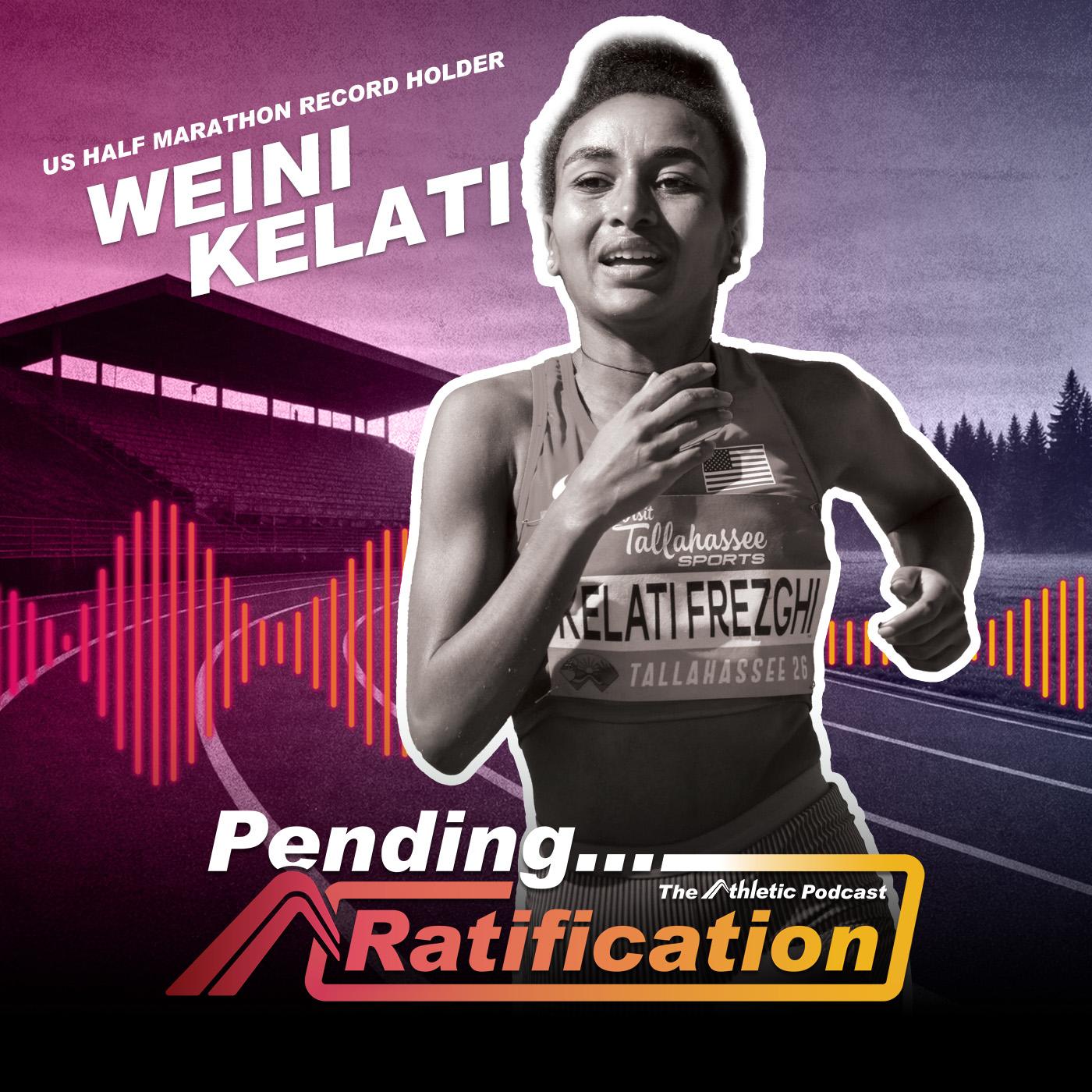
speaker-0: No, no you cannot. So well with that being said, ⁓ let's get on with our show actually. You know, let's talk about our guest who's gonna be on with us today. ⁓ she is an awesome human being. ⁓ her story is incredible from you know, growing up in Eritrea and now ⁓ being a United States citizen and running for the US. She got to run at the Paris Games ⁓ f for the for the US ⁓ and then just most recently rebroke her US half marathon record ⁓ in Barcelona. So that's really Really awesome that she's been able to do that and consistently be a presence on the road scene as well. So, in this episode, let's welcome in Wayney Caladi to pending ratification. You've been through the worst, like methods can break it. Have a world record ratified.
speaker-1: Like keep having fun with it.
speaker-0: Wayne Khaladi, it is always a pleasure to catch up with you. How are things going? How is twenty twenty six going for you so far?
speaker-2: Thank you, thank you for having me. It's going great so far.
speaker-0: Yeah, what's been going on in your world? Give us give us some details. What's been going on in your training? What's been going on in your racing? Obviously you had a pretty good half marathon you wanna talk about?
speaker-2: Well, nothing changed. It's been the same for me, just training with friends here in Flagstaff and working in new goals as I'm thinking to do some long distances. ⁓ I'm adding a little bit mileage at the time to get ready for that and to talk about my half marathon that I have done this early this year. was just like ⁓ nothing crazy. It was just like 75 miles a week training and trying to hit some good workouts there, but it's... Yeah, just like a basic building for longer distances and some faster workouts.
speaker-0: Maddie, you're a pro runner too. Is seventy five miles what it what is your average?
speaker-1: Well, I'm I'm not running the half marathon, so my mileage is up to sixty, which is a lot for me running the eight and the fifteen. But yeah, that's some good work that Wayne's been putting in at seventy five.
speaker-0: Yeah, so then what it I mean, if seventy five is a low base for you, Wayney, what what what's the highest you will go f in in training?
speaker-2: Well, it depends from person to person. A lot of people, they like to do 90s and 100s these days. And I feel like, I don't want to go out there until I change a marathon. When I run track, my 10K and 5K training was like 60, 65. But when I do hackmarth and you have to go a little bit longer during the long runs and that put me into 75. 75 is not a lot these days, trust me. So if I wanted to run a longer...
speaker-0: You're telling me 'cause I do th I do thirty five miles a week.
speaker-2: Well that's good. They're not doing a longer distance like I have in the marathon but I don't think 75 is good enough for distance running so definitely looking forward to improve that. Probably 90, 90 I can handle 90 to train for a marathon but we'll see basically how I feel.
speaker-0: Th that is a lot of mileage. I mean, did you even I mean, what was the farthest you ran when you were in college, Maddie?
speaker-1: Well the highest mileage week I've ever done is seventy five and that kinda that was like exhausting for me. So kudos to you, Wayney, doing that week after week and thinking about moving up to ninety. Yeah.
speaker-0: That is that is a lot. So but of course, you know, we all get to this point in our in our lives. ⁓ we all have backstories and yours, ⁓ Wayney, is is a fun and and interesting one too. You know, growing up in Eritrea, what was, you know, life like for you? You know, some of us, you know, have never been outside of the United States before. We don't get that perspective of what it's like to live in a in a different country, in a in a different part of this world. So, you know, what was life like growing for you ⁓ growing up for you when you were in Eritrea?
speaker-2: Well, of course it was very different from here. I would say I had a normal life, fun, doing things outdoor as a kid because we don't spend our days just... Wasting our time in social medias and watching TV's and all that kind of stuff. ⁓ The things that we will do is just playing after school with your friends, be more social and going to school. ⁓ And walk a lot of ⁓ miles ⁓ to going to school and yeah, just to... A lot of other activities and work to school, I would say.
speaker-1: So when you were growing up in Eritrea, how did you get into running? Were you doing that with your friends or is that some like did you have family members who were runners? How did you get involved in the sport originally?
speaker-2: Well, I always say this, I start running accidentally. That's funny. Because, so, I had no knowledge about running. I did not know anything about it. Just like, of course we would walk and run to school as... Pretty little kids, like a seven years old kid, you just see how to walk to get to school. That's how you get there because there was no transportation. So we'll ask our friends to hold our backpacks and then we'll race each other on the way back from school. But I don't think running would take me this far. I did not know like it can, I can do something with it. So one time I was just sitting with my friends at the sport class, that's what we call the physical education class. And I was sitting, this teacher was like, why didn't you run? And I was like, no, was so, like I was sore from the other day. because you never done something like this so you have to get up and run and I was like okay let me show you what I can do so it was like a mixed boys and girls race so I was the second one boy beat me and he was like ⁓ wow you're really good at this you should continue doing it and I was like what what do want me to do with this? And he was like, you can compete. And I was like, wow, this teacher is not going to leave me alone. well, you get grades based on the performance you do. You do running and a lot of different sport. That's how you get grades for that class. And I was like, I wanted to get a good grades and I ran and he wanted me to compete. And I was like, wow, this is crazy. So I made that excuse. I'm not gonna say it in this ⁓ podcast because the family are gonna be watching because it was a good excuse. ⁓ And he was like, but I grew up being pretty honest. So I can't make up things. when I, like. telling him I started laughing and he knew that I was just lying. He goes like, no, have to come at 8 a.m. in the morning. We're gonna go to different place to compete. And I was like, wow. Thought I was gonna stop here, but he wanted me to do another race or wherever that I was thinking and We woke up early in the morning. We walked to the race place. We were exhausted as a kid It wasn't that long, but it took us about five hours to get there to get to oh, yes Yeah, we were just like in the middle school and sixth is great and it was just like very long walk for us to get there and And I was like, wow, this kids have slept until I get here and I woke up early in the morning to get here. I don't want to lose. I want to win the race. So I get first place. And he was like, oh, you call for the next one. And I was like, wow, when is it going to be in? And so they took me to the city. And I raced with the professional runners that I've been training for two, three years. And I got third. I wasn't happy about that. I was like, I thought you always get first place. But how did I end up getting third? And they were really happy. They said, ⁓ do you know this runners they train every day? And you beat them. And I was like, I don't know. I just win first place. That's how I get into running.
speaker-0: So you only knew how to win because that was the only experience you really had when you first got in. You didn't know anything else. If you lost you're like, ⁓ I don't want to do this anymore, right?
speaker-2: Yeah, I've been getting second and third place wasn't me because every time when we race each other coming back from school, I used to get first place. So that's what I wanted to get. It doesn't matter. It doesn't matter whether it's a boy or girl. I just want to win the race.
speaker-0: So whatever it took, it no matter what, like you could go out there and trip somebody if you really wanted to. And you just wanted to get first place.
speaker-2: Running gets harder when you get to know it actually but first I was like, okay I'm gonna get first place and it happens somehow but when I get third it was hard for me and I was like, hopefully they're gonna They're gonna leave me alone not to do it again, but they said ⁓ that's pretty good You should continue and I was like, wow, that's very interesting and Fun fact I had another race though. It was like in the middle of the class that they had to call me ⁓ you have to do this race because you have to to qualify for nationals and I was like what I thought we were done and I wasn't training already so they said ⁓ like you have to go right now ⁓ school is not gonna count as you like it's not gonna count you miss school if they take you from school Because they take that responsibility. So they took us to this place and they said, you're going to run cross country. I've never heard of it. And I was like, what is that? And they took me to this place and the race was done by the time we get there because we walked. It was far. So we found one person that was a coach for the professional runners and he told us, the race is done. And I was like, wow, we walked this far and the race is done. What are going to do right now? And he told us, well, we're going to time you. we were five other runners from the same town. So he said, you get to run and we're going to time you. If you get a good time, then you get qualified. I wasn't thinking about that. All I had, like in my mind I just, how do I finish this race really quick so I don't have to worry about it? And he told me you have to run, it was two K-Cores and he said you have to run three times. to for in here and I was like what are you crazy that's that's pretty long so I started I took off I just took off like a sprinter so I didn't even know how to run a pace to pace myself and run the race I ran and I finished it in um two and four minutes for six k course it was pretty hilly and I had no running shoes and he was like no you're pretty good you need a cod fight for national we need you and I joined the National Army.
speaker-0: So you you initially it seems like you're trying to find your way out of it and then to just keep pulling your break back into it.
speaker-2: I know, I just like, don't want to do it anymore. was like, hopefully I will be done after this, but they keep telling me, ⁓ you're good. You should continue. You should do this. And I was like, ⁓ my goodness. Running pulls me back and I wanted to quit running.
speaker-0: Have you have you ever had an experience where you know and I'm sure everybody has their different running stories, but like have you ever had an experience like that, Maddie, where it's like, this sounds really fun at first and then you do it, it's like yeah, I don't want to ever wanna do that again.
speaker-1: I mean, for me that was probably like every cross country race ever because I've just never been good at cross country. But this is just so fascinating to hear because I feel like for a lot of athletes, especially in the US, they're specializing in track and field so early in like focusing on it trying to get, you know, a college scholarship or what you know, whatever, like from such a young age, ⁓ for better or worse with that. But like this is so you're you're just a competitor at heart, so it's just really cool to hear this story and here that you would just go and try to win, just 'cause you wanted to win, not because you were thinking about anything ahead of what was happening on that day. ⁓ yeah, that's really fascinating to hear. I feel like, ⁓ I can't relate to that at all. Like ⁓ my stories of not wanting to run are like so different than that.
speaker-0: So where did that competitive drive then come from for you, Waney?
speaker-2: ⁓ I've done maybe from school. I used to be pretty good at school. was in it. So here we don't have to place based in our grades here in the United States. But back home, they do that. You have to be like one, two, three. I was always in the top three students. And if I don't get top three, I used to just cry or just like don't feel like I have done enough for... School, have somehow, maybe it comes from school, I always ⁓ have had this competitive mindset, even though I don't know where running was going to take me.
speaker-1: Yeah. Do you have siblings who also run or ⁓ were you just doing it out on your own?
speaker-2: ⁓ A lot of cousins that following the footsteps right now, which makes me really happy. Some of them were born after I left Airtree, some of them are, they were pretty young ⁓ when I was there, but yes, I do have a couple cousins who run, not none of my sub-amines though. They used to do cycling and one of them ⁓ running, but they quit.
speaker-0: So for so then you kind of blazed a little bit of a trail for your family to kinda get involved with this. I mean w I mean it sounds like maybe your were your parents involved in running it all or was it kinda just you found it on your own?
speaker-2: No, I mean my family, they used to tell me that they were ⁓ very... I would say they were pretty athletic in every sport, but they don't do it for just... I don't think they know that running can bring something into their life. They were just doing it for fun when they were young, but they never continued ⁓ running or other sports. So I think I'm the first one from my family and everyone is doing it right now, which is good.
speaker-0: That's awesome to hear. Well, one of the first opportunities that really came for you as you kind of pointed out about, you know, some of the younger races that you had, whether it was an elementary school or middle school, but the first time that you actually got to experience like a national championship or even like go to a global championship was coming to Eugene in twenty fourteen. How did that opportunity come about and how were you able to qualify for the world junior team?
speaker-2: Well, I have represented Eritrea and a couple other African championships outside of Eritrea. ⁓ Yeah, and like not in track but in Chris country, like I have represented Eritrea in many different states. Just for track it was different. I went to France to get the time qualification because it's high altitude in Eritrea, the time doesn't count and you have to go outside of Eritrea to run on your own to get the standard to be able to qualify. But I did not know that was ⁓ going to be the next one here in the like high work field at the high work field in the United States. I was just like running to get the standard and I was lucky. I was the first junior girl at the time who has the only time qualification. Yeah.
speaker-0: So did you know anything about Hayward Field or anything about the United States prior to coming over and and racing at your first World Juniors?
speaker-2: Not a lot. used to watch a lot of DaemonLeaks and other track races back home. All I know is the DaemonLeak that happens in Egypt. That's the only thing that was in my mind. Also, well, knew about, Miff Kflesky was one of the very good ES runner at the time when we watched the TV like World Championships, Diamond League or other sports. His name will come up on the national TV that he represents United States and he was an Eritrean American.
speaker-0: So you had it so you had an idea, you know, what the running scene was like in the US, just based off, you know, some of the athletes that have performed at the World Championships or as as you pointed out at the Diamond League. But when you came to the US for the first time, were w were your expectations different? Were they the same? Was your experience like what what how would you describe your experience when you first stepped onto Hayward Field?
speaker-2: Well, I had no idea what's gonna look like, what's gonna be. ⁓ As I first arrived in the United States, I did not know anything about... ⁓ I know, as I mentioned, I know, like I used to watch ⁓ some races on TV and I know a lot of foreigners, the sprinters especially. ⁓ The US Winters were pretty competitive against the Jamaicans and I loved watching them. ⁓ But other than that I did not know, I had no idea.
speaker-0: Well, I think we did a little research, Maddie and I did. Your favorite athlete, do you wanna tell her wh who her favorite athlete was? I think it was
speaker-1: Right, we we did see, ⁓ I think it was in your college bio that your favorite athlete was Usain Bolt. Is that still true today?
speaker-2: Yes, it is. It's just like, as I said, I used to watch a lot of DemonLeaks and World Championships and... ⁓ I feel like he's a perfect example of what athletes need to be in the field, out of the field. And so my favorite thing about him was giving high five for the kids who carry his stuff. And he handled ⁓ the... ⁓ I like after he went, he handled everything like a pro. And of course, that's no doubt he's still my favorite athlete.
speaker-1: ⁓ that's awesome. So for those who don't know your story, you come over to the US, you race at Hayward Field for world juniors, and you decide to stay in the US instead of going back home. ⁓ you end up going to Virginia, growing up going to high school there. ⁓ can you tell us a little bit of just the complexity of emotions, like what that was like ⁓ deciding to start a new life here in the US instead of ⁓ going back home at that time at what sev seventeen years old I believe.
speaker-2: Yeah, I mean, like I've mentioned many times this, coming here, I did not know anyone. I didn't know what it's gonna look like. ⁓ But all I was thinking was like, I'm just gonna stay here. I don't know how, though. And I found this stranger who became a family. I saw them ⁓ at the track and I was like, ⁓ I wanted to stay. I go with you? That's how I was able to live after the competition. And after I find out that I have cousins here in the United States, I was able to contact them through a distance cousin. And I stayed in Eugene for a week and then I flew to Virginia because my cousin, my third cousin, my third distant cousin asked me if I wanted to come and live with him and I said yes. And he was a runner ⁓ himself. He went to college. He got scholarships somewhere in Texas. I don't remember the name of the college that he attended, but he knows a lot about running and he was pretty happy that ⁓ when he, after he found out that I was a runner and I want to continue running, but I don't know how at the time, but once I, ⁓ flew to Virginia and I said ⁓ I wanted to work. That's when it comes to discussion that I don't want to get, I don't want to continue running because I don't know ⁓ what are the future going to be. What was the future going to be about running? And I was like, okay, I'm just going to. work and help my family but he said you still can continue running and help your family and I will show you how that's what I do now like when I was young so you can ⁓ still go to high school and that will open a lot of doors for you to continue running but it was amazing because I was lucky to have him in my life Just he knows where the good team in Virginia and he contacted me with this coach and I was able to make quick friends and life was amazing in Virginia. It's like to make a new friends and continue running.
speaker-0: What was it like that first week in Eugene and just realizing you know you had made this decision, you do not know who these people are that you are with now, and then all of a sudden you find out you have a cousin in Virginia. I mean I can only imagine, you know, I'm sure English was obviously not your first language. I'm sure you were, you know, learning a lot on the fly. You know, what was that first week like being in Eugene?
speaker-2: was it was pretty hard. I was getting very emotional that knowing I'm not going to see my family again. I wasn't able to sleep or eat even before the race. So, and until that, my back doesn't make it there. I had no clothes to change. I was staying in my room. almost like the entire day and night, just crying and wondering what I'm going to do. But once I see these people, they were Eartran's, I feel safe because as I always say, the Eartran community are very welcoming and very connected. It feels like you found someone from ⁓ a family member. That's how it felt the first time I saw them at the high work field. And I don't stay awake with them, just to clarify. But they drove me to someone who knows my cousin.
speaker-1: Gotcha. So are you still in contact with these these people that you found at like watching you at Hayward Fields? Are you still in contact with them today?
speaker-2: Well, not these days, but I have met them a couple times when I was in college and I had a good connection with them. But when I turned pro, I think, hey, they're busy and then I became busy. We didn't get to talk that often. But I'm pretty sure one day I would love to go and visit them.
speaker-0: Yeah, for for you then moving to Virginia to go, you know, live with your family. It sounds like you're it was your third cousin. Did things become a little bit easier then because there was some familiarity?
speaker-2: I feel like relief that I found my family member, but we didn't know each other at all. So, but I feel like, I'm safe. I'm with my family right now. So that's all I was thinking to go back and think about.
speaker-1: Can you remember what were some of the biggest culture shocks or things that just seemed maybe like silly about the US when you first moved here?
speaker-2: Well, I don't know. can't remember. I mean, the... had... The lung barriers was... That's the biggest problem, I would say, but... I don't think I... had a problem with just... getting used to the culture because... I know it's very different, but I have friends, ⁓ really nice friends that helped me to just... get used to it really quick.
speaker-0: Well, I g I gotta ask, just from a food perspective, what was the very first American food that you had that you were like, This is so different than what I grew up eating?
speaker-2: Well, everything. Even the fruit was very different for me. Not the other fruits. the first... Even, I would say for three months, everything I tasted was very different. I can't eat. So, I just like... I was eating a lot of cookies. That's pretty bad. I know. But... It's... ⁓
speaker-0: What kind of cookies?
speaker-2: A lot of different kind of cookies. I can list the names. The chocolate chip and then like the other. Oh my goodness, what was the?
speaker-0: Chocolate chip or
speaker-2: ⁓ Oreos, my goodness.
speaker-1: ⁓ yeah.
speaker-0: ⁓ yeah. Double stuffed or regular stuffed?
speaker-2: It's very interesting. It has the whipped cream inside of it.
speaker-0: Mm-hmm. Yeah, but what I'm asking is do you like the double stuffed Oreos or do you like the Oreos that are j like the the ri the or the normal Oreos, I should say? Double stuffed has more cream in the middle. Okay. That is the right answer and the right and the only
speaker-2: I used to have the It's really funny. Because every food I tasted was very different. I can't get used to it. And I rather taste something dry. Not like, I wouldn't say it's a food, but it's like something, a snack or something similar to ⁓ the food that I grew up with.
speaker-0: So did you have the Oreo cookie with milk, at least?
speaker-2: I do sometimes but the milk taste is very different mostly with tea.
speaker-0: Interest I have that's an interesting commentation.
speaker-2: You ever tried that? It's very... No way.
speaker-1: Not
speaker-0: What kind of tea?
speaker-2: The black tea, no sugar and plus the Oreo, I guess.
speaker-0: Interesting. I might have to I've I I'm ne I'm not a tea guy by any means, but that's I've never heard that combo. Yeah, I mean that if if it what what would you if you were on a scale of one to ten, what would you rate having an Oreo in a cup of tea? What's what what's that experience like?
speaker-2: If you ask me if I can eat it right now, But at the time, it's like better than sleeping hungry, I guess. Because as I said, the food taste is very, different. It took me six months to get used to it.
speaker-0: ⁓ no. Wow. Jeez. Wow. So then were you at the time when you were living in Virginia, was that kind of at the start of when you were working or was that when you started attending school as well?
speaker-2: ⁓ but I mean like I start work working later, but when I start school most of the time
speaker-0: Yeah. Yeah. So then what was that adjustment like, you know, going to, you know, a a public school? I mean I know obviously you were in school back home and if you weren't top three in your grade, sounds like you would get upset about that. So, you know, what was that adjustment like being part of the the the d this type of education system over here?
speaker-2: the teachers were very nice and the friends my friends were ⁓ trying to teach me some like English but it was it was in it I won't say it was an easy ⁓ transition for me it was very hard I was struggling ⁓ because I don't understand what they were saying in class at the same time fun fact Here, we have to switch classes for every subject. Back home, we don't have that. One time, so I was in my English class, I thought another teacher will come in instead of switching classes. I stayed there. There was like another students that came in and I took class with them because I did not know what to do. I suppose not being in that class, it was hard for me and I was like, wow, this is like different than usual. But what's happening here, I don't understand a single word. So then the teachers, called my family, I guess. They figured out that I wasn't. ⁓ I did not leave school and they were trying to find me by knocking every door. So I was seeing some students that I supposed not be there. It was very interesting.
speaker-1: ⁓ wow. I can't even imagine what that was like. also that I feel like I remember in some of my college classes if I would get a little lost and have no clue what was going on and I still I understood the language, I was just getting lost in the content. So ⁓ I can only imagine how how difficult that was for you. did you have an easier time just with your studies and stuff by the time you had decided to go to the University of New Mexico to run and get your education there? ⁓ did school become a little bit easier by that point after having a few years of high school in the US under you, or was like the switching of the classes and all of that was that just like a constant ⁓ challenge throughout getting your education?
speaker-2: Yeah, mean college was like very easy for me. ⁓ Just getting used to the system and all the, ⁓ I was able to understand to speak English. ⁓ It was like the easiest transition for me going to.
speaker-1: What did you major in when you were in college? What's your degree in?
speaker-2: Publish and hold.
speaker-0: What was your experience like in Albuquerque? Because you know, you come to Eugene, Oregon, completely different than I'm sure Virginia, and then you go from Virginia to Albuquerque, very probably a little bit similar to Eritrea in the sense you're at out at altitude, but like you're just going from all different all these different places and experiencing different parts of the United States. So, you know, what was that like for you to go to another place in the United States?
speaker-2: Where I love Albuquerque. That's when I felt like, I find this... So I took my visit when I was in high school. And I had a few colleges that I wanted to attend in terms of like, they have a good running team in school. And I visited a few colleges and... But my first visit was the inverse of New Mexico. As soon as I landed in New Mexico, I felt like, wow, I love it. Because I used to live very similar back home in Eritrea. It's high altitude, know a lot of trees, and we don't have that humid and hot weather back home. was just... Most of the time is 75 The hottest can be is 80 65 is the I don't whether when it goes 40 people complaints and I just Albuquerque brings the memory that I grow up and it feels like a home for me That's why I just I love Albuquerque
speaker-0: So how did you know Coach Franklin make that transition easy for you, along with the fact that you guys had so much success when you were in school, when he was the head coach at the University of New Mexico?
speaker-2: Coach Franklin was amazing. So Laura and Jimmy as well. The whole community in New Mexico is very tight. They have a great... ⁓ Athletics facility, would say, especially for cross country. And I've seen their team winning NCAAs before and just I was really happy to be able to join their team. And when I get there, ⁓ Joe was a great coach and ⁓ always cares about his athletes and coach Laura my goodness, she's ⁓ like a big sister and a mom I would say she really took care of us so it feels like I was with my family not in college where you have to do everything in your own and ⁓ You struggle handling things But in New Mexico it was very different you create a family. It just took which were part of your life. I would say he, Joe set me up for good, not only running, ⁓ like for future, like making decision going to professional and all that stuff.
speaker-0: Yeah. When you look back, you know, in twenty fourteen when you had made that decision to stay and then, you know, X amount a year later, I would say what, you graduated in twenty twenty one from University of New Mexico. Yeah, so seven years, so much has happened over that span of time. You you f you finally find something in Albuquerque that just like this is a family.
speaker-2: Thanks.
speaker-0: Would you have had it any other way over those seven years with the journey that you were part of, you know, just not knowing what it was gonna be like after you decided to stay, and then seven years later you have an education, you have a degree, you've been a part of some very, very good cross country teams at the University of Mexico. Would you have wanted life any other way?
speaker-2: No, I wouldn't trade that for anything else. That was the best experience I've had. And I'm so proud that I was able to do that. And I'm very thankful to have the right people who guide me to go the right direction instead of ⁓ working in this grocery store or other, I respect the work, but ⁓ it's just very different. So. I would say I'm very thankful for the people who helped me to get here.
speaker-0: I am curious though, because your your background's a little different than some international athletes. Because, you know, some of them they don't come to the US until, you know, they are in college. Whereas you, you start, you kinda got that high school experience and you got to experience what that that, you know, racing against high school athletes and that the ability to go, you know, get recruited and all that stuff. So, you know, how big of a difference is it from an international's athlete's perspective to run? in the N C double A system 'cause it is not only life changing for you, it's life changing for a lot of people.
speaker-2: Well, it's amazing to go through that because it will make you stronger for ⁓ wherever you wanted to do in life. it's the biggest league after Olympics World Championship in Diamond Lakes. I would say it's the first biggest sport. and it's in the United States. We are lucky to have it. It helps you to grow mentally and physically. mean, it's just like every time when you do a race, you know that you're racing against a lot of runners that come from across the world. And you feel like you're racing almost at the world championship. It's just like... We're all at the same level getting our education and trying to learn how to handle everything. So I think every runner that passed by NCAA or college is anything can handle because we learned that how to raise, fail, and achieve the goals that we want on the highest stage.
speaker-0: Everyone's there's the phrase, the American dream. Have you felt like you've lived that? Have you felt like you've gotten the American dream just based off your experiences here?
speaker-2: Well, sometimes I feel like, I have achieved a part of it and sometimes I feel like, no, I haven't done enough for it yet. ⁓ And the reason is because my goal is, always, I have like a very high goals and until I achieve that, don't feel like I've done enough for it because ⁓ I feel like I have the ability to go further.
speaker-0: I I honestly love to hear that. I mean the fact that you you're you're not satisfied. You're not satisfied with just stopping here, Waney. It seems like you have a lot more unfinished business to take care of in in this running career than
speaker-1: It goes all the way back to when she wasn't happy with getting third place in those youth races.
speaker-0: Not even the youth racist. In the classroom, she was not happy with that. So if she's not what's the saying from Tal have you ever seen Talladega Nights before, Wayney? If you ain't first, you're last. That's the saying in Talladega Nights. So I'm not saying you need to live by that that line your entire life, but that's the first thing that comes to mind. And I'm making
speaker-2: No. That's right. That's how I feel sometimes, you know, like, um, when you have some big goals, you feel like, wow, like I wanted to get there. I feel, I feel like I'm heading into the right direction by doing this little things that can get me there, but haven't accomplished or achieved anything that I want in life in terms of running. I'm pretty happy the life that I have right now and doing all the NCAAs, high schools and getting my degree and ⁓ I look back and I feel like, I'm so proud of myself. I'm able to do this with ⁓ my family. You know how much I miss them and... ⁓ And I still can be like the same as the other athletes or other ⁓ kids that have family with them in the United States where they can call their they can talk about every problem they have. I don't have that. I have to deal ⁓ with whatever I'm doing by myself and tell myself my family that I'm doing okay. I'm good and still try to take care of them. But in terms of where I want it to be, ⁓ I don't think I have done anything for what I can do. ⁓ Just like I'm proud of this little moment and little ⁓ steps that I've taken toward to achieve some bigger goals.
speaker-1: Yeah, your story is really inspiring. Like you're clearly a very resilient person and a resilient runner being able to, you know, put on a happy face for your family all the time just to make them feel at ease. Like that takes a very strong person. this kind of brings us to some more recent news for you. You've recently switched from running for Under Armour to Nike. ⁓ and in light of all the goals you're talking about and and everything you want to do still, how has running for Nike been for you so far?
speaker-2: Yeah, the last few years was under Armageddon, it was really great and it was the hardest choice to make. ⁓ I will say every time when it comes to something to make a decision, would never been easy for me as it's I have to deal me and myself. But I'm very happy because Nike makes it very clear that they're very interested on working with me and I'm looking forward for the long partnership that when we can what we can achieve together.
speaker-0: Well, the first race that you ran in the Nike kit was pretty good, I would say.
speaker-2: Thank you, but still more to come
speaker-0: I mean I w I was gonna say I I would think, you know, breaking your own American record is a pretty good way to start in in the new kit. Not that, you know, when you were in Under Armour, I the last time that you wore an Under Armour kit was when you won the US title in in Portland and cross country. And you and I got a chance to talk about that and how special that was for you. But, you know, this is a new part of your life. This is kind of like it's in the year twenty twenty six where, you know, it's it's a year of new things. This is one of those things. ⁓ but you also seem like, you know, you're you're wanting to step up in distance a little bit. It sounds like, you know, you have been doing a couple of half marathons, but maybe it might be time to do the full marathon. Is is that something that's on your radar this this twenty twenty six year?
speaker-2: ⁓ yeah, I mean, I feel like this is the time because I always like to take my time and do what I'm doing, like what I'm doing. At the same time, I have to make sure that I'm not wasting my time. The short-distance is when I know I'm good, but not great and ⁓ track because It's getting crazy. And to be able to middle on track, have to have that speed. ⁓ I always loved the road racing, but I have to make sure that I have to do good the things that I don't like, which is in the track side. So I always, I was like, this is my last year. I'm going to go up to distance, but I... So I was like, no, I haven't finished a business. I have to make the team or do great in the track side. That's why I was keep going back to the track. But finally this year feels like it's the right time to step up and do some long distance racing.
speaker-0: Do you feel like even to your point about track getting so much faster, so much quicker? Do you feel like you have to do a little bit more track races now because the roads are getting quicker? I mean, I know you watched what happened in London over this last weekend, and not only you know you had two men break two hours in the marathon, but you had someone finish third and run two hours, and you have a a woman running two fifteen for the fastest recorded marathon time. So do you feel like you know there's gonna be a mixture of, you know, getting some work on the track and and getting quicker that can translate over to the roads?
speaker-2: Yeah, absolutely, because I'm not saying the marathon is slow. It's getting even crazier because you have to long that, you have to handle that pace, that fast pace for a very long, long time. it's, when I see it, I feel like it's almost the same. They ran same as a 10K race. And you have to do that like four times, four 10 Ks, even more than that in the marathon. That's crazy to me. I'm just like saying it's very different. To be good at the track side, have to come from the short distances. Like you have to have this like a very sharp speed, whether you used to run a 400, 800, or 1500 all the way to 10K. I didn't have that. I started as 5K, 6K. I was a distance runner from the beginning. It's hard for me to go down than going up. So for the grid racing, of course, I'm going to do some track ⁓ races that will help me to improve my speed. I'm still going to work on my speed while I'm doing the ⁓ longer stuff just to. To be good at it because ⁓ all the runners that they do marathon used to be like really good track runners too. You have to have that closing, you have to have that entrance, you have to have everything.
speaker-0: Yeah. Well, and given how fast the US women right now are ra racing the marathon distance. Again, going back to Boston, what those ladies were able to do, you know, even at the half marathon distance with the the ten mile, you got Emma Grace Hurley, you know, doing her thing, Jess McClain doing doing her thing. So, you know, I I feel like in s some ways or the other everyone's just watching what they're doing and then just bettering it. Just getting faster, getting stronger. And just making it competitive, which I think at the end of the day we all want that. I mean yes, we want to win, and I know you you love winning, but we also want it to be a competitive and and make each other round each round each other much better than everybody else, right?
speaker-2: Yeah, I mean that makes you better. Like our distance women are getting amazing. I mean like I was like it's getting very competitive. It's just to be a part of them and I know we push each other to better results and to faster times and it just makes me happy to see that and hopefully I achieve something in the distance running as well.
speaker-0: Yeah. So I I gotta imagine then L A twenty twenty eight, would we see you run a marathon at those Olympic Games?
speaker-2: Yeah, sure, that's the goal.
speaker-1: So
speaker-0: That would be really exciting to see you to see you run that. And then, you know, of course, you know, being a a US citizen and racing at the ⁓ in the United States during the Olympics would be probably just a dream come true. I know that's been an on on the topic, especially when you qualified for the Olympics in Paris. And you know, that was a great moment for you to enjoy that, but I gotta imagine if you qualify for the US team, that's gonna be at like the top of one of your greatest moments of your career.
speaker-2: Yeah, I'm excited for what to come because ⁓ as you mentioned, that was my first Olympic team that I made. ⁓ And the 10K, retract team. And this one is gonna be very different and it's gonna be here in the United States at the home soil. And very excited. ⁓ Hopefully it will be one of the... five or six women are able to make the team and run to get a good result.
speaker-0: Yep. Well, and you got to experience that when you were at Tallahassee at the World Cross Country Championships earlier this year, which was a very cool opportunity, and kind of just like a little bit of a taste of what's to come for hopefully ⁓ twenty twenty eight when you can represent the red, white, and blue again. So ⁓ we're as we're getting to the end of this episode of pending ratification, we are gonna go to a segment called Records Under Review. It's kind of a rapid fire segment, and these are very lighthearted type questions. I know we sent them to you. Hopefully you got some answers. Prepare for them.
speaker-2: ⁓ So.
speaker-1: Don't wear boxing your spikes.
speaker-0: So I'm gonna start off with mine. Give me your Mount Rushmore of your favorite T V characters.
speaker-2: Oh wow. It's crazy I didn't even realize I'm back. You know, I don't watch TV's.
speaker-0: ⁓ okay.
speaker-2: Yeah, I don't have none.
speaker-0: Well if you don't watch T V then give me your Mount Rushmore of your runners, all time runners.
speaker-1: Top four all time runners. You know Usain Bullets on there.
speaker-2: Hmm, so it has to be from any event
speaker-0: It could be anything. It'd be your any all time greatest runners. Who are your four favorite runners of all time? Mm-hmm that are on your mount rushboard.
speaker-2: ⁓ message a person ⁓ can i add someone that retires
speaker-0: Yeah, I you so you got Usain Bolt, you got MJ W. Who else?
speaker-2: Alison flex because she never disappointed I used to pick her when I was in Eritrea and always wins that makes me happy and ⁓
speaker-0: Alright, that's three.
speaker-2: Oh my goodness, I need to get some distance renders too.
speaker-0: You can throw a thrower in there if you want.
speaker-2: A throwers? Well, I don't think I watched that.
speaker-0: You could easily just say Ryan Krauser since he's arguably the greatest shot putter of all time.
speaker-2: ⁓ yeah! ⁓ my goodness, okay wait. Perfect! ⁓ And do I have to find like a... I mean do I have to get fourth? The fourth one? Do I have to...
speaker-0: If you if you want to just do three, that is perfectly fine.
speaker-2: Okay, I'm pretty sure I have a lot of them, but once you ask, I just get lost. I don't know why.
speaker-0: That's okay. So all right, Matty's got one for you.
speaker-1: Hard to pick on the spot for sure. Next question. If you could be front row for the concert of any band or singer or performer of any kind, dead or alive, what who would you choose to be front row of their concert?
speaker-2: ⁓ my goodness, Beyonce.
speaker-1: Great answer. Great answer. I would be there right next to you.
speaker-0: Beyonce. Okay. What's your favorite song by Beyonce?
speaker-2: Oh my goodness. Um... No! Oh my goodness.
speaker-0: And you have to sing it. Yeah.
speaker-2: Well, I like all of her songs. I don't know. I'm pretty bad. I pick one. Sorry. Don't ask me to pick one of her songs. I don't know.
speaker-0: That that is that is that is perfectly okay. So all right, my next question for you is how would you describe your job to a five year old? Like what you do for a living.
speaker-2: Well, fun, flexible, and lot of travel. Does it count?
speaker-1: Yeah.
speaker-0: Mm-hmm.
speaker-2: Well, in a running way. Well, I would say it's fun to do it and it'll help you make a lot of new friends and you can travel around the world and ⁓ you have to have a goal and work hard for it. I don't know if they can describe it.
speaker-0: I think that's perfect. That's that sums it up for running.
speaker-1: Okay. Two more questions. Next question. What is something that's at the top of your bucket list? What's something you wanna do non running related? What's something that you wanna do before you die one day? What's at the top of your bucket list?
speaker-2: after I retired from running.
speaker-1: Yeah.
speaker-2: Well, I want to work at the hospital just helping people as a population health major. I'm in major.
speaker-1: Yeah, that's awesome. That's wholesome.
speaker-0: That's awesome. All right, last question for you, and we told you at the beginning of the show, or at before we were started recording this, that you had to think about this one. This involves ⁓ if you were to set a world record in something non running related, what would that world record be?
speaker-2: You know, swimming.
speaker-0: Swimming, okay. When and what what what specifically in swimming?
speaker-2: Yeah. I would say the short distance. I don't know how 100 meters sprinting. The reason I picked that is I don't know how to It feels like...
speaker-0: Okay. All right. Yeah. So you think you Katie Lad
speaker-2: It feels like very fun just watching it and I feel like I wish I know how to do that.
speaker-0: Well maybe that's on your bucket list then. Yeah. Learn how to swim. We really appreciate
speaker-2: Learning how to is my bucket list.
speaker-0: ⁓ that's a good one. That's you okay, learn how to bike. Gotcha. Okay. Well that one I think we can definitely work out. Maybe we we we could maybe the next time you're in Eugene, we'll get you a bike and then we'll teach you how to ride a bike when you're here at for for USAs. How about that? ⁓
speaker-2: That sounds fun.
speaker-0: Awesome. So well, Wayney, it is always a pleasure catching up with you and thank you so much for sharing your story. I know it's one that as Maddie has pointed out, it is one that is both inspiring and one that, you know, people can look up to and, you know, just get a better understanding of the you know. We we only see you runners as as runners at the end of the day. We don't necessarily know what goes behind the scenes. So we are very grateful for you for sharing your story and telling us all about how you got into this sport, how you know, you found, you know, a purpose in this sport. ⁓ and we're glad that you're you're continuing to do this 'cause you're doing an awesome job at at this sport. So ⁓ again from me and Maddie, we again really appreciate your time. Good luck this twenty twenty six outdoor season and the road season. and you know who who knows what this year will look l look like the rest of the year, but I'm sure great things are to come and and of course the next two years we when we look at LA twenty twenty eight. So Wayney Kalati, really appreciate your time. ⁓ thanks again for hopping on with pending ratification.
speaker-2: Thank you, thank you for having me. This was fun to do and hopefully we will have more stars to tell outside of running when I'm ready. But thank you, that was fun.
speaker-0: Awesome, appreciate Wayney. Hey everyone, thanks for tuning in to this episode of Pending Ratification.
speaker-1: If you enjoyed this episode and want to tune into more, be sure to check out runnersface.com or subscribe on Spotify and Apple Podcast. And I'm your co-host, Maddie Mooney.
speaker-0: I am your co host Keenan Gray. This episode was produced and edited by Ben McGrath and Ian Turpin. Catch you on the next episode of Pending Ratification. Lekker!
speaker-1: It was great. I ran a eight hundred at the ⁓ Oregon Team Invite ⁓ on the open day. And I'll tell ya, racing in Hayward is always fun, even at a meet like that where it's not very busy, so it was like mostly kind of an empty stadium. It's still such a cool feeling. So yeah, it was a great opener. Excited to race some more.
speaker-0: never know what that feeling is like. I have okay, I take that back. I have ran one lap around the Hayward Oval. It was the media four hundred for the Diamond League final in twenty twenty three. And I did not break sixty seconds. I was trying to train for it. I ran in flats. I think I ended up running like a sixty two in flats. I was actually okay with that. Yeah. ⁓
speaker-1: That's pretty good, honestly.
speaker-0: I lost to one of our my our colleagues at at Athletic Net, Logan Hannigan Downs, who he ran in spikes, he ran a fifty seven. ⁓ no, I know. I felt I felt like if I would have had spikes, I probably could have ran at least fifty nine, maybe fifty eight seconds. Like I was trying to tra I was training hard for it. I may have had like three weeks out, so probably not enough time to do a lot of speed type work. Like I
speaker-1: That's the only reason why.
speaker-0: I would go to the track right down from where I live, do reps on that, I would do hill sprints next to where my apartment is at. ⁓ clearly that did not work because one, I didn't have enough time to prepare for that. And two, I ran sixty-two seconds. So if if that's
speaker-1: I tell ya. What always makes what ⁓ humbles me is that ⁓ the top American women in the fifteen hundred will close their fifteens in sixty. Wow.
speaker-0: You know what I mean? You are making me feel very I know. They're and they're and they're world class athletes. Some of them, you know, medalists, some of them American record holders, some of them, you know, that do just a fantastic job at this sport. ⁓ so that's cool you're able to, you know, get your your season underway at at Hayward Field. Anything else going on on the outside though? I mean running can't be the only thing you're doing.
speaker-1: Hm, believe it or not, I do have some hobbies right now. I've recently picked up line dancing and I've been playing some community volleyball with some of the Eugene community members. yeah, I've been ⁓ I've been staying busy outside of the running. Something like that. Yeah.
speaker-0: So you're multi sport athlete now? Like what's what's line dancing like? I've you know, there's thoughts of me trying that, then I realize I'm am scared to dance in front of public, so then I kinda pull myself away from it, but
speaker-1: Well, you know, there is always a lesson. It starts with a lesson, Tuesday nights. This is what I'm doing on Tuesday nights. And the lesson goes well. And then they open it up to just normal line dancing and e like everything goes terribly because people are very serious about line dancing in this community. You can't just jump in and try to like follow someone's footsteps. Like people will get pretty pretty upset when you're messing up the flow of the dance floor.
speaker-0: And were you one of those people that were like, Yeah, I can go in there and do that and then realize, No I can't
speaker-1: One hundred percent. I thought for sure. I my my arrogant self thought for sure I could just pick it up and dancing is not my forte. I don't maybe like I've probably gone like five times now. So Well you're that's true. I mean that's true. I don't know if the rest of people would say that, but
speaker-0: How many weeks have you been doing this now? Yeah. I mean if you look at compared to where you were the first time versus the fifth time. Very true. Maybe you made like, you know, one percent improvement. I have no idea.
speaker-1: I I think of it as a form of cross training, you know. I'm really like working my brain, working my feet, trying to keep up with everybody. Volleyball, ⁓ similar ability level for me, honestly. I play. My team has four former division one volleyball players on it, one of who was a professional up until last year. So, ⁓ my job is usually to just like get out of the way while they do their bumps, what is it? Set bump spike.
speaker-0: So then what's volleyball then? Well, set spike is what I was told when I was at
speaker-1: See, I don't even know what's going on. But ⁓ it's fun and we crush every team we play, so I th it's confidence booster. Is that because of you? ⁓ it's absolutely not because of me. You could take you can take credit though. Well I'm I'm the moral support, I'm the personality hire. So Yeah. Who's on court, hype woman on court.
speaker-0: You're the hype woman. Yeah, so you're just you know, you s so you're just standing in the corner and just cheering everybody on and hoping you know, the ball does not come towards you.
speaker-1: Some yeah. Sometimes when we're way ahead they'll like let me spike and it usually d I can't jump. I'm only five four. I can't like get up that high. It usually doesn't go over the net.
speaker-0: And you would be a perfect libero if that's if that's the case. Well, ⁓ on in my world, I just got back from like a seventeen day trip from Los Angeles and Des Moines, Iowa. And let me tell you, at first, you know, it's a great idea. This sounds awesome. I get to go cover track meets across the country, and then you know, your day ten to it, and you're like, okay, I'm ready to go home.
speaker-1: So maybe one day. Yeah.
speaker-0: Yeah. And that's how I got at the kind of at the tail end of it. I was getting very, very tired. I loved every minute of it. It was fun. But to a point I'm like, all right, I'm ready to go back home and get back to my own bed and get back to a routine. But, you know, I got to sa see some really cool performances, some really cool stadiums, meet a lot of cool people, and just experience, you know, track and field ⁓ up and down the West Coast, but also in the Midwest. And I gotta tell you, Drake relays. They love their track and field. Absolutely. I don't know if you got a chance to go when you were in school. I know Wisconsin had a couple of field athletes competing there this weekend, but let me tell you, if if you're a track field fa athlete and you've never been to the Drake relays before
speaker-1: Better.
speaker-0: go to the Drake relays. It is without a doubt one of the coolest experiences aside from the tornado warning that I had to deal with. Stuck in a Mexican restaurant, although everyone seemed like it was perfectly fine. It was just another day in Des Moines and we survived it. So I think that's the best lame part of it like I survived the tornado warning.
speaker-1: No, not everyone can say that. Can't go to a meet in the mid west without a tornado warning.
speaker-0: No, no you cannot. So well with that being said, ⁓ let's get on with our show actually. You know, let's talk about our guest who's gonna be on with us today. ⁓ she is an awesome human being. ⁓ her story is incredible from you know, growing up in Eritrea and now ⁓ being a United States citizen and running for the US. She got to run at the Paris Games ⁓ f for the for the US ⁓ and then just most recently rebroke her US half marathon record ⁓ in Barcelona. So that's really Really awesome that she's been able to do that and consistently be a presence on the road scene as well. So, in this episode, let's welcome in Wayney Caladi to pending ratification. You've been through the worst, like methods can break it. Have a world record ratified.
speaker-1: Like keep having fun with it.
speaker-0: Wayne Khaladi, it is always a pleasure to catch up with you. How are things going? How is twenty twenty six going for you so far?
speaker-2: Thank you, thank you for having me. It's going great so far.
speaker-0: Yeah, what's been going on in your world? Give us give us some details. What's been going on in your training? What's been going on in your racing? Obviously you had a pretty good half marathon you wanna talk about?
speaker-2: Well, nothing changed. It's been the same for me, just training with friends here in Flagstaff and working in new goals as I'm thinking to do some long distances. ⁓ I'm adding a little bit mileage at the time to get ready for that and to talk about my half marathon that I have done this early this year. was just like ⁓ nothing crazy. It was just like 75 miles a week training and trying to hit some good workouts there, but it's... Yeah, just like a basic building for longer distances and some faster workouts.
speaker-0: Maddie, you're a pro runner too. Is seventy five miles what it what is your average?
speaker-1: Well, I'm I'm not running the half marathon, so my mileage is up to sixty, which is a lot for me running the eight and the fifteen. But yeah, that's some good work that Wayne's been putting in at seventy five.
speaker-0: Yeah, so then what it I mean, if seventy five is a low base for you, Wayney, what what what's the highest you will go f in in training?
speaker-2: Well, it depends from person to person. A lot of people, they like to do 90s and 100s these days. And I feel like, I don't want to go out there until I change a marathon. When I run track, my 10K and 5K training was like 60, 65. But when I do hackmarth and you have to go a little bit longer during the long runs and that put me into 75. 75 is not a lot these days, trust me. So if I wanted to run a longer...
speaker-0: You're telling me 'cause I do th I do thirty five miles a week.
speaker-2: Well that's good. They're not doing a longer distance like I have in the marathon but I don't think 75 is good enough for distance running so definitely looking forward to improve that. Probably 90, 90 I can handle 90 to train for a marathon but we'll see basically how I feel.
speaker-0: Th that is a lot of mileage. I mean, did you even I mean, what was the farthest you ran when you were in college, Maddie?
speaker-1: Well the highest mileage week I've ever done is seventy five and that kinda that was like exhausting for me. So kudos to you, Wayney, doing that week after week and thinking about moving up to ninety. Yeah.
speaker-0: That is that is a lot. So but of course, you know, we all get to this point in our in our lives. ⁓ we all have backstories and yours, ⁓ Wayney, is is a fun and and interesting one too. You know, growing up in Eritrea, what was, you know, life like for you? You know, some of us, you know, have never been outside of the United States before. We don't get that perspective of what it's like to live in a in a different country, in a in a different part of this world. So, you know, what was life like growing for you ⁓ growing up for you when you were in Eritrea?
speaker-2: Well, of course it was very different from here. I would say I had a normal life, fun, doing things outdoor as a kid because we don't spend our days just... Wasting our time in social medias and watching TV's and all that kind of stuff. ⁓ The things that we will do is just playing after school with your friends, be more social and going to school. ⁓ And walk a lot of ⁓ miles ⁓ to going to school and yeah, just to... A lot of other activities and work to school, I would say.
speaker-1: So when you were growing up in Eritrea, how did you get into running? Were you doing that with your friends or is that some like did you have family members who were runners? How did you get involved in the sport originally?
speaker-2: Well, I always say this, I start running accidentally. That's funny. Because, so, I had no knowledge about running. I did not know anything about it. Just like, of course we would walk and run to school as... Pretty little kids, like a seven years old kid, you just see how to walk to get to school. That's how you get there because there was no transportation. So we'll ask our friends to hold our backpacks and then we'll race each other on the way back from school. But I don't think running would take me this far. I did not know like it can, I can do something with it. So one time I was just sitting with my friends at the sport class, that's what we call the physical education class. And I was sitting, this teacher was like, why didn't you run? And I was like, no, was so, like I was sore from the other day. because you never done something like this so you have to get up and run and I was like okay let me show you what I can do so it was like a mixed boys and girls race so I was the second one boy beat me and he was like ⁓ wow you're really good at this you should continue doing it and I was like what what do want me to do with this? And he was like, you can compete. And I was like, wow, this teacher is not going to leave me alone. well, you get grades based on the performance you do. You do running and a lot of different sport. That's how you get grades for that class. And I was like, I wanted to get a good grades and I ran and he wanted me to compete. And I was like, wow, this is crazy. So I made that excuse. I'm not gonna say it in this ⁓ podcast because the family are gonna be watching because it was a good excuse. ⁓ And he was like, but I grew up being pretty honest. So I can't make up things. when I, like. telling him I started laughing and he knew that I was just lying. He goes like, no, have to come at 8 a.m. in the morning. We're gonna go to different place to compete. And I was like, wow. Thought I was gonna stop here, but he wanted me to do another race or wherever that I was thinking and We woke up early in the morning. We walked to the race place. We were exhausted as a kid It wasn't that long, but it took us about five hours to get there to get to oh, yes Yeah, we were just like in the middle school and sixth is great and it was just like very long walk for us to get there and And I was like, wow, this kids have slept until I get here and I woke up early in the morning to get here. I don't want to lose. I want to win the race. So I get first place. And he was like, oh, you call for the next one. And I was like, wow, when is it going to be in? And so they took me to the city. And I raced with the professional runners that I've been training for two, three years. And I got third. I wasn't happy about that. I was like, I thought you always get first place. But how did I end up getting third? And they were really happy. They said, ⁓ do you know this runners they train every day? And you beat them. And I was like, I don't know. I just win first place. That's how I get into running.
speaker-0: So you only knew how to win because that was the only experience you really had when you first got in. You didn't know anything else. If you lost you're like, ⁓ I don't want to do this anymore, right?
speaker-2: Yeah, I've been getting second and third place wasn't me because every time when we race each other coming back from school, I used to get first place. So that's what I wanted to get. It doesn't matter. It doesn't matter whether it's a boy or girl. I just want to win the race.
speaker-0: So whatever it took, it no matter what, like you could go out there and trip somebody if you really wanted to. And you just wanted to get first place.
speaker-2: Running gets harder when you get to know it actually but first I was like, okay I'm gonna get first place and it happens somehow but when I get third it was hard for me and I was like, hopefully they're gonna They're gonna leave me alone not to do it again, but they said ⁓ that's pretty good You should continue and I was like, wow, that's very interesting and Fun fact I had another race though. It was like in the middle of the class that they had to call me ⁓ you have to do this race because you have to to qualify for nationals and I was like what I thought we were done and I wasn't training already so they said ⁓ like you have to go right now ⁓ school is not gonna count as you like it's not gonna count you miss school if they take you from school Because they take that responsibility. So they took us to this place and they said, you're going to run cross country. I've never heard of it. And I was like, what is that? And they took me to this place and the race was done by the time we get there because we walked. It was far. So we found one person that was a coach for the professional runners and he told us, the race is done. And I was like, wow, we walked this far and the race is done. What are going to do right now? And he told us, well, we're going to time you. we were five other runners from the same town. So he said, you get to run and we're going to time you. If you get a good time, then you get qualified. I wasn't thinking about that. All I had, like in my mind I just, how do I finish this race really quick so I don't have to worry about it? And he told me you have to run, it was two K-Cores and he said you have to run three times. to for in here and I was like what are you crazy that's that's pretty long so I started I took off I just took off like a sprinter so I didn't even know how to run a pace to pace myself and run the race I ran and I finished it in um two and four minutes for six k course it was pretty hilly and I had no running shoes and he was like no you're pretty good you need a cod fight for national we need you and I joined the National Army.
speaker-0: So you you initially it seems like you're trying to find your way out of it and then to just keep pulling your break back into it.
speaker-2: I know, I just like, don't want to do it anymore. was like, hopefully I will be done after this, but they keep telling me, ⁓ you're good. You should continue. You should do this. And I was like, ⁓ my goodness. Running pulls me back and I wanted to quit running.
speaker-0: Have you have you ever had an experience where you know and I'm sure everybody has their different running stories, but like have you ever had an experience like that, Maddie, where it's like, this sounds really fun at first and then you do it, it's like yeah, I don't want to ever wanna do that again.
speaker-1: I mean, for me that was probably like every cross country race ever because I've just never been good at cross country. But this is just so fascinating to hear because I feel like for a lot of athletes, especially in the US, they're specializing in track and field so early in like focusing on it trying to get, you know, a college scholarship or what you know, whatever, like from such a young age, ⁓ for better or worse with that. But like this is so you're you're just a competitor at heart, so it's just really cool to hear this story and here that you would just go and try to win, just 'cause you wanted to win, not because you were thinking about anything ahead of what was happening on that day. ⁓ yeah, that's really fascinating to hear. I feel like, ⁓ I can't relate to that at all. Like ⁓ my stories of not wanting to run are like so different than that.
speaker-0: So where did that competitive drive then come from for you, Waney?
speaker-2: ⁓ I've done maybe from school. I used to be pretty good at school. was in it. So here we don't have to place based in our grades here in the United States. But back home, they do that. You have to be like one, two, three. I was always in the top three students. And if I don't get top three, I used to just cry or just like don't feel like I have done enough for... School, have somehow, maybe it comes from school, I always ⁓ have had this competitive mindset, even though I don't know where running was going to take me.
speaker-1: Yeah. Do you have siblings who also run or ⁓ were you just doing it out on your own?
speaker-2: ⁓ A lot of cousins that following the footsteps right now, which makes me really happy. Some of them were born after I left Airtree, some of them are, they were pretty young ⁓ when I was there, but yes, I do have a couple cousins who run, not none of my sub-amines though. They used to do cycling and one of them ⁓ running, but they quit.
speaker-0: So for so then you kind of blazed a little bit of a trail for your family to kinda get involved with this. I mean w I mean it sounds like maybe your were your parents involved in running it all or was it kinda just you found it on your own?
speaker-2: No, I mean my family, they used to tell me that they were ⁓ very... I would say they were pretty athletic in every sport, but they don't do it for just... I don't think they know that running can bring something into their life. They were just doing it for fun when they were young, but they never continued ⁓ running or other sports. So I think I'm the first one from my family and everyone is doing it right now, which is good.
speaker-0: That's awesome to hear. Well, one of the first opportunities that really came for you as you kind of pointed out about, you know, some of the younger races that you had, whether it was an elementary school or middle school, but the first time that you actually got to experience like a national championship or even like go to a global championship was coming to Eugene in twenty fourteen. How did that opportunity come about and how were you able to qualify for the world junior team?
speaker-2: Well, I have represented Eritrea and a couple other African championships outside of Eritrea. ⁓ Yeah, and like not in track but in Chris country, like I have represented Eritrea in many different states. Just for track it was different. I went to France to get the time qualification because it's high altitude in Eritrea, the time doesn't count and you have to go outside of Eritrea to run on your own to get the standard to be able to qualify. But I did not know that was ⁓ going to be the next one here in the like high work field at the high work field in the United States. I was just like running to get the standard and I was lucky. I was the first junior girl at the time who has the only time qualification. Yeah.
speaker-0: So did you know anything about Hayward Field or anything about the United States prior to coming over and and racing at your first World Juniors?
speaker-2: Not a lot. used to watch a lot of DaemonLeaks and other track races back home. All I know is the DaemonLeak that happens in Egypt. That's the only thing that was in my mind. Also, well, knew about, Miff Kflesky was one of the very good ES runner at the time when we watched the TV like World Championships, Diamond League or other sports. His name will come up on the national TV that he represents United States and he was an Eritrean American.
speaker-0: So you had it so you had an idea, you know, what the running scene was like in the US, just based off, you know, some of the athletes that have performed at the World Championships or as as you pointed out at the Diamond League. But when you came to the US for the first time, were w were your expectations different? Were they the same? Was your experience like what what how would you describe your experience when you first stepped onto Hayward Field?
speaker-2: Well, I had no idea what's gonna look like, what's gonna be. ⁓ As I first arrived in the United States, I did not know anything about... ⁓ I know, as I mentioned, I know, like I used to watch ⁓ some races on TV and I know a lot of foreigners, the sprinters especially. ⁓ The US Winters were pretty competitive against the Jamaicans and I loved watching them. ⁓ But other than that I did not know, I had no idea.
speaker-0: Well, I think we did a little research, Maddie and I did. Your favorite athlete, do you wanna tell her wh who her favorite athlete was? I think it was
speaker-1: Right, we we did see, ⁓ I think it was in your college bio that your favorite athlete was Usain Bolt. Is that still true today?
speaker-2: Yes, it is. It's just like, as I said, I used to watch a lot of DemonLeaks and World Championships and... ⁓ I feel like he's a perfect example of what athletes need to be in the field, out of the field. And so my favorite thing about him was giving high five for the kids who carry his stuff. And he handled ⁓ the... ⁓ I like after he went, he handled everything like a pro. And of course, that's no doubt he's still my favorite athlete.
speaker-1: ⁓ that's awesome. So for those who don't know your story, you come over to the US, you race at Hayward Field for world juniors, and you decide to stay in the US instead of going back home. ⁓ you end up going to Virginia, growing up going to high school there. ⁓ can you tell us a little bit of just the complexity of emotions, like what that was like ⁓ deciding to start a new life here in the US instead of ⁓ going back home at that time at what sev seventeen years old I believe.
speaker-2: Yeah, I mean, like I've mentioned many times this, coming here, I did not know anyone. I didn't know what it's gonna look like. ⁓ But all I was thinking was like, I'm just gonna stay here. I don't know how, though. And I found this stranger who became a family. I saw them ⁓ at the track and I was like, ⁓ I wanted to stay. I go with you? That's how I was able to live after the competition. And after I find out that I have cousins here in the United States, I was able to contact them through a distance cousin. And I stayed in Eugene for a week and then I flew to Virginia because my cousin, my third cousin, my third distant cousin asked me if I wanted to come and live with him and I said yes. And he was a runner ⁓ himself. He went to college. He got scholarships somewhere in Texas. I don't remember the name of the college that he attended, but he knows a lot about running and he was pretty happy that ⁓ when he, after he found out that I was a runner and I want to continue running, but I don't know how at the time, but once I, ⁓ flew to Virginia and I said ⁓ I wanted to work. That's when it comes to discussion that I don't want to get, I don't want to continue running because I don't know ⁓ what are the future going to be. What was the future going to be about running? And I was like, okay, I'm just going to. work and help my family but he said you still can continue running and help your family and I will show you how that's what I do now like when I was young so you can ⁓ still go to high school and that will open a lot of doors for you to continue running but it was amazing because I was lucky to have him in my life Just he knows where the good team in Virginia and he contacted me with this coach and I was able to make quick friends and life was amazing in Virginia. It's like to make a new friends and continue running.
speaker-0: What was it like that first week in Eugene and just realizing you know you had made this decision, you do not know who these people are that you are with now, and then all of a sudden you find out you have a cousin in Virginia. I mean I can only imagine, you know, I'm sure English was obviously not your first language. I'm sure you were, you know, learning a lot on the fly. You know, what was that first week like being in Eugene?
speaker-2: was it was pretty hard. I was getting very emotional that knowing I'm not going to see my family again. I wasn't able to sleep or eat even before the race. So, and until that, my back doesn't make it there. I had no clothes to change. I was staying in my room. almost like the entire day and night, just crying and wondering what I'm going to do. But once I see these people, they were Eartran's, I feel safe because as I always say, the Eartran community are very welcoming and very connected. It feels like you found someone from ⁓ a family member. That's how it felt the first time I saw them at the high work field. And I don't stay awake with them, just to clarify. But they drove me to someone who knows my cousin.
speaker-1: Gotcha. So are you still in contact with these these people that you found at like watching you at Hayward Fields? Are you still in contact with them today?
speaker-2: Well, not these days, but I have met them a couple times when I was in college and I had a good connection with them. But when I turned pro, I think, hey, they're busy and then I became busy. We didn't get to talk that often. But I'm pretty sure one day I would love to go and visit them.
speaker-0: Yeah, for for you then moving to Virginia to go, you know, live with your family. It sounds like you're it was your third cousin. Did things become a little bit easier then because there was some familiarity?
speaker-2: I feel like relief that I found my family member, but we didn't know each other at all. So, but I feel like, I'm safe. I'm with my family right now. So that's all I was thinking to go back and think about.
speaker-1: Can you remember what were some of the biggest culture shocks or things that just seemed maybe like silly about the US when you first moved here?
speaker-2: Well, I don't know. can't remember. I mean, the... had... The lung barriers was... That's the biggest problem, I would say, but... I don't think I... had a problem with just... getting used to the culture because... I know it's very different, but I have friends, ⁓ really nice friends that helped me to just... get used to it really quick.
speaker-0: Well, I g I gotta ask, just from a food perspective, what was the very first American food that you had that you were like, This is so different than what I grew up eating?
speaker-2: Well, everything. Even the fruit was very different for me. Not the other fruits. the first... Even, I would say for three months, everything I tasted was very different. I can't eat. So, I just like... I was eating a lot of cookies. That's pretty bad. I know. But... It's... ⁓
speaker-0: What kind of cookies?
speaker-2: A lot of different kind of cookies. I can list the names. The chocolate chip and then like the other. Oh my goodness, what was the?
speaker-0: Chocolate chip or
speaker-2: ⁓ Oreos, my goodness.
speaker-1: ⁓ yeah.
speaker-0: ⁓ yeah. Double stuffed or regular stuffed?
speaker-2: It's very interesting. It has the whipped cream inside of it.
speaker-0: Mm-hmm. Yeah, but what I'm asking is do you like the double stuffed Oreos or do you like the Oreos that are j like the the ri the or the normal Oreos, I should say? Double stuffed has more cream in the middle. Okay. That is the right answer and the right and the only
speaker-2: I used to have the It's really funny. Because every food I tasted was very different. I can't get used to it. And I rather taste something dry. Not like, I wouldn't say it's a food, but it's like something, a snack or something similar to ⁓ the food that I grew up with.
speaker-0: So did you have the Oreo cookie with milk, at least?
speaker-2: I do sometimes but the milk taste is very different mostly with tea.
speaker-0: Interest I have that's an interesting commentation.
speaker-2: You ever tried that? It's very... No way.
speaker-1: Not
speaker-0: What kind of tea?
speaker-2: The black tea, no sugar and plus the Oreo, I guess.
speaker-0: Interesting. I might have to I've I I'm ne I'm not a tea guy by any means, but that's I've never heard that combo. Yeah, I mean that if if it what what would you if you were on a scale of one to ten, what would you rate having an Oreo in a cup of tea? What's what what's that experience like?
speaker-2: If you ask me if I can eat it right now, But at the time, it's like better than sleeping hungry, I guess. Because as I said, the food taste is very, different. It took me six months to get used to it.
speaker-0: ⁓ no. Wow. Jeez. Wow. So then were you at the time when you were living in Virginia, was that kind of at the start of when you were working or was that when you started attending school as well?
speaker-2: ⁓ but I mean like I start work working later, but when I start school most of the time
speaker-0: Yeah. Yeah. So then what was that adjustment like, you know, going to, you know, a a public school? I mean I know obviously you were in school back home and if you weren't top three in your grade, sounds like you would get upset about that. So, you know, what was that adjustment like being part of the the the d this type of education system over here?
speaker-2: the teachers were very nice and the friends my friends were ⁓ trying to teach me some like English but it was it was in it I won't say it was an easy ⁓ transition for me it was very hard I was struggling ⁓ because I don't understand what they were saying in class at the same time fun fact Here, we have to switch classes for every subject. Back home, we don't have that. One time, so I was in my English class, I thought another teacher will come in instead of switching classes. I stayed there. There was like another students that came in and I took class with them because I did not know what to do. I suppose not being in that class, it was hard for me and I was like, wow, this is like different than usual. But what's happening here, I don't understand a single word. So then the teachers, called my family, I guess. They figured out that I wasn't. ⁓ I did not leave school and they were trying to find me by knocking every door. So I was seeing some students that I supposed not be there. It was very interesting.
speaker-1: ⁓ wow. I can't even imagine what that was like. also that I feel like I remember in some of my college classes if I would get a little lost and have no clue what was going on and I still I understood the language, I was just getting lost in the content. So ⁓ I can only imagine how how difficult that was for you. did you have an easier time just with your studies and stuff by the time you had decided to go to the University of New Mexico to run and get your education there? ⁓ did school become a little bit easier by that point after having a few years of high school in the US under you, or was like the switching of the classes and all of that was that just like a constant ⁓ challenge throughout getting your education?
speaker-2: Yeah, mean college was like very easy for me. ⁓ Just getting used to the system and all the, ⁓ I was able to understand to speak English. ⁓ It was like the easiest transition for me going to.
speaker-1: What did you major in when you were in college? What's your degree in?
speaker-2: Publish and hold.
speaker-0: What was your experience like in Albuquerque? Because you know, you come to Eugene, Oregon, completely different than I'm sure Virginia, and then you go from Virginia to Albuquerque, very probably a little bit similar to Eritrea in the sense you're at out at altitude, but like you're just going from all different all these different places and experiencing different parts of the United States. So, you know, what was that like for you to go to another place in the United States?
speaker-2: Where I love Albuquerque. That's when I felt like, I find this... So I took my visit when I was in high school. And I had a few colleges that I wanted to attend in terms of like, they have a good running team in school. And I visited a few colleges and... But my first visit was the inverse of New Mexico. As soon as I landed in New Mexico, I felt like, wow, I love it. Because I used to live very similar back home in Eritrea. It's high altitude, know a lot of trees, and we don't have that humid and hot weather back home. was just... Most of the time is 75 The hottest can be is 80 65 is the I don't whether when it goes 40 people complaints and I just Albuquerque brings the memory that I grow up and it feels like a home for me That's why I just I love Albuquerque
speaker-0: So how did you know Coach Franklin make that transition easy for you, along with the fact that you guys had so much success when you were in school, when he was the head coach at the University of New Mexico?
speaker-2: Coach Franklin was amazing. So Laura and Jimmy as well. The whole community in New Mexico is very tight. They have a great... ⁓ Athletics facility, would say, especially for cross country. And I've seen their team winning NCAAs before and just I was really happy to be able to join their team. And when I get there, ⁓ Joe was a great coach and ⁓ always cares about his athletes and coach Laura my goodness, she's ⁓ like a big sister and a mom I would say she really took care of us so it feels like I was with my family not in college where you have to do everything in your own and ⁓ You struggle handling things But in New Mexico it was very different you create a family. It just took which were part of your life. I would say he, Joe set me up for good, not only running, ⁓ like for future, like making decision going to professional and all that stuff.
speaker-0: Yeah. When you look back, you know, in twenty fourteen when you had made that decision to stay and then, you know, X amount a year later, I would say what, you graduated in twenty twenty one from University of New Mexico. Yeah, so seven years, so much has happened over that span of time. You you f you finally find something in Albuquerque that just like this is a family.
speaker-2: Thanks.
speaker-0: Would you have had it any other way over those seven years with the journey that you were part of, you know, just not knowing what it was gonna be like after you decided to stay, and then seven years later you have an education, you have a degree, you've been a part of some very, very good cross country teams at the University of Mexico. Would you have wanted life any other way?
speaker-2: No, I wouldn't trade that for anything else. That was the best experience I've had. And I'm so proud that I was able to do that. And I'm very thankful to have the right people who guide me to go the right direction instead of ⁓ working in this grocery store or other, I respect the work, but ⁓ it's just very different. So. I would say I'm very thankful for the people who helped me to get here.
speaker-0: I am curious though, because your your background's a little different than some international athletes. Because, you know, some of them they don't come to the US until, you know, they are in college. Whereas you, you start, you kinda got that high school experience and you got to experience what that that, you know, racing against high school athletes and that the ability to go, you know, get recruited and all that stuff. So, you know, how big of a difference is it from an international's athlete's perspective to run? in the N C double A system 'cause it is not only life changing for you, it's life changing for a lot of people.
speaker-2: Well, it's amazing to go through that because it will make you stronger for ⁓ wherever you wanted to do in life. it's the biggest league after Olympics World Championship in Diamond Lakes. I would say it's the first biggest sport. and it's in the United States. We are lucky to have it. It helps you to grow mentally and physically. mean, it's just like every time when you do a race, you know that you're racing against a lot of runners that come from across the world. And you feel like you're racing almost at the world championship. It's just like... We're all at the same level getting our education and trying to learn how to handle everything. So I think every runner that passed by NCAA or college is anything can handle because we learned that how to raise, fail, and achieve the goals that we want on the highest stage.
speaker-0: Everyone's there's the phrase, the American dream. Have you felt like you've lived that? Have you felt like you've gotten the American dream just based off your experiences here?
speaker-2: Well, sometimes I feel like, I have achieved a part of it and sometimes I feel like, no, I haven't done enough for it yet. ⁓ And the reason is because my goal is, always, I have like a very high goals and until I achieve that, don't feel like I've done enough for it because ⁓ I feel like I have the ability to go further.
speaker-0: I I honestly love to hear that. I mean the fact that you you're you're not satisfied. You're not satisfied with just stopping here, Waney. It seems like you have a lot more unfinished business to take care of in in this running career than
speaker-1: It goes all the way back to when she wasn't happy with getting third place in those youth races.
speaker-0: Not even the youth racist. In the classroom, she was not happy with that. So if she's not what's the saying from Tal have you ever seen Talladega Nights before, Wayney? If you ain't first, you're last. That's the saying in Talladega Nights. So I'm not saying you need to live by that that line your entire life, but that's the first thing that comes to mind. And I'm making
speaker-2: No. That's right. That's how I feel sometimes, you know, like, um, when you have some big goals, you feel like, wow, like I wanted to get there. I feel, I feel like I'm heading into the right direction by doing this little things that can get me there, but haven't accomplished or achieved anything that I want in life in terms of running. I'm pretty happy the life that I have right now and doing all the NCAAs, high schools and getting my degree and ⁓ I look back and I feel like, I'm so proud of myself. I'm able to do this with ⁓ my family. You know how much I miss them and... ⁓ And I still can be like the same as the other athletes or other ⁓ kids that have family with them in the United States where they can call their they can talk about every problem they have. I don't have that. I have to deal ⁓ with whatever I'm doing by myself and tell myself my family that I'm doing okay. I'm good and still try to take care of them. But in terms of where I want it to be, ⁓ I don't think I have done anything for what I can do. ⁓ Just like I'm proud of this little moment and little ⁓ steps that I've taken toward to achieve some bigger goals.
speaker-1: Yeah, your story is really inspiring. Like you're clearly a very resilient person and a resilient runner being able to, you know, put on a happy face for your family all the time just to make them feel at ease. Like that takes a very strong person. this kind of brings us to some more recent news for you. You've recently switched from running for Under Armour to Nike. ⁓ and in light of all the goals you're talking about and and everything you want to do still, how has running for Nike been for you so far?
speaker-2: Yeah, the last few years was under Armageddon, it was really great and it was the hardest choice to make. ⁓ I will say every time when it comes to something to make a decision, would never been easy for me as it's I have to deal me and myself. But I'm very happy because Nike makes it very clear that they're very interested on working with me and I'm looking forward for the long partnership that when we can what we can achieve together.
speaker-0: Well, the first race that you ran in the Nike kit was pretty good, I would say.
speaker-2: Thank you, but still more to come
speaker-0: I mean I w I was gonna say I I would think, you know, breaking your own American record is a pretty good way to start in in the new kit. Not that, you know, when you were in Under Armour, I the last time that you wore an Under Armour kit was when you won the US title in in Portland and cross country. And you and I got a chance to talk about that and how special that was for you. But, you know, this is a new part of your life. This is kind of like it's in the year twenty twenty six where, you know, it's it's a year of new things. This is one of those things. ⁓ but you also seem like, you know, you're you're wanting to step up in distance a little bit. It sounds like, you know, you have been doing a couple of half marathons, but maybe it might be time to do the full marathon. Is is that something that's on your radar this this twenty twenty six year?
speaker-2: ⁓ yeah, I mean, I feel like this is the time because I always like to take my time and do what I'm doing, like what I'm doing. At the same time, I have to make sure that I'm not wasting my time. The short-distance is when I know I'm good, but not great and ⁓ track because It's getting crazy. And to be able to middle on track, have to have that speed. ⁓ I always loved the road racing, but I have to make sure that I have to do good the things that I don't like, which is in the track side. So I always, I was like, this is my last year. I'm going to go up to distance, but I... So I was like, no, I haven't finished a business. I have to make the team or do great in the track side. That's why I was keep going back to the track. But finally this year feels like it's the right time to step up and do some long distance racing.
speaker-0: Do you feel like even to your point about track getting so much faster, so much quicker? Do you feel like you have to do a little bit more track races now because the roads are getting quicker? I mean, I know you watched what happened in London over this last weekend, and not only you know you had two men break two hours in the marathon, but you had someone finish third and run two hours, and you have a a woman running two fifteen for the fastest recorded marathon time. So do you feel like you know there's gonna be a mixture of, you know, getting some work on the track and and getting quicker that can translate over to the roads?
speaker-2: Yeah, absolutely, because I'm not saying the marathon is slow. It's getting even crazier because you have to long that, you have to handle that pace, that fast pace for a very long, long time. it's, when I see it, I feel like it's almost the same. They ran same as a 10K race. And you have to do that like four times, four 10 Ks, even more than that in the marathon. That's crazy to me. I'm just like saying it's very different. To be good at the track side, have to come from the short distances. Like you have to have this like a very sharp speed, whether you used to run a 400, 800, or 1500 all the way to 10K. I didn't have that. I started as 5K, 6K. I was a distance runner from the beginning. It's hard for me to go down than going up. So for the grid racing, of course, I'm going to do some track ⁓ races that will help me to improve my speed. I'm still going to work on my speed while I'm doing the ⁓ longer stuff just to. To be good at it because ⁓ all the runners that they do marathon used to be like really good track runners too. You have to have that closing, you have to have that entrance, you have to have everything.
speaker-0: Yeah. Well, and given how fast the US women right now are ra racing the marathon distance. Again, going back to Boston, what those ladies were able to do, you know, even at the half marathon distance with the the ten mile, you got Emma Grace Hurley, you know, doing her thing, Jess McClain doing doing her thing. So, you know, I I feel like in s some ways or the other everyone's just watching what they're doing and then just bettering it. Just getting faster, getting stronger. And just making it competitive, which I think at the end of the day we all want that. I mean yes, we want to win, and I know you you love winning, but we also want it to be a competitive and and make each other round each round each other much better than everybody else, right?
speaker-2: Yeah, I mean that makes you better. Like our distance women are getting amazing. I mean like I was like it's getting very competitive. It's just to be a part of them and I know we push each other to better results and to faster times and it just makes me happy to see that and hopefully I achieve something in the distance running as well.
speaker-0: Yeah. So I I gotta imagine then L A twenty twenty eight, would we see you run a marathon at those Olympic Games?
speaker-2: Yeah, sure, that's the goal.
speaker-1: So
speaker-0: That would be really exciting to see you to see you run that. And then, you know, of course, you know, being a a US citizen and racing at the ⁓ in the United States during the Olympics would be probably just a dream come true. I know that's been an on on the topic, especially when you qualified for the Olympics in Paris. And you know, that was a great moment for you to enjoy that, but I gotta imagine if you qualify for the US team, that's gonna be at like the top of one of your greatest moments of your career.
speaker-2: Yeah, I'm excited for what to come because ⁓ as you mentioned, that was my first Olympic team that I made. ⁓ And the 10K, retract team. And this one is gonna be very different and it's gonna be here in the United States at the home soil. And very excited. ⁓ Hopefully it will be one of the... five or six women are able to make the team and run to get a good result.
speaker-0: Yep. Well, and you got to experience that when you were at Tallahassee at the World Cross Country Championships earlier this year, which was a very cool opportunity, and kind of just like a little bit of a taste of what's to come for hopefully ⁓ twenty twenty eight when you can represent the red, white, and blue again. So ⁓ we're as we're getting to the end of this episode of pending ratification, we are gonna go to a segment called Records Under Review. It's kind of a rapid fire segment, and these are very lighthearted type questions. I know we sent them to you. Hopefully you got some answers. Prepare for them.
speaker-2: ⁓ So.
speaker-1: Don't wear boxing your spikes.
speaker-0: So I'm gonna start off with mine. Give me your Mount Rushmore of your favorite T V characters.
speaker-2: Oh wow. It's crazy I didn't even realize I'm back. You know, I don't watch TV's.
speaker-0: ⁓ okay.
speaker-2: Yeah, I don't have none.
speaker-0: Well if you don't watch T V then give me your Mount Rushmore of your runners, all time runners.
speaker-1: Top four all time runners. You know Usain Bullets on there.
speaker-2: Hmm, so it has to be from any event
speaker-0: It could be anything. It'd be your any all time greatest runners. Who are your four favorite runners of all time? Mm-hmm that are on your mount rushboard.
speaker-2: ⁓ message a person ⁓ can i add someone that retires
speaker-0: Yeah, I you so you got Usain Bolt, you got MJ W. Who else?
speaker-2: Alison flex because she never disappointed I used to pick her when I was in Eritrea and always wins that makes me happy and ⁓
speaker-0: Alright, that's three.
speaker-2: Oh my goodness, I need to get some distance renders too.
speaker-0: You can throw a thrower in there if you want.
speaker-2: A throwers? Well, I don't think I watched that.
speaker-0: You could easily just say Ryan Krauser since he's arguably the greatest shot putter of all time.
speaker-2: ⁓ yeah! ⁓ my goodness, okay wait. Perfect! ⁓ And do I have to find like a... I mean do I have to get fourth? The fourth one? Do I have to...
speaker-0: If you if you want to just do three, that is perfectly fine.
speaker-2: Okay, I'm pretty sure I have a lot of them, but once you ask, I just get lost. I don't know why.
speaker-0: That's okay. So all right, Matty's got one for you.
speaker-1: Hard to pick on the spot for sure. Next question. If you could be front row for the concert of any band or singer or performer of any kind, dead or alive, what who would you choose to be front row of their concert?
speaker-2: ⁓ my goodness, Beyonce.
speaker-1: Great answer. Great answer. I would be there right next to you.
speaker-0: Beyonce. Okay. What's your favorite song by Beyonce?
speaker-2: Oh my goodness. Um... No! Oh my goodness.
speaker-0: And you have to sing it. Yeah.
speaker-2: Well, I like all of her songs. I don't know. I'm pretty bad. I pick one. Sorry. Don't ask me to pick one of her songs. I don't know.
speaker-0: That that is that is that is perfectly okay. So all right, my next question for you is how would you describe your job to a five year old? Like what you do for a living.
speaker-2: Well, fun, flexible, and lot of travel. Does it count?
speaker-1: Yeah.
speaker-0: Mm-hmm.
speaker-2: Well, in a running way. Well, I would say it's fun to do it and it'll help you make a lot of new friends and you can travel around the world and ⁓ you have to have a goal and work hard for it. I don't know if they can describe it.
speaker-0: I think that's perfect. That's that sums it up for running.
speaker-1: Okay. Two more questions. Next question. What is something that's at the top of your bucket list? What's something you wanna do non running related? What's something that you wanna do before you die one day? What's at the top of your bucket list?
speaker-2: after I retired from running.
speaker-1: Yeah.
speaker-2: Well, I want to work at the hospital just helping people as a population health major. I'm in major.
speaker-1: Yeah, that's awesome. That's wholesome.
speaker-0: That's awesome. All right, last question for you, and we told you at the beginning of the show, or at before we were started recording this, that you had to think about this one. This involves ⁓ if you were to set a world record in something non running related, what would that world record be?
speaker-2: You know, swimming.
speaker-0: Swimming, okay. When and what what what specifically in swimming?
speaker-2: Yeah. I would say the short distance. I don't know how 100 meters sprinting. The reason I picked that is I don't know how to It feels like...
speaker-0: Okay. All right. Yeah. So you think you Katie Lad
speaker-2: It feels like very fun just watching it and I feel like I wish I know how to do that.
speaker-0: Well maybe that's on your bucket list then. Yeah. Learn how to swim. We really appreciate
speaker-2: Learning how to is my bucket list.
speaker-0: ⁓ that's a good one. That's you okay, learn how to bike. Gotcha. Okay. Well that one I think we can definitely work out. Maybe we we we could maybe the next time you're in Eugene, we'll get you a bike and then we'll teach you how to ride a bike when you're here at for for USAs. How about that? ⁓
speaker-2: That sounds fun.
speaker-0: Awesome. So well, Wayney, it is always a pleasure catching up with you and thank you so much for sharing your story. I know it's one that as Maddie has pointed out, it is one that is both inspiring and one that, you know, people can look up to and, you know, just get a better understanding of the you know. We we only see you runners as as runners at the end of the day. We don't necessarily know what goes behind the scenes. So we are very grateful for you for sharing your story and telling us all about how you got into this sport, how you know, you found, you know, a purpose in this sport. ⁓ and we're glad that you're you're continuing to do this 'cause you're doing an awesome job at at this sport. So ⁓ again from me and Maddie, we again really appreciate your time. Good luck this twenty twenty six outdoor season and the road season. and you know who who knows what this year will look l look like the rest of the year, but I'm sure great things are to come and and of course the next two years we when we look at LA twenty twenty eight. So Wayney Kalati, really appreciate your time. ⁓ thanks again for hopping on with pending ratification.
speaker-2: Thank you, thank you for having me. This was fun to do and hopefully we will have more stars to tell outside of running when I'm ready. But thank you, that was fun.
speaker-0: Awesome, appreciate Wayney. Hey everyone, thanks for tuning in to this episode of Pending Ratification.
speaker-1: If you enjoyed this episode and want to tune into more, be sure to check out runnersface.com or subscribe on Spotify and Apple Podcast. And I'm your co-host, Maddie Mooney.
speaker-0: I am your co host Keenan Gray. This episode was produced and edited by Ben McGrath and Ian Turpin. Catch you on the next episode of Pending Ratification. Lekker!
