


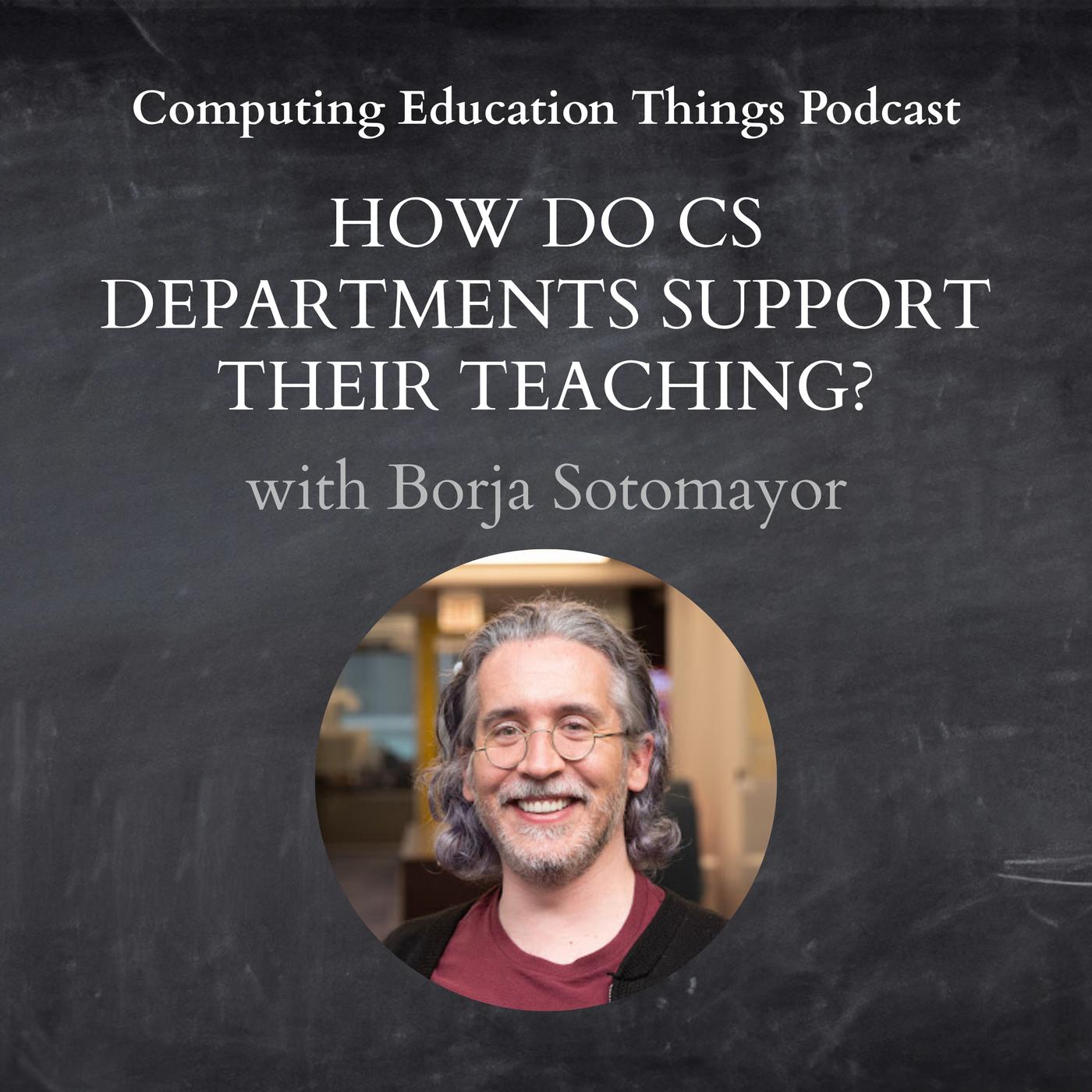
Daniel Prol: Hello everyone, welcome to the fifth episode of Computing Education Things. I'm really excited today because as you know, I'm a PhD student in computer science here at University of Houston and hopefully a future computer science professor. So I'm obviously interested in learning more about how my CS department could support me, but I really think that this is also relevant for anyone teaching in a CS role right now. I hope this episode gives you some ideas and the person who knows a lot about this topic is Borjas Sotomayor, senior instructional professor in the Department of Computer Science at the University of Chicago and former director of the master's program in computer science there. I think he's the perfect guest for this topic because he's currently on sabbatical focusing on how computer science departments support their teaching activities. Borja, thank you so much for being here.
Borja Sotomayor: Mm-hmm. Thank you, it's a pleasure.
Daniel Prol: Sure, I appreciate your time. So let's dive into a few topics here and feel free to take the conversation in a different direction. That's the beauty of this format. You never really know where it's going. But I think it helps to have a general notion of some factors that end up influencing teaching at the end of the day. So I was thinking one of them I think has to do with motivation, right? Because, ⁓ you know, the teaching priority on the institution over other obligations, such as research, such as service, which may vary, right? Depending on the time of the year. But as faculty, we can spend our time or too much time, for example, preparing classes, right? And because, I mean, it's... ⁓ is normal. is changing fast, it's nature, the nature of CS is ⁓ fast-paced, continuously evolving. But it might be that teaching is not a priority for my institution, your institution there, ⁓ or maybe it's considered less important than the other two, than research and service. So do you think that sometimes this disparity between The personal perception and the institutional perception of the priority of teaching can affect how much CS departments prioritize support for these teaching practices.
Borja Sotomayor: No, think absolutely and just I guess for a little bit of context for ⁓ the listeners, ⁓ you know, as you mentioned, I'm sort of on sabbatical this year and I'm conducting a research study on how computer science departments support their teaching activities and specifically at R1 universities, specifically at research oriented universities because as you said, ⁓ those are the kind of universities that tend to be very focused on research and ⁓ you know, teaching sometimes takes kind of like a second place to ⁓ research an ⁓ even service. ⁓ The motivation for this study, ⁓ on the one hand, is a little bit self-serving. ⁓ As you mentioned, I was the director of the master's program in computer science for many years. Before that, I was the associate director. And I sort of got to a point where I sort of thought, think it's the right time for me to do something different ⁓ in my department. I actually, I'm very lucky that our department ⁓ at the University of Chicago, the Department of Computer Science at the University of Chicago is very teaching friendly and we have a chair that is very pro teaching and very pro teaching crack faculty. And I'm stepping into this new role in the department as director of teaching and learning where I'm gonna be supporting the teaching activities ⁓ of the department. This is not... ⁓ It's not a common role, but it's not an unknown role. I've talked to number of universities as part of this research study where some departments will have an associate chair for education or a deputy chair or even just a director of education or sometimes people like the director of undergraduate studies or the director of graduate studies end up also being kind of like the lead person on teaching support and pedagogy and stuff like that. But ⁓ to... ⁓ To sort of answer your question a little bit more directly, I think that in research-oriented universities, my sense after talking, I've talked with about 20 people from 20 universities at this point, ⁓ is that interestingly, a lot of people do feel that overall they are in a supportive environment, that supports their teaching, that they feel sort of supported, ⁓ but that that support is very informal. That support is very informal, it's very ad hoc. because all of the formal structures, a lot of the effort in providing resources to the faculty is definitely more centered on research. ⁓ And it's not that people are not able to find mentors, they're not able to find people who will help them with teaching questions, et cetera, but it is a little bit more on the individual faculty member to do that. obviously, there's many different institutions and they handle each each of them handles this very differently and we can get into that so like later on but overall that that tends to be kind of like the the general you know state ⁓ of things
Daniel Prol: Yeah, very interesting. So let's focus on the teaching side, right? Because yeah, if you check my previous episodes, we also talk about research, but this one is especially focused on teaching. So let me make a comment here because I was working in the industry before and sometimes I think that there are some things that
Borja Sotomayor: Mm-hmm. Mm-hmm.
Daniel Prol: CS departments cannot really teach CS professors, right? For example, I think ⁓ this relates to the professors' innate curiosity. There is sometimes a gap between real world problems and teaching from my perspective. ⁓ I'm trying to reduce that gap with my outsourcing efforts, with my newsletter, with this podcast also. But I don't think this... this training should come from the CS department, rather from the professor who is connected to the industry, who understands, for example, if they are teaching in true to programming, where they need to spend more time. I think that often comes from that industry connection. How do you see this ⁓ relationship between the real world and the teaching? And maybe if you got some insight from your interviews around this topic.
Borja Sotomayor: ⁓ So, you know, it's not something that came up a lot in this ⁓ study, but I definitely do have thoughts on this, because it's something that has certainly come up whenever we've had to sort of think about what our curriculum should look like and what our classes should look like. And I think you do want to walk a fine line in that, you know, college is... ⁓ I think we can't kid ourselves and sort of like not... ⁓ sort of accept and realize that ultimately many of our students are gonna go into industry and that it behooves us to make sure that they're prepared to make that jump to industry, that we can't just sort ⁓ of focus only on purely theoretical sort of stuff. ⁓ But I like to frame it more in terms of, the purpose of a computer science education college is really to teach you the foundations of the discipline. And foundations, people tend to equate foundations with theory, which I think is a false equivalency. Because you can learn the foundations of, know, a discipline, can learn the foundations of computer science in both a very theoretical and a very applied, you know, way. My favorite example is that when I was in college, I maybe took like four like operating systems, like classes that were very, just very, very blackboard bound. Just explaining like all the algorithms and like here's how the processor schedules the processes and here's how the You know, the hard drive schedules, the reads, and all that. Here's how the virtual memory works. And I kind of like understood it in principle, but I always felt like it never really fully stuck. And then when I came to the US, and I went to grad school at the University of Chicago, I took ⁓ a class, ⁓ an operating systems class that actually involved implementing an operating system in C. It was a simulated architecture, but it was still a sufficiently realistic architecture that you had to of bang your head against the desk to sort of like figure out a lot of like low-level details and stuff like that and ⁓ you know the Having to actually implement it myself, which is a very hands-on very practical experience Taught me so much more about operating systems than just you know kind of like reading about it or having very theoretical explanations and That tradition is sort of carried on over the years at UChicago. Our operating systems class still involves implementing an operating system. In my networks class, we have students implement an RFC compliant IRC server. We have them implement the TCP protocol. And it's all very ⁓ hands on, but it focuses on foundational knowledge. It focuses on really understanding the foundations of the discipline. And in my networks class specifically, I usually tell students, look, One of the goals of this class is to teach you how to work with network protocols. And I'm having you implement the IRC protocol not because it is some sort of protocol that's in wide use like today, which still has its uses, but it's not like a widely used protocol anymore like it was in the 90s, but because it's a good vehicle to experience what it's like to take a real sort of a network specification and figure out how to translate it to the code. Because you're going to, when you go into industry, I can guarantee you that you're going to be handed some sort of protocol specification or some sort of data interchange format. ⁓ And I'm not going to be able to teach you that in college, because those are proprietary formats that I don't have access to. But I need to teach you how to understand how to pick up those, how to read those protocols, how to interpret them, how to implement them, and so ⁓ on. ⁓ I think that it's okay to kind of ⁓ be aware of what students are going to need to do in industry, but I don't think that industry should dictate what we should be teaching in college. And I usually go to alums of my class and just often just talk with them and just sort of hear from them, hey, what are you doing in industry? What are the tools that you're using? I try to sneak as much of that in my classes, but again, at the end, the ultimate goal is to make sure that students have a very solid foundation in computer science, both in theory and in practice.
Daniel Prol: Yeah, absolutely. And I was reading this week ⁓ articles about how technical interviews are changing, right? And ⁓ how lead code maybe is not effective anymore because maybe you don't need to write code line by line. But at the same time, I think you have access to AI, right? You still need to...
Borja Sotomayor: Mm-hmm.
Daniel Prol: need to have some, yeah, some, or you need to have this knowledge to really know, right, how to think throughout the problem. ⁓ I'm just developing a new product that basically I want the students to ⁓ decide if they want to use AI or not while they are solving the problem, but I'm going to analyze the prompts afterward to see if they need some more help and I can design an intervention for them ⁓ in order to ⁓ cover that gap. this, you know, you made me think about the methodologies, ⁓ you know, because I think it's an important topic when we talk about, you know, teaching in the classroom. ⁓ So each professor has their own style, right? Some focus on on problem solving on the board, others use small groups or more class discussions, and others prefer more like theoretical lectures. In the CS community, do you think the lack of methods is a concern or it's more about lack of time to innovate in their own approach? What's your take?
Borja Sotomayor: ⁓ I mean, ⁓ let me sort of answer this from the perspective of what I've been hearing as part of the study that I'm conducting, which is that, and ⁓ you sort of alluded to this at the beginning of the conversation, that if you are someone who is teaching in a computer science department, particularly under R1 university, where there's gonna be a pretty heavy emphasis on research, and again, this varies the degree to which the university might be focused on research, might vary from one place to the other. But both tenure line faculty members, faculty members who are going to be doing both research and teaching, and teaching track faculty members who are mostly going to be focused on teaching, one of the things that I sort of heard from several people was that they end up having to deal with so much of the small stuff, all the logistical stuff of running the class and so on and so forth, that really eats into the time that they could be spending making updates to the class, innovating in the class. ⁓ There was one university that I spoke to ⁓ which is on the complete other end of the spectrum in terms of how much ⁓ teaching support they provide to their faculty members where they actually have like a small staff of instructional designers in the department. So not as part of a central center for teaching and learning or anything like that, like in the department itself, they have a group of staff members that are instructional designers, instructional support staff, and they're there. And every semester, they're assigned to three or four classes, and they're there to sort of provide support. on whatever the faculty member needs. So these are not domain experts. These are not computer scientists. But they can handle setting up all the EdTech stuff. They can deal with interacting, emailing, dealing with student requests, and really only escalating to the faculty member the things that require faculty input. And it's up to the faculty member to decide how much they want to use them. Some faculty members use them a lot, and they have like
Daniel Prol: Hmm.
Borja Sotomayor: knowledge in like, you know, instructional design and syllabus design and they can provide feedback on that and so on. And when I talked to the faculty members of that institution, they said that they did really appreciate that it takes so much stuff off their plate that it really opens up time for them to focus on, you know, how can I, you know, rethink this class or how can I, you know, make changes to ⁓ the class. ⁓ You know, I will say that across the board, I ⁓ usually go to SIXE, the Computer Science Education Conference, most years. I find it incredibly useful to hear the perspectives of other people. ⁓ And I think that, especially when I talk to teaching crack faculty, ⁓ almost across the board, everyone gets some amount of professional development funds that they can apply towards going to conferences like that. think what they're, I think... ⁓ when I asked them, do you use this to go to Sixy, the answers were a little bit more mixed. And I think that maybe that's the part that's missing a little bit, being able to actually go and talk to other educators and hear what they're doing and so on.
Daniel Prol: Yeah. Yeah, by the way, I went to 60 Technical Symposium this year in St. Louis. I really recommend every single PhD student or even undergraduate student to submit a poster. Because it's a really great experience, think you can also do hackathons, internal hackathons, or you can also participate in CS groups in your school.
Borja Sotomayor: Mm-hmm. Mm-hmm.
Daniel Prol: but then going to an actual conference is really useful. yeah, you touched, think the schedule management topic, right? Basically, I think it's really important for, well, here I'm talking about my perspective. I'm not ⁓ a professor yet, but I think blocking time, right? Intentionally for teaching preparation, even for research. is very important, right? And that leads me to the onboarding because I think you ⁓ touched a little bit in your previous comment, right? I guess all professors need some sort of mentoring, right? And guidance on how to navigate everything and time allocation from other professors, you know, not only for logistics, right?
Borja Sotomayor: Mm-hmm. Yeah.
Daniel Prol: or a tech, but also a mentor who will advocate for you in the future, you know, he's gonna advise you to, I think this mentoring dynamics can help a lot. It might even be a good question during the interview process, right? Because, you know, do you have these mentors? What kind of mentor I'm gonna have, et cetera? Because having a mentor, I think really helps to navigate this new reality as a new. faculty.
Borja Sotomayor: No, absolutely. in this study that I'm conducting, we have an entire area of the study that's dedicated to understanding how do departments onboard new faculty, whether can your line or teaching crack, into how are they supported before they start teaching for the department and their first year teaching for the department. And again, I think overall, ⁓ the people that I spoke to, because I spoke to a lot of junior faculty members who had had been teaching for five or less years. ⁓ So the memory of that first year was pretty fresh in their mind. And again, overall, people tend to feel like that they're in a supportive environment, but the degree to which they receive formal support can vary a lot. So I saw a number of different mechanisms ⁓ where only a few schools had formal mentorship programs, like formal mentorship programs ⁓ dedicated to teaching. Because if you're a tenure line faculty member, it is definitely more common for you to get some sort of mentor where the understanding is that they're there to mentor you on everything, but it's kind of implied that it's mostly going to be about research and maybe they'll be able to answer questions about teaching and stuff like that. But if you're a teaching crack faculty member or you're a tenure line faculty member that wants ⁓ mentorship on teaching, there's much less formal mentorship arrangements there. Now. All that said, something that is very common that I saw at a lot of universities is ⁓ that when you are, you know, when you're in the hiring process and, you know, let's say that you got the job and you're sort of talking with the department about what you're going to be teaching your first year, ⁓ a very common model was to have that new faculty member ⁓ co-teach with someone their first semester or even their entire year. And even though they don't have a formal mentor in the department, ⁓ that faculty member, that more senior faculty member that they're co-teaching with, sort of becomes their de facto mentor. And when I would ask junior faculty members, in your first year, if you had questions about how do I upload my grades? Where do I find this thing? How do I set this up in my class? Who do you go to? They would almost always say, I just go talk to my co-instructor, because they sort of know all of this stuff. So co-teaching is a really great way. to sort of like learn the ropes of how things are done at the institution ⁓ before you have to sort of teach entirely on your own. I've also seen arrangements where new faculty members get a reduced teaching load their first year or especially and for tenure line faculty members, there's more, their first semester or quarter, you're only teaching like a small seminar. that kind of like, where you just work with a few graduate students. So you have a little bit more flexibility to plan for teaching during the rest of the year. ⁓ And the last point I'll make about mentorship is I did talk with someone ⁓ who made a very interesting point, is that mentorship is great in principle, but mentorship also has to be very deliberate. Like it can't just be the department saying, we've assigned you a mentor and then just kind of like hope that like magic will happen because these two people are going to be meeting periodically.
Daniel Prol: Mm-hmm.
Borja Sotomayor: There is also, I think, when a department does, runs a mentorship program, ⁓ I think there has to be an element of, let's think through exactly what the goals of the mentorship are and what we want to accomplish and how we're going to structure that mentorship relationship.
Daniel Prol: Yeah, so this leads me to another question I had for you because I recently I was listening to this professor from Wash U called Jen Hempstra and she published this book called Lab work to leadership. So all of these resources will be in the description. I'll you know, I think it gives good advice on leadership and mentorship and coaching. Areas where academics sometimes or are not always trained for that, right? Such as, you know, given good feedback, right? Creating, in my case, right? Creating a collaborative ⁓ lab, like building trust, building psychological safety, for example, right? I think this book explains this very well. But, ⁓ you know, at the same time, I don't know if it's something that
Borja Sotomayor: Mm-hmm.
Daniel Prol: Yeah, that for example, you can attend business school, right? You can go through these programs that teach you in a few days or a few weeks how to be a better leader, et cetera. But I don't know if CS departments or do you think they can also teach that?
Borja Sotomayor: ⁓ I think that's where you start getting into ⁓ pretty much every university I talk to has some sort of center for teaching and learning. ⁓ I am a big, big, big fan of the one we have at the University of Chicago. I use them, I ⁓ use a of their services when I was a PhD student at the university. I think that ⁓ they really helped me ⁓ better understand what pedagogy is and how to design a class and what good teaching looks like and stuff like that. And I think that ⁓ those kinds of partnerships with those centers are very important so that it doesn't... I think there's a lot of things where, yes, it makes sense for the department to handle this themselves. ⁓ And I'm not saying that it's not a bad idea to, like, for the department to maybe do a little training on... ⁓ I forgot to make the point earlier that... The person that I spoke to also said, if someone's going to be a mentor, they should be trained on what it means to be a mentor and how to be a good mentor and provide that kind of support. And some of that training can come from the CS department, but I think that that's where, if you go to one of these centers, they're usually going to... If they don't already have some sort of training for that, they're usually going to be more than happy to work with you in figuring out what that training is going to look like.
Daniel Prol: Yeah, so I forgot to mention something before where we were talking about, you know, the different concerns professors might have. One of them is class size. I think, you know, it's very related to what I'm living now, right? Because ⁓ especially in, you know, on Erwan universities, you know, the class size sometimes is huge, right? That's a mystery. ⁓
Borja Sotomayor: Mm-hmm.
Daniel Prol: in my software engineering class, had 110 students. And this semester I have around 80 in a software design class. And these are classes for seniors and juniors, but, you know, into the programming like 200 or more, right? I don't think there are enough resources that teach you how to navigate such large classes. Yesterday, I was listening to this podcast, Design for Learning. from Notre Dame about these two-stage exams for large classes. The main idea is that two-stage ⁓ exams increase student teamwork, student collaboration by having students first complete the exam ⁓ individually and then immediately retake it in randomly assigned groups. I think it's a very interesting approach, but I want to hear from you. have some other insights.
Borja Sotomayor: ⁓ into how to manage large classes. This is ⁓ what I was the director of the master's program. ⁓ One of the things that we would work with a lot of adjuncts from industry, and we had and continue to have just a phenomenal adjunct faculty in that program of people in industry who just really enjoy teaching and sharing what they know, what they learned in industry, and sharing it with our students and so on. And I think the one thing that sometimes catches people by surprise ⁓ who maybe don't have a formal academic background, and I guess you could say the same of maybe someone could be in a PhD program and had not actually taught their own class until they got their first faculty position and not having a good sense of what teaching a class involves, but that, you know, Teaching a class is a lot more than just showing up for your lecture hours, talking for however much time, and being done with it. That might be the case for small classes. That might be the case for very small classes. But when you're running a large class, ⁓ you are the manager of a staff. You are the manager of a staff of TAs and graders. And I talked to a number of universities that have multiple tiers of head TA and regular TA. and they have TA training and they have TA communities and so on and so forth. And I think that running these large classes effectively does require departments to provide enough TA support and waiter support, but it also involves the faculty member sort of understanding that they are also gonna be a manager in that role, that they're going to have to work with these TAs. And when you have a very, very large class and a very, very large team of TAs, You really need to start thinking about, okay, maybe I'll have a few head TAs that then manage the graders so I don't have to sort of individually manage every single person in the course staff. Some universities will have some sort of, sometimes this is done by the instructional support staff that I mentioned earlier. Sometimes they have some sort of role that is usually like course assistant, course coordinator, who is someone who is there to kind of help manage all of that. all of that stuff. And I think that that is something that, you know, I was never explicitly taught how to do all that and people are often not taught how to do that. And that ⁓ I think part of addressing that issue is, ⁓ you know, at the PhD level, at the stage when people are doing their PhD, like there has to be more training and pedagogy. ⁓ you know, that should be required to complete the PhD or not, I think that's, you know, that is a battle I think that everyone would have to like fight in their departments. But, ⁓ you know, I have spoken to departments where they will have a semester-long or a quarter-long CS pedagogy class that PhD students can take optionally, typically, ⁓ that, you know, covers pedagogical aspects of how do you design a syllabus, how do you design an assignment, the principles of you know, things like Bloom's taxonomy and stuff like that. ⁓ But they'd also go into, hey, let's talk about what is actually involved in running a class so that when you do it for the first time, it's not an entirely, ⁓ you know, a complete surprise. And then when those, you know, there's fewer opportunities for PhD students to teach their own classes, but when they do have a chance to teach their own classes, it is very often the case that they are assigned either a faculty member to co-teach with or at least a faculty member who is kind of like going to be the official mentor, like that first time that the PhD student is teaching, and they can sort of advise them on how to deal with all of the more management aspects of the class.
Daniel Prol: Yeah, interesting. So last topic I want to dive into is evaluation. Basically, how to approach it. One way, I guess, is basically from the perspective of metrics, right? How to measure evaluation. The other day I was listening to a lot of podcasts, I know, but this one was with the professor.
Borja Sotomayor: Mm-hmm.
Daniel Prol: philosophy professor from Tulsa called Jennifer Frey, who does a lot of outreach to broader audiences related to her teaching. But, you know, those contributions she said in this podcast are not considered in her evaluation, right? Instead, other metrics, right? Like number of publications, citations, dominate more, right? Maybe it's a matter of expanding what counts.
Borja Sotomayor: Mm-hmm.
Daniel Prol: as valuable contributions to the R1 institutions. But I don't know, I want to know your take in what matters for the people you are interviewing. And yeah, I also have my own opinion here, but I think, you know, recognizing how students ⁓ also benefit from the outreach. For example, this professor, right?
Borja Sotomayor: Mm-hmm.
Daniel Prol: probably was attracting or is attracting so many people to study at this university. We don't know, right? It's difficult to quantify, but yeah, what's your take here?
Borja Sotomayor: So this is something that we definitely talked about in the study whenever I interviewed ⁓ both junior and senior faculty members to better understand how teaching is assessed at their institution. ⁓ As you said, it is very common, especially at R1 universities, that the teaching assessment component, ⁓ particularly for tenure line faculty members where Again, the research is going to be a big part of what's going to be considered for their reappointment, their promotion. There's generally a sense of, as long as you're doing an OK job and your research is good, you're fine, et cetera. the departments will sometimes do a very just cursory look at student evaluations, the kind of student evaluations or feedback that students fill out at the end of ⁓ the quarter. ⁓ the situation is a little bit different for teaching crack faculty members because their job is teaching. Their career advancement depends on how well they do teaching. And that's where you do start seeing things like maybe when you're being considered for reappointment, when you're being considered for promotion, it's not just the student evaluations. It's also things like maybe you have a peer come and do an observation and sit in your class and write a little report. getting, ⁓ you know, having the instructor write some sort of like teaching statement or collecting things like syllabuses and so on. ⁓ Unrelated to this study, I am actually ⁓ at the University of Chicago, one of the co-organizers of our colloquium on the evaluation of teaching, which we run. Like this is something that is being done by the Center for Teaching and Learning. ⁓ And ⁓ we sort of like offer this every year, sometimes every two years, sort of like two day workshop to sort of talk with the people in departments who are going to be in a position to assess and evaluate their teaching crack faculty and or even the tenure line faculty to sort of go over like how do you evaluate teaching and one and I just coincidentally happened to have the book in front of me but one book that we've really enjoyed sort of like reading has been Let's see if I can get the focus right. Transforming college teaching evaluations. guess it's like the auto blur is, ⁓ there we go. I think I just have to cover my face with it. ⁓ But one of the, this book presents a very specific methodology called TEval. ⁓ They have a website and they talk about the methodology in a lot of detail. But I think one of the things that I really liked about the method that they propose is that
Daniel Prol: Now yeah.
Borja Sotomayor: Look, there's different dimensions of excellence in teaching or teaching effectiveness, and there's different ways in which you can understand whether someone is effective in each of those ⁓ dimensions. can look at their syllabus, can look at student feedback, you can do additional surveys, can do observations, you can get letters from students that ⁓ talk about the instructor in more ⁓ depth. and stuff like that. I think that ⁓ talking with people for this study, I think that there was a bit of a sense of the evaluation of my teaching, yes, they do tell me these are the things that we are going to collect and these are the things that we are going to look at, but that it does feel a little bit like a black box ⁓ in terms of how are those materials going to be evaluated and what kind of feedback am I going to get back from them. And at many institutions, it is often the case, especially for the tenure line faculty, where the only thing that is looked at is the student evaluations, which there's a lot of literature that talks about how these are very, very problematic and they can be useful for some things, but not usually across the board.
Daniel Prol: Yeah, so it's very interesting what you said about having like a more objective approach. Like I was thinking like a rubric where you can evaluate each of these aspects from a professor. But yeah, in terms of service, right? I think, know, sometimes you even don't know as a TA, right? I even don't know sometimes what my students are thinking about me, but I think a good way to
Borja Sotomayor: Mm-hmm.
Daniel Prol: approach this is like, okay, I receive this feedback from the survey. So let's now see or tell the professor, okay, maybe you need to improve in this aspect of your teaching, right? Let's see what the department can offer, right? Like having this kind of match between what the service say and what the departments can offer and yeah, and you can also ask for help.
Borja Sotomayor: Mm-hmm.
Daniel Prol: Right. So Borja, this was a great talk. Thank you so much. I'm really grateful. What is the best way to contact you?
Borja Sotomayor: ⁓ I think if you just Google for my name Borja Sotomayor, ⁓ you'll find my University of Chicago page and I have all of the various ways to of like contact me and links to my Blue Sky and my LinkedIn and my GitHub and everything. So everything is there. My University of Chicago page also has, if anyone is interested in this research study that I'm conducting, ⁓ my academic page, the main page, has a very prominent sort of box that sort of says, click here for more details on this study, or if you want to even sign up for the study and be interviewed for the study. So that's that, think. My University of Chicago page is probably the best starting point to either contact me or just learn more about the stuff that I do.
Daniel Prol: Yeah, so I will share all of this in the description below. Goodbye everyone and see you in the next episode.
Borja Sotomayor: Mm-hmm.
