

UTSKRIFT 🔗
Matt: Welcome to The Difference, the podcast. I'm Matt Stevenson Dodd.
Helen: I'm Helen Gregg.
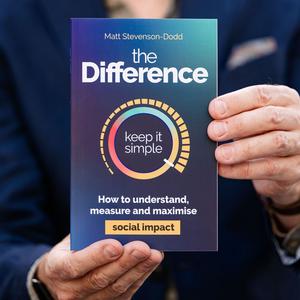
Matt: And this podcast is all about taking a deeper dive into the stories and case studies contained in my book, The Difference, How to Understand, Measure and Maximize Social Impact. We want to get behind each of the case studies in the book, meet the people involved and find out more about how these amazing organizations set out to understand, measure and maximize the difference they make in the
Helen: And I should just say that The Difference by Matt Stevenson Dodd is of course available to order in all good bookshops now.
Matt: Thank you, Helen. So I'm delighted to welcome our guest today, a brilliant leader and changemaker in the UK's migration and refugee sector, and someone who's spent her career supporting migrants and women at the intersection of the migration and criminal justice systems, Marci Boletta. Welcome.
Marchu Belete: Thank you so much for inviting me to this podcast
Matt: thank you so much for joining us. It's great to have you with us.
Helen: So, Marciu, as you may be aware, we like to start the podcast with a little game, and we're going to ask you to tell us two truths and a lie. Now, then it's up to myself and Matt throughout the podcast to try and... get to the bottom of which of these we think is a lie. And at the end of it, we'll come back to you and give you our guesses. So, Machu, over to you. Tell us two truths and a lie.
Marchu Belete: Well, I have come prepared just to beat you at your game. truth and lie, in random order, the first thing is that I love singing and I have an excellent singing voice. The second thing is I met the previous queen, Queen Elizabeth II. And the final one is... I represented Islington Borough on a volleyball tournament when I was in secondary school. So yeah!
Matt: You
Helen: That's amazing. I really want all of those to be true.
Marchu Belete: Thank you.
Matt: I don't know.
Helen: really hard. I love this game because you get such an insight into not only the lives of the people we're talking to, but also exactly where their deviousness themselves comes from.
Marchu Belete: Thank
Matt: So, Margie, to give us a sense of your answers and whether we can help the listeners, could you just give us a 30 second intro to you and your background?
Marchu Belete: Yeah, I am a leader, a change maker, and I'm really interested in the idea of making a better place for all of us. And that really comes from my experience as coming to the UK as a refugee and the kind of systems of harm I experienced as I went through the immigration process. So my kind of always been my desire is to make an impact on people who are at the margins of society and really think about how do we build a better system, a better community for all of us so all of us who live in this place can belong. So yeah, I started my career as a volunteer and then throughout I was a a co-director at Women for Refugees Women, then a chief executive
Load full transcript
at Hibiscus, and now I'm a director of Migration Exchange. my kind of the theme of my career has been migration, but really that is centered on thinking about how do we all create a better space for everyone to belong.
Matt: I mean what a great career as well and you can see the theme really running strongly through that and I know today we'll be talking a lot about Hibiscus but I think you know the fact that you've continued your career really speaking out for you know for that sense of justice and for that sense of fairness for people I think is just so impressive.
Helen: And I know obviously, Marciu, we met when I was working with you at Hibiscus from I was in the Trust Impact capacity. And we spent a lot of time together in terms of I could see your passion and the real drive you had in that arena, which is honestly what drew me to you in the first place, which is always nice. And I think obviously, I know... when we met, you'd already started on your impact journey. But what would be really helpful for me and interesting, I think, would be to know what was that pivotal moment for you when you realized that you were not focusing enough on the impact that you wanted to be making.
Marchu Belete: So in the context of Hibiscus, I joined the organisation in October 2020 and it was a real kind of moment of change in the world because it was in the middle of the pandemic and so there had been a lot of changes within the organisation where people were working from home most of the time and a lot of the kind of services we run, the community groups couldn't do that anymore. And so when I joined Hibiscus, I joined an organisation that is supposed to be supporting migrant women. That's what I signed up for, but really when I came to look at the kind of numbers, indicative is that we were working thousands of people, but the majority were men. And so I was a bit confused and the previous... leaders in the organization have kind of the mission drift was very much as a result of the resources and the money we were receiving to deliver services by the government, by the Home Office. So I felt really kind of conflicted about, you know. being a a new chief executive at this organisation, but it has kind of drifted from its core mission and what I kind of came in to deliver on. And I just thought it was very risky at the time and that's why I wanted to ensure that we kind of focus back on the things we've set out to do.
Helen: with the best one in the world, you start a new job as a chief exec, the last thing you want to do in your first three months is go, by the way, everything's wrong. It's really not a great feeling, is it, to walk in and just go, this isn't what I signed up for. So how did that all play out for you? How did you get the support to move it forward? And how did you manage that as a leader?
Marchu Belete: think I had a great chair in Rachel who was amazing and supportive and really believed in me and really kind of, you know, I've never led an organization this size before, so it was just took a chance on me to lead. And I think, you know, transformation were happening at the board level. that Rachel was leading on, is really thinking about who are the trustees we need to help us think about this question of impact or what is our purpose really. So I did a lot of one-to-ones in the first 90 days to really have an understanding and also not only just within the organization, but externally to develop that and make sense of what this organization is, what the purpose is, I kind of went back to the history of the organization and why it was set up and it was, you know, with a clear vision and mission in 1986 when Olga Heavens, who was the founder of the organization, was really driven by a sense of injustice that was experienced by black women from Nigeria and Jamaica who were kind of experiencing the double whammy of the criminal justice system and the immigration system and she really wanted to make a difference in those lives. So I went out and looked for her and we met and invited her to the organization to tell us the history and why she set up this organization and I just felt that that mission was still valid. that that mission was still, you know, that we needed to work towards that mission. That mission wasn't completed. Still a long way to go. And so I was, I kind of made the case to the board that we need to question why we are working with men when we are set up as a women's organization.
Matt: Yeah, I mean that's quite a heady mix of things to happen in your first 90 days, it? You know, sort of, mean, brilliant that you were listening mode. And I think that's... often people just rush in and think, you know, can make changes, I can do things, but actually it's really good to listen and hear what's going on and talk to the people who are delivering on the ground and speaking to the beneficiaries and all the things you did there. you know, then you've got this kind of real sort of sense of, hang on a minute, we've really drifted from where we started out. you know, what a brilliant idea to bring Olga back in. know, and often I think, when we talk to clients, we say, let's go back to when this was first founded. What was the original purpose here? And is that still valid? And that was such an interesting thing to do, I think.
Helen: Yeah, it was. So, so, Martu, could you start talking us through a little bit about those challenges and how you navigated some of them from an impact perspective?
Marchu Belete: Yeah, I think the first stage is to convince or to get a buy-in from everyone that why we need to develop a new strategy align our purpose across the organisation so that we are working towards the change we want to see in the world. And so, you know, beyond like listening, then it was crafting clear messages about like, why do we need to, why purpose, you know, what's the point? Everyone was happy doing their work. It was a very difficult time, as I said, there was the
pandemic, there was at the height of Black Lives Matter protests. But I also felt like this was the moment to do it because there was such need. The need was there that migrant women were still experiencing the double disadvantage. whether it's being criminalized or whether it's going to detention centers. The need was clear. So I kind of had three key messages, which were really around firstly, what... are the women experiencing right now? It always starts with who are we here for and what happens if we don't deliver on the mission that we set out to do. And I think that was really, really important to centre. I think we worked really well to think about what is the purpose of this organisation and for everyone to be able to actually state in one sentence what the purpose is. And that took time, that took a lot of conversation as you know, that took a lot of workshop, there was loads of what language specifically to use. And once we have an agreed purpose, then the question was, well, how do we align to this purpose statement, which is all the practicalities.
Matt: did you have a sense of what you wanted that purpose to be? You you were saying that the original sort of vision of Olga was very much in your mind. Did you, I'm just quite interested in how hard you pushed yourself as CEO on that purpose. And then if you could just sort of reflect on what were the sort of, what were the alternative views in the organisation and how strong was that in terms of what you were facing?
Marchu Belete: So in terms of the first question in regards to how different was my view to the purpose we landed on, I was very clear that my work here at Hibiscuit was to really help everyone come together and arrive at a purpose. And that was my mission. I also felt really, you know, my whole career has been about working from the margins and really listening to women who are experiencing the inequalities of the world and the systems we live in. I'm happy to work in a way where to let things emerge, I don't have to decide at the beginning and it's just the way I work, I'm very collaborative so I was happy to kind of let what emerges but at the same time, knowing that we can't keep having this conversation endlessly without any decisions being made. So my role was to build the structure around it to enable others to come together and arrive at a decision. That's the way I saw my role. We need to be rooted in our history and reminding people that why, and then building the structure and bringing people who can enable us to do that, such as yourselves.
Helen: Yeah, I know. remember that workshop we did in London with Mark, my colleague who was the lead impact consultant. And two things really struck me. One was the, as you've mentioned, the passion of your team in the room that day. And with passion often comes disagreement. And therefore it was a really, really lively day. But amazing. It was just fabulous. And the other thing that struck me was that quiet leadership. I think we often forget the value of quiet leadership. And I'm not saying that you're a quiet leader in everything you do, Martiu. I know you're very vocal in lots of other ways, but your presence in the room was felt and was powerful, but without being... overwhelming for participants who could be there. And I was really, really impressed by how that empowered the room to come together and be open and honest while still being respectful of each other. The other thing I would just say is that the climate at the time, I don't know if you remember this, but I'm fairly sure that was the start of some of the even more tricky Home Secretaries in relation to the immigration agenda. the—it was definitely the Conservative government at the time. And there were certainly some big announcements happening around that, which really bought everything quite— quite raw, I thought. I don't know if you remember that and did that have an impact at all, do you think, on the conversations?
Marchu Belete: Yes, definitely. And I think, you know, the political climate continues to be draconian and fractured or fracturing even more now. But at the time, think Priti Patel maybe was the Home Secretary. Well, this is the thing that I was trying to... say to the team and also to everyone at Haviscus that, you know, currently the way we're structured was only supporting people down the stream where all the bad things have happened already, all the structures have enabled people to really suffer. and where I saw where hibiscus could really be is actually working at the root cause of the problem so that we don't have thousands of people that we need to support. downstream if that makes sense. I think you know yeah at the source like let us how can we focus our energy and not forgetting some service delivery is a cool part of our you know the work that we do. But at the same time, using that expertise, using that decades of experience and wealth of data that we had to actually make a case for the policy changes that will impact thousands of people more and that will prevent the suffering of women caught up in the criminal the system and also in the migration system and that was the thing I was trying to get to and why they needed to be kind of a clear purpose and a impact that we are making to be able to make that change in the world.
Matt: that's so focused and clear, isn't it? But set against that is the big problem that is actually why the case study is in the book, which is, you know, with all the best will in the world, we could want to be that sort of organization. But if the money is actually directing us... to something completely different, i.e. in your case, working with men as well, because that Conservative government wanted you to have a bigger contract to work with all of the people in those immigration centres. You had quite tricky problem there, which was, is it impact or is it money? I'm just wondering if you could just talk us through how you felt about that.
Marchu Belete: Yeah, and it's very tricky because obviously without the money we won't be able to do any of the work that we need to do. But, There was three key things, right? So there was the resource question. So once we clarified the purpose and agreed that women was the central, like the purpose of this organization was to support migrant women. I think then we needed to work backwards and see where the impact was. yes, the money question was a big one, but I also made the case to the board and also to the staff that we've drifted so much in our purpose. We were violating our... article, memorandum article, why we were set up in the first place. So that's a key risk with the Charities Commission. And so I think what needed to happen once we made that decision about the purpose was how do we timetable this towards the change we want to see. It wasn't going to be immediate because livelihoods were at risk that some team members were working only and predominantly with men and so now that we've shifted to a women-only organisation, what does that mean for them? So yeah, so there was a long timeline and I think this is the hardest decision all leaders have to make about... resource question we could have continued working as we were getting the money that the contract allows us and pretty much that would have been an okay charity and we would have done okay work in supporting individuals and the livelihoods of staff members would feel secured you know it was It was okay to be, but I think the moment required us to step up. There were all these changes that were happening externally that required us to meet the moment and change. that was the kind of change I was driving. And so there needed to be practical solutions, whether it's how are we going to find the money to deliver on... other things we were doing, what is the timeline looking like in kind of, you know, stopping this contract, this government contract, which is a huge amount of our income. So there was like lots of practical decisions to be made on the way and a lot of, you know, conversations and yeah, there was a lot of work behind it.
Matt: No doubt.
Helen: And this is exactly the kind of dilemma a lot of our clients are facing. to be true to our purpose, but the money isn't around necessarily for what we want to be doing. So I think we've already established you've had lots of challenges in your role as chief executive of Hibiscus. What would you say was the hardest part of the journey through all of it?
Marchu Belete: The hardest part, all of it was hard. I to say, all of it wasn't easy. It wasn't easy. But I was very lucky because I had put in place a really good senior leadership team who were just believed in the new purpose and really...
Helen: You
Marchu Belete: wanted to see the change, a meaningful change, a meaningful thing that we were driving, the impact we were wanting to have. I also had a great chair to support me. through this. I think the hardest thing is the practicalities when it came down to actually making this change. You know, the HR questions, the fundraising element that needed to be done to continue to resource the organisation. Yeah, there were like lots of questions. Would my life be easier if I just went along with things that I felt like I needed to ask? It would have been so much easier if I just kind of let things be and just, yeah.
Matt: Yeah.
Helen: Yeah, but can I just say though, it's not lucky that you put a senior leadership in place that was excellent. That's good leadership.
Marchu Belete: I think part of it is also like I kind of put in place a new department that was really working towards policy change and that was gaining momentum and we were being recognised and there was a lot of kind of we were seen as experts. and there weren't many charities working at the intersection that we were. So that kind of momentum and that recognition from external partners really also helped our case to
Matt: Yeah, there's definitely something to be said for being really clear about your core purpose, isn't there? Even if it does require a change of direction and... and then sort of wait where you go and say, yeah, mean, that was probably the biggest decision any leader has to make really is, you know, do I follow the money or do I actually stick to the principles and redefine this purpose? I wonder just how you felt about building that culture in that team. You you've obviously brought together a group of great people who now believe in this purpose, but how do you build a culture and how do you bring risk into that culture? Because... All teams should be taking risks to try and achieve more social impact, but that's not often the case in many charities.
Marchu Belete: Yeah, I guess I was always good at in our team meetings, pointing to like, who are we there for, you know, who are we here to serve and The answer was always migrant women. always seeing risk from that perspective. And this is also something I talk about in my current role at Migration Exchange. Because the of the external environment has completely fractured. We are living in a time of great influx. are... The migration sector in particular is experiencing the rise in draconian policies, like changes to migration policies in 50 years, like huge changes that will impact hundreds of thousands of people. We are kind of experiencing the harsh realities of... our kind of safety as even staff members in terms of the rising far right groups and vigilantes and in that environment I think easy for maybe big charities or funders to see risk as perceived risk, you know, what is the risk to our reputation, what's the risk, you know, if we do this thing or do that thing, whereas for people on the ground, for migrant people who are actually experiencing risk to their safety, their kind of... as they exist, their homes, their kind of children, all those things is like, where comparing those risks is really important and really centering the
risk of people on the ground versus, you know, in more high tower. Like you could feel that this is risky, know, working on migration is risky, well, compared to what, so.
Helen: And I think you're the first person we've interviewed so far, Marcie, who is no longer at the organisation they were at when we worked with them. So just a special question for you. What have you taken from your experiences at Hibiscus around impact and brought into the work you're doing now at Global Dialogue?
Marchu Belete: Well, I kind of, when I contacted you about Impact Framework, I was like, can you help us again doing our Impact Framework? So we're working with your colleague to do that. And again, We're still developing clarity. Well, I should say we have developed a clarity since I joined about what we are at Migration Exchange and who we are for, who we serve. And so we've developed a clear statement, impact framework. We've just did our strategy. So I'm really excited about where we are because... we need to meet this moment. Things have changed so rapidly. And so I'm always questioning, are we fit for purpose? is this mission, like how do we kind of continue driving change when the context changed so much and is shifting so much continuously? yeah, like being really centering impact. And when I say impact, it's not just the kind of tick box of numbers but actually the difference we are making in people's lives has to take priority over like everything else.
Matt: Yeah, I think that's such an interesting point, isn't it? Because putting the difference at the heart of your purpose allows you to be flexible and move. Whereas sometimes I think if you sort of create a purpose that's about what you do, then that changes because you have to change what you do with the context of the environment. And as you say, things are changing so fast in the migration sector that you can't have a purpose that's just describing what you do. It's such an interesting point.
Helen: is. Did the late queen inspire you when you met her? Did she give you any tips at all, Marcu?
Marchu Belete: So can I tell you the story of how I met?
Helen: Please do.
Marchu Belete: So she was a patron to a charity and I was a beneficiary of this charity and so we were invited to an event and at this event, actually this is what happened, that before she came out she had the protocol person came out and gave us like a heads up about how to address the Queen. So he said things like, say, ma'am, riding with ham. And me and my friend, we were like, no, do we have to curtsy when the Queen comes? And then we're like, no, no, we're not going to, because we don't believe in all that. But as soon as she came, we were just like, how low can we go down to the floor?
Helen: Ha
Marchu Belete: When we looked at each other, we were just great. We never spoke of it again.
Helen: So not a royalist, but we like the late queen.
Matt: I love that story. I that story. And it's helped us narrow down the two traits in a line. Thank you.
Marchu Belete: Do you think it's true or am I really good storyteller?
Matt: there.
Helen: So, pulling it back slightly to impact. I'm going to ask you when you think... the work of your charity is done. And we're going to focus on global dialogue, I think, because that's your current role. And obviously, it's the one that you're operating in at the moment. So could you just give a little bit of a bit more sort of information? We've talked a lot about Hibiscus, a little bit more about what global dialogue is and does. And then let us know when you think the work of global dialogue will be complete.
Marchu Belete: So Global Dialogue is a human rights charity and what it does is it kind of supports programs to be hosted and to be run individually. So I run a program called Migration Exchange focused on improving migration systems in the UK for good. I kind of feel like I'm not sure if any charity work will be completed as such because I feel like care and working towards a caring world and caring community is what we do as charities and care will always be needed for human beings and other beings in the world and even our planet. So I don't know if there would be a time when our mission is no longer needed as such. I also feel like the kind of systems we're trying to tackle, whether it's racism, They've taken a very long time to get to the place they are, like 400 year history. So it's kind of unrealistic to expect that our mission would be completed in the next 10, 20 or 50 years, given the kind of political climate we are in. In saying that, I also feel that charities need to really look at themselves currently and the influx we are in this moment, whether it's the political environment, whether it's AI and the technological leaps that we're experiencing, and really ask themselves, are they the right... organization to be able to make and bring about impact and change in this new world. And if the answer, the honest answer is no, then I think it's okay to sunset. It's okay to kind of say actually that there are better charities or more know, charities that are more able to function in this moment better than us and let us let go of this entity. And I think more leaders need to drive that change, I feel. Also, the resource constraints, you know, at the moment there's not much money going around. I think a moment has arrived that we can't afford to work in silos anymore. you know, working in human rights, what's that without climate justice? What's that without, you know, racial justice, disability justice, all this justice, you know. it doesn't make sense anymore to work in silos when there is such a huge threat to all our agendas, whether it's the far-right authoritarianism, whether the shrinking civic space. So given all that, I invite everyone to take a moment to really think about. how we kind of bring about change in this new world we are in.
Helen: beautifully put, Marcu, thank you.
Matt: I think there's something about that
sense of a shared vision together, but then understanding what your organization's unique purpose is in helping achieve that vision. And I think you just outlined it really beautifully there, Marcie. We do need to come together. Organizations do need to work together towards a shared vision, but also need to be really clear about the difference that they are making within that so that they can genuinely work together.
Marchu Belete: Yeah, and I think, you know, given that, you know, this whole rule-based order society... in the global sense is being eroded so dramatically. I just want us to reflect as charity leaders, what does that mean for us who are trying to mainly bring about change by tackling policies and rules.
Helen: Fabulous, thank you. So we're going to return to your Two Truths and a Lie. Would you like to make your guess first?
Matt: Well, I'm now perplexed as to whether you've double-bluffed us on the Queen story. And if you have, that is just genius. So, I...
Marchu Belete: No.
Matt: I think the Queen's story is true and I think you're also a good singer because you said it with such confidence. think, I remind you, that could be the lie. Anyway, I'm going to go with that you're a good singer, but I don't think you represented Islington at volleyball.
Helen: So I'm going the other way around. I think you did represent Islington at volleyball, but that you're... And I apologize if this isn't true, but I don't think you're a great singer. And that's not based on any experience of your singing in any capacity at all, are you? I think it was just one of those things that is quite a good one to throw in at the beginning. So I'm going the lie is the singer, the other two are true.
Marchu Belete: Now I'm going to treat you to some singing just to prove you wrong.
Helen: Go free!
Marchu Belete: You're right Helen, of course. The thing you did not want to hear me sing.
Matt: That would have been amazing.
Marchu Belete: you
Helen: just finish off on some awesome song.
Matt: Or awful sagas if I remember.
Helen: write a theme tune for you, Marcia, and you can just sing it for us. But you represented Islington at volleyball. That's incredible! Was that, was that, was that indoor or beach volleyball? Because I know Islington is famous for its beaches.
Marchu Belete: I'm sorry. Yes, I did. Yes. Yeah, we might just buy the sea, you We've got climate issues. And tropical weather. Yeah, the Queen's story is definitely true.
Matt: And the Queen's story was true then. That's brilliant.
Helen: Unless you've got loads of time to prepare that, I don't think you could make that level of detail up. That was fantastic. I I loved, I loved that fact. The Queen, the late Queen, I should say, did rather inspire that in people, I think. So you're not alone.
Marchu Belete: I think it was just the power, like you felt it. She was such a tiny woman but like as she approached and everyone like you know bowed down and we were just like... I was about 19, 18, 19 so yeah it happened a long time ago.
Helen: Yeah. for you. Okay. Yeah.
Matt: Amazing. So, Marci, thank you so much for that amazing podcast. It's just brilliant to hear what really... are those key decisions that leaders actually have to make. Because I think people sometimes look at CEOs and think, well, that's an easy job. And it's those kind of key sort of things that you really have to go through where there is not really a right answer, actually. You've got to make a judgment call and you've got to stick to it. And it's clear, I through your career that you've had a few of those moments where you thought this is the right thing to do and you've stuck with it. So it's been brilliant to hear that. Thank you.
Helen: And thank you so much just for your eloquence in terms of how you talk about. your call to action that we heard at the end, is just so important, I think, in this current environment. Machu, lovely as ever to see you. Thank you so much for your time. Take care.
Marchu Belete: Thank you very much. Bye.
Matt: Thank you.
Helen: Bye.