

► Tell us about you and your podcast
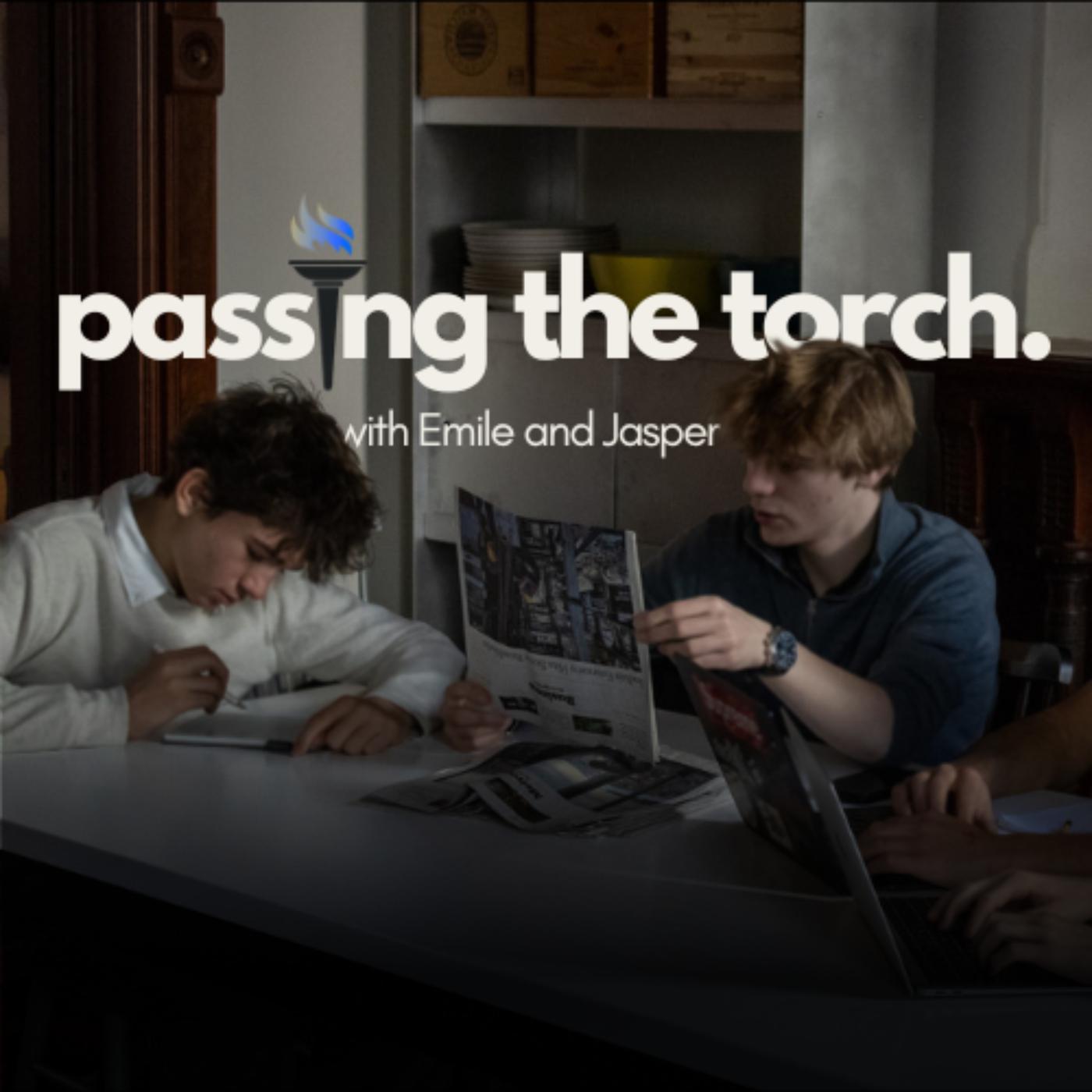
Passing the Torch is hosted by Jasper and Emile, two high school juniors from Brooklyn who built a media company reaching over 32,000 subscribers at firms like Blackstone, McKinsey, Goldman Sachs, and NVIDIA. We also founded BYCIG (Brooklyn Youth Charitable Investment Group), a 501(c)(3) nonprofit where high schoolers manage real investment portfolios to learn financial literacy firsthand.
Our podcast explores the careers, decisions, and mindsets of people shaping finance, business, and the professional world—told from the perspective of Gen Z entering that world ourselves. We interview executives, investors, and operators, but we also dig into structural questions: how industries actually work, what the path to success looks like now versus a generation ago, and what our generation is getting right and wrong about careers.
Our listeners are a mix of young professionals early in their finance and business careers, students figuring out their path, and surprisingly, senior professionals who want to understand how the next generation thinks. About 72% of our subscriber base works at major financial institutions and corporations, so the audience skews ambitious and professionally oriented.
► Why & how did you start this podcast?
We started the podcast as a natural extension of our newsletter. We'd built an audience of 32,000 subscribers who wanted to learn about careers and opportunities in finance, but we realized some conversations just work better spoken than written. When you're hearing someone describe the moment they decided to leave a comfortable job to start a fund, or how they think through a decision under pressure, tone and nuance matter. You can't get that in a newsletter.
We both grew up listening to podcasts—shows like Invest Like the Best, The Knowledge Project, and My First Million shaped how we think about business and careers. What we noticed was that most finance and business podcasts are hosted by people who've already made it. The questions come from the top looking down. We wanted to ask questions from where we actually are: two 17-year-olds trying to figure out what excellence looks like and how to get there. That's a different conversation.
Our initial goal was simple—create something we'd want to listen to if we weren't the ones making it. Conversations that are genuinely useful for someone early in their career or still in school, not just entertaining for people who already know how everything works.
We launched the podcast in late 2024, a few months after starting the newsletter. The first episode took us about three weeks from deciding to do it to publishing—we didn't want to overthink production quality at the start. We figured we'd learn by doing and improve as we went.
► How'd you find the time and funding to do this podcast?
We're both full-time high school students, so finding time is mostly about ruthless prioritization. We treat the podcast like a real commitment, not a side hobby—it goes on the calendar just like classes or BYCIG work. Most of our recording and editing happens on weekends and in the gaps between school obligations. Having a co-host helps because we can divide the work: one of us handles guest outreach and scheduling, the other focuses on editing and production for a given episode.
We release episodes on a regular cadence, and each one takes roughly a week from recording to publishing. The actual recording is usually 45 minutes to an hour, but the prep work—researching the guest, outlining questions, editing, writing show notes—adds several more hours. We've gotten faster as we've developed a repeatable workflow.
On funding, we've kept costs intentionally low. We started with basic equipment and free or cheap software, and we've gradually upgraded as the audience has grown. Hosting is minimal cost, and we handle editing ourselves rather than outsourcing it. The newsletter business helps offset some expenses now that we've started doing sponsorships, but early on we funded everything out of pocket. Our philosophy has been to stay lean until we have real traction—no point spending money on production polish if we haven't figured out what actually resonates with listeners yet.
► What do you gain from podcasting?
The biggest gain from podcasting isn't revenue—it's access and relationships. When you have a podcast, you have a legitimate reason to reach out to people you admire and ask them for an hour of their time. We've had conversations with executives, investors, and founders that we never would have gotten as two high schoolers cold emailing for advice. Those relationships have opened doors we didn't even know existed—mentorship, introductions, opportunities to collaborate. The podcast is almost like a Trojan horse for building a network.
Beyond access, it's made us sharper thinkers. When you know you have to ask intelligent questions to someone who's been in the industry for 20 years, you prepare differently. You read more carefully, think more critically, and learn to listen for what's actually interesting versus what sounds interesting. That skill carries over into everything else we do.
On the business side, we do take sponsorships, though we've been selective. Our newsletter has been the primary revenue driver so far—the podcast and newsletter work together as a single media property, and sponsors often want both. We started getting inbound sponsor interest once the newsletter crossed about 15,000 subscribers, and we've grown from there. We don't share specific revenue numbers publicly, but the business is profitable and self-sustaining at this point.
For finding sponsors, most have come inbound through the newsletter or through our network. We also proactively reach out to companies whose products we think would genuinely resonate with our audience—that authenticity matters to us and makes the pitch easier.
► How does your podcasting process look like?
Our process is pretty streamlined at this point. For recording, we use Riverside.fm—it gives us high-quality audio and video without needing to be in the same room as our guests, which is essential since we're interviewing people all over the country. Most interviews happen over video call, though we do in-person recordings when we can make it work logistically. For editing, we use Descript, which lets us edit audio like a text document and speeds up the process significantly. Hosting is through a standard podcast platform, nothing fancy.
On the hardware side, we each have a decent USB microphone and headphones. We started with truly basic setups and upgraded gradually as we learned what actually mattered for sound quality. The biggest lesson was that a quiet room matters more than expensive gear.
For finding guests, we work a few angles. Some come through our network—subscribers who make introductions, people we've met through BYCIG, connections from previous guests. Some we cold outreach directly, usually through LinkedIn or email. Having 32,000 newsletter subscribers helps open doors; when you can offer someone exposure to an audience at top finance firms, they're more inclined to say yes. We also keep a running list of people we want to interview and revisit it regularly.
Preparation is where we spend the most energy. Before each episode, we read or watch everything we can find on the guest—interviews they've done, things they've written, their career history. Then we outline questions, but loosely. We've found that the best conversations happen when we're prepared enough to ask smart follow-ups but not so scripted that we miss interesting tangents. We aim for a real conversation, not an interrogation.
► How do you market your show?
Our biggest advantage is that we don't have to market the podcast separately—it's part of a larger media ecosystem. The newsletter is our primary distribution channel. When a new episode drops, it goes out to 32,000 subscribers who already trust us and want to hear what we're putting out. That built-in audience means we're not starting from zero with every episode the way most new podcasts do.
Beyond the newsletter, LinkedIn has been surprisingly effective. Our audience skews professional, and LinkedIn's algorithm rewards content from younger voices right now—posts about new episodes, clips from interviews, and behind-the-scenes insights tend to get solid reach. We're building out short-form video as well, pulling compelling 60-second clips from episodes for LinkedIn, Instagram, and TikTok. Those work well for reaching people who haven't heard of us yet.
Twitter/X is useful for engaging with the finance and business community directly. We'll share guest announcements, react to news, and tag guests when episodes go live, which helps tap into their audiences too.
We don't have a precise breakdown of listener acquisition sources, but if we had to estimate, probably 50-60% comes through the newsletter, 20-25% from social media and word of mouth, and the rest from podcast platform discovery and search.
Honestly, the newsletter does the heavy lifting—everything else is supplementary. Our strategy has been to nail one channel before spreading thin across many, and email is the one we control completely.
► What advice would you share with aspiring (new) podcasters?
The biggest thing we've learned is that distribution matters more than production quality. We see a lot of aspiring podcasters obsess over gear, editing software, intro music—all the polish. But none of that matters if no one hears it. Before you launch, have a real answer to the question: how will people find this? If you don't have an existing audience, a newsletter, a social following, or a clear niche where you can be the obvious choice, start there first. We were lucky that the newsletter came before the podcast, which gave us a launchpad most new shows don't have.
Second, your first ten episodes will be rough, and that's fine. We listen back to our early recordings and cringe at the pacing, the questions we didn't follow up on, the awkward transitions. But you can't edit your way to being a good interviewer—you have to do the reps. Ship episodes even when they're not perfect. You'll improve faster by publishing than by tinkering.
Third, the guest's audience matters as much as their credentials. A mid-level person with an engaged Twitter following of 20,000 might do more for your reach than a C-suite executive who won't share the episode. Think about who will actually help you grow, not just who sounds impressive.
On resources, we've learned a lot from just studying podcasts we admire. Listen to how Tim Ferriss structures questions, how Patrick O'Shaughnessy builds rapport quickly, how the My First Million guys keep energy high. The craft is learnable if you pay attention. For the business side, the blogs from Transistor and Buzzsprout have solid tactical advice on growth and monetization.
The real secret is just consistency. Most podcasts die after ten episodes. If you're still publishing at episode 50, you're already ahead of almost everyone.
► Where can we learn more about you & your podcasts?
You can find everything at our main hub:
Newsletter & Podcast: bycig.substack.com — this is where we publish weekly and where all podcast episodes live.
BYCIG (our nonprofit): bycig.org — if you're interested in our work teaching high schoolers financial literacy through real portfolio management.
Email: jg@bycig.org — we read everything and try to respond to everyone who reaches out
We don't have a Patreon or donate link for the podcast—if you want to support us, the best thing you can do is subscribe to the newsletter, share an episode with someone who'd find it useful, or leave a review on Apple
Podcasts or Spotify. That stuff actually moves the needle more than donations at this stage.