
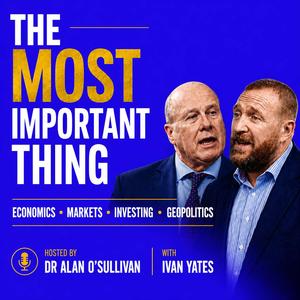

TRANSCRIPT 🔗
WEBVTT
00:00:00.080 --> 00:00:05.120
We want to focus on something uh fascinating, which is markets history.
00:00:05.440 --> 00:00:09.759
And we have the curiosity, does history repeat itself?
00:00:10.160 --> 00:00:12.560
Humans are driven by fear and greed.
00:00:12.720 --> 00:00:14.160
That's the common denominators.
00:00:14.560 --> 00:00:21.839
But surely the dot-com bubble, surely the very same is going to happen to AI in 2027.
00:00:22.160 --> 00:00:25.199
Is that not just plain common sense?
00:00:25.519 --> 00:00:29.600
Welcome to the long and short, part of the most important thing.
00:00:29.839 --> 00:00:31.600
Join Ivan Yeats and Dr.
00:00:31.679 --> 00:00:39.119
Alan O'Sullivan as they take on the major issues shaping markets, economics, politics, and geopolitics.
00:00:39.280 --> 00:00:46.799
From interest rates, investment trends, and government policy to elections, global conflict, and shifting economic power.
00:00:46.960 --> 00:00:52.719
They break down what's happening, why it matters, and where they agree or disagree.
00:00:53.039 --> 00:00:55.920
So let's get on with today's episode.
00:00:57.039 --> 00:01:21.680
Hello and welcome to another episode of The Most Important Thing with me, Ivan Yates, and Alan O'Sullivan, which we take a deep dive into the library of interviews that Alan conducted in the first phase of The Most Important Thing, where the best brains available on the planet in terms of economics, banking, finance, markets, and all aspects of finance were discussed.
00:01:21.760 --> 00:01:26.000
And we're now gleaning and distilling some salient points.
00:01:26.079 --> 00:01:32.159
And today we want to focus on something fascinating, which is markets history.
00:01:32.560 --> 00:01:36.239
So we all think of the nineteen thirties, the depression.
00:01:36.400 --> 00:01:42.000
We think of the crash, global financial crash in 2008.
00:01:42.640 --> 00:01:47.040
And we have the curiosity, does history repeat itself?
00:01:47.200 --> 00:01:49.359
And that's what we want to discuss today.
00:01:49.519 --> 00:01:54.719
And there are a handful of interviews that alluded to history.
00:01:54.959 --> 00:01:58.640
So Alan, let's start uh with the simple question.
00:01:58.879 --> 00:02:01.200
What does history teach us about markets?
00:02:01.519 --> 00:02:07.599
Yeah, you you kind of hinted towards the famous Mark Twain quote, history doesn't repeat, but it rhymes.
00:02:07.840 --> 00:02:09.360
And you know what does that mean?
00:02:09.840 --> 00:02:17.840
Basically, there's a common denominator between the 1929 stock market collapse and the 2008 financial crisis.
00:02:18.000 --> 00:02:22.479
And it's not just a policy mistake, banking collapse, it's human nature.
00:02:22.879 --> 00:02:30.960
Humans, beings existed and made decisions about financial markets in 1929 and 1930s, very same 2008.
00:02:31.360 --> 00:02:33.840
Humans are driven by fear and greed.
00:02:33.919 --> 00:02:35.199
That's the common denominator.
00:02:35.280 --> 00:02:40.400
So there hasn't we same 100 years from now.
00:02:40.719 --> 00:02:47.280
Take a listen to that very point being made uh back in a previous episode of The Most Important Thing.
00:02:47.599 --> 00:02:47.919
Absolutely.
00:02:48.000 --> 00:02:49.680
And that's what we get from financial history.
00:02:49.759 --> 00:03:04.240
That first book I wrote looked at the bottom of bear markets to see if there's anything in common with the bottom of bear markets and found that there was, and a lot of it was to do with greed and fear, and came up with some indicators as to as to how we know when that green that sorry that fear is passing.
00:03:04.400 --> 00:03:06.639
People say to me, Why don't you write one about the great tops?
00:03:06.800 --> 00:03:14.560
Well, I th I think it's just a hell of a lot more difficult because there's a well, best described uh originally by Schiller and obviously taken up by Greenspan.
00:03:14.800 --> 00:03:19.919
There's an irrational exuberance at the top, which is exceptionally difficult to know when it comes to an end.
00:03:20.080 --> 00:03:24.479
So one day maybe I'll try and tackle the human emotions at the top of a market.
00:03:24.800 --> 00:03:34.400
Uh I think it was much easier to tackle those at the bottom of the market, but to try and proclaim that markets are always efficient, that there is no irrational exuberance.
00:03:34.479 --> 00:03:38.240
Uh I think we've, you know, if you've been around for long enough, you realize that isn't the case.
00:03:38.400 --> 00:03:45.120
So where do you discover perhaps something, not complete and full understanding of those greed and fear, but something about it?
00:03:45.199 --> 00:03:46.319
It's got to be financial history.
00:03:46.639 --> 00:03:57.840
But does that tell you that uh hypercrashes, you know, uh fundamental market milestones are really black swan events that occur once a century?
00:03:58.080 --> 00:03:58.639
Is that what you're saying?
00:03:58.800 --> 00:04:00.319
Or could it happen every decade going forward?
00:04:00.639 --> 00:04:03.360
Yeah, I mean Nassine Taleb ha quoted this black swan.
00:04:03.439 --> 00:04:04.319
What's a black swan?
00:04:04.400 --> 00:04:07.680
It's an event that nobody saw coming, right?
00:04:07.919 --> 00:04:11.039
Uh it's an event that everybody saw after it happened.
00:04:11.120 --> 00:04:11.280
Okay.
00:04:11.599 --> 00:04:12.400
That's pretty rare.
00:04:12.560 --> 00:04:13.599
And and very rare, right?
00:04:13.759 --> 00:04:14.400
Black swan.
00:04:14.560 --> 00:04:18.879
So 9-11, maybe, uh, two planes, two buildings, that type of thing.
00:04:19.120 --> 00:04:25.600
You you could argue that uh financial market crashes are not black swans because it's fairly predictable.
00:04:25.680 --> 00:04:29.600
Human behavior is fairly Well, there's always been bear and bull markets, haven't there?
00:04:29.839 --> 00:04:31.040
There's always been bear and bull markets.
00:04:31.279 -->
Load full transcript
00:04:31.759
Explain that to me.
00:04:32.160 --> 00:04:35.360
Those terms, because they're frequent terms, but they're rarely explained.
00:04:35.600 --> 00:04:37.600
Yeah, so where does it come from?
00:04:37.759 --> 00:04:40.560
A bull, when a bull attacks, it attacks up, okay?
00:04:40.639 --> 00:04:43.120
You're from the farming background, hopefully you never saw that.
00:04:43.279 --> 00:04:46.000
A bear will push down on his on his victim, okay?
00:04:46.160 --> 00:04:48.639
That's the bear, the bull is is is attacking up.
00:04:48.720 --> 00:04:49.839
That's the distinction, okay?
00:04:50.079 --> 00:04:51.040
Bull is positive.
00:04:51.120 --> 00:04:53.680
So if I'm bullish on equities, I like equities.
00:04:53.839 --> 00:04:56.240
If I'm bearish on bonds, I don't like bonds.
00:04:56.480 --> 00:04:56.720
Okay.
00:04:57.040 --> 00:05:06.480
And and and typically a bull run or a bear run, people say, oh, there's been seven consecutive years, that's the end of it, now it can't continue.
00:05:06.639 --> 00:05:10.560
Is there any historic lesson of how long a bull run can last?
00:05:10.879 --> 00:05:12.079
Yeah, I it's interesting.
00:05:12.319 --> 00:05:22.480
Typically, bull runs have actually since uh the middle of the last century, the 1950s, bull markets have got longer and longer.
00:05:22.639 --> 00:05:22.879
Okay.
00:05:23.279 --> 00:05:31.279
So if you look at we had the number of crashes like 2008 was the longest recession in post-war history, 19 months.
00:05:31.439 --> 00:05:35.279
Uh, then we had a long period right up until COVID, four months.
00:05:35.439 --> 00:05:40.879
Before that, like the 70s and 80s, there was recessions every every couple of a couple of years.
00:05:40.959 --> 00:05:46.480
And you say, well, recession, that's an economy, but typically that is associated with a stock market collapse as well.
00:05:46.560 --> 00:05:52.639
So a recession is defined by a couple of quarters, consecutive quarters of zero growth.
00:05:54.000 --> 00:05:56.160
Negative GDP growth, negative GDP.
00:05:56.240 --> 00:05:59.439
But that's a very blunt instrument, but that's generally uh Okay.
00:05:59.759 --> 00:06:06.800
So we spoke to Edward Chancellor, and he traced bubbles back to Mississippi and South Sea schemes.
00:06:07.040 --> 00:06:10.240
Just recap for us of some of the things he told us historically.
00:06:10.560 --> 00:06:18.160
Okay, so Edward Chancellor is a very famous uh financial historian, uh winner of the Hayek Book Prize in 2023.
00:06:18.800 --> 00:06:26.319
And what Edward Chancellor did, spoke of during our interview, was historical bubbles, asset price bubbles.
00:06:26.480 --> 00:06:41.199
If you look at, you mentioned the Mississippi bubble, uh you talk about the tulip bubble in Holland, where people were basically had speculated that a flower was equivalent to the price of a townhouse.
00:06:41.279 --> 00:06:41.439
Okay.
00:06:41.759 --> 00:06:47.680
You're talking uh you talk about the the financial
crisis in 1929, the Wall Street crash.
00:06:48.079 --> 00:06:50.000
Back to my point at the very start.
00:06:50.160 --> 00:06:57.360
Uh it's markets are driven not by assets, they're driven by people making decisions about assets.
00:06:57.600 --> 00:07:04.480
Like there's a very famous uh line is that there's nothing more miserable than watching your neighbor get rich.
00:07:04.720 --> 00:07:11.439
And if you and we see it today, about uh stock market, Bitcoin, you know, oh I made this, I made that.
00:07:11.680 --> 00:07:16.240
You know, uh people are envious by nature and they don't want to miss out.
00:07:16.399 --> 00:07:19.680
Fear of missing out is a is a major factor in these bubbles.
00:07:20.000 --> 00:07:23.199
Let's just hear from the aforesaid gentleman now.
00:07:23.600 --> 00:07:49.439
I, for instance, have have a chapter on um on John Law uh in the Mississippi bubble, who was you know operating in in France in the uh late 1710s, and and he you know he was a central banker in sort of um among other things, who manipulated the French interest rate Dan and and and created uh a great speculative boom and um eventually and uh and pretty soon an inflation.
00:07:49.519 --> 00:08:12.399
So and and and what's interesting is is that the modern central bankers um they they sort of emulated law without really quite understanding, you know, without really following through that actually law brilliant man though he was, uh his whole um project, his system as he called it, uh was a tremendous failure.
00:08:12.560 --> 00:08:17.759
So I think that that's you know that that's one problem um that Bernanke and others have.
00:08:18.560 --> 00:08:28.240
The other is that they and this goes back to again what we were talking about, is they don't study the history of economics.
00:08:28.879 --> 00:08:55.120
They I think there is because they view uh economics as a science, they consider that it moves continually forward, that it progresses, that that that that the contemporary canon of economic thought contains you know all there is to know about economics and that all error has been purged from the system.
00:08:55.759 --> 00:09:01.039
Okay, so Steve Keane uh predicted the global financial crash.
00:09:01.360 --> 00:09:03.759
Um why did so many economists miss it?
00:09:04.080 --> 00:09:10.960
Yeah, so so Steve Keane was looking at something, he was shining a light on something that mainstream economists weren't.
00:09:11.039 --> 00:09:13.200
He was looking at private debt.
00:09:13.679 --> 00:09:36.879
So a lot of uh mainstream economists would have been looking at perhaps government debt and not seeing a huge amount of it leading up, but Steve Keane studied previous financial financial uh bubbles and realized that when you get private debt to extreme levels, uh you get a major problem.
00:09:37.039 --> 00:09:41.039
And and that that was the the the the factor that Steve Keane was looking at.
00:09:41.440 --> 00:09:43.200
Well it's actually ridiculously simple.
00:09:43.360 --> 00:09:46.080
Uh what I look at is the level of private debt.
00:09:46.559 --> 00:09:46.879
Okay.
00:09:47.279 --> 00:09:50.960
Now you'd imagine that economists look at the level of private debt.
00:09:51.120 --> 00:09:51.679
They don't.
00:09:51.840 --> 00:10:03.919
They collect the statistics because the way that the way that the uh post-war uh statistical architecture was set up, a guy called Copeland established uh what's it called the flow of funds tables in the States.
00:10:04.080 --> 00:10:16.639
And therefore they, as part of that, they the economists economists and statisticians and people working for financial institutions, you know, collect collect data on levels of household and corporate debt as well as government debt.
00:10:16.720 --> 00:10:19.679
Uh but the neoclassicals have completely ignored that data.
00:10:19.919 --> 00:10:28.559
So according to their pre their preconceptions, they argue that uh uh private debt uh does not change aggregate demand.
00:10:28.799 --> 00:10:30.000
So they leave it out completely.
00:10:30.080 --> 00:10:33.759
I've proven, not just asserted, I've proven that that's wrong.
00:10:33.919 --> 00:10:42.480
Uh that uh if when you borrow money from a private individual, like if I borrowed money from you or vice versa, we'd be changing who can spend the money.
00:10:42.559 --> 00:10:44.720
We wouldn't change the amount of money in existence.
00:10:44.879 --> 00:10:48.720
But if you go to borrow money from a bank, the bank says, that's a great idea.
00:10:48.879 --> 00:10:55.440
Here's a you know half a million euro to buy a mansion buy a property in Dublin, and by the way, you owe us half a million dollars.
00:10:55.600 --> 00:11:00.000
So they've created debt and created money at the same time, and that becomes part of spending power.
00:11:00.480 --> 00:11:00.720
No.
00:11:01.279 --> 00:11:11.120
Jesse Felder, in contrast, uh spoke about the 40-year playbook, I suppose, of low interest rates and uh rising valuations.
00:11:11.360 --> 00:11:13.200
Uh he he said that's over.
00:11:13.360 --> 00:11:14.639
What will replace it?
00:11:15.039 --> 00:11:35.600
Yeah, again, a common theme that we've spoken about so far is that the the playbook for portfolios for the last number of years uh may have been falling interest rates, benign uh peace environment, peace dividend, uh very little inflation.
00:11:35.759 --> 00:11:41.519
And again, it's back to that Jeffrey Gunlock line, the Bond King, saying that the rules have all changed.
00:11:41.600 --> 00:11:48.320
And if the rules change, the economic regime changes, you shouldn't be using old rules for a new game.
00:11:48.480 --> 00:11:49.600
And that's what he's saying.
00:11:49.679 --> 00:11:51.279
That's what Jesse Felder is saying.
00:11:51.360 --> 00:11:55.200
So real assets, uh, sell financial assets, buy real assets.
00:11:55.360 --> 00:12:04.720
You know, I I would I wouldn't go with that extreme, but definitely
owning property, owning uh commodities, owning gold, that's the play he's talking about.
00:12:05.039 --> 00:12:08.320
We actually have the clip of that, and we play it now.
00:12:08.639 --> 00:12:10.480
Now we've seen a sea change in recent years.
00:12:10.559 --> 00:12:18.720
That that is a uh a stark departure from what we became used to over the last 40 years prior to the pandemic.
00:12:18.960 --> 00:12:26.320
This this era of fall of disinflation and falling interest rates that's been really good for financial assets.
00:12:26.399 --> 00:12:27.679
It's been really good for stocks.
00:12:27.840 --> 00:12:35.600
Cost of capital has come down, you know, and discount rates on equities, on equity valuations have come down, supporting valuations.
00:12:35.919 --> 00:12:38.960
Obviously, uh disinflation is good for the bond market.
00:12:39.039 --> 00:12:40.559
Um, interest rates come down.
00:12:40.799 --> 00:12:50.639
You not only get the you know, the the payments of interest on your bonds, you get you know some capital appreciation too as long-term bonds rise in value.
00:12:50.960 --> 00:13:02.720
So, you know, that has really been since the very early 80s, kind of the the order of the day, that the paradigm that investors have gotten used to for a very long time.
00:13:03.200 --> 00:13:11.039
Um, there are so many signs uh of change in the world that suggest that that that era is over.
00:13:11.279 --> 00:13:20.399
That era of disinflation, of falling interest rates, of rising equity valuations, of really good returns from financial assets has come to an end.
00:13:21.039 --> 00:13:22.639
It's just it's in the rearview mirror.
00:13:23.039 --> 00:13:31.600
An observation I make of of the more than 20 interviews that I heard on the most important thing is that a lot of them uh are contrarian.
00:13:31.759 --> 00:13:34.879
They actually swim against the tide of public opinion.
00:13:35.039 --> 00:13:38.799
They're they're you know that that they're not part of a consensus.
00:13:39.120 --> 00:13:47.039
Um right now, in 2026, what's the most contrarian view that interests you?
00:13:48.480 --> 00:13:55.919
A contrarian view by definition is taking an idea that everybody loves and going against it.
00:13:56.240 --> 00:14:03.840
So we see a lot of money pouring into defence stocks, for example, into the aerospace, and we've seen a huge rise up in that.
00:14:04.480 --> 00:14:24.799
So now it's it's it's it's the end of August uh 2026 and if there is peace in the Middle East, that's inverted commons, if the Ukraine uh Russian wars is is sorted, I think you're gonna see a big uh recalibration of that.
00:14:25.120 --> 00:14:30.000
And all that capacitor to produce military manufacturing they'll be stranded.
00:14:30.240 --> 00:14:34.320
I I st I still think that there'll be money, like like the the horse is bolted.
00:14:34.480 --> 00:15:02.480
It's like you know, like there there will still be reserves and and capital funded towards defence, but not at the scale that justifies the price of those def some of those defense stocks similar to AI militia one of the things that that fascinates me about sort of economic history, uh like Bill Cullen is someone, you know, uh he said he suffered three recessions and nine downturns over a 50-year period.
00:15:02.799 --> 00:15:06.080
Like, what part about uh this is strange?
00:15:06.240 --> 00:15:16.000
Like surely everything in terms of sectors of business, you know, there's too many hotels, there aren't enough hotels, you know, there's too many airlines, you know what I mean?
00:15:16.080 --> 00:15:23.120
Now there's a price war, now there's a scarcity of capacity, all of those cycles are actually perpetual.
00:15:23.279 --> 00:15:28.159
That and like I I tell people when they're opening a business, first of all, be aware of the macroeconomic cycle.
00:15:28.320 --> 00:15:29.919
Are we in a boom or bust mode?
00:15:30.240 --> 00:15:33.919
But secondly, just tell me how many beckon shops there are in Ireland.
00:15:34.080 --> 00:15:41.360
Like, you know, today there's 800, there was 1300, and there's going to be pubs, one in four pubs have closed since 2005.
00:15:42.080 --> 00:15:48.159
So these are cycles of, you know, people, young people, would prefer gym membership than to go to the pub.
00:15:48.240 --> 00:15:52.559
Uh so so basically uh there are cycles and there are trends.
00:15:53.039 --> 00:15:55.519
How how how can you identify a cycle?
00:15:55.919 --> 00:15:57.039
Yeah, it's a very good question.
00:15:57.200 --> 00:16:04.159
I mean, this is where you're getting into this uh the diff diff difference between a secular trend and a cyclical trend.
00:16:04.399 --> 00:16:13.039
So a secular trend is a very long-lasting like energy security, like demographics, like yeah, you know, a pension problem, debt.
00:16:13.360 --> 00:16:17.919
Cyclical is much closer to human behavior, uh, as you mentioned.
00:16:18.240 --> 00:16:19.200
A fad or a trend.
00:16:19.840 --> 00:16:27.600
Well, a shorter-term trend, let's say and capital floods into it because what's worked well in the past attracts capital.
00:16:27.759 --> 00:16:31.519
And then you get overcapacity uh Like the construction industry.
00:16:31.840 --> 00:16:40.960
One of the reasons why people don't go into that as a career is because they say, look, I can remember when every architect was out of a job, and and so on that they they see it as cyclical.
00:16:41.120 --> 00:16:41.200
Yeah.
00:16:41.519 --> 00:16:51.759
And it is and it is cyclical because we get what we get is a bust, and then we get a long lead time where there's no money and there's no lending, and uh and then we have a shortage.
00:16:52.000 --> 00:16:53.840
So, you know, I know that myself.
00:16:53.919 --> 00:16:57.120
I were having worked as a quantity surveyor, and you know, you had a choice.
00:16:57.200 --> 00:17:02.000
You could either go to Sudan and build a motorway, or you could do something else, right?
00:17:02.159 --> 00:17:05.839
Because there was nothing happening in Ireland uh post the financial crisis.
00:17:06.000 --> 00:17:08.240
But now you can't get a quantity surveyor, right?
00:17:08.319 --> 00:17:10.559
You can't get a quantity surveyor for love or money.
00:17:10.799 --> 00:17:13.599
So it is very some careers are quite cyclical.
00:17:13.759 --> 00:17:16.240
But if you want stability, join the public sector.
00:17:16.559 --> 00:17:21.839
So looking forward from the lessons of history, surely it's staring us in the face.
00:17:22.000 --> 00:17:26.880
Now, all you investment types uh hate to have any bad news, I find.
00:17:27.039 --> 00:17:37.599
But surely the dot-com bubble that burst in in 1987, surely the very same is going to happen to AI in 2027.
00:17:37.759 --> 00:17:40.480
Is that not just plain common sense?
00:17:40.880 --> 00:17:44.319
So you're talking about 1999, the the dot-com bubble in 1999.
00:17:44.640 --> 00:17:46.799
Um, there is a distinction.
00:17:46.880 --> 00:17:58.720
I I I I, for one, have been warning for a while about AI and evaluations, but it's not accurate to compare uh companies like Pets.com in 1999 to NVIDIA.
00:17:59.119 --> 00:18:04.880
NVIDIA has real earnings, real cash flow, strong balance, you know, it's a real company, there's real money.
00:18:05.200 --> 00:18:05.839
It makes chips, yeah.
00:18:06.079 --> 00:18:10.960
You put dot com behind a name in 1999 and you it got a huge IPO.
00:18:11.039 --> 00:18:12.720
It was a pure frenzy bubble.
00:18:13.039 --> 00:18:22.319
But but at the same time, digital transactions have like you take betting, like 95% of all bets now are done on an app.
00:18:22.480 --> 00:18:25.920
Whereas, you know, 30 years ago they were done over the counter of a high street.
00:18:26.160 --> 00:18:31.920
But what you'll probably find, and correct me, you know closer to this than I am, but probably Patty Powers is probably at the cutting edge of that now.
00:18:32.079 --> 00:18:36.799
And what happens with a company is you either adjust, you either change your business model or you die.
00:18:37.119 --> 00:18:42.240
So there's different companies have just like you mentioned cyclicality, companies have cyclicality as well.
00:18:42.319 --> 00:18:46.880
You've got early stage, you get mature, and eventually companies die off as well.
00:18:46.960 --> 00:18:50.960
They become too big, too bloated, inefficient, and competition eats them up.
00:18:51.119 --> 00:19:04.240
So a company has a life cycle just like And so just on that, because people will tell you, all my grandfather in Kerry uh put 10 euro into Kerry foods, and now it's a global giant, in fact, was split in two.
00:19:04.319 --> 00:19:06.559
You think of CRH and so on.
00:19:06.720 --> 00:19:14.000
When you talk about maturing businesses, uh do you because people always need to eat dairy products, like people always need cement.
00:19:14.319 --> 00:19:21.200
Uh what what's your view of those type of long-standing companies that are have a good uh earnings ratio and so on?
00:19:21.519 --> 00:19:23.599
But they have diversified their income streams.
00:19:23.680 --> 00:19:33.599
All of those businesses, Glam B is another one going to the protein and supplement business, all of and as has have carry group, and they've gone into different geographies.
00:19:33.680 --> 00:19:35.359
I mean, these Is that what they need to do?
00:19:35.599 --> 00:19:41.039
I I I I think they need to be competitive, they need to be looking 10 years old, what's the next market?
00:19:41.119 --> 00:19:42.640
Uh, where's the market going?
00:19:42.799 --> 00:19:44.319
So that's leadership as well.
00:19:44.480 --> 00:19:51.440
That's making sure you've got a strategic board uh and making sure that you manage your reputation is key there as well.
00:19:51.759 --> 00:20:04.559
Okay, so to to conclude, um in terms of of the lessons of history, is there anything that uh pertains to Ireland of historical significance?
00:20:05.039 --> 00:20:08.880
I would say related to Ireland is we have short memories in this country.
00:20:09.119 --> 00:20:15.359
I mean, looking back at the financial crisis, there was a lot of reports done on causes.
00:20:15.680 --> 00:20:21.039
Concentration of uh tax receipts in construction was a big problem.
00:20:21.440 --> 00:20:22.400
Properly related taxes.
00:20:22.720 --> 00:20:24.400
But we haven't learned our lesson there.
00:20:24.480 --> 00:20:33.519
I mean, we need to be very, very careful with our over-concentration of uh corporate tax receipts with the American multinational pharma tech.
00:20:34.000 --> 00:20:35.920
Uh and we need to diversify.
00:20:36.079 --> 00:20:42.000
Now, I mean, we've built up this war chest, obviously, uh, but I hope we don't need it sometime.
00:20:42.319 --> 00:20:43.680
All right, thank you, Alan.
00:20:43.759 --> 00:20:52.319
So that concludes uh this episode of the most important thing, where we looked at the lessons of history as it affects uh economics and markets.
00:20:52.559 --> 00:20:58.480
I hope you found it interesting because it is true that history may not repeat itself, but certainly rhymes.
00:20:58.799 --> 00:21:01.440
That's it from Alan and from me, Ivan.
00:21:01.680 --> 00:21:03.759
Thank you for joining us until the next time.
00:21:03.920 --> 00:21:04.720
Goodbye.
00:21:07.599 --> 00:21:10.160
Thank you for listening to the most important thing.
00:21:10.319 --> 00:21:14.240
This podcast is for general information and educational purposes only.
00:21:14.480 --> 00:21:25.759
Nothing in this episode is financial, investment, tax, legal, or pension advice, and nothing said should be taken as a recommendation to buy, sell, or hold any investment, asset, or security.
00:21:26.000 --> 00:21:31.039
Any assets, stocks, or markets we discuss are for discussion and illustration only.
00:21:31.279 --> 00:21:37.039
The views expressed by our hosts and guests are their own, and they may hold positions in investments mentioned.
00:21:37.359 --> 00:21:38.880
Investing involves risk.
00:21:39.039 --> 00:21:43.839
The value of investments can fall as well as rise, and you may get back less than you invest.
00:21:44.160 --> 00:21:47.519
Past performance is not a reliable guide to future performance.
00:21:47.759 --> 00:21:55.920
Before making any financial decision, please seek independent advice from a regulated financial advisor who understands your personal circumstances.
00:21:56.160 --> 00:21:57.359
Thanks again for listening.
00:21:57.519 --> 00:21:58.319
Until next time.