

TRANSCRIPTIE 🔗
WEBVTT
00:00:04.240 --> 00:00:13.039
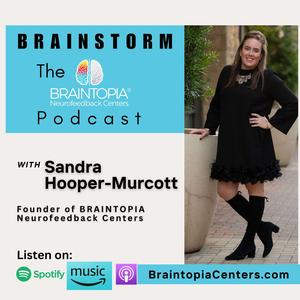
Welcome to Brainstorm, the Brain Topia Podcast, hosted by Sandra Hooper Murcott, founder of Braintopia Neurofeedback Centers.
00:00:13.199 --> 00:00:22.719
With locations across the Dallas-Fort Worth area, BrainTopia helps children, teens, and adults improve brain function through advanced neurofeedback brain training.
00:00:22.879 --> 00:00:35.600
On this podcast, we explore the science of brain health and real-world solutions for symptoms linked to anxiety, ADHD, sleep challenges, emotional regulation, and cognitive performance.
00:00:35.920 --> 00:00:42.479
This is Brainstorm, where understanding your brain is the first step toward lasting change.
00:00:50.719 --> 00:00:58.320
Stress reshapes the brain's wiring, but with the right training, those patterns can be calmed, reorganized, and strengthened.
00:00:58.479 --> 00:00:59.119
Welcome everyone.
00:00:59.200 --> 00:01:07.200
I'm Chelsea Earlywine, co-host and producer, back in the studio with Sandra Hooper Murcott, founder of Brain Topia Neurofeedback Centers.
00:01:07.359 --> 00:01:09.439
Sandra, how are things going for you this week?
00:01:10.000 --> 00:01:10.239
Great.
00:01:10.400 --> 00:01:11.280
We're happy to be here.
00:01:11.519 --> 00:01:11.760
Good.
00:01:11.840 --> 00:01:12.239
All right.
00:01:12.319 --> 00:01:13.680
Well, let's dive right in.
00:01:13.920 --> 00:01:19.599
Today's question is how does stress impact the brain and how do you retrain it?
00:01:20.159 --> 00:01:20.719
Great question.
00:01:20.879 --> 00:01:28.239
So stress is something that is uh the, I mean, number one paramount with so much, and and we're seeing it across the board.
00:01:28.400 --> 00:01:32.879
So almost everyone who comes through our doors is experiencing some kind of stress.
00:01:33.120 --> 00:01:36.400
The world, the, you know, just everything that's going on.
00:01:36.480 --> 00:01:38.159
That's that's a nature of what's going on.
00:01:38.319 --> 00:01:43.040
So the first thing that we do is again, start with the QEG brain map.
00:01:43.120 --> 00:01:48.640
We need to see what is causing that, what it, what is the root cause of what's going on with stress.
00:01:48.799 --> 00:02:02.640
We don't only use objective data from our brain map about how the brain's operating, because we also use the subjective data about symptoms that they're experiencing and why they're feeling these ways, because nothing that we do in neurofeedback is in a silo.
00:02:02.959 --> 00:02:05.200
We always look at a four-pronged approach.
00:02:05.280 --> 00:02:16.719
So we're looking at environmental factors, we're looking at metabolic factors, we are looking at uh functional patterns and factors, and then psycho-emotional patterns as well and factors.
00:02:16.960 --> 00:02:20.479
So we have to look at all of these things to know what is causing the stress.
00:02:20.639 --> 00:02:26.159
Do we have a gut health issue that, you know, even are we eating too much gluten or, you know, and that's different for everybody.
00:02:26.240 --> 00:02:32.319
So that's the first thing that we want to show is that stress is our feelings are real, but they don't always tell the truth.
00:02:32.479 --> 00:02:38.560
So we have to look outside of just how we're feeling and really take both of those factors in.
00:02:38.800 --> 00:02:46.560
So once we identify what is causing the stress, we go back to a part of the brain which you'll hear me talk about a lot, which is called the amygdala.
00:02:46.719 --> 00:02:50.479
And the amygdala is our alarm system of the brain, and that can be activated.
00:02:50.560 --> 00:02:53.360
It's at a location over the temporal lobe called T3.
00:02:53.680 --> 00:02:56.479
That can be activated for so many reasons.
00:02:56.639 --> 00:03:00.800
And there's so many things that can cause our brain to think that we're in danger.
00:03:01.039 --> 00:03:06.639
Whether that's true or not, most of the time it's not true, and that's what we call true anxiety.
00:03:06.879 --> 00:03:20.000
And so we want to make sure and um isolate what's going on in that area, especially in those temporal lobes, so that we can see what we really need to do as far as kind of turning that amygdala off when we need to.
00:03:20.159 --> 00:03:34.080
And that's that's part of what the brain training does is helps us to be able to say and to pull out of that spin of stress and anxiety to be able to know what is truly logic, what is true, and what is what I'm just feeling right now.
00:03:34.879 --> 00:03:35.120
Okay.
00:03:35.280 --> 00:03:41.919
So what happens, Sandra, in someone's brain when they experience chronic stress for an extended period of time?
00:03:42.639 --> 00:03:44.319
So that's a that's a great question.
00:03:44.400 --> 00:03:47.919
So chronic stress over a period of time can go one of two ways.
00:03:48.000 --> 00:03:54.080
At the beginning of that, oftentimes it makes the brain waves, well, it does, it makes the brain waves move very fast, right?
00:03:54.159 --> 00:04:06.800
So we're seeing impulsivity, we're seeing big emotional reactions, we're seeing a lot of feeling like, you know, I'm amped up, whether that's hearts racing or panic attacks or different things like that.
00:04:07.039 --> 00:04:23.600
Now, the challenge, and the reason why neurofeedback is so important is that we see different phases of this because over a prolonged amount of time, when your brain is in this fight or flight mode for so long, the central nervous system cannot and doesn't want to live like that.
00:04:23.680 --> 00:04:27.839
And so what it will start to do is start to shut down, right?
00:04:28.079 --> 00:04:36.000
Not shut down as if like our brain's not working, but shutting down into feeling like I need to protect myself.
00:04:36.240 --> 00:04:41.199
And so I need to like put this over here in this box and I'm not going to think about this.
00:04:41.360 --> 00:04:56.879
There's certain clinical terms that I won't use because
Load full transcript
I'm not a psychologist and you know, can't diagnose that, but it's basically going into a more depressed brainwave pattern, not depression, but a depressed brainwave pattern where the brain is saying, the central nervous system is saying, I can't handle this.
00:04:57.120 --> 00:05:02.959
And so then we see an opposite reaction of instead of impulsivity, we see more of a disconnecting.
00:05:03.120 --> 00:05:09.600
And we see someone who used to be very extroverted now want to be at home a lot and to be by themselves.
00:05:09.839 --> 00:05:21.920
So it's that's why neurofeedback is so important in that kind of stage one in anxiety, so that it helps the brain to not and the central nervous system not get to the point where it says, I'm just gonna shut down because I can't, I've got to protect myself.
00:05:22.000 --> 00:05:22.959
I can't live like this.
00:05:23.199 --> 00:05:23.759
Oh, yeah.
00:05:23.920 --> 00:05:33.199
So which parts of the what what brain regions are we looking at that tend to become overactive or underactive during stress?
00:05:33.519 --> 00:05:41.600
Okay, so that can they can affect all of them, but what really happens at the beginning of this is a lot of times we'll see it in sensory motor.
00:05:41.680 --> 00:05:51.360
So that is basically when you're through the middle part of the brain and then in the central sulcus, where the brain is saying, I'm taking in all of this and I just don't know how to handle it.
00:05:51.519 --> 00:06:04.639
You know, so that then we're gonna see in children, sometimes that manifests in um sensory issues, like I'm gonna cover my ears or I need to close my eyes and I need to stim because I, you know, my my body just feels overwhelmed.
00:06:04.720 --> 00:06:06.319
So I need to do something in movement.
00:06:06.560 --> 00:06:16.079
For adults, it can be, I need to, you know, I need to go off and be by myself, whereas I used to be with my people, you know, it manifests differently, but it it starts in that sensory motor area.
00:06:16.319 --> 00:06:22.319
And then as it moves along, it can go into the occipital lobes, which is where we're processing things.
00:06:22.560 --> 00:06:30.639
And so um that that's the challenge is we don't want that to become like a trauma response in our brain, but it can if we let it go on too long.
00:06:30.800 --> 00:06:35.839
So that's why the idea of just powering through, which in my generation, I'm 47.
00:06:35.920 --> 00:06:39.120
So in my generation, it was kind of like put some dirt on it, power through.
00:06:39.279 --> 00:06:46.480
And now we want to say, no, don't do that because you can get help, you can change the way that your brain is processing these things.
00:06:46.720 --> 00:06:49.199
And that that's ultimately what neurofeedback does.
00:06:49.279 --> 00:06:54.000
And it doesn't have to do it with um meds that maybe can cause other issues as well.
00:06:54.160 --> 00:07:02.000
So it's a safe way to really help your brain and support your brain as it is going through the stresses that we will experience in life.
00:07:02.319 --> 00:07:04.079
So let's talk more about that piece of it.
00:07:04.160 --> 00:07:09.519
So, how does neurofeedback help calm the stress response and restore that balance?
00:07:10.000 --> 00:07:15.680
So, what it's doing is it is it's giving audio and visual feedback that's making the brain change.
00:07:15.839 --> 00:07:24.959
So it's again identifying that this is an area that's either a good pattern or a bad pattern because the brain likes to stay in the patterns that it's in.
00:07:25.199 --> 00:07:32.480
So it's going to say if the brightness is high on the TV and the sound is high as you're going through your neurofeedback sessions, it's going to tell the brain, this is good.
00:07:32.639 --> 00:07:33.600
This is what we want.
00:07:33.759 --> 00:07:35.360
This is what we're training to do.
00:07:35.600 --> 00:07:41.120
If it, if the brightness is low and the sound is low during a neurofeedback session, and it's constantly fluctuating the whole time.
00:07:41.360 --> 00:07:45.360
So it's constantly making your brain work, it's telling the brain, this is not good.
00:07:45.519 --> 00:07:46.720
This is not what we want.
00:07:46.879 --> 00:07:49.600
This is not something that this is not something that's serving us.
00:07:49.759 --> 00:07:58.000
And so over 30 minutes and 30 plus sessions of this, that's what's truly changing the way that the brain responds to things.
00:07:58.160 --> 00:08:01.519
Much like if we are driving and there's a curb, right?
00:08:01.600 --> 00:08:04.560
And the curb tells us we're not going this direction.
00:08:04.800 --> 00:08:06.079
You need to go a different direction.
00:08:06.160 --> 00:08:11.680
And sometimes that curb, we hit it and it's not always fun, but it always sends us in the right direction.
00:08:12.480 --> 00:08:13.519
That's a good analogy.
00:08:13.680 --> 00:08:21.120
So, Sandra, what changes do clients typically notice first when their stress patterns begin to regulate?
00:08:22.000 --> 00:08:28.160
The first thing that typically people will see is that they again, we don't stop all of the triggers, right?
00:08:28.240 --> 00:08:29.120
Triggers are all around us.
00:08:29.199 --> 00:08:30.480
So those triggers will still come in.
00:08:30.560 --> 00:08:34.799
What they will typically see is okay, that wasn't as bad as last time.
00:08:35.039 --> 00:08:40.639
Or once the trigger happens, even if I have a response to it, I can pull myself out of that.
00:08:40.720 --> 00:08:46.799
And again, not sit in the spin of rumination and saying, oh, this is, you know, this is going to take me down.
00:08:47.039 --> 00:08:51.120
But again, saying, okay, this is what's happening, and now I can move out of that.
00:08:51.279 --> 00:08:54.080
So I heard something this week that was really helpful to me.
00:08:54.240 --> 00:09:01.440
And it was the idea that your brain cannot be reacting in the amygdala as well as
processing at the same time.
00:09:01.600 --> 00:09:07.519
So when you're in this high stress environment, we need to activate what we're noticing.
00:09:07.679 --> 00:09:12.960
So it was like five things that you see, and four things that you can feel, and three things that you can hear.
00:09:13.120 --> 00:09:19.759
And when you get into that processing part of your brain, it kind of turns off that emotional spin that you have.
00:09:19.840 --> 00:09:21.679
And so neurofeedback helps that process.
00:09:21.759 --> 00:09:31.840
It helps us to be able to transition really quickly into or more quickly, into I'm in this emotional space, but I need to be in this logical space.
00:09:32.240 --> 00:09:33.840
Yeah, that makes a lot of sense.
00:09:34.159 --> 00:09:44.399
So, Sandra, before we close out here, are there lifestyle habits or other tips that you have that pair well with neurofeedback for stress?
00:09:45.279 --> 00:10:02.799
I would say there are so many different things that what like box breathing and again this strategy, this this 543 strategy that counselors will really help you with and that trained professionals will give you as far as different strategies to use.
00:10:02.960 --> 00:10:03.519
I love those.
00:10:03.600 --> 00:10:10.879
I love learning those because those are things that we can use in our everyday life to move ourselves along.
00:10:11.039 --> 00:10:23.519
Now, what we say, why we say those will work even more, they will be even more beneficial, is the brain is in a place to be able to receive those much better if it's in a more regulated state.
00:10:23.679 --> 00:10:37.200
So we always like to say neurofeedback is going to get that, is that functional work that's gonna get you to be able to use all of these other tools that we can learn from amazing professionals uh and have it be that much more effective.
00:10:37.360 --> 00:10:41.759
So, and that supplementation is another thing that that is very helpful as well.
00:10:41.840 --> 00:10:43.600
So again, we don't work in a silo.
00:10:43.919 --> 00:10:47.919
We know that we need all of the other practitioners that are doing amazing work.
00:10:48.080 --> 00:11:00.559
And we just like to be able to support all of the work that they're doing through helping the brain to be able to respond faster and regulate more quickly with all of the wonderful tools that other practitioners can teach us.
00:11:00.720 --> 00:11:02.720
Oh, it's so insightful, Sandra.
00:11:02.879 --> 00:11:06.000
Thank you so much for all of this really helpful insight.
00:11:06.159 --> 00:11:09.919
We appreciate your expertise, and we'll see everyone next time.
00:11:15.360 --> 00:11:19.360
You've been listening to Brainstorm, the Braintopia podcast.
00:11:19.600 --> 00:11:31.440
If you or someone you love is struggling with symptoms associated with anxiety, ADHD, sleep issues, or focus challenges, neurofeedback may offer a safe, non-invasive path forward.
00:11:31.600 --> 00:11:45.919
To learn more about Braintopia Neurofeedback Centers and our locations across the Dallas-Fort Worth area, visit BrainTopiaCenters.com or call 972-640-7022.
00:11:46.399 --> 00:11:54.159
That's BraintopiaCenters.com or 972-640-7022.
00:11:54.639 --> 00:11:55.919
Thank you for listening.
00:11:56.080 --> 00:11:57.919
We'll see you next time.