

TRANSKRIPTIO 🔗
Matt: Welcome to The Difference, the podcast. I'm Matt Stevenson Dodd.
Helen: and I'm Helen Grieg.
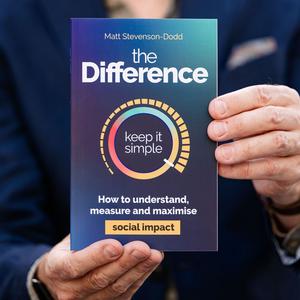
Matt: And this podcast is all about taking a deeper dive into the stories and the case studies contained in the book, The Difference, how to understand, measure and maximise social impact. And we wanted to get behind each of the case studies, meet the people involved and find out more about how these amazing organisations set out to understand, measure and maximise the difference that they wanted to make in the world. And I should say, the difference is available to order in all good bookshops. So I am delighted to welcome our guest today, someone who I've personally known for a very long time and someone I hugely admire as a leader and a friend, Frank Fletcher. Welcome.
Helen: Hi
Matt: Frank, can you remember when we first met?
Frank Fletcher: So I was desperately thinking about this the other day. I can't remember when we first met. It must have been a PPL event. I do remember the conversation that we had on the day that you launched Trust Impact and I picked the phone up to you and I actually remember where that's in London I was because I was there the other day ⁓ Morton who you obviously know who works together and I was walking down that particular street. It's just behind Smithfield. not far from where my dad lives. And I was walking down the street and I said to Karenda, this is the street that I was walking down when I phoned Matt up and said, we need to sort out our impact. And I see you've just launched your company trust impact today. So let's do it. So yes, I don't remember where we first met then, do you?
Matt: Well, I think you're right. I think it was a PPL thing because I was chief executive of League and you were obviously at Adam MacArthur and we were both in the trust, weren't
Frank Fletcher: people who don't know, PPL is the wonderful People's Postcode Lottery, who are just the most fantastic funder. You've your plug-in for the book, I've got my plug-in for ⁓ Postcode Lottery and their wonderful year-on-year unrestricted funding.
Helen: ⁓
Matt: right. mean, what an incredible organisation. I think you're right. And I do remember that call because you were the first person to call me ⁓ when I out. I was quite nervously setting out thinking, ⁓ what have I done? And then Frank phoned and it was ⁓ I think this is going to be all right. We're to be okay.
Frank Fletcher: You've always said that since but yeah.
Helen: Well, and we've just celebrated our seventh birthday, Frank. So that means officially you've been our, you are our longest serving client of seven years.
Frank Fletcher: Excellent.
Matt: That's why it's so good to include you in the book, Frank, because the story and the work that we did together I think is really important. It's the first chapter in the book, it's the opening bit. me, it's probably one the most fundamental things about what I write about in the book and we'll get into that in a moment.
Frank Fletcher: Thank
Helen: To get us started, we wanted to ⁓ just ask you for two ⁓ and a lie. ⁓ Now, purpose of this is that during the podcast, and I are going to and work out ⁓ which of those that you've told is the lie, ⁓ which are the truth. And at end of the podcast, we are going to take our guesses. ⁓ And you can ⁓ impress us the things that have done. ⁓ Is that okay? And have you ⁓ two truths and a lie that you can tell us.
Frank Fletcher: Okay. my first ⁓ truth or the lie is that I have spent more nights ⁓ sleeping on boats than hotels in the past five years. second is that my real first name is Francis. And my last is that I got my first opportunity to go sailing thanks to Ken Livingston.
Helen: The Ken Livingston.
Frank Fletcher: Ken Livingston and for your younger ⁓ listeners, viewers, Ken Livingston was the Mayor of London ⁓ long Sadiq in the of the GLC. ⁓
Helen: Wow. Okay.
Matt: while.
Frank Fletcher: And we're slightly left of Corbyn just to give a bit more back to him. It's my first opportunity to go save him. He might be really insulted about that. I'm really sorry of him.
Helen: you
Matt: think this is going to be really hard for her. I can actually believe all of those.
Frank Fletcher: Well, there you go. ⁓ I take games like Two Truths and a Lie very seriously.
Helen: Yes.
Matt: I can see that.
Helen: The competitive spirit's coming out here.
Frank Fletcher: was it. I'm to have a wager, Matt and Helen. ⁓
Matt: Yeah, of course you would. yeah. ⁓ just to give ⁓ our listeners and viewers a little bit of clue on this, can you give us a sort of 30 second background into Frank where you might spill some beans, Frank? I don't know whether you're going to do that.
Frank Fletcher: Well, possibly, although I'd like to I'm very competitive. So my name's Frank Fletcher. I'm the CEO of the Ellen MacArthur Cancer Trust. And I've spent the majority of my career basically working in organizations that support young people through outdoor activity. So, you know, know this is point of the podcast, so we talk lots about the difference, not do, but up until we had lots of conversations about, know, we did lots of stuff in the outdoors and... and use that as a vehicle for change. So yes, I spent most of my career doing that. For the last 20 years, I've CEO of the Ellen MacArthur Cancer Trust and we use sailing and outdoor adventure to help eight to 24 year olds believe in a brighter future following cancer treatment.
Helen: I'd like to start really by asking you what the pivotal moment was for you that you realized you weren't focusing enough on impact. ⁓ But was something happening? ⁓ Did you suddenly have a light moment? What was it that made you realize it wasn't? quite at the forefront of where you needed it to be.
Frank Fletcher: So I think there was a pivotal moment which I'll come to. I I actually think, Matt, going back to Street League, I love football and I'm a London boy. And, you know, when I first met you and you started talking about Street League,
Load full transcript
I was like, oh, wow, okay, that's really interesting. And then, I mean, it was impossible to have a conversation with you, about Street League without talking about Impact.
Matt: Yeah, sorry about that.
Frank Fletcher: And that's great compliment, by the way. And ⁓ I that's probably where my thinking started because I sort of thought, wow, this is like, you know, I can see why Strictly works ⁓ that the start of like, ⁓ are we looking this right? Are we, you know, like, am I missing something here? But then there was just this moment where I realized, and I think actually other people in the organization maybe got there before me actually, which was that actually we needed to be a different organization rather than a dual organization. And I think that it's, you know, ⁓ taken a long time and I'm not sure we're there. And when we come on to chat later, I think that will come out. ⁓ You know, we had spent years collecting vanity metrics. So I'll give you our best vanity metric. So what we did is we had a strap line set, Ellen McArthur Cancer Trust rebuilding young people's confidence. And we had that on claving, had that walls, we had that on sails and boats. We had that plastered everywhere. And we're a really nice organization and we do a good thing and we've got lots of nice people in the organization. So we bring young people in and we'd spend four days with them and they'd be surrounded by logos, walls, sails, boats that said rebuilding young people's confidence. And then what we do after four days Matt is we go to them and say, on a scale of one to 10, have we helped you to rebuild your confidence? And what surprise, surprise. They all said, yeah, you've helped rebuild my confidence because they loved us and they liked us. They'd had a really good four days. And that for me was probably our biggest vanity metric, was like, actually, we spend four days telling you we're going to rebuild your confidence in quite sublimable ways. And then we're going to ask you at end of the four days if we've rebuilt your confidence. And then we're going to go around and say 98 % of young people who come stay with the LMAG Alpha Cancer Trust and rebuild their confidence. And ⁓ yeah, so I sort of had that light bulb moment of actually, it's about difference. So look, we were delivering and we still are delivering inspirational trips for young people. But we didn't understand at the point that we started this thinking about how to measure that in a meaningful evidenced way. it's about the difference that you make. ⁓ So yeah, that was you know, was our pivotal moment.
Matt: Yeah.
Helen: I mean, that's a full 360, 180 turn, isn't it, really, ⁓ to go to actually, ⁓ that's not what we need do. We don't need do that, We can just measure it a different way rather than ⁓ feeling like we're doing something that isn't necessarily... giving the young people the autonomy and voice to really respond to what is actually happening on these trips.
Frank Fletcher: Yeah, ⁓ I always think we weren't doing it deliberately. We just didn't know, it wasn't like we set out to go, well, if we, like, you know, if we do this, well, I don't know, mean, some organisations might do that, but we certainly weren't. It was just, we didn't know how to do it differently. ⁓
Helen: Of course. Yeah.
Frank Fletcher: So yeah, we suddenly realized that we can measure this. So it wasn't deliberate. It wasn't that we wanted to collect information that wasn't evidenced and wasn't robust. was just that we didn't... I mean, I'll be really honest, an impact has come so far. in the last eight, nine years. mean, you know, Matt, I think it's easy to forget how groundbreaking you did, what you and the team at Trust Impact did, how groundbreaking that was. Because people didn't talk about impact in that way. And people didn't, you know, certainly in the charity world, I'm sure they did in other parts of the world, but certainly in the charity world, I it's easy to how far we've
Matt: it a brave move that you as well because you don't really have to do it. in a lot of ways, know, those stories that you're able to tell about all these people who came and their confidence was built. You know, a lot of the time that's enough for organisations to raise money to do the things that they need they need to do. And it takes a braver leader to go, actually, that is enough, but we are not doing everything we want to do for our young people. And we're not sure that we're doing everything we want to do for the young people, the for the purpose, for the cause of what we're trying to do. I think that's the brave move.
Frank Fletcher: Yeah, that wasn't just me that was brave. That was the board of trustees that were brave. That was the rest of the team that was brave. We've never seen... Yeah, actually probably one of my disappointments that quite often impact and fundraising get sewn together. And I'm not entirely that's always the best partnership. ⁓ don't want say that it isn't important. because it is, but actually our drive to measure in an academically rigorous evidence way our impact was actually about improving what we do rather than trying to raise more funds. And I would say for the vast, vast majority of our funders, actually they're far more interested in the... that meeting young people, the stories, the understanding, then actually, ⁓ and ⁓ obviously we have some funders who are really interested in our impact data and that's great, but actually some of our funders, that's not the driver. And I think, you mentioned the bravery, had conversations as a board where we sort of ended up in a place where we said, well, look, we'll measure this. And if it shows that we're making absolutely no difference at all. Or even worse, it shows that we're having a negative effect. Because actually what we do is we bring young people together who've come through cancer treatment. And there are some long-term effects of cancer treatment, survivor kill, infertility,
long-term health effects, risk of relapse, et cetera, et cetera. So actually, one of the things that didn't come out thankfully, is actually we might have got to that evidence data that said well actually when you bring your people together and they realize actually all of these things that actually they are going to face in the next 10, 20, 30 years maybe this is actually being negative for them and obviously we didn't see that let's be really clear but actually you know where we got to with the board and with the team and was actually well look if we're doing something that's making no at all or even worse ⁓ we're having a negative effect, then we need to go and do something else. And that, I mean, you know, ⁓ was quite an interesting conversation that got us to there, if I'm honest. But was a really important conversation, which is that you want to know that what you're doing is having a positive impact. And you want to be able to evidence that ⁓ and just go and ask somebody at end of the week, have we helped you rebuild your confidence?
Matt: Yeah. It's that sense of wouldn't you want to know, isn't it? Actually, yeah.
Frank Fletcher: Absolutely. Yeah, absolutely. Yeah.
Helen: So Frank, what was the hardest part then of the impact journey for you? Because obviously, few, we didn't find out that we weren't having the effect that we wanted, which is always a relief. But obviously, that journey from January 2019 to now, we've worked alongside your team, and there's been lots of developments and so on. What was the hardest part for you and the organization throughout that process?
Frank Fletcher: I mean, I think it's worth mentioning that three months into this process, that little thing called COVID came along and knocked on the door. So I think we did one in-person session. And then I think the rest of all of our impact work was done during COVID by Zoom. Which I actually have to say, you know, this is endangering becoming bit of a loving, so apologies.
Matt: I think so. you
Frank Fletcher: It is a great credit to you because actually, I mean, you just launched, you you launched a couple of years before, you were getting busy. We'd come on board and said, right, we're going to do this. And we did a great day all together in cows. And then I think, you know, three weeks later, we're all in lockdown and, you know, it's like, well, we've got to keep this going. I mean, that's obviously very specific to that time. I mean, I think it's the hardest bit was not the technical side.
Matt: Yeah.
Frank Fletcher: the hardest bit is cultural. And we had some technical challenges and actually have always been overcome. I think we like a lot of charities. We were focused on activities, numbers, logistics. ⁓ You know, that's how charities work. You know, we took this many young people on trips this year. We did this. You know, we had this number of them. Do you know what mean? And you have all those statistics that your organization is really comfortable with
and by the way, we have not got past all of these at the moment. I'm going to talk about a couple of things that I know we're still working on. But I think that cultural shift to a mindset where impact drives strategy really means challenging those old habits. So actually rather than going to your board and saying we're going to increase our beneficiaries by X or we're going to do this, this, this and this. Actually you're going to your board and saying and your team. and wider stakeholders and say, we're going to have this impact. quite a big shift. ⁓ you ⁓ and things that I'd put underneath that said that letting go of comfortable but shallow metrics. we still use them, by way. mean, I'd to say that we don't, you all those shallow, ⁓ comfortable metrics, we've stopped using them all. Never them. ⁓ Organization is perfect. ⁓ Absolutely not. You know, we still talk about some of those comfortable metrics, but we...
Matt: Thank
Frank Fletcher: talk about them slightly less and we talk about impact as well. Being curious, and being that when you're being curious that you don't necessarily have all the answers. So, ⁓ you know, we have our wonderful Impact dashboard. Anyone go and see it. I'm sure you'll put a link in the show notes. ⁓ Ellen McAfee can start, slash Impact.
Helen: Yeah.
Frank Fletcher: But it doesn't always give you black and white. So what it does do is it gives you stuff where you go, I wonder why that's happening? Why are we seeing that? What's that about? you know, quite uncomfortable as a charity because you're used to being the experts. We're going to do this and that's going to mean that this happens. Off we go. And that's not how the real world works. So you have to get that again, this is cultural. You have to get to that. It's okay to be curious and to think about things and think about why that happened. ⁓ And the other two hardest parts. I think helping staff feel safe when the data said we needed change. So it didn't actually happen as it turns out, but we have two bases that deliver very similar programs. know, one of the fears in the organization was it would suddenly show that one of our bases in, you know, we have a base up in Scotland, have a base on the Isle of Wight. You know, one might be showing that it's having this amazing effect on the impact of young people's wellbeing and the other bases. Now that didn't happen, so it's okay, but actually that's, you know, like... you needed to hold, know, staff needed to feel that they were going to be safe when data said we needed change. And then...
Matt: Yeah.
Frank Fletcher: You know, and we still haven't done this, but you start by looking at data and ⁓ wellbeing measure, ⁓ ⁓ and still lost a bit of that quality of data. And that was for us was to basically concentrate on, right, we're going to do this, ⁓ the Wally Keddenberg scale, and we're going to use that to measure wellbeing. But because you're putting all your effort into that, you ⁓ stop collecting the the sort
of qualitative data that you need. the last thing is recognizing that impact was the work. It's not something you squeezed the five minutes of a board meeting. And I can't tell you how many phone calls I've had from people who said, look to your impact dashboard. I'd really like to do that. Can you put me in contact with the IT guys that made that happen? Like it's not about the IT. Like you can talk to Matt and trust impact and you can talk to the team about impact. But the flashy techie bit that everyone gets carried away with, I mean, it's lovely Matt. I'm not being really bad at air, and I promise. It's fantastic. But like people become obsessed with that's the bit.
Matt: That's all.
Frank Fletcher: ⁓ well, I could just do that bit. And actually, that's not what it is. It's about making sure that difference not do and
Helen: in.
Frank Fletcher: impact is ⁓ the work, not something you add on at the end.
Matt: We. We see this all time, a lot of our, Helen's nodding as well, a lot of our clients will come to us first off and say, I really like that dashboard. Can we have the dashboard? And then you have to sort of say, well, you look at Ellen MacArthur, right? They spent a lot of time thinking about what it is, the difference that they're trying to make in the world and how would they measure that without over-complicating it and without trying to tell too many stories. And that transformation for Ellen MacArthur was quite big. ⁓ think, what you've alluded to, Frank. that change is quite big. And it is quite daunting for staff to potentially see those things in front of them. So you brought up the dashboard, was, it's almost like the cherry on top of the icing on top of the cake, isn't it? It's the last little bit. But I just wondered if you could reflect on now you've lived with the dashboard for, I don't know, what was it, about three or four years now, just your sort of reflections. Because it is a very honest and live account of the change that is being made or is not made by the trust.
Frank Fletcher: Thanks.
Matt: You know, again, admiration for your ability to take that step and do that. But I just wonder if you could reflect ⁓ how that's been.
Frank Fletcher: Yeah, so I think I think you're right. think the danger is that's just the bit that everyone concentrates on. And I'm sure we're taught through the impact journey that we had and all the stages we went through. mean, love the dashboard and I go look all the time. I think I probably drive the team slightly mad. look, we've obviously had a few more surveys back as I can see a changing one percent. Sorry, You do slightly obsessed with it. I think it is great because it's there and it's open. And know, Matt, sometimes it doesn't show you what you want it to show. So, you know, while we've been on this impact journey, we've been on a journey around whether we are truly reflective ⁓ all young people in recovery from cancer in the UK and we're not. And, know, we've got, you know, we've spent an awful lot of time over the last, you know, they're actually very similar to the time that we've spent working on our impact, working on how we become more reflective, how we reach young people that we're not reaching. You know, if you're a black young man in Birmingham, you're less likely to, you know, in recovery from cancer, you're less likely to come and, you know, take part in the activities that the Eleanor McArthur Cancer Trust does than if you're not. if you're a white young man from somewhere else in the country. But actually equally, if do get you through the door, ⁓ actually, know, some of our impact data shows that ⁓ we're having... ⁓ Now, of that we don't have a big enough, you know, ⁓ we'll data sets, Matt, and you'll get excited and talk lots. So some of it is about being curious and thinking about things. ⁓ you so some of our data, you know, isn't great. And some of our data makes us go, ⁓ we need to be doing that better as an organization. So, mean, I felt we talked a lot about it from the beginning, but I think if you're gonna have data like have, you've got to be completely transparent. So people can go and see the good stuff and equally, if they do a bit of digging around, they can see some stuff that we've already that we know we need to do better. And it's really interesting, because I talk to people. And they say, oh yeah, but you know, and I literally explained to them that we do not touch the data. Like literally, I mean, you obviously know how it works because you guys designed it, but literally that sits within our website. We have no control at all. You know, it literally pushes from your very clever systems that you can probably describe better than me, or basically you can describe better than me, onto our website. So we can't change anything. We can't take anything down. can't hide anything. We can't adjust anything. And I say that to people and they like, look at me like, what do you mean? It's like, I don't know. It's completely open, transparent. What you see is completely unedited. That's it. And I think, but I think if you're going to do this, that was the only way to ever do it. ⁓ you're, you can't, otherwise you're just. you're just presenting what you want to present and we never wanted to do that, we wanted to present what's there.
Helen: And I think what's really interesting is that what you're describing is probably just puts you further ahead than an awful lot of charities because you actually know. You actually know now where your gaps are. The number of people we've worked with who have started with, look, we know we're doing a good job. We know that this is okay. We just need to be able to prove it from a data perspective who are then at the end towards the middle or end of the journey have then started going, hang on a sec, we never knew this. We did not know that we were not serving these communities. We were ⁓ not achieving this outcome. ⁓ I think there's ⁓ element of ⁓ journey that
everyone's on now ⁓ impact, certainly in the charity sector, ⁓ the need to really understand your data. And the charity Soar Poppacy that came in and... 1st of January, 2026 is pushing towards that. How's that affected the team, sort of that awareness? Has it been of a positive in that it's focused the work ⁓ has it ⁓ a slightly damaging effect initially, which has taken a while to recover from? How has it worked?
Frank Fletcher: So I think you're right, Helen, that getting honest about what we didn't know was the first stage of our impact journey. So actually admitting that we didn't have the right data to understand whether our support was actually doing all of the things, making the difference that we wanted to make was the first stage. This is not a... podcast about COVID. So I'm dreaded going back to COVID. don't know why I've suddenly gone down this road map. It wasn't even in my notes, I that part ⁓ of reason that it worked for us without the challenges that you described is because it happened to be in a period of history. particularly at the yellow MacArthur Council Trust, but I imagine in lots of other organisations and lots of other places in the world where we were having to be really honest with people. So actually it was a time where we were being very open and honest and transparent. This is where we are. We don't actually know what's going to happen next week. not even sure that the people in charge of our government know what's going to happen tomorrow. So actually let's all get comfortable with the fact that we also don't know. You so I think
Matt: you
Frank Fletcher: And I never actually thought about it until you asked that question in that way. And think that we were very lucky at when we did this. That actually by the time people really started looking at it. they were comfortable with the fact that we were just being honest. I mean, I do remember, Matt, we were talking about memories earlier, I do remember when you sent me the first data and I was in a hotel room in, I can't even remember where I was, but I was in a Premier in my hotel of choice. I hope you get a bit of advertising for them.
Helen: a hotel room, not a boat, just so we're really clear.
Frank Fletcher: a new way of cleaning, but I've lots of time on boats as well But literally I remember sitting there thinking, and I remember opening it and going, shhh. So I'm actually like, well I swear, is this a swearly podcast or not? Shit, what if this actually says that we make no difference at all? And actually you sounded happy about it you said you were sending that over, so just thought you didn't say that.
Matt: Thank Yeah, I wanna.
Helen: Yeah.
Frank Fletcher: But yeah, opening that up for the first time and then sharing that with the team and saying, look, here it is. So I do think you're right, Alan. I do think that honesty is hard. Being honest about what you don't know. I think sometimes, and I think possibly charity chief execs sometimes feel they can't say,
don't know. And actually we might be a better sector if more often we went, I don't know, I have no idea, not clear. And we were honest about what we didn't know. I hope that's answered your question. think I may have gone off on a slight round of apologies.
Matt: No, I think that's such a great answer and a great question, Helen. Well done. I mean, think the question for me latterly that's come out of the dashboard, Frank, is I think, and I like you, I look at it pretty much every day because I love it. I think it's so interesting. But I was looking at the sort of demographic considerations that are shown in the dashboard. and just how each demographic experiences arise or not arise in their wellbeing over time. And I know I think there's a story isn't that your staff noticed some of this happening and then wanted to sort of work on inclusion and other things. And I was just looking at the dashboard the other day and the change, if you filter the data to 2025, the change is quite profound on that activity that you undertook to actually make a change because you saw it in real time. wonder if you could reflect on that.
Frank Fletcher: Yes, I think you're right. We have seen a change. I mean, to be the spirit of transparency and honesty, we still have a long way to go. But when the, in what we've given is our team the tool to go and look themselves. So they don't have to wait to get a feedback report or an impact report or the ⁓ senior leadership come down from the hill with the ⁓ stone of, you know, the 10 impact, you know, learnings this quarter. Actually, anybody in the organization, be it, and we've got children, 50 volunteers, we've got 30 freelance skippers who are delivering on the front line. They're the people who, you know, make it happen day in, day out. We've got a staff team. Every single one of them can go look at exactly the same data that you're looking at. But they can go and see exactly the same data that I can see, that you can see. And then that completely empowers them exactly as you described, Matt, to come and say, I've seen this. Like, I can see this. can we do? So you're right. You're ⁓ empowering team to see everything live. There's no hoarding of information. I'll just show them this little bit of information because that's the only bit of information I want them to see or I'm going to look really clever because I've kept this back for me to talk about. everyone is there for everyone. If you want to go and see it, go and see it.
Matt: Have you experienced any downside on that?
Frank Fletcher: think one of the downsides is that people are so used to seeing data that says 99 % of young rebuilt their confidence. I think sometimes your challenge is that because people are so used to seeing positive, positive, positive data, that when they see data, there's actually far more evidence based. And therefore doesn't show you that 99 % people had the most wonderful experience and everything is solved. And that's actually one of the conversations I had with a funder once, which was, you know, it was a really good conversation and they still funded us. I mean, it must have gone okay. But, you know, actually explaining to them that, that doesn't read like some other charities present their impact because we've done this in a different way and we've actually used the work and environmental wellbeing scale. that's, you know, that, you know, and again, so, and we, you know, they're seeing live data that we're not presenting. You know, it's there, it's real. So, yeah. So I think there is that and that's probably an ongoing challenge which is people being comfortable that our results are really good but they're not nine out of ten, 99 percent because that's not how well-being works in young people.
Helen: If you'll just let me indulge me for a moment in an anecdote. I used for years worked in housing and every quarter we had to return a workbook to our local authority. And I would get very stressed about the outcomes that we were reporting on and what numbers they were and so on. And I was talking to a few colleagues across the sector one day and they all looked at me as if I was mad because I was giving them honest feedback. ⁓ I was... putting the actual numbers in the workbook and not making it up. Now, I'm not for a minute suggesting that that happens on a large scale, I couldn't believe it. I couldn't believe that people would do that. And I think that's ⁓ of the things that live data, transparent data really does combat. you're right, Frank, until the whole sector's doing it, ⁓ it ⁓ anomalous you're being transparent. So ⁓ listen, I would like to take us back a little bit if that's okay, because I'm conscious we started this section by saying, everyone wants the dashboard, and all we've done is talk about the dashboard. And Frank, you did mention several things that have been challenging in the journey. Could you just very quickly talk us through what your impact journey was with Trust Impact, just sort of highlights or headlines, if you like, about what stages you went through?
Matt: Yeah.
Frank Fletcher: ⁓ that first bit talked about honest about what we didn't know so important. I think then actually the most important Matt, that you did with us and you were very much involved that in our one in-person and I love the lifeboat analogy. ⁓ So we redefined our purpose, our needs and our vision. What difference are we are we here? ⁓ I'm sorry, not in general in the world, just the Ellen MacArthur Cancer Trust. And you kept coming back to the lifeboat. know, like if you've only got 12 seats in the lifeboat, Frank, what 12, you know, what 12 things are you putting in the lifeboat? What 10 things are you putting in the lifeboat? What, you know, and actually, this really shouldn't be a podcast about COVID. We then went into COVID. It was incredibly useful because we were like, we know what our lifeboat is because we've sat in a room with Matt and we've said, This is our life
bait. And so that redefining purpose, need and vision. And that was really important. So that was the second, for me, the second bit of that journey.
Matt: I think Frank, famously you said to me when I said you could only have a small lifeboat, you said I need a bigger one. I'm going to get more money and I'm going to get a bigger lifeboat so we can do more.
Frank Fletcher: Exactly. Yeah, and then I ended up in a world where you couldn't build a bigger lifeboat because actually it wasn't possible. you were really wrong. And then I think for us, ⁓ ⁓ ⁓ how we were going to measure. So ⁓ you know, working that what we wanted to measure was that wellbeing, was that previous piece of work, and then working out that actually we could use this academically robust measurement. You know, we were no longer asking those vanity questions. We were using something that someone else had designed that we had to use under license. We could only use in a certain way. And that for me was, that was, you know, one of the eureka moments for me was like, okay, I get this now. going from a do to difference made such a big difference. And that clarity then gave us clarity on other decisions we were making and other things we were doing. And then, ⁓ you know, I think my final thing really was that that Transparency earns trust. So actually, you know, anyone can go and look at that dashboard, anyone can see it. And you know, we're completely open about that. And I think that that for me, those are the journey, that's those sort of stages of the journey that we went through.
Matt: Yeah. So just going to the do and difference point, Frank, it was actually an offhand comment, I think, from you after we'd done the theory of change. And you were almost sort of remarking on sort of the process and saying, you know, actually we've stopped talking about what we do now and we started talking about the difference. And when I was writing the book, I thought, what are the key things that I'd like to sort of put in this book? And that was the first thing that came to mind. I just thought, remember that conversation with you. And I remember that change because I thought it's such a nice way of describing the process that you really need to go through to start seeing things, not as how we operationalize ourselves and how many things we run and. you know, how many activities all happen over here and everybody gets really excited and 95 % of the board meetings are all about finance and you know, nobody ever talks about what we're trying to change in the world to that complete change of like we're putting impact at the heart of this and lo and behold, we've now got a live dashboard that tells you whether we're doing this thing or not. and not just me as the CEO, but everybody involved, stakeholders, staff, people, young people, everybody can see it live. And that is such a transformation. That's why I wanted to put it upfront in the book in chapter one. And it was from that comment that you
made.
Frank Fletcher: Thank you. I will talk about my loyalties later, Matt. ⁓
Matt: You will.
Helen: was about to say is is Frank getting royalties for naming the book.
Matt: Yeah.
Frank Fletcher: Also, just, you mentioned it there, and Helen, sorry to... That coming back to that theory of change was so important. I still have that theory of change. I know we've updated it a couple of times since. It still sits behind my desk. You know, and we have updated it a few times since, but, you know, we can... Completely looked at that new and actually that is you know doing that is so important getting that bit light so important
Helen: makes me so happy. Thank you, Frank. ⁓ a shout out to Hannah Woods, we should say as well, because Hannah worked so closely with you on all of that.
Matt: Yeah, me too. 100 % and John Leitch as well along the way.
Frank Fletcher: I mean, John and Hannah, John, Leeds and Hannah, massive respect to both of them
Matt: should also mention Alex as well, ⁓ just incredible ⁓ design again on the ⁓
Frank Fletcher: and sort of that technical issues that I didn't even understand.
Helen: He's a boy genius, says Alex.
Frank Fletcher: Okay.
Matt: I was just going to say on the theories of change, Frank, there's so many that I've seen in my career that are just so complicated and so convoluted. And I think yours is always the one that I pull up as an example to say, this is how you can write a really clear theory of change from one end to the other. doesn't try and overcomplicate things. It really focuses. And it ends with this lovely thing about we're helping young people believe in a brighter future. We've got this catalyst moment that is this sailing trip. that we can put something behind us and we can put something in front of us. And it's always so profound, think, that seeing that on a page and the clarity that you got to with the team is really, really special.
Frank Fletcher: I'm resisting the temptation at this point Matt to say so what
Matt: Yeah.
Frank Fletcher: because I think you said ⁓ so what to so many times we're like I want to this ⁓
Matt: No. You're just relieved. Relieved when we got to believe in a bright future.
Helen: Our revenge is sweet. So Frank, we've talked a little bit about the risks involved with this. How do you build a culture where there are upsides to taking risks in pursuit of impact? Because it's scary. People don't like risk in the charity sector, I've found.
Frank Fletcher: I did get a little bit of warning on some of these questions. ⁓ And actually when I looked at this question, I I have no idea how to answer it ⁓ because I'm not sure we're there yet. And I it's with difficulty. ⁓ So ⁓ honestly, joking aside, it's really hard. And I honestly think we're there when I think really difficult. ⁓ to build that culture and think you've almost just got to chip away it slowly but surely. I think you're right as a sector, we're really bad this. there was a... There was an organization years ago, not even an organization, an event I think called Pizza for Losers. Do you remember that, Matt? Was that a thing? Where people came together from the charity sector and ate pizza and shared all the things that they'd got desperately wrong. It was brilliant. And I do think we're really bad as a sector of getting stuff wrong. But also we're bad because we're... We're taught to be bad. The whole culture from our funders, from our boards, from our teams is, what's that famous expression? No one ever got fired for employing IBM. That really dates me, I'm afraid. For younger listeners and viewers, there was a big infrastructure IT company called IBM who had 95 % of the market. They had this great, and it was an advertising campaign they ran, you know. one ever got fired for using IBM. And was years ago, maybe 35. And I think the charity sector was still there. No one ever got fired for doing the safe thing.
Matt: nice glossy annual report with nice photos in it
Frank Fletcher: Absolutely. actually, why would you want to tell people that are some things that you could be doing better? I remember, and another shout out to a great person, Kate did, when Kate was at Young Lives, she did an impact report, and it was the first report I'd ever seen ⁓ where there was a page that said, the things that haven't gotten right. I mean, you probably remember it, Matt, as well. And I remember the whole of the sector went,
Matt: I think.
Frank Fletcher: ⁓ my God, like, there many things they did that didn't work. And it was like a major thing. Like, people were like, ⁓ my God, that's really brave. And you think about it now and you think, that's mad. But actually, it's still the culture of the sector. So how did we build a culture? I don't think we have. I think we've moved it along a little bit. And I'm not sure we're there yet. Yeah, and it's just, it's really hard. It's really hard to go, we tried this and it didn't work.
Helen: find fascinating ⁓ that the sector, we work with some of the most complicated situations in entire country. ⁓ And yet people, the people who us money, the people who are judging us or so on, just expect us to get it right first time, 100 % of the time. And it's like, ⁓ there is no wand here. I find it... one of those ongoing confusing aspects when I talk to people, with I want 99 pence of every pound to go to the frontline service user, but we won't get into that.
Frank Fletcher: ⁓ wait. look, this is a buggerhole so you can edit it out. But we do it in society. Like, you know, government make U-turn is a headline and it's a terrible thing because the people who are in charge of the things that really matter to us, like the NHS and schools and all those things that really matter, they have a policy ⁓ and then they get two months down the line and they realise it's the wrong ⁓ And they go, ⁓ that's the wrong thing to do. Let's not do that. And then suddenly it's like, ⁓ my God, it's a U-turn. They should resign and blah, blah, blah. Now hold on a
minute, I've tried something. It hasn't worked. So they're going to try something else. Like that's how it should work.
Helen: That's good management.
Frank Fletcher: yes, they it. It wasn't right. They're going to do something different. Isn't that great? You know, it is. ⁓ It's, yeah, I've been very have job that I absolutely do and I have a wonderful board and I've been Chief Except for a very long time. And therefore, actually, I do feel ⁓ confident enough that can try things and because I have a supportive board and because... I've been here a while and I have a track record. If I did try something tomorrow and it didn't work, I feel that I probably would still be chief exec six months later. But I think there are chief execs in roles that have just started, that perhaps don't have the supportive board that we have, that feel like, oh my God, if I do that and it goes wrong, I'll be out of my job and I've got to pay the mortgage. And therefore actually we become really We don't do the things we should be doing.
Matt: just ⁓ saying that came to mind that risks are okay, but it's how you mitigate risks, isn't it? ⁓ how you think about risks. And actually the fact that you've been there for so long and that you're so trusted and your team are so trusted and you're so transparent allows you to go and do these extra things. Whereas a new CEO in place, maybe with a new board, there's no trust yet. There's no kind of relationship. You've got quite a lot to get through before you can get to those sort of levels of trust.
Frank Fletcher: Yeah, absolutely.
Matt: Yeah, I was also thinking we get some clients from the corporate sector particularly or even sort of quite high profile public sector where they look at your dashboard and they think there's no way I could do that because we'll just be completely taken apart by the media or by other stakeholders or people who don't like us or whatever.
Frank Fletcher: have media locking in the door tomorrow. ⁓
Matt: Yeah, we're all a bit afraid of the Daily Mail test, aren't we? It's like, what are they going to say if this comes out or this doesn't work or this doesn't happen? And I think, I was just reflecting on whether that was easier or more difficult for the work that you've done than say a high profile sort of public body where they can't do it. And you might say, actually they should do it. we all did it, we'd be in a much better place.
Frank Fletcher: a really good question. ⁓ my children are well past school age now and off having various different adventures. But, wouldn't it have been great when my kids went to school that I could see complete transparency from, you know, the local comprehensive in cows that said, you know, here's our data, completely, you know, open, transparent. But you never get that. You know, maybe there is something unique about the charity sector that allows us to do that. And whether that's how we're funded or whether that's, you know, how we're governed or whether that's...
But yeah, I think you're right. I think the more transparency you could have across all sectors, better would be.
Matt: Yeah.
Helen: So I think we're going to start wrapping up now, Frank, but I think to finish us off before we come back to your two truths and a lie. ⁓ ⁓ your work done? When is the work of Ellen MacArthur Cancer Trust done?
Frank Fletcher: Uh-huh. So it's a really interesting question for us because in a funny way, we aren't going to affect when our work is done, which does lead to the question, should we be doing something different? So in answer to your question, when would our work be done? I mean actually it's when young people come through treatment and they don't need our support. And been involved with ⁓ Lives Versus Cancer and ⁓ ⁓ ⁓ couple of other charities now who've worked on the ⁓ research that we undertook and then the Star, you know, collective that we're all, that we're involved in now, which is actually looking at how do we make systemic change to how people are treated. So our work actually be done where ⁓ are kinder, young get psychological support at the point of diagnosis, they have trauma informed diagnosis, get psychological support through treatment, all young people get good outcomes. So in terms of when can we shut our doors, probably not a very long time ⁓ and actually not. entirely in our control. ⁓ I think this is a really interesting question and cut this out, it's too long. You know, there was a charity called Towing the Water took servicemen who were injured in the Iraq war and the Afghanistan war and lost limbs and they took servicemen, competitive sailing and it worked brilliantly because what people who've being in the army and lost an arm or a leg really missed was competitive sport. But actually it was really difficult to compete at the same level. And they were brilliant. They did some fantastic work and they did it really well. And I remember talking to the guy who'd started this charity, basically said, Lloyd said, we need to stop because thankfully we're no longer fighting wars in Iraq and Afghanistan and therefore people are not being sent home injured. And I always remember having this really great conversation with Lloyd. He was very sensible about it. And he basically said, people don't want us to close our doors because they like the charity. And he says, I keep having to say to people, we're not needed anymore because, you know, thankfully we're not sending young men out to, you know, that part of the world. And thankfully they're not losing their arms or their legs and therefore they're not coming back and needing our support. And it was a really interesting conversation because so pleased you're asking it. because actually charities do need to think about how do we put ourselves out of business? And I suppose for us, it's a really interesting question because probably not in control of being able to close our doors. And there's that amazing quote from Desmond Tutu about, ⁓ point you
have to stop pulling bodies out of the river and have to go upstream and find out why they are falling in. It's one of my favorite quotes in the world. ⁓ And you're right. And maybe actually, ⁓
Matt: Yeah.
Frank Fletcher: to finish on the fact before the two lies, or one lie and two truths, which is actually maybe we should be thinking also about, and we are taking part in this piece of work to work out how we put ourselves out of business.
Matt: Yeah. Yeah. Thanks Frank. I mean, I think that's such a good story. And I love the idea of looking up the river. mean, that's, it's just so important all the time to lift your heads up and look at what's going on. And this comes back to doing difference again, really, doesn't it? you get, you get stuck in do, you get you stuck with your head down and you don't see what's going on.
Frank Fletcher: Yeah. Thank you.
Matt: ⁓ So ⁓ in conclusion then, let's go back to the start and let's have think about these two truths and a lie. Helen, your take? ⁓
Helen: So just to recap, we've got number one, I've spent more nights on boats than hotels in the last five years. Second one, was my real first name, is Francis. the third one, ⁓ was given my first opportunity to sail ⁓ Ken Livingston. So my guess ⁓ I think lie is that your first name is Francis. ⁓
Matt: Okay, in reverse order, Frank, ⁓ can believe that Ken Levinson gave you your first sailing trip. It's it's too random to not be true. ⁓ I could also believe that you first named Francis, because it's ⁓ way you squirmed a little bit when Helen tried to get you on the spot in that one.
Frank Fletcher: ⁓ wow. Yeah.
Matt: that gave it away for me. I think the more nights on the boat than in hotels is close. I think it's one of those that's probably like within a few nights of each other. And I know how much you travel, right? I mean, I've seen you in all sorts of places, in all sorts of events, but then again, you must spend quite a bit of nights on a boat. So I'm going to say number one is the lie.
Frank Fletcher: So you're entirely right, Matt. I have definitely spent more nights traveling in hotels by a very long distance in boats. So yeah, my real name is Francis. But no one calls me Francis. My mom used to call me Francis, but yeah, no one calls me Francis now. And yeah, went to school ⁓ Prockley in South London. And in those days, there was the GLC and the Inner London Education Authority. they stuck us on a bus and took us to Surrey Docks, which is now called Surrey Keys and considerably posher ⁓ stuck us in little dinghies and took us sailing on a Wednesday afternoon. So yeah, you've got it right, Mark. Yeah, well not with Ken, but Ken was obviously running GLC in Iliya. I did meet Ken ⁓ years later and told him that story and he wasn't very impressed. yeah.
Matt: With Ken. you
Helen: you so much, Frank. We've really enjoyed talking to you this afternoon. I've learned an awful lot more about what happened in COVID than I thought I might need to know. ⁓ But also, ⁓ we're not going to get away from it, are we? The COVID had, positive and negative. Really, really grateful for you spelling out that ⁓ the dashboard... ⁓ just having that pretty picture at the end is only a tiny, tiny part of the impact journey. So thank you so much for doing that. And we're just really grateful for you, for giving us your knowledge about how an impact journey operates within ⁓ charity such as yours and ⁓ really honest about what some of those challenges are for you and the team. Thank you so much. Really enjoyed talking to you and hope to see you again soon.
Matt: Yeah, thanks Frank.
Frank Fletcher: Thank you, Alan. And thank you to you and Matt and actually the whole team at Trust Impact. I know we talked about them a little bit in this podcast, but actually one of the real pleasures of the last ⁓ years. doesn't feel that long, but the real pleasure of last seven years has been working with you guys on this. So thank you all so much.
Matt: Yeah, Frank. Thank you.