

TRANSCRIPCIÓN 🔗
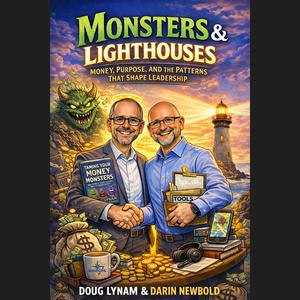
Darin Newbold: All right, well good day and welcome to Monsters and Lighthouses. We are so excited to have you here, Doug. Great to see you. We took a little bit of a break, so hey, it's good to catch back up.
Doug Lynam: Yeah, it's been a few weeks since our last show, but this is going to be a good one. I'm excited about it.
Darin Newbold: We are, well, we've spent the last. gosh, eight episodes, I guess. And we've kind of been building on it and building this foundation around money monsters. And Doug, you've been doing a fantastic job of really laying that foundation. We've gone through all nine numbers, all nine money monsters and how that all plays out. We even talk them through the dark night of the soul and kind of went through the downs. And then we came back up, fortunately, and we're now at that place of we've made it to the money master, but This podcast is not just the Monster podcast, it's Monsters and Lighthouses. And you set this up really great last time because you had talked about, you know the things that I've been doing with what I call bold GPS, your bold guided purpose system.
Doug Lynam: it's really exciting. I can't wait to get into that today. You've come up with some really cool framework to sort of take the Enneagram and just dial them way tighter. And this is going to be fun.
Darin Newbold: I like it, thank you, and I appreciate that. So what we wanted to do today is really kind of move to that lighthouse. And the way I really describe that is that the lighthouse on the hill, it's that guiding, guide point that is out there. And when we say lighthouse, we don't mean that this is your goals, or this is not a mission statement, or even a vision statement. The lighthouse is that place where you're guided to And it's one of those things where you can maybe move a little left or a little to the right, but you're always guided back to it. And I'm reminded that a real lighthouse, a real lighthouse's function is two fundamental things. It's to show ships where it's safe in a harbor, but it also shows where the rocks are. And we want to avoid the rocks, and we obviously want to... make it through safely. So that's really kind of a little bit about the lighthouse, but Doug, kind of from your introduction to this and maybe just a couple of things that you thought on it.
Doug Lynam: Yeah, so the way I'm kind of framing it in my mind, and this is really your expertise, so I'm really excited to learn more from you about how this system works and how it pairs with the Enneagram. But my kind of framing it is like, Enneagram tells you your general kind of course direction by going north, south, east or west in life, which where my kind of heading generally speaking, and then your bold GPS and the purpose factor kind of narrows that in towards more of a clear compass heading. So know, you're taking a range of possibilities and dialing it down to a more narrow band. And then when you layer that with some individual coaching, then you can just laser point yourself in that direction and get yourself, make sure that you're living the life that you want to live and finding your highest fulfillment and satisfaction in everything that you do.
Darin Newbold: Exactly, exactly. One of the ways that I've looked at it is basically the Enneagram is that map of who a person is and it describes and it's that map that we all have with us, we just don't know what it is and a lot of times it's reading books, having some coaching, other experiences to really understand it, but you have this map. But a map is only as good as we use it. But if we don't know where we're going or where we even ought to be going, that starts to be a challenge. And that's where you have this map. Now you have a lighthouse on the hill to provide some direction, that purpose, and to
Doug Lynam: Yep, exactly.
Darin Newbold: ultimately live into that purpose.
Doug Lynam: Yeah, I'm excited. So I can't wait to see where this takes us.
Darin Newbold: Well hey, no worries. Well, a little bit of framework around the purpose factor. Now, important safety tip, I did not create the purpose factor. It was created by a wonderful couple here in Dallas, Texas that it is now been endorsed and is basically part of. all of the John Maxwell coaching. So all John, John, John, I always want to say John well, it's John Maxwell. Basically the Maxwell coaches have endorsed Purpose Factor to bring it into their coaching. That's how impactful this has been. And, and so just wanted to bring that in. But what I've done with it is because I have such a passion for the Enneagram, just like Doug. He layered the Enneagram onto his, this money idea and how to manage it and where we go wrong or where we go sideways and where we can get better. I layered the Enneagram or I'm layering the Enneagram on the purpose and how we can live into that purpose. It's all about awareness. Awareness is that first step, but the second step is then having a direction to go and then being able to make doing better decisions. So to break down the purpose factor, it's fundamentally four primary components. So the first component is your natural advantage, and this is what you're naturally good at. This is how you tend to show up each day in life and in work. It has the least opportunity to change or even adjust over your life, this is kind of how you show up and come forward. the second component, second primary component is what's called your acquired skills. And those are the skills that you learn, obviously, through education, through work experience, through life, all of those things. These are built in, they're not wired in. So these are things that you built up and... game through your life. The third one, the third primary component is one that I just, I really like it and to me it's so unique because I've never had anybody say, wow Darin, this is the problem you're specifically attracted to and best designed to solve. And that's what's called your pull passion.
Load full transcript
So this is what pulls you forward passionately. And it's the primary problem that is your best suited to solve. It's, what pulls you toward and makes you want to take action in areas. And then the last piece is what's called your origin strength. And this came from your origin story. Now, it's called origin strength and the focus is on the strength because origin stories can be a bit messy, to say the least. And so the origin strength is really how you've overcome challenging things in your life. And those are the muscle that is built through resistance and how you've overcome those. And those are the four primary components. Now within each of those, there's five types. And we'll go into those here in just a second as well. But Doug, your thoughts just on the overarching those four primary components.
Doug Lynam: Yeah, it's really exciting because then you take four, if you've got four components and you've got what five different combos in each that gives you like 625 combinations possible. So it really dials, it's taking, we're going from the Antigua with nine possible, know, what would I call your sacred gift or, you know, and then taking that and now we really can get that super dialed in. It's really exciting. And so you've got a much more accurate and much more precise diagnosis of where you need to be going, what your ideal direction in life is and should be, where you naturally inclined to go.
Darin Newbold: and The other thing is, is like any good map and GPS, gonna, it gives you guiding points to help avoid some areas. And that's where that, the Enneagram really plays a big role in, hey, I can be running as fast as I want, but if I'm running and I'm going through the hardest and worst places to go through, well, I'm gonna be banging my head and suddenly my purpose is not gonna feel very good, is not gonna be fit, not gonna feel right. And I have found areas And as we go into the five, each of the primary components, the five types within them, you'll see, and I definitely want to run this past you because I want us to talk it through, there can be some conflicts. There can be some areas where you might have in you this purpose of a certain direction, but by your Enneagram type, there are certain natural things that can or may get in your way.
Doug Lynam: Excellent.
Darin Newbold: So, all right, back to our natural advantage. Our first one, we have five types here. So those are, the first one we'll talk about is the builder. So the builder, they have big visions, they start things, love to innovate, they move with speed, strategic
Doug Lynam: Thank
Darin Newbold: thinking, and they don't necessarily need all the information out there for them to get started. But they want to create new things and they want to... build something often bigger than bigger than themselves. So that's the that's the builder. The next one is the is the truth teller. Now the truth teller has strong convictions. They're a natural skeptic driven to uncover and share truth makes decisions towards reform. This kind of sounds like one of the Enneagram types does it not Doug? Exactly.
Doug Lynam: Yeah, I hear six and one in there a lot, yeah.
Darin Newbold: Exactly is that truth teller. The next one is the T. six ones in it. Yeah, yeah.
Doug Lynam: And also 6 ones and eights too. And it could be a five. There's a little five in there. so again, layers on the anagram, but it also, yeah. So there's a lot of nuance here we're getting to. Yeah.
Darin Newbold: There's some blending and that's what's interesting is that it's the blending. I really think, mean virtually any number can be any of the, any type can be any of these. What
Doug Lynam: Right.
Darin Newbold: you're gonna find is, is some of them they more naturally flow to and others there may be, wow this could be a, it's an interesting hey how they grew up and some of the influences that they had. But continuing on, we got the builder, the truth teller, then there's the teacher, the teacher insatiable curiosity. loves details and nuances shares knowledge broadly, their logic based, their logic based decision maker. So you start to see a little bit of a five but fives, fives hoard information. So not necessarily there. The next one on the list is an overseer. They bring peace from chaos, they finish what others abandon. They're deep,
Doug Lynam: 9.
Darin Newbold: deeply rational, get things done through other people. And then lastly, you have a recruiter and the recruiter, their They're kind of that salesperson, they're excitable, they sell others ideas and how they get things done, they're relationship oriented, they're energized by being energized and they move very quickly.
Doug Lynam: What's your natural advantage, Darin?
Darin Newbold: I'm, mine's the builder to build stuff up and we did yours purpose so Doug and yours is.
Doug Lynam: I'm the recruiter, right? So Energizer Connector, rally people around vision, build community. That sounds pretty spot on for me. Think about my life's journey. Yeah.
Darin Newbold: It's interesting and I see myself a little bit, I could see either the builder or the recruiter, but I feel like, I feel like the builder fits it really when I really started to embrace it and really read into all the details and all of that it really, it did, I could feel it like, wow, this makes sense.
Doug Lynam: Yeah. Yep.
Darin Newbold: And that's, that's what's really cool. All right, next primary component, go ahead.
Doug Lynam: And not to confuse folks, there's a, have a, there's different, we have the same word for different ideas. So in my Enneagram system, there is a builder, but that's not the same as the builder in the, in the bold GPS, right? Purpose factor.
Darin Newbold: important key distinction. So yes, builder here is specific to a natural advantage as opposed to
Doug Lynam: It didn't
Darin Newbold: our money monsters and those. So the next one is our acquired skills. And the five types within the acquired skills are
first off the craftsman, which you would think of, they work with their hands or their body, they're active, kind of that down to earth, very common sense. They thrive on tangible results and crafting things. The next one is the intellectual. So they're the thinker, they're going to research, take things apart, make them better. They love sharing hard-won knowledge, so they love to research and find out really cool things and then be able to share them with others. And then the next one is the messenger. They're the communicator, storyteller, content creator, they build and they borrow platforms to move people to action. So that's the messenger. And then the protector, their brain is...
Doug Lynam: sounds a little bit that time my brain is making enneagram connections for those who are familiar with the instinctual variance in the enneagram, sounds a bit like the social type in the enneagram. Yeah.
Darin Newbold: yeah, the messenger, yeah, very much so, very much so. So then the next one is the protector, and this is the brain always on. They organize detail, they protect people from mistakes. They're organized and they have a high degree of responsibility. So those are the ones that are, hey, they're kind of taking care of us and keeping us pointed in the right direction. And then they'll,
Doug Lynam: I'm a very one-ish native.
Darin Newbold: yeah, yeah. Yeah, yeah, one and eight and especially a very a great health, a very healthy eight is that protector.
Doug Lynam: healthy up.
Darin Newbold: Strategists, they're the ones, hey, they're taking a reverse engineering success, they're forecasting and they operate very much in that present moment. they're that strategist, they're the ones that's going to know what to do next. They're kind of there, hey, this is our next path. This is what we're going to do. So from your perspective, of across your career in the military, the monastery, and then financial advisory and speaking and all of that, what's your acquired skill and how do you see it relating to what you do?
Doug Lynam: I'm an intellectual, so that researcher, synthesizer taking complexities apart, putting them back together, which is what I did in my last book, Taming Your Mighty Monster. I took the whole Enneagram apart, deconstructed it, and rebuilt it from the ground up. What I hope and others have said is a much more coherent system that filled some gaps that were, for me, the Enneagram had some holes in it. First of all, the big hole was, well, why does this work? That was a big hole. And then taking this 2D model that we typically draw the anagram on this flat surface and putting it into a 3D model so you can actually see the growth potential built into it and many other innovations. And what's that? Those EGO maps, building those ladders up for each of the nine types. So it fits right in. researching what was out there, synthesizing together a new way, taking the complex idea apart, and then making it usable for others. It makes perfect sense.
Darin Newbold: Yep, yep. Well, for me, I was gonna tell a little story. this is several years ago, 20, gosh, this would have been no, early 2000s. So 2003, four timeframe. I was in a meeting and it was a gentleman that I knew relatively well. We'd been meeting regularly for a period of time. And he made a comment to me and in the moment and even leaving the meeting, I was a bit offended. And he said, wow, Darin, you're a promoter. And my brain went to either a used car salesman or or the circus promoter, know, come on, come on, all that, you know that.
Doug Lynam: Mm-hmm. Yeah.
Darin Newbold: I did not have a very good image of what that meant. But my acquired skill is the messenger and that communicator. And it's interesting, all these years later, it really does come back and yes, that is, that is me. I'm the one that I love to come in and tell the stories and bring it together and take the concepts and put them in a way that then they can be communicated to others and definitely fits.
Doug Lynam: Maybe this is maybe, let's just have curiosity. is your, do you know, I forgot what your instinctual stack is on the enneagram. What's your, the.
Darin Newbold: It's either self-pres and then social or it could be social and then self-pres is typically
Doug Lynam: Okay.
Darin Newbold: how I would see it.
Doug Lynam: Okay. So yeah, I was wondering if that social was at the top or it's in there. So that's, that's curious.
Darin Newbold: It's definitely in there. I'm a believer and not everyone on the Enneagram necessarily agrees with this. There are some that believe that your instinctual variants, basically the subtypes as they're called, which are the, as we're talking here, self-preservation, social, and then one-to-one, or sexual as it's called. Some believe that those don't change, that those are very, very set. And I'm a believer that they do, because I believe,
Doug Lynam: I agree.
Darin Newbold: I know there's been times in my life where I was much, more one-to-one and very focused
Doug Lynam: Okay. Yeah.
Darin Newbold: on it. Now, I do believe that self-presence has always been ever-present, but also I believe that social has been there and it does move around.
Doug Lynam: Yeah. And maybe we should do another episode on the instinctual variant sometime for folks. We haven't covered
Darin Newbold: Absolutely.
Doug Lynam: that content yet in our podcast, but we'll get there. Some people are feeling completely lost, but for those who can follow along, don't mean to lose
Darin Newbold: Yeah
Doug Lynam: you folks, but it's a cool topic we'll get to one of these days.
Darin Newbold: it definitely adds adds flavor to it. But all right, continuing on to my to my favorite of the four components within the purpose factor is pull passion and pull passion. That's that primary problem that that you're attracted to solve. there's five types. So those five types, the first one is, no surprise, it's the problem solver. And what that means though
is that they're drawn to those really big, really complicated problems that affect a lot of people. And they're not discouraged by past failures, or they're frustrated by small tasks, or disconnected from the larger impact. Problem solvers are the ones that we hope, that they really are, but we hope that they're in those positions of government where they're solving those really big complicated across-the-board problems that really touch a lot of people's lives. Now I don't know that they're lot all that, but that's a whole that's not a topic for our Monsters and Lighthouses, but anyway next up next up on our list is the need-satisfier. Yeah, yeah, we'll
Doug Lynam: Yeah, I just, we can go down the political rabbit hole here.
Darin Newbold: we'll wave off on that one. So the next up is the need-satisfier. They're called to serve the needs, serve individuals in a genuine need. They measure their impact by tangible results. They're very much driven to help people and help others become self-sufficient. And they don't want to take the recognition. Sounds very much like a, tends to be a bit of a type two would fall into this, that very much the helper. And then the next one on the list is
Doug Lynam: A counter type 3? A counter type 3 would be in that? Yeah?
Darin Newbold: Could be, yes. And even a, there's a, I forget the sub, there's a subtype. I think it's the social. Yeah, it's the social seven could show up as that as well because
Doug Lynam: yeah.
Darin Newbold: they can often be mistyped as a two because they don't want to show off certain things.
Doug Lynam: What about nines? I think that could fall on that too, little bit not taking the credit. Yeah.
Darin Newbold: Absolutely, absolutely on the Hurt Healer and being that force for peace. The next one on the next type within the pull passion is the desire fulfiller. This they want to create this memorable experience. They see any opportunity for improvement. They're the person that walks into the restaurant and sees the line and says, wow, if you just did this and this, this line would be shorter and faster and we could, could get, I could get my food faster. That kind of thing. And then the last one is the injustice equal injustice equalizer. And they're the ones drawn to the issues of fairness, equality, they have that strong moral compass. They're energized when they can level the playing field. And they are ones that often see the problems that others will overlook. So I definitely
Doug Lynam: Yeah.
Darin Newbold: see the Type 5 and the Type 9 in that injustice equalizer really bubbling up. Absolutely.
Doug Lynam: Well, and also eights and twos, I could see that, and certain sevens, so I could see that falling there as well.
Darin Newbold: So for my pole passion, my pole passion is the desire for filler. And telling the story about the restaurant or going someplace, I'm very much that. I see that and it starts to drive me crazy. And I have to turn it off. That is one of those things that
you turn it off. Otherwise, I'll get frustrated and be like, please, for the love of peanut butter and jelly sandwiches, would you do something to make this better?
Doug Lynam: ways. Yeah. I have a little bit of that as a three, kind of do that too. We want to work because we're efficiency experts. well, we
Darin Newbold: You're exactly.
Doug Lynam: want to, this is my solving the problem is like how we speed this whole thing up. I'm not waiting in line for 20 minutes.
Darin Newbold: And for you, Doug.
Doug Lynam: well, so I'm my whole passion is problem solver being drawn those big systemic problems like aiming your money monster. Like this is a societal wide problem. And how do we make money a force for good in the world? Like this is the big, this is the big problem of our, of our era in a way. Like
Darin Newbold: Mm-hmm.
Doug Lynam: how do we stop using money as a weaponizing essentially, or using it for the self and grand Isaman ego projects and actually put it in service of building a more beautiful. life for ourselves and building a more beautiful world around us. So that's about as big a project, a problem you could probably tackle, I would imagine.
Darin Newbold: And this is so, I just looked at this just because I have the information up. I won't mention names, but a now a mutual friend of ours that I just introduced you to and you had a great conversation with him. You guys both share the acquired skill of the intellectual and the pull passion of problem solver. Yeah. And so you.
Doug Lynam: Is that Matt? Yeah. We'll a shout out to Dr. Matt Markle. He's a good friend and a brilliant writer. He's got a good book called The Antipreneur for those people who want to check that one out. I highly recommend it.
Darin Newbold: Yes, and I've been on Matt's his podcast as well. He's got a fantastic podcast all about all about the entrepreneur and being the best that you can be. So that's those are the first three major, major pieces with the five types within them. So our last one is the origin strength and the five types within that origin strength. The first one is the present strength and that's Those are the ones that have this deep relational loyalty. They go above and beyond for those that they love. can even isolate under stress. Their past makes them dependable and they're the ones that they're there when you need a friend. They're the ones that are present. That screams type six in a big way.
Doug Lynam: yeah, 100%.
Darin Newbold: So the next one is your discerning strength. These are highly intuitive. They see what others don't. They can often predict other events. Under pressure, they can become micromanagers a bit. And their real gift is this discernment, because that discernment becomes the gift of protection for others in the way they can see. And then the third type is what's called the all-in strength. And these are the ones that they go, as it says, all-in, fully committed. When they believe something and they understand it, they're gonna go after it. And they swing between this full-on confidence and then the fear of failure. And so it is an all or nothing. It's like, hey, I'm going to conquer this or my gosh, there is no possible way. But they're not intimidated by big goals and they inspire others because they're like, hey, I'm all in. Let's go. You know, let's take the hill.
Doug Lynam: Awesome. So which ones, what's your origin string? Oh, there's one more. Sorry. Few more. Sorry.
Darin Newbold: We haven't got there yet. Please hold. There's two more. Two more. We have the empathetic...
Doug Lynam: I wasn't counting.
Darin Newbold: No worries. Empathetic strength is the next one. And they pick up on the nuances and the dynamics that others miss. So empathy is that being able to feel what others are feeling and recognize. And so they do that and that's their strength. They can have this deep sensitivity and they can often go from deep sensitivity to almost self-protection. And so that's where they can kind of run into some challenges. but they are very attuned to others and so they're the ones that they can help others really make sure that they're genuinely seen and that's that strength of the...
Doug Lynam: Yeah, 4th, like a 402.
Darin Newbold: very much the empathetic strength. And then the adaptive strength is the last one. And they're the ones, this, could be reading a type three definition here, I think, because the adaptive strength says reads rooms and ensures everyone, no, a two, I'm sorry, a two, reads rooms and ensures everyone feels included and they're all taken care of. But they also wrestle with their own identity and consistency. And it's their adaptability that allows them to bridge bridge people who would not otherwise connect. So they're the ones that say, wow, you this, you know, whatever crazy kind of person you need to meet this doctor over here and two wildly different people, but they can they can see those connections that others may not.
Doug Lynam: I can see that in a social subnet, can see that in a two, I can see that in a three. Yeah, can see, well, yeah. Again, playing with the subtypes, could create a couple of models, but definitely the two.
Darin Newbold: So you asked me mine. So mine is the desire for filler.
Doug Lynam: Oof.
Darin Newbold: so we, desire for fillers are all about elevating that experience. It kind of goes back to that, or no, just, sorry, we're talking the origin
Doug Lynam: Origin.
Darin Newbold: strength. I'm sorry. Desire for filler is the one for pull passion. Mine is empathetic strength.
Doug Lynam: wow. So how does that look? What does that look like for you in a practical level?
Darin Newbold: it's interesting because I am I tend to show up.
Doug Lynam: Yeah.
Darin Newbold: Sorry, go ahead.
Doug Lynam: No, yeah, maybe give me some examples, you're doing it, I'm sorry to cut you off.
Darin Newbold: No worries. I tend to show up and the interesting thing is strength finders, my top five strength is empathy.
Which is kind of not common and hey, it just happens to be what it is. I am probably four out seven and even though I don't go into the negative range of the emotions much, I'm probably a much more sensitive. Seven then maybe others. I mean, I I'll cry at a commercial a good commercial I cry pretty much every time the national anthems played if if it's at least decently done and so I have that that real deep Almost four ish kind of that deep sensitivity but where it shows up is when when When I get out of my own way and really connecting and this is in that coaching moment. That's when I can really help someone understand where they're at and then kind of be with them, but then also help them move beyond it. And it helps them to be seen and helps them to really know themselves. And I can then have a connection that helps me really know them as well. And that's where I see it show up. And it's interesting. I didn't know this until, or I didn't understand it until I took, this was before I really got into the Enneagram and I had looked into the Strengthfinder and I really liked that. And I started to understand the empathy and I worked, used to work for a technology company and I did these presentations where they were just kind of an entertainment presentation, but it was presenting information, but there was an entertainment factor to it. And it wasn't until I'd done a few of those that I realized that when I'm speaking, I'll feel the room
Doug Lynam: Mmm.
Darin Newbold: and it'll help guide me in changing
Doug Lynam: Yeah.
Darin Newbold: what I'm saying because I'll feel the room and recognize, wait, they're not getting this or they're not feeling it or wow, they're really feeling it, all right, I can take it to another level. And that's where
Doug Lynam: Yeah.
Darin Newbold: I found it really, really helpful for me.
Doug Lynam: Yeah, can, I hear a great public speaker I know, and I can imagine as a pastor that probably helped you a lot on the stage. feel like, hey, you ever fall asleep? No. And getting everybody excited and then fulfilling the needs of your community, that would be.
Darin Newbold: Never was quite a pastor, but I have done the public speaking stuff, but yeah that It makes sense being able to do that I Helped I helped start a church. I the lead by help
Doug Lynam: You started church back in Texas? Okay.
Darin Newbold: the lead pastor. I was his executive Kind of his executive director on on the more on the business side. No worries
Doug Lynam: I made some assumptions there.
Darin Newbold: No worries, but but it does it really does help and and that's where that's where there's those origin strengths can really help up So how about you?
Doug Lynam: Well, mine is all in, right? Overcoming
Darin Newbold: Yep.
Doug Lynam: hard things. You know, once I commit, I commit fully. Audacious goals fuel me and small ones flatten me. That pretty much describes and you throw on top of that my ADHD and you got to be going to the Marines, right?
All in, got to be top of my class, got to go 100%. Even St. John's College, where I was at, that's a very intellectual place, another story. But then from the Marines went then the monastery. Once I left the Marines,
Darin Newbold: yeah, now I'm gonna give up everything.
Doug Lynam: Now I'm to give up everything. I'm all in and then I'm all out. Right. And now I'm all in on the monastic thing. I'm going hard at that for 20 years. then now I'm out. And now I'm going to the finance thing. All in. When I commit to something, it's that free energy as well, laser focus target and that goal and just everything goes after that one thing. And so it's a real strength. also has its limitations as well and can get me in trouble when I'm not. Careful.
Darin Newbold: And that's one of the things, the purpose factor, it is an assessment in and of itself. It comes in at about, what is it, 43 pages? No, 46 pages. It's a 46 page report
Doug Lynam: That's huge.
Darin Newbold: that the nice thing is is it was, gosh, late last year. early this year was adjusted and to the 46 pages and they got rid of some fluff even and so yeah every assessment is going to have a you know I say fluff it's more of not not real meat of the thing and this one only has a couple of those pages in there just and a lot of it's just illustrative that needs to be in there to help create create the message
Doug Lynam: Yeah, I'm thinking more about that all in, right? It's like that I'm a three sexual dominant or one to one, right? So that kind of that I am the target, like just go at it hardcore is just so, so very, very descriptive of the way I operate in the world. So I find this a very exciting and useful tool.
Darin Newbold: It is and what's interesting in a minute, we're to go down a couple more things here and assuming we have time. what we might do is grab your purpose factor and look at that all in, because within each of the segments in the assessment, it's gonna provide not only, here's the strong points, it also gives, hey, here's some blind spots, here's some areas to work on, here's how best you lead others and how best you can be led in each of those. And it really creates, and that's what I love about it, because it creates this. almost a framework for coaching of, here's the baseline. Here's all the things that we can look at. Here's some blind spots that you may not have even recognized. Or you've recognized them, but nobody's ever really called it out this way. So.
Doug Lynam: Yep. Awesome. well, but give me a favor, run me through your four elements again, and then, or maybe you're getting this, and would you, do you want to get to, I mean to jump the gun, but what your purpose is? How does, how does this come together? How do we actually get to our purpose factor from all of this? What does it, what does it do for us?
Darin Newbold: Absolutely, absolutely. So my purpose, so what ultimately comes out of this is two primary statements. One is your purpose factor or your purpose factor statement, and then what fulfills you. And maybe we need to go back. In fact, we missed this early on, so let's hit it here. How do we define purpose? Because a lot of people will say, oh, hey, my purpose is to... have a job, my purpose is to be a coach, my purpose is to be a financial advisor. No, that's not your purpose. Purpose is defined as the best of who you are in the service of others. So when you're giving the best of who you are in that service of others, you're going to receive the fulfillment from others, which is the result of you living and working in your purpose. So for me, my purpose is to build something bigger than myself or yeah, build something bigger than myself to create shared experiences. Now that's a very simple statement and it's short. And at first you might say, in fact, I did say to myself, I was like, that's it. But like any good thing, you need to peel back the onion with it and recognize, wow, to build something bigger than myself to create shared experiences. There's a lot of meaning in there. And guess what? also starts to create some, well, a little bit of barriers or I would call guardrails to say, okay, this other crazy idea, these other crazy things that an ADHD7 wants to ping pong off it, well, maybe I don't need to worry about those. So that's my purpose. And then what fulfills me is I am most fulfilled by connecting with authenticity to effectively communicate and inspire others. Well, that's that messenger piece. So when you look at when you look at your purpose factor and if you do And there's there'll be an offer here at the end of this. We'll have an opportunity for you to do what I what I call the bold GPS starter map, which is the an Enneagram assessment and the purpose factor and then a 90 minute coaching session with me. We go over it. But basically, your natural advantage and your pull passion are the two things that come together to really create that purpose factor statement. So when you see that, for instance, I'm looking at Doug's, he is the recruiter advantage. And then his pull passion is the problem solver. And those come together for Doug's purpose is to inspire excitement around a cause to solve meaningful problems. And that's how that comes together. And then the flip
Doug Lynam: It hits it right in head. It hits it right in the head.
Darin Newbold: side of that, or the fulfillment piece, those come from those acquired skills and your origin strength. And so his fulfillment comes from the intellectual skill set of the acquired skills and the origin strength of that all in. So he's most fulfilled, Doug's is most fulfilled, tapping into perseverance, hence the all in, tapping into perseverance to analyze and interpret complex information.
Doug Lynam: Yep, that's what I do as an investment advisor.
Darin Newbold: And it's so, when I read that, when I originally got this, Doug, I was like, my gosh, this, so you, mean, taking apart the Enneagram and putting it back together,
dang,
Doug Lynam: Yeah.
Darin Newbold: that's a lot.
Doug Lynam: Yeah. And doing that. then so what you do with coaching, I'm basically doing with investment advisory work. So you're helping people coaching around there and I'm taking, you people come bring their money to me, help analyze it, interpret it, put it into help them, you know, put that in service of their higher purpose and then use that wealth as a tool for love and service in the world. So it's really, that's a, more, what more meaningful problem could you be solving than that?
Darin Newbold: Absolutely. So that's the, I'm glad you asked that. So that puts together kind of the purpose statement as well as your fulfillment statement. And kind of one of the next areas, just real quick, and we don't need to spend a lot of time on this, but one of the things that I like to look at, and I'm gonna do it just for myself as a type seven, I think each type can see their purpose and you and I before the show were talking about, yeah, it's a very positive, it's framed in very positive words and stuff. And you and I are well versed in the Enneagram. The Enneagram, it's both positive and kind of a lot of negative, not negative, but some less than, shadow side,
Doug Lynam: There's a shadow side.
Darin Newbold: bingo, love it. There's a lot of shadow side to it. And so just looking at the purpose factor, one of the areas where, at least a type seven who a type seven for those just as a reminder type sevens are our base fear is is pain or probation basically being locked in lock us in a closet and that's pretty much torture and so anytime that we have these boundaries and stuff that creates a challenge well one of the areas that that challenge can challenge me around the purpose is, is, crap, now, now I have a purpose when now I'm supposed to be in this lane. Well, now every fiber of my being and I not necessarily but a part of a lot of fibers of my being want to jump out of that because somebody told me or the purpose factor told me or whatever that I'm supposed to be in this lane. And so that's one of those areas that recognizing each of our types as we look at our purpose factor. And it's different for you, Doug. It's different. But for me, my type 7, the sin or the, what's the word you, vice. The
Doug Lynam: vice. Worst vice. Worst vice? Yep.
Darin Newbold: worst vice is gluttony.
Doug Lynam: Yeah.
Darin Newbold: And so, okay, know, I, type 7s are the definition of FOMO, fear of missing out. And so, wow, if I'm in this lane, there might be something better. just across the street or over here or this or that. And that's a real challenge. So those are growth areas for at least a type seven as they're looking at their purpose. So for you, Doug, just any quick
Doug Lynam: Yeah. Yeah.
Darin Newbold: thoughts there.
Doug Lynam: Well, I'm thinking about like the recruiter and my natural advantage and that call in it's like as a type three, you my worst vice is, is deceit, which it means that constant
mask changing or that self promotional self promotion, and then even promoting the ideas or the things that I'm excited about always kind of put a positive spin on everything. And so it's a natural advantage in so many ways, but I just need to be careful that my authentic self doesn't get lost along the way. And I'm so all in, I'm recruiting people, energizing, connecting, researching, know, and then pulling people these big problems ideas. But then it's sort of like, I can get so focused on those goals that I am maybe not. being authentic along the way and being too good at the recruiting and not good enough at saying, well, here's some dark side here we need to look at. There's some problems that we need to look at. There's maybe going so fast that I'm even using people along the way to get to those goals and treating people like Lego blocks rather than human beings. I'm so all in, right? It's like I want to get to that goal and then I can step on people and that can really cause a lot of emotional and personal and professional heartache along the way.
Darin Newbold: It's kind of like in the news, you often hear of that very influential, world renowned on the TV, evangelist of some variety that then leads the flock down a path.
Doug Lynam: great.
Darin Newbold: that's that, they become bigger than, or the idea of themselves almost becomes bigger than themselves and they believe it. And then they cause others to believe it.
Doug Lynam: Right. Yeah. That's the real problem with the three is the deceit that where the three we get ourselves in trouble is we believe the lies we tell ourselves. That's what can make us so at times charismatic and at times so effective because when we're when we're bending and distorting the truth in those ways, we don't feel like we don't even recognize that we're lying to ourselves first. and then lying to others. And so that what makes the deception so believable in a sense, it makes it so convincing because we're not even aware of it ourselves that we're doing it. So it's like someone who believes
Darin Newbold: Exactly. Exactly.
Doug Lynam: why can promote it more effectively and someone who, I know I'm being, I'm consciously saying, this isn't quite right. And I know it consciously that I probably, if I have any integrity, I wouldn't do it in the first place. And so even someone with three with integrity, it's it's not intentionally deceiving anybody because you've got this blind spot in yourself that you're not even aware of.
Darin Newbold: We've kind of hit to our time base and there's an area that I do want to go over, but I think we'll put that on for our next episode is to take this lighthouse and really start to tie it into the four pillars that we have in your money monsters, kind of that earning, saving, investing and giving. What does that start to look like? And we can go into a little bit more detail because I think for this time we just don't have the time to really hit it the way we need to.
Doug Lynam: Yeah, we'll get, we got a lot of space. This is a deep topic. We're going to need some more breeding room on all this.
Darin Newbold: exactly. Exactly. So with that, what I'd like to do, we're going to close it out. But I want to kind of call out a couple of things for for our listeners to to take advantage of. And Doug, you thought about this, we kind of had some notes on it. And I was going to let you go first. If you had something or how you wanted to propose this, I know you talked about, hey, people bringing their financial resources and allowing you and your firm. Because what you guys are doing, I did talk to our mutual friend, Matt, this morning, right before this. And Matt's one of those guys that when he I feel like he researches and he's incredibly smart. is a rocket scientist, believe it or not. He really is. And when he says, wow, I really like Doug's firm and I really like what they're doing and yeah, I think I'm going to go there. So that meant a lot to me is his endorsement of you. I mean, I already know you're a great guy and what you're doing and you wouldn't choose an advisory firm that was not up to your level and standards, but it was also an affirmation from him. how best can someone yeah
Doug Lynam: Well, thank you. That's a very generous tip. Thank you for that.
Darin Newbold: well how best can someone tie in with you and take advantage of that
Doug Lynam: Yeah, well, I'll put my firm website, my email address and the show notes, but I'm at Course Management Investment Advisors in Pinehurst, North Carolina, we're the golf capital of the world. And if anybody wants gets out this way for some golf, come check me out. But what I like about Course Management, the reason I joined them is they're doing really innovative work around structured notes and structured products, which most investment advisors don't offer. Or when they do offer them, they're you know, providing off the shelf products that they're getting from a wholesaler. But we're one of the leaders in the nation in building and designing them ourselves so we can take real advantage of opportunities in the market to give people asymmetrical returns where the risk reward and the structure notes are complicated. We can maybe do a show on that at some point. We can talk more about that in depth and detail. But it's really a really interesting way to get equity-like returns with a bond-like structure on the fixed income side, to get real downside protection. on your investments with upside, really strong upside potential. And that's a whole other show we can go into at some point, but we
Darin Newbold: Absolutely.
Doug Lynam: really do offer things that other firms can't do. so if anybody, we do have a minimum investment of 250,000 for our firm. But if you're curious about how you might, we might be able to do a better job for you, particularly on your fixed income side of your portfolio, because it's really hard to get alpha on equities these days. It's really tough. But when we're looking at structured notes for fixed income, it's really exciting about what works. keep them both, but we have the potential to do.
Darin Newbold: That's awesome. That's awesome. So in the show notes, you'll see all the information about about Doug, his firm and how best to connect with him. So for me, I wanted to offer up, we've talked about this bold GPS thing, bold guided purpose system. And so for me, that's that map of who a person is your Enneagram and getting an Enneagram assessment. And then tied into that is the purpose factor assessment. And we put that together and then we'll get together for at least 90 minutes as a 90 minute session to really go over that, to really type in your type and then really look at how does that tie in and start to build your personal kind of map and. GPS for where you want to go and what that looks like. That's normally priced on my website and everything at $397, but for listeners, I have a code and it will be in the show notes. That code is ML2026. So for Monsters and Lighthouses, it's ML2026. put that in and that will reduce it $100. So you get $100 off. So it'll be $297. Would welcome anyone and everyone to take advantage of that and set that up because I think that's, it's a great starting place.
Doug Lynam: It is an amazing job with your clients. had so many success stories of people who work with you and they come away transformed. So I really encourage folks to check Darin out. He's an excellent coach and I highly recommend him for anybody who's listening.
Darin Newbold: Super. Thank you, Doug. Thank you, everyone that's listened. Definitely take a look at the show notes. Take advantage of stuff and welcome to both Monsters and Lighthouses, because now you know more about the Lighthouse. Take care, guys. Until next time, we'll see you.
Doug Lynam: Be well.