
# Fred Lerdahl
Top Podcast-Folgen
Aktualisiert:
Alfred Whitford (Fred) Lerdahl (born March 10, 1943, in Madison, Wisconsin) is the Fritz Reiner Professor Emeritus of Musical Composition at Columbia University, and a composer and music theorist best known for his work on musical grammar and cognition, rhythmic theory, pitch space, and cognitive constraints on compositional systems. He has written many orchestral and chamber works, three of which were finalists for the Pulitzer Prize for Music: Time after Time in 2001, String Quartet No. 3 in 2010, and Arches in 2011.
Generative theory of tonal music
Welcome to random Wiki of the Day where we read the summary of a random Wikipedia page every day.Our random article today is Generative theory of tonal music.A generative theory of tonal music (GTTM) is a theory of music conceived by American composer and music theorist Fred Lerdahl and American li…
Koussevitzky's Legacy: A Conversation with Members of the Koussevitzky Board

May 2, 2014. Serge Koussevitzky championed the music of his time throughout his career, and the Foundation established in his name has continued to support the music of living composers since his death in 1951. Members of the foundation board (James Kendrick, Fred Lerdahl, Gunther Schuller, Fred Sh…
177. The Evolving String Quartet
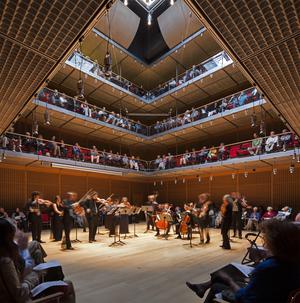
Works for string quartet by Musicians from Marlboro and Daedalus Quartet:
Haydn: Quartet in G Major, Op. 17, no. 5
Lerdahl: String Quartet No. 1
This week, we’ll hear a pair of string quartets—one from the father of the genre, and the other from a relative newcomer.
We begin with Papa Haydn, the a…
In Memoriam

From Stravinsky’s famous In Memoriam: Dylan Thomas to Hindemith’s Trauermusik, composers have long written their most personal and moving music as a tribute to a friend or great figure they admired. We’ll remember several great personalities with musical tributes by modern day composers.
…
podcast 55-Yoshiaki Onishi (Gaudeamus Muziekweek)
Yoshi a Japanese American composer and conductor who is currently a Teaching Fellow at Columbia University. His principal teachers at Columbia have been Fabien Lévy, Fred Lerdahl, and Tristan Murail. His music has been performed worldwide by such ensembles as JACK Quartet, Next Mushroom Promotion, …
163. Give It Time
Works for string quartet by the Borromeo String Quartet and the Daedalus Quartet.
Brahms: Quartet No. 3 in B-flat Major, Op. 67
Lerdahl: Quartet No. 3
We’ll begin the podcast with Brahms’ third string quartet, performed by the Borroemo Quartet. This quartet, Brahms’ opus 67, came some two years af…
Chapter Eight: Music and Language

Around 90% of the world’s languages are tonal, meaning that unlike English, Spanish, or German, tone patterns are used to distinguish words and inflections. Speakers of tonal languages like Mandarin are more likely to develop perfect pitch, meaning they can tell what note is being played, without n…
Interview Carter Pann
Today, Elizabeth and Nicole get some much-needed, soul-searching inspiration from composer Carter Pann. We talk about the value of not being perfect in your youth, the complicated beauty of embracing identity in your work, and Carter shares some great advice about ways to stay curious for adventure…
PODCAST-SUCHMASCHINE
Auf unserer Website können Sie3,828,185-Podcasts und196,365,349-Folgen nach Personen, Orten oder Themen durchsuchen.

Eine Investition in Wissen bringt die besten Zinsen – deshalb höre ich Podcasts.
‐ Benjamin "Llamacorn" Franklin
BEARBEITEN
Vielen Dank, dass Sie uns helfen, die Podcast-Datenbank auf dem neuesten Stand zu halten.
