

TRANSKRIPT 🔗
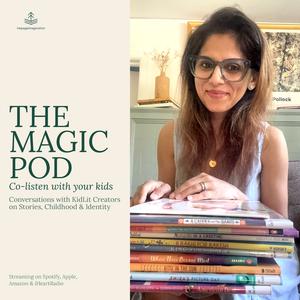
inkpageimagination: Stories travel across oceans, across generations, across languages. Welcome to the magic pod. I am Kruti and this is episode nine. Let's begin the way all good stories do with a voice. India words by Mira Sri Ram or by Mitte. Namaste We stretch up to the sun, waking to a minor song. We tap and clap our antlets chime along Clingle Tinkle. Hot and sticky, time for a bath. Ma rubs first, then she paused. Splish splash. She dries then dresses as a black dot and kisses Hello everybody and welcome back to the Magic Pod. I am your host Kruti, and that beautiful reading of India you just heard was by six-year-old Rudra. Today's guest is Mira Sri Ram. She grew up in India and moved to the United States at the turn of the millennium. She was an electrical engineer before she became a picture book author. And she made that leap because she realized that children like her own could be. were missing from the books on the shelves. Mida is a two-time South Asia Book Award winner. Her books have received starred reviews from Kirkus, School Library Journal, and Publishers Weekly, and have been selected as Best Books of the Year by School Library Journal and the Asian Pacific American Librarians Association. You might know her from The Yellow Suitcase, A Garden in My Hands, Dumpling Day, or Between two worlds, her lyrical biography of the trail-brazing artist Amritashi.
Inkpageimagination: Hi Mira, welcome to the Magic Pod. I am so honored that you are here today. Thank you so much for your time.
MEERA SRIRAM: Thank you. Thank you so much for having me, Kriti. I've been looking forward to this and looking forward to our conversation.
Inkpageimagination: Let's talk a little bit about your craft and your transition from being an engineer to being an author. How did that happen?
MEERA SRIRAM: So I was always a science kid. I loved STEM and I'd always dreamed of becoming an engineer. So that's what I did. And I have a master's in electrical engineering and I went on to work in the Silicon Valley as a chip designer. Around that time, I became a parent and I started reading books to my first bond, my daughter. And that's when I was exposed to the world of picture books. I fell in love with them. I realized how awesome they were in terms of the aesthetics, in terms of the themes that they encompassed. And eventually I realized that something was missing. Just seeing ourselves in the pages of the books, our stories, cross-cultural themes. immigrant experiences, children of color, all of that. And I used to blog with another parent in my early years of motherhood, just recommending any good book that I came across and I wanted to share. And then that's also when what was missing was so stark. I realized that... something needed to change and I so wished I could be part of the change, do my bit in sort of propelling the change. So I quit my job as an electrical engineer and I decided I wanted to tell our stories. But obviously not having, you know, grown
Load full transcript
up in the U.S., not having an academic foundation or a background in the humanities or in creative writing, not having read picture books as a kid. I didn't know where to start. I was completely lost. And this was off to the time. This was like two decades ago. My daughter is 22 years old now.
Inkpageimagination: Wow, that is quite a journey. That is definitely not an easy one, I'm sure, but we're so grateful that you found your way in sharing all of our collective voices for our children here today. So thank you so much for going through that so that my children who are six and three could benefit from that.
MEERA SRIRAM: Thank you. Thank you for acknowledging that. Yeah. When I see parents come up to me and say, my child calls me, Amma, or like from the yellow suitcase, this is exactly what happened to us. you know, we have the masala daba at home and when families see themselves and the joy that comes from that makes it all worth it at the end of the day.
Inkpageimagination: Absolutely. Tell us a little bit about your childhood. What stories inspired you?
MEERA SRIRAM: So we had a very tiny library in my neighborhood, which had a ton of books. And we had to pay money to borrow a book. It was a lending library. And every summer, that was the big thing. because both my parents worked. Those were the days when we didn't have gadgets or technology. So we'd just just lying in the porch in the warm sun, like not knowing what to do, staring at the ceiling, just playing in the mud, So we would look forward to this allowance that we get to go borrow books. And I read mostly British. authors and authors from the West and detective novels from the West like the Nancy Drews, the Hardy Boys, the Famous Fies, Dana Girls, all of these series. it was amazing. They were just like such great page turners. you know, you would get totally invested in them. But also, this was like a fantasy land. Like I did not know what Sausage was. Like we didn't have white picket fenced houses. It was just so glorious to me in my head. And I also read a lot of the homegrown stuff like the the comics that I'm sure you know the Tinkle and Chanda Mamas all of that. And then into my teens, I enjoyed Arkha Narayanan and you know, some of that. So so mix of homegrown books and also from the West, right? And this goes back to what we were talking about earlier about what propelled me to switch careers and think of a career in writing was also because it is so fascinating to me how I did not see myself reflected in the books even when I was a child. Because I grew up in an urban city like with both parents working. And we have these stories that were set in our own home, like in our country, in India, but they were mostly in forests and with talking animals and the mythology and folk tales and woodcutters which were all great. But again, that did not tell my story.
Inkpageimagination: That is so beautiful. when did you feel like you found your voice
MEERA SRIRAM: the first story that I
wrote, I remember did not sound like a picture book at all. So my voice was all wrong. And then I remember taking it to my peers, like a critique group, and they were like, have you ever read a picture book before? Did you grow up here? Maybe you have a chapter book voice. Are you a novelist? And I'm like, oh my gosh. I remember I was actually in tears driving back home. And then, so I sort of shelved that story. And then I, The Yellow Suitcase, which ended up being my debut. was a story that I wrote as my second manuscript and that sort of like just flowed. Like it just came out of me with the picture book voice, maybe because of the themes, the topic, it just felt like more poetic, a little bit more lyrical. And that's when I found my voice, the lyrical voice, so to speak, that seemed more natural for me. Yeah.
Inkpageimagination: what a powerful story to be your debut novel. So for those of you who have not read the book, it deals with loss, loss of a grandparent. And as I was reading it, something that stood out to me the most was my nana, which is my mother's father, he passed away on my birthday. I vividly remember having a little purse with me with things in it. And
MEERA SRIRAM: Now, I'm
Inkpageimagination: when I read the yellow suitcase, I was like, my gosh.
MEERA SRIRAM: Yeah. Wow. Wow. Yeah.
Inkpageimagination: So.
MEERA SRIRAM: Yeah. That's the thing, right? How stories connect us because you read the book as an adult, not even like you were not a kid and did not. This did not happen across continents, but yet the experience is universal. The emotions that it evoked, you know, were similar. So that's a part of stories, right? That's a part of books. And just when it resonates with you comes the joy. I feel seen. My story is not in a vacuum, but it exists. And I can process this with someone who has been through this, through the book, through the story. So I have had so many people to still, to date talk about the Yellow Suitcase and how it, you know, just finding those moments those connections, how it resonates, how it's similar. In fact, it could be a different culture. It could be a different kind of a funeral. It could be in a different place. It could be a pet. It doesn't have to be a human, but yet across all those walls and boundaries, we connect through the story and through the experience.
Inkpageimagination: Right, because grief and loss are so integral to who we are as humans and your story really does cross all of these boundaries and hits the core of that human emotion of loss so beautifully.
MEERA SRIRAM: Well said, exactly how I feel that as humans, we keep shying away from these themes, but especially when I was writing that story, there was hardly any grief book and these were considered niche topics, right? Like they would be shelved in this mental health or like that kind of a category in a library or in a bookshelf. And I was like, this is one thing that happens to everyone, every one of us. this is inevitable. you know, a neighbor maybe passes on or a pet, So why are we not talking more about this? And this can just be that conversation starter. Even if you cannot, if you haven't experienced this in your life, your kid hasn't been through grief. It's something that they need to understand if they see a friend going through it. I cannot emphasize the importance of. having these difficult conversations with your or uncomfortable conversations with your children and a book could be a good tool or like a starter.
Inkpageimagination: your books have so much imagery. My daughter is in love with Dumpling Day that book is just so full of flavor. every time they read it, they create food. They're like, can we eat this? Can we eat that? Was that the intention
MEERA SRIRAM: I know.
Inkpageimagination: with that book?
MEERA SRIRAM: mean, so going back to a little bit of the craft, if I may. So when I get an idea, the first thing I ask myself is why? Why do I want to tell the story? So I need to believe in the importance and the need for that story so I can fight for it, so I can let it pour out. So with Dumpling Date started, with my own experience as an immigrant when I moved here and how food was such a cultural bridge for me. So we would have all these potlucks with my neighbors and our friends where we would bring a food, a dish that represented our heritage and we exchanged recipes and all of that. And food always brings us all together around the kitchen table, around the Thanksgiving table, whatever you wherever you are. And so that was the idea. And the overarching message, if I may say so, is that like dumplings, regardless of how we look, no matter what we speak, what we celebrate, we are all humans with the same range of emotions and experiences. So that's something I tell the kids all the time. It's just a fun way to get across. that theme of celebrating our differences, just like dumplings, right? Like one is steamed, one is fried, one is baked, one is brown, one is white, one is spherical, one is triangular, one is flaky, one is crunchy, one is soft, one is hard, one is sweet, one is savory. They're all dumplings. So we as a species are the same.
Inkpageimagination: I'm going to use this. are all dumplings. We are all dumplings because why not?
MEERA SRIRAM: Yeah.
inkpageimagination: You're listening to the Magic Pod. I am Kruti, and today I'm in conversation with Mira Sriram, engineer-turned picture book author, and the writer behind The Yellow Suitcase, Dumpling Day, A Garden in My Hands, Between Two Worlds, and so many more.
Inkpageimagination: Between Two Worlds navigating intersectionality. Tell us a little bit about the Between the Two Worlds story about Amrita Shergill.
MEERA SRIRAM: so Amrita Sherigal, I've always looked up to her and so for so many different things. And of course her art. Unfortunately, she died when she was 28, I was just completely falling in love with her courage, just her personality of how she was unapologetic about so
many things about her identity and how she navigated growing across cultures because her father was sick and her mother was... East European, Hungarian. And she found the same kind of need for the navigation in her art, in finding her voice. And it's so strongly resonated with me. She found inspiration in what she saw in India. the lives of women and the cave art and the colors, the rich color palette from India. But she also was schooled in Paris, the schools of art in Paris and in the West, and she drew inspiration from so many different Western creatives. So that amalgamation is where she found her sweet spot. You don't have to choose. You don't have to be one or the other, but just the blending of both is creating something. And she ended up creating something so much more richer and beautiful because of that blending, because of that amalgamation. And that's something that I figured that so many of us and children who are just feeling divided by two things. They don't have to feel that way. It doesn't have to be culture. It could be any aspect of identity. It could be religion. It could be two homes. It could be language. But then finding the power in embracing both is such a beautiful thing to do. And that's what is, for me, was the takeaway from Amrita's story or how she navigated. growing up across cultures and how she found her voice in art. Yeah, so thank you for giving me the opportunity to talk about the process.
Inkpageimagination: No, that is so beautiful. I am just, I can't wait to read it now because I really believe in this power of intersectionality. we so often, specifically I think in the diaspora, like sometimes we forget that we are raising
MEERA SRIRAM: Mm-hmm.
Inkpageimagination: children in this intersectionality, that they're not one or the other, that they don't have
MEERA SRIRAM: Mm-hmm.
Inkpageimagination: to sort of be it food, be it culture, be it, absolutely anything.
MEERA SRIRAM: so that's where the story of like why Amrita and what I intended for it and what propelled me to create that and all of that. Yeah, in front.
Inkpageimagination: That is so beautiful. Speaking of children, let's say a six, seven year old, walk up to you and say, what advice would you give me if I wanted to write? What did you say to the little ones?
MEERA SRIRAM: I would say read. Definitely read. read the kind of books or the stories that you want to write. If you want to write a poem, then read more poetry. If you want to write a short story, then read more short stories, that kind of a thing. read and then be honest, be bold and courageous. There's no right or wrong. If it's coming from you as a human, that there will be humans who would connect with it. So I always tell people, just be very honest and raw with whatever you want to say and tell. And then don't give up. Like it might be
Inkpageimagination: you
MEERA SRIRAM: hard. You might make mistakes, people might tell you it's not great, but once you know like the why, like going back to what I was talking about, like why do I want to tell the story? Because of blah, blah, blah. It could be anything. Because it's funny, because it's new, because it's like no one has told the story or because it's such a great thriller. It could be anything, but if you believe in the value of that story, then stick with it.
Inkpageimagination: love that so much. bold. Something we don't often tell our children.
MEERA SRIRAM: Right,
Inkpageimagination: Your parenting journey has been maybe made easier, it's not quite the word, but has been largely dependent with your relationship with books with your children, right?
MEERA SRIRAM: Mm-hmm.
Inkpageimagination: So if you had to give advice to families, parents, specifically in the diaspora, as
MEERA SRIRAM: Mm-hmm. Right.
Inkpageimagination: it pertains to reading or reading aloud with their children, what would you say?
MEERA SRIRAM: Okay, I have a few different things. I would say engage in literacy activities and also celebrate reading in books. That's something that we did a lot in our home. So just fun trips to the library. Associating books and reading with celebration. So if it's an important day, then gift a book. Hey, let's read a book together because it's a special day and let's celebrate with this reading together as a family or whatever. Also, I would say building diverse bookshelves. Yes, we need mirrors because if we feel that our stories are missing, we go find them. It's important. It's so affirming for children to see their experiences and even see their physicality represented in books. So definitely we need mirrors. I cannot emphasize the importance of seeing yourself in books. We all have come to appreciate that now. But also seeking windows. So that's the only way you can nurture empathy by understanding and experience outside of your own by reading that, seeing that. So building books, bookshelves with both mirrors and windows. I always, when I, at school visits, I say, share a mirror and seek a window. So you share a mirror with someone, a mirror book with someone, and then you seek a window book at the same time. So yeah, these are some of the things that I would encourage families to invest in, in sustaining this love relationship with books and reading. Yes.
Inkpageimagination: love that so much. And you explained mirrors and windows so beautifully.
MEERA SRIRAM: I do want to credit Dr. Sims-Bichoff for the Middles and Windows concept.
Inkpageimagination: Yes. Yes. Thank you so much All right. So, rapid fire. The right age to stop reading to your child.
MEERA SRIRAM: There is no age limit. No, I read to my mother sometimes. Yeah, she'd be like, oh, where are my glasses? And I'd be like, okay, let me just read it to you. And I would end up reading a picture book. She loves picture books too. Yeah, I believe picture books, all books are for zero to 99.
Inkpageimagination: how many books are too many books in a home?
MEERA SRIRAM: There cannot be too many books in your
home. Yeah, I'm totally guilty of indulging in books. So my nightstand has books, my books in front of my fireplace, my coffee table, my work table. Yeah. Yeah. So they cannot be too many books. Yeah. These are very easy questions. These are like.
Inkpageimagination: agree with you. was a trick question. Trick question, right? Okay, the next question is, if you want to raise a reader, you have to fill in the blanks.
MEERA SRIRAM: read to them, read with them, be read to by them. Makes
Inkpageimagination: like the last one. That is
MEERA SRIRAM: them reader. It doesn't even have to be words. looking at print is print awareness is an early literacy skill, Looking at pictures, even having a book upside down is reading. Audiobooks are reading, graphic novels are reading. Yeah, wordless picture books are still reading. So whatever
Inkpageimagination: beautiful.
MEERA SRIRAM: works for your child.
Inkpageimagination: If you had to suggest top three picture books right now what would they be?
MEERA SRIRAM: Oh, so many. Oh my gosh, such a hard question. Watercress by Andrea Wang and Jason Chen. And then Spanish is the language of my family by Michael Ginhart. also, I have this book by my. author friend Manisha Bajajayar of Kite. I have Bread is Love by Pooja Makhjani.
Inkpageimagination: These are great suggestions. Before we say bye, what is coming up next in terms of books? What can we expect? What should our listeners be looking for?
MEERA SRIRAM: So I have a body of work that I'm excited about and I do have a book coming out. We still don't have the release date yet, but I do have one coming out in the pipe. It's about a holiday. And it's about an immigrant family navigating the challenges of celebrating the holiday when no one else around is celebrating. So I will leave you with that, but we will wait for the official announcement soon. Yes.
Inkpageimagination: Very cryptic, I want to know what this holiday is. I can't wait to read it. Mira, thank you so, so, so much. This has been such a pleasure and such a joy. Thank you so much for your time.
MEERA SRIRAM: Thank you for having me. really enjoyed our conversation. I can't believe we've covered so much ground here But
Inkpageimagination: you
MEERA SRIRAM: thank you, thank you so much,
inkpageimagination: That was Mira Sriram. You can find all her books and listen to this episode again anytime at the Diaspora Bookshelf. Head to thediasporookshelf dot com. It is a free curated library of South Asian Diaspora Children's Literature, and Mira's books are right there waiting for you. If you're listening with a child this week, here is one thing to try. Build a shelf together. One Mitter book, a book. That looks like your family. One window book. A book about a family that looks different from yours. Share a mirror and seek a window. If the magic pod made you smile today, please follow us on Spotify or Apple Podcasts or whatever you're listening to us right now. And do leave us a review. It takes a minute and it helps other families find us. I am Kruti and next week on the Magic Pod, we meet Puja Makijani. She grew up in New Jersey, became a journalist, published in the New York Times and The Washington Post, and then she became a picture book author. You might know her from Mama's Sorries, Bread is Love, or Her Latest, Together for Mama, a book about postpartum depression that nobody else had the courage to write for children. That's next week on The Magic Pod.