

TRANSKRIPT 🔗
Matt: Welcome to The Difference, the podcast. I'm Matt Stevenson Dodd.
Helen: And I'm Helen Gregg.
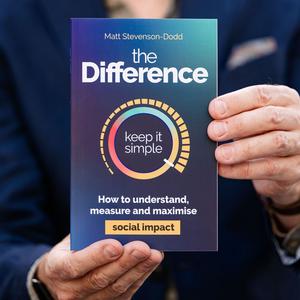
Matt: And this podcast is all about taking a deeper dive into the stories and case studies contained in my book, The Difference, How to Understand, Measure and Maximize Social Impact. We want to get behind each of the case studies in the book, meet the people involved and find out more about how these amazing organizations set out to understand, measure and maximize the difference they make in the world.
Helen: And of course, we should just say that the difference is available to order in all good bookshops now.
Matt: Thank you. Today we are delighted to be joined by Elizabeth Funk. Elizabeth is one of the early pioneers of impact investing and a leader in using for-profit capital to address urgent social challenges. She's the founder of Dignity Capital, a senior partner at Dev Equity and the force behind Dignity Moves, focused on housing solutions for people experiencing homelessness. Elizabeth, welcome.
Elizabeth Funk: Thank you, it's a pleasure to be here.
Helen: It's so lovely to meet you, Elizabeth. I've obviously read the book. And I'll be honest, think chapter nine is one of my favorite chapters in the book. And that's mainly because of your contributions. So thank you so much for joining us. On that note, we do like to start by getting to know our guests a little bit. And the first way we do that is to ask you to tell us three things about yourself, two of which are true and one of which is a lie, that good old game that we've all played. And throughout the podcast, Matt and I will try
Elizabeth Funk: you
Helen: and work out through various nefarious means as to which of those is the lie. And then at the end of it, we'll both have a guess and you can reveal the truth. Does that sound okay?
Elizabeth Funk: Okay, that sounds great.
Helen: Over to you. What are your two truths and a lie?
Elizabeth Funk: So let's go with, I raised my children in Paris. I used to be a competitive figure ice skater and the performer Sting was an investor in my first fund.
Matt: Well, Elizabeth, know you've had a fantastic career. I wonder, this could be quite hard to do, but could you summarize your background in 30 seconds?
Elizabeth Funk: Sure. I started off at Stanford undergrad in economics and was hired by Microsoft to be a product manager because they wanted non-technical people to design Word and the new early applications on Windows. Went on to Yahoo to be a product manager there in the very early days of the internet. So kind of a consistent theme of disruptive stages in our industry. And then when I left Yahoo, Ran a public company for a couple years, but was really smitten with the ideas that we'll talk about today, impact investing, and spent 18 years of my life running impact investment funds of various types. When I all of a sudden, God help me, found it a nonprofit, which is quite an interesting twist for those who know me and my passion for impact
Load full transcript
investing. So it'll be an interesting conversation.
Helen: Wow, that's amazing. And I'd be honest, I think you're very different from a lot of the other guests we have on because the majority of them are embedded, A, in the UK charity sector, and B, are indeed British. So.
Elizabeth Funk: Born and raised in Kansas City.
Helen: I think that the starting point is going to be, I suppose, at what point did you realize that impact measures just weren't really working from your perspective, that you weren't getting what you needed from impact in the work that you were doing? Or even when you recognize that impact was a thing that wasn't being recorded at all in any way?
Elizabeth Funk: Well, it's kind of funny because I started the Dignity Fund back in 2001 and the concept of impact investing, the term wasn't even coined until 2007. So the biggest problem that I had when I was starting was that, you know, I raised this fund, which we can talk about why, but people didn't understand this idea of impact investing. My investors were, you know, they wanted to contribute and so they'd send it to their investment people who would say, no, no, no, no, this is a charity. go send it to the foundation people. And the foundation people will look at it and say, if you're asking for an investment, you got to to the investment people. And so I get ping-ponged back and forth. Nobody even understood it, much less understood how to try to measure the impact of an investment because they were so siloed in the big family offices and so forth. And so it was uncharted territory, let's say that. It wasn't until much later that people started asking about, you when we first started distributing back, They understood the returns, understood the financial numbers, but the impact side of the office was saying, well, what do we even do with this? And so it was very, were early days and the impact measurement concept didn't really exist. But we wanted to be able to demonstrate to our investors that good was happening. And really the point of the Dignity Fund when I started it was to seed this idea of impact investing, because I really believed that that we could do a whole lot more good if we could harness the power of capital and the microfinance industry, which was what really grabbed my heart. Coming from Silicon Valley, I knew that the power of letting someone be an entrepreneur was really, really powerful. And heck, if you could bottle that energy, you could sell it for a million dollars a drop, right? And letting people build their own way out of poverty really resonated for me. And yet the vast majority of the microfinance organizations were 2000 borrowers or fewer. They were all run by former school teachers and didn't have any scale because they weren't tapping the capitalist system. And so I really kind of had my aha moment when I said, wait a minute, why don't we bring investment dollars to this and be able to really scale it. And so shaping what that looked like and trying to even explain to anybody, quite frankly, why you would want to invest your dollars and not just give it away. And so it was an interesting journey. But as you noted in the book, the naive questions we all asked ourselves were, well, what percent come across the poverty line, right? And I always laugh at the idea of a poverty line because there is no ceremonial line in the sand. And particularly in the poorest of the poor communities, they don't really rely on currency for the most part, right? They're trading bags of rice for milk and so forth. And so there would be no reasonable way to measure. whether somebody's annual income was above what some United Nations agency had decided was a poverty level. That was just absolutely infeasible to measure at that time. So we had to get creative and we had to tell ourselves, we want to know if these people are doing better, if they're prospering. so as you noted in the book, the kind of arbitrary, but I think very real measures that we came with were does the person have a solid floor when they took out their first loan and do they now have a solid floor in their home because dirt floors are responsible for a lot of disease and a lot of obviously dirt and a lack of cleanliness in the home but really medical concerns. And then the second one was are their kids in school, particularly their girls? Because if you could afford to send kids to school at all, you would send your boys. But for the most part, the poorest families didn't have the luxury of sending them to schools. Even though schools are free, they couldn't afford uniforms. and pencils, but they also needed the kids to work in the fields. And so if you were able to send your girls to school, that was the measure of success. That was a measure of prosperity. And so those were the two measures that we used. When the loan officer issued the loan at the beginning, they asked those two questions. And when they repaid the loan after the first loan cycle and a second loan cycle and so forth. Now, of course, internally, we also measured other things like, are they repaying on time? Are they? eligible for bigger loans because each loan was very short-term and longer? Are they growing their business? Those kinds of things that we would measure, but from the simple measure of success for the families, was those two.
Matt: Yeah, I just, love the, well, I love all of this, right, but I love the idea that, you you can't just have this imaginary line of a poverty line and, you know, great, everybody's gone over it and there's some sort of celebration. I also think the two measures are really, really quite special because they're very focused, they're clear, that, you know, they're simple to get your head around. I just wondered, Elizabeth, what was the... what was the process that you went through to try and get to those two when you realised that actually it was only two that you needed? Because there is an over complication in measurements a lot of
the time. How did you get to that point?
Elizabeth Funk: Yeah, was really conversations with the loan officers themselves, who as you must recall, a lot of the loan officers in microfinance have themselves been microfinance borrowers or themselves are coming out of these communities. One of the constraints, as you noted in your book, is that the loan officers are often illiterate. And so there was no chance of getting them to document anything really much more complicated. than those measures. But those were things that they could visibly check. We also didn't want to burden the loan officers with accounting and, you know, obviously going through the person's financial records to make sure that they were earning more than they were last year, which would be a normal, you know, impact measurement. So when the loan officers go out to the villages and they literally visit the borrowers to collect the loans, those are very visible and easy things to measure. And those were things that the loan officers themselves took pride in.
Helen: okay. And I think there's a part in that chapter, I like, where Matt, you're talking about Street League and how actually there were a lot of other things that you could have measured, but you chose not to because although you knew they existed, it was about keeping it really simple. Elizabeth, I'm guessing... you had a similar list of recognising there were probably lots of other things that could also be measured. So how did you refine it down? What made those two the most important out of the plethora of things?
Elizabeth Funk: Yeah, well, they apply to health and education, right? And so it was also a way where if our investors cared about poverty, but also cared about other global issues and intergenerational as well. And so they were able to be sort of multiple categories at once. You know, my son's college, most schools have general education requirements that you have to take at least one history and one. you know, art or whatever. if you could find a course that was both history and art, it was a twofer, right? And so in this case, these measures were at least two, even three measures rolled into each. And that was, you know, I think, especially important.
Matt: It's really interesting, isn't it? I just wonder if you can reflect on how leading those measures might have been. know, because sometimes people say, it's the things that get measured that get done. So did you ever sort of found that there was a counter to this where,
Elizabeth Funk: Mmm.
Matt: you know, people were actually measuring, yeah, we've got a hard floor, right? So tick, that's great. And we go after all of the houses that have got hard floors because that's the measure. Did that happen or was that a consideration?
Elizabeth Funk: I don't think so and keep in mind it wasn't a measure, there was no incentive for the borrowers to, of all of the choices they could use with their money, that they would do those two things in order to. you know, get scored because the borrowers weren't impacted by those scores. So the only books that would be impacted to perhaps have a bias towards those two things would be the loan officers. But we didn't, we didn't perceive that, you know, if we wanted to try to guide what the loan, what the borrowers did with their money, which we, never did. but if we wanted to try to guide it, getting your kids in school would have been one of the things we would have wanted to incent. And so,
Matt: Yeah.
Elizabeth Funk: you know, upgrading the home would have been secondary, but getting your kids in school is such a fundamental driver of intergenerational well-being and prosperity that that's what we would have encouraged them to do anyway. I didn't sense that. What I also sensed was there were other corollary effects, though. course, of our borrowers were women. And one of the things most of our organizations did was require that you vote in every election that you're eligible to vote in. while we wouldn't tell you how to vote, we required that you come back with your voter slip that showed that you did vote. And that was a really powerful cultural transformation tool because in a lot of these communities, the women legally were allowed to vote, but culturally they were dissuaded from doing it. Their husbands didn't want them to do it. And when they said, sorry, honey, I have to, then all of the women were voting. And when the women were voting, you started to see women take leadership roles in the communities. You started to see the community making decisions about their their culture and their society that would be different than if it was only male-led. So we were really proud of secondary effects like that. We also saw women become more independent. In a lot of these families, the women were earning more than their husband, and they controlled their money. And in a lot of cases, depending on the geography, but certainly later as technology came along, we insisted that they put it in a bank, even if they weren't literate. they could deposit it in a bank and be able to get their money out with a fingerprint instead of codes and buttons and so forth. And so all of sudden it wasn't eligible, it wasn't available for their husband to go dig it out from under the mattress and go drink it, right? And so that women's empowerment started to change a lot of family dynamics in really important ways. So there were lots of spillover effects for sure.
Helen: That's amazing. I think with your first fund, what was Sting's motivation for getting involved with that?
Matt: You
Elizabeth Funk: You're tracking me, dropping me. So that one is true. And Sting was brought to our fund by an investment advisor who was a friend of mine and was cheering for what we were doing. You know, in the early days when I started Dignity Fund, it was really a friends and family fund it was eight million dollars it was just to prove a point because i've been this the origin of it was that i've been
invited to potentially join the bank at the board of grameen bank mohammed unis's organization and i'd attended a a board meeting in upstate new york it steve rockefeller's home and and i was looking through their materials and i can notice that the bigger banks in their portfolio were more profitable and were able to afford to charge a lower interest rate because there are economies of scale in the operations. And so, and I looked at them and I saw that the bigger banks were profitable. And so I just blurted out at the meeting, I said, wait a minute, why aren't you taking investment capital? You could get so much bigger and charge a lower interest rate. Muhammad Younus was furious. He yelled at me he said, it's unethical to make money while doing good. And then Steve Rockefeller pulled me aside at the break and he said, don't worry so much about the ethics. It's just not possible. And I remember I was not back to JFK airport before. I was thinking, gosh, darn it. I'm right about this. I know I am. And so I literally called friends and said, would you put something in this little trial pilot fund called the dignity fund. That's what I named it. But we did debt, not equity. So the investors wouldn't have a perverse incentive to charge the highest rate possible, right? They would get the same return anyway. And we invested in 12 organizations, I think it was, across nine countries over those eight years. And so Sting was one of those. But what's funny is I was also the chairman of the board of Unitas, which was a nonprofit that was designed to scale organizations, microfinance organizations. with technical assistance and then bringing in money. And so I was running a nonprofit and a for-profit at the same time, which was very tricky. And Sting, when he did the last police tour, all 136 concerts of the final tour of the police, he donated eight front row tickets and eight backstage passes for my nonprofit to auction off. And his PR people got wind of it and said, wait a minute, this doesn't look right to be both an investor and donating philanthropically. You have to choose which one you're going to do because they didn't like the optics of it, which I'll tell you that story has led to a lot of years later of really thinking about what is the right relationship between for-profit investment and philanthropy, because you don't want philanthropy to be playing a role in enriching people. And yet there's a really important way to have philanthropy doing the groundwork and the capacity building and building these organizations and then bringing in investment capital to skyrocket the growth. And so I spent a lot of my years thinking about the balance between those two and what the bright lines are. But in the end, Sting ended up having to sell his shares because he didn't, his team didn't want the publicity question. and passed those shares along and went forward with the non-profit support that was so powerful.
Helen: That's amazing. It is, thank you.
Matt: That's such a cool story. When I was 15 and learning to play bass, you'll see I've got some guitars behind me. It was police records that I listened to all the way through. it's a great story. I love one of those front row seats and backstage passes, I have to say. I mean, such a great story about the investment and being an early pioneer of that. But what do you think was the biggest learning from that, particularly from an impact perspective over the course of that time? before you moved on, what would you say is the biggest takeaway?
Elizabeth Funk: Yeah, so a number of things. think, you know, impact is a really broad spectrum and there's everything from on one end philanthropy, which is, you know, no expectation of return other than impact and you're going after a very impactful purpose. And on the other end of the spectrum is for-profit businesses that have decided that they need to be impact because it's cool and it attracts additional money. And so you get the people who wanted to start a nonprofit who reluctantly develop a business model of some sort so that they can be sustainable and the guys that are trying to make money who put a little greenwashing on so that they can look like their impact. in between. And I would say that everything in between is valid. It really is. Even the full extreme, which I know I sound a little negative about greenwashing, but even if this impact movement inspires for-profit businesses to be a little bit more savvy and more thoughtful about the impact that they're making, all of that spectrum is valid. What's really important is that you decide where you are on that spectrum day one. because you want to be aligned with your investors and the companies that you invest in so that when we're in the boardroom making a board decision, we're not at that point deciding between prioritizing impact or prioritizing profit. You know, it's a great example. One of my impact companies is a hot chili pepper company in Latin America based in Ecuador with a female CEO, which you don't see. very often and the impact thesis is about poverty alleviation in rural, which the vast majority of extreme poverty is rural. So she has about 2,000 farmers that she distributes these hot chili seedlings to and they grow the seeds, which then she mashes and dries and sells on the international market. And so it's about poverty alleviation and increasing the income to those farmers. Well, if we want to alleviate poverty, we want to pay as much as possible for that product. If we want to maximize returns, we want to pay as little as possible for that product. I don't want to be deciding that in the quarterly board meeting. I want us to be aligned at day one where we are in that spectrum, both of which are valid. And so in our case, in that case, we decided that our goal is to continue the organization's growth. So we want to retain enough profit so that the organization can continue to do more good for more farmers. And to that extent
only. so, you know, that was the funds thesis from the beginning. And so with our dignity fund, microfinance fund, we fixed the returns, as I said, with debt because we didn't want to get into the question of whether we were charging excessive interest rates. And yet we also made the decision that the fund itself would bear the exchange rate risk because we didn't want to lend money to a microfinance organization in the Philippines and have that microfinance organization squeezed if exchange rates shift.
Matt: Yeah.
Elizabeth Funk: But other than that, We had a fixed return to our investors, which was the basic return that we got adjusted for currency. So my big learning was that this impact is a really, really wide scale. I would also say that the ESG concept has done in some ways more harm than good to impact investing because people think, I've got an ESG portfolio. I'm an impact investor.
Matt: Thanks
Elizabeth Funk: ESG is about making your for-profit, usually capital markets, investments perform better. ESG, if the company is looking at environmental and social and governance factors, their stock will outperform those who don't. So it is not about impact. It is about outperforming the market. It's still a good thing to do, but to the extent that people start to think, okay, I've got a total impact portfolio because my investments are all ESG, that's kind of backward thinking. Impact investing, if you think of it as a bullseye. The center is that philanthropic work. And one step out is philanthropic work that's trying to be sustainable. And then one step out is philanthropic work that has a business model that is a for-profit model. And then you get out to the ESG type companies that are also doing good work or hopefully moving in the right direction because of what they're measuring.
Helen: I think having that laid out that it sort of doesn't matter where you are on the spectrum as long as you're clear on it and united on it. aligns so closely with some of the work that we do with organizations, So I was going to ask, so imagine the scenario if you're in that situation where everyone's been really clear, you've really helped people be very simple about these are the things we're going to measure. And you're two years down the line and some enthusiastic bright person who's new to the environment goes, but what about this? What about this thing that we could also measure? And everyone gets really excited because they're like, yes, that would really say something. It's really the zeitgeist at the moment. It's what's happening. It'll make us look really cool or whatever that might be. How do you manage that conversation about bringing people back down to Let's keep it simple. Let's keep it real.
Elizabeth Funk: well as long as it's not changing the thesis of what we set out to do i'm not opposed to having additional measures as long as they are adding i mean i think that the pros and cons of adding additional measures is really the importance of making sure that the that in that case alone officer isn't overburdened with data collection and so you know i guess by my thought would be that it is easy to collect and it really would you know enhance the investors perspective about the impact that they're making, then I'm not opposed to adding. But as long as it isn't then pulling the fund or the priorities in a direction that was different than originally agreed. And keep in mind, you know, these impact funds are usually five to seven year vehicles, but they're usually fully invested in the first three years. Save it for the next fund. Each fund, I hope, is iterating on what the last fund did and maybe making different choices about what types of things we now need to invest in as time has developed. And also, of course, since 2001, technology has really changed what we're able to collect and what we're able to track. so those may no longer be the best impact measures if we started a microfinance fund today. In fact, in a lot of microfinance funds, the loan officers no longer go out to the villages. so times do change. But if we're changing midstream, as long as you stay true to what you were originally setting out to do. adding additional measures that don't impact a lot of time can also add a little more enthusiasm, that's for sure.
Matt: I'm just interested in your view on sort of non-repayment of loans and default rates. I remember in the UK when social investing started to become a real thing in the sort of 2000s, that I was concerned when people would say, you know, we have a 99 % repayment rate. And I was sort of thinking, well, is that taking enough risk? Is that actually, you know, just... just normal finance really, rather than social investing. So I just wonder what your thoughts were on that.
Elizabeth Funk: Well, so first of all, keep in mind my microfinance days were a long time ago and technology has really evolved. I am still on some boards of microfinance, but my microfinance specific portfolio wound up in 2009. So with a caveat that things have changed because back when we started the Dignity Fund, there was not such a thing as overburdening the loan, the borrowers and, one of the concerns that mohammed unis had very rightfully was that if we were mo moving with a profit motive that a lot of actors would come in and start but you know getting loan getting borrowers to look to borrow more than they could afford and be overburdened and so uh... with i think from our perspective when we were doing the dignity fund we did have about ninety eight percent repayment rates but that was because first of all we would never collect when somebody couldn't pay let's say that we would always there to We remembered that our goal was poverty alleviation, not profit maximization. And so if somebody has had a medical emergency or an unforeseen financial trauma, then we would just restructure the loan and let them pay it back slower over time. All of our loans were only about six month
loans at first. so extending that to 12 months, we certainly wouldn't have wanted someone to make the wrong decision and say, for instance, not feed their children or whatever. in order to repay the loan. And so that's really why there were such high repayment rates was because we were coming at it from a social purpose. And so therefore we were much more generous than a traditional bank would be about repaying. Keep in mind also that we didn't take collateral. The person's collateral was their relationship in their community. so borrowing groups would borrow with groups of 12 and you would all technically cross guarantee each other's loans. And so while we would certainly never have really collected from some other woman for the first woman's loan, they all knew that they were in on this together. And so I think behind the scenes, they probably gave each other money, know, repay here, I'll borrow from you there, before the loan officer ever even knew. And so those were two of the reasons why we think that the repayment rates were so high, but certainly a lot higher than commercial banks had.
Matt: Yeah.
Helen: That's really interesting. I've worked for years with finance teams who generally we all roll our eyes out and go, there's so risk averse. It doesn't sound like that was your experience in this. And is that because of the people you were involved with? They'd already made that conscious choice that actually they were prepared to take a risk in this field.
Elizabeth Funk: So I, from the investor's perspective, I mean, again, this was ancient history. This was before this impact investing idea came along. And so they were, first of all, it was all friends and family who believed in my passion for microfinance. And, you know, I would often tell them the story about one of the, what really got me into microfinance was when I went to India and visited a microfinance organization and I met a mother, single mother who had a cow, her husband is long gone and she had three children. And she sold that milk to the local community and she never made enough to be able to feed them all every night. And she said, every night I had to decide which child I was gonna look in their eye and say, sorry honey, not tonight. And as a young mother who knows how hard it is when your child is hungry and you're at the playground three blocks away, it just tore me apart. And she was planning, she was saving her pennies to buy poison so that she could put them all out of their misery at the same time. when her neighbor heard what she was planning and introduced her to a microfinance bank that lent her $400 so that she could buy a special thermometer that would allow her to pasteurize her milk into cheese. And that $400 saved her life and her kids' lives. And by the time I met her, she had her kids in school, the kids were on bikes, biking cheese off to the next neighborhoods and the next villages after school selling cheese because cheese sold for so much more of a profit than milk. and that $400 changed her life. Then I remember thinking that's, and she was willing to work for it, right? She wanted to work. So I remember telling those kinds of stories to the, you know, to my investors. And so because we were starting from, you know, it was as if I was asking them for money for charity. And of course, at that point, microfinance was entirely charity. Then it wasn't about risk averse. They were planning to just give it. And in fact, I remember one, not understanding why the money came back. He's like, well, what happened? I gave it away. I said, no, you invested it. You're getting it back. He said, why do I get it back when I'm giving to a charity? I mean, people just didn't understand. And so they weren't looking at the investment from a risk perspective. In fact, I often said, well, you know, I don't know what the return is going to be, but I know one thing. It will be better than if you gave it away. And that's your return expectation.
Matt: Yeah, yeah.
Helen: Yeah.
Matt: Wow, what a story. And I was just thinking then about the power of storytelling in impact measurement. mean, we at Trust Impact are quite interested in data and live data and telling the bigger picture, but you can't lose sight of the fact that a really compelling story like that. does carry a lot of weight. think often though people just rely on the stories and not the facts. So I just wonder if you could reflect on that, in that earlier part of your investing, that balance between the interesting data that you were getting from the hard floor and the girls going to school with the power of the storytelling. How did you approach that?
Elizabeth Funk: Both. It's yes and. And then also there's of course the third data point. So telling the stories of the individual borrowers, telling on aggregate what your impact measurements were. But of course also we had to do the financial reporting, which was portfolio at risk and number of loans taken, repeat loans. That was also a sign of success was, you would get a small loan at first for six months, but if you were repaid it on time and you were doing well with it, then you were eligible for a bigger loan and a bigger loan and a bigger loan. and longer payment terms. so that was really internally the metric of success that we watched, which was is our portfolio having repeat customers, repeat borrowers who are growing their businesses, because that's how we knew from a financial perspective they were prospering. Because the loan officer who was on the ground was making the decision that they were worthy of a bigger loan and were, know, and when we think about, you know, risk, I think of risk. in an investment in a bank is the risk of the collateral, right? And so in this case, when we don't have a collateral, I do not want your sewing machine or your cow as collateral. I do not want it. I would much rather have your reputation. And we know that when somebody's reputation is what's on the line,
there is not a risk of non-payment. And we just see that. And so I think that's something also that the investors understood in terms of risk. that money was going to get repaid. might take longer, it might get repaid by somebody else, but there really wasn't risk in the portfolio, especially of course, when you're dividing an investment across a whole lot of $400 loans. That's a very, very diversified portfolio.
Helen: been your favourite moment over the last 25 years since you started this? you have decided you now basically created Impact Investing,
Matt: I'm
Helen: which is amazing.
Elizabeth Funk: Hahaha!
Helen: But is there anything for you that's made you just go... That's it. This is why I've done what I do.
Elizabeth Funk: That was probably the one, mean, the moment of that debate with Muhammad Yunus, I would call it politely, in the boardroom was really the moment that changed my life. Because I walked away thinking, I understand the objections, but I also know that, and I respect the concern that if we're doing this for profit, that we're going to you know, ultimately be pressured to make the wrong decisions and to hurt the borrowers. And yet I really came to feel very fundamentally that if investors make a lot of money solving problems, the world's problems will get solved. And we can be crass about it and say greed is a powerful force, or you can call it ambition, but it is a powerful force. And if we really want to see real change happen at scale, then we've got to swim with the forces and not against them. And I just know that as you know, I've got a lot of very generous friends and I could pass the hat and ask for donations and I might get a hundred dollars here or there, but I get a hundred thousand dollars or a million dollars if they had some surety that they were going to get their money back with a modest return. And that's what we've got to harness is that incentive. And the more wealth that gets created, by impact investing, the more impact that will happen. And we need to not be ashamed of that. And I remember when, know, SKS was one of the investments in India that might, the nonprofit, Unitas, had been very involved in. And the headline was, shame, investors make a billion dollars off of the poor. It's like, yeah, and many millions of people came out of poverty because of it. And that's how we're going to get more people out of poverty. so, you know, really having the courage to stand with those ethics and say, if my investors make a return, but I can help more people and afford to charge them a lower interest rate, I'm good with my investors making a return. There's no shame in that.
Matt: Yeah, yeah. I think this is always a challenging concept, isn't it, for those working in the sector, because like you say, people will be up in arms that people are making profit from people, but we never really seem to reach the scale that private business does. Why is there no charity the size of Google or Amazon? why are they not being able to create those things at scale and it is about the capital invested and the lack of ownership and all the sort of things that go along with that. So we do need to think about these things in a different way.
Elizabeth Funk: Yeah, you know, there's a TED talk that I I watched. wish I could remember his name, but it's I think the title is the way we think about nonprofits is wrong or something.
Matt: Yeah.
Elizabeth Funk: But you know why we don't have a charity that's the size of Google is because we look at nonprofits and we shame them for spending money on marketing, shame them for big salaries. We want all of the money to go to the product. right, the services being delivered. And yet that means that you're expecting, you know, there's nothing shameful about spending millions and millions advertising, you know, cigarettes or liquor or anything. But if you want to advertise the good work that you're doing solving poverty, somehow that's shameful. And yet we expect them to grow to the size of businesses that Google is. And so if we allowed these charities to be run as for-profit businesses where you could pay for the truly top talent, even if that's a salary of a half a million dollars. If you can get the top talent, that's how you're going to grow an organization. And we expect them to do so much
Matt: Just on that culture of risk taking and the way people run businesses, that culture does not exist as much in... the non-profit sector. People don't take risks, they're not encouraged to take risks. And I, in the book, talk about this because it feels really important to me that if you want to solve some of these problems, you do need to take risks to try and change the way we've done things.
Elizabeth Funk: Mmm.
Matt: I just wonder if you could reflect on that from a sort social impact investor perspective.
Elizabeth Funk: Yeah. It's called equity in Silicon Valley. have it. We have venture capital that is risk capital that puts big money, $10 million into a startup does not expect it to be profitable anytime soon. In fact, if it is profitable, it's not likely to be a success because you invest extensively in your early technology, invest in getting the product out there. And that foundation is what allows you to become a Google and that is equity risk capital. Philanthropy, it was the big shocker to me. I don't know why I didn't really internalize it until I started my own nonprofit. You have to convince people to donate money to you and you can only spend what they have donated to you. Right. And there is no such thing as as venture capital. And so you can't take risks. You only got the little money that somebody gave you and you've got to spend it on what it is. And you don't have the luxury of investing in, know, risky ventures that may or may not have the impact that they need to. And so I have really been struggling with the idea. My nonprofit, you know, we lucked out, if I will, because it was the right place at the right time.
And we did get some early money that allowed us to scale. But I see so many of these little nonprofits that are just never going to break out because They don't have any awareness. They can't spend any money on advertising or getting their name out there. And they get dribs and drabs of funding and they have to spend it to do their impact and slowly grow. And in venture capital, you can have a really crazy idea. And venture capitalists, quite frankly, especially early stage venture capitals, angel investing is a game of the odds. Ron Conway, who was really the founder of the angel investing concept, told me, said, I'll make a hundred investments. And only one of them has to be Google. The other 99 can fail and I still come out way ahead. And that kind of thinking of invest in 3000 things and expect 2000 of them not to work. That's okay. But we're trying and making big risk and big scale. And then only a few of them have to really break out and change the world. And that kind of thinking doesn't exist in charity at all.
Helen: And it's fascinating because we're working with lots of clients at the moment who are all in the not-for-profit sector acknowledging the landscape has changed. we all know that if you always do what you've always done, you always get what you've always got. And yet, risk is still a massively dirty word.
Elizabeth Funk: Yeah, it's really tough because, you know, it's a total chicken and egg problem, which is that you get some charity who's got a really smart leader and a smart idea, but that's totally not proven. you know, it's a tough call to invest in new organizations. think probably the better risk to take is an organization that already exists. and has at least proven its ability to execute and they want to try a new model or a new product line. That's, think, probably the best layer of risk. And I realize it's a big ask to get startups even to that stage, but that's what we did with our microfinance as well. is that we would look at these banks that were 2,000 borrowers or fewer. They all were about that size. the ones that, as long as, once you'd made it to about 2,000 borrowers and you had five or six years under your belt, we knew that you at least had the ability to execute. And then we would look at who were the leaders, look at the people themselves, because it ultimately, when you're doing risk, you're betting on the individuals. not the business model. Every business model has a hockey stick. That's not, you they all do, right? There's not a way to look at that. So can make a more informed decision if the organization has at least hit some basic milestones and has proven their foundation. And if they have a leader that you believe in. But I would think that the best place to take risk would be once an organization has at least hit that threshold.
Matt: Yeah, yeah. So coming up to date and your work at the moment, Dignity Moves, can you tell us a bit about that and also sort of how does social impact feature in your current work
Elizabeth Funk: Yeah, so I had been running impact investment funds for 18 years when the pandemic hit. We were just preparing to raise our third fund in Latin America. And to be honest, you know, I loved my work, but I was getting a little bored after 18 years. It wasn't new. And, and so I was kind of thinking about what I might do next. I, a group of fellow business leaders from young presidents organization, we, came together to form kind of a study group to learn about homelessness because we were just, everyone's so curious about this problem, especially here in California, because it's just in fathomable. that at this day and age in the wealthiest country in the world, the wealthiest time in history, that people are sleeping on our streets. And we started with the presumption we don't know anything about this situation. But we know one thing for sure, whatever we're doing isn't working. We're spending more and more money and the problem keeps getting worse. And so as we looked at it, it was really kind of a, you know, it was a thoughtful exercise that I won't really take you through. the bottom line is that all of these big dollar budgets we're spending in California and nationally in the US are for permanent housing because only when someone is in permanent housing, they're no longer homeless. If they're sheltered, they're still homeless. And so we don't invest in shelter. and the problem is that permanent housing costs a million dollars per unit in our big cities, literally 600, 700 thousand dollars per unit across California. And so we can't build it fast enough and at scale and can't afford to so the result ends up on our streets. And so we started looking at it kind of analytically and said, well, why does it have to be permanent? Nothing like it is permanent. I understand why it's not a bunk bed in a warehouse. Nobody likes that. We don't invest in it because nobody wants to go. During COVID, obviously, our awareness was that it was also not safe. So, but why can't we build something really fast and inexpensive that is still a private cabin, but that isn't permanent? And so we went off on that tangent. We borrow vacant land. We use relocatable, mass produced little cabins. Heck, you can buy tiny homes on Amazon for $10,000, right? Like really inexpensive. Borrow vacant land that's temporarily available. We use emergency building codes and build these communities where everybody gets their own room. And then they get assigned a case manager, intensive supportive services, and help navigate them to something more permanent. You know, I started it thinking it was going to be because everything is impact investing to me, at least at that point, that we would have people invest in it. And yet I quickly realized there is not a business model, at least in those early days. We didn't want people to pay rent. We're obviously trying to help them get back on their feet. But what was interesting was that cities and counties and
the system in general was fiercely opposed to this idea because they saw it as taking money. away from permanent housing, is the only thing we really need. When people get into our little cabins, dignity moves is what it's called. They're still homeless, but worse, it hides the problem. And so people think that what we're doing is really counterproductive. And the more we started to get some traction on this, we built a couple of communities, the more and more resistant the powers that be in the system became. And in that kind of scenario, I can't with a straight face take investment dollars. And you know, I came to... around to understand that even after preaching for 18 years that if the world's problems are going to get solved, you need the capitalist system to do it at scale, I've come around to believe that philanthropy plays a very important role in de-risking new solutions. We came in with the fully philanthropically with our first site in San Francisco, $2.2 million from the bank and a couple of big foundations built it entirely philanthropically. And then we walked everybody through it, every city council member and the mayors and the neighboring test and everybody went, wait, what? $2.2 million, you've got 90 people sleeping here, and jaws dropped. So all of a sudden, everyone's thinking, wow, we need one and we need one. And so over time, it's now taken off to the point where governments will see this as a valid use of taxpayer money. We bring less and less philanthropy to the table each time we bring one of these projects. Sometimes we need that in order to get the government to do it. But now, as we get forward, governments are going to start taking this up to some extent themselves. We also now working on an investment model where private investors can help, which I don't need to get into all of the details, but I'll leave you with this, which is that because our little cabins are relocatable, they're actually not classified as real property in the tax code. In the United States, they're classified as personal property, which thanks to Trump's recent tax bill, the investor can get a hundred percent depreciation in year one on that asset. And so it becomes very interesting to start to get private investors involved in building these cabin communities and looping it back to my impact investing days just after a long journey and the last four years funding things philanthropically.
Helen: That's incredible. you. I've seen them in the UK. We've seen shipping containers being converted into one bedroom flats and things like just fascinating.
Elizabeth Funk: That's exactly what we do, although we don't use shipping containers themselves. We did on one of our communities. We have 12 communities open right now and we're opening three more this month. And we've got another 12 or so in the works. So it's really scaling. And in one of them, we did use actual shipping containers, but they're not purpose built. They're not intended to be housing. And so there's a lot of retrofitting to do to make them feel warm and cozy. But what we do often do is build these cabins in the dimensions of shipping containers so that they can be transported with the shipping container trucks and on trains. But that's exactly what this is.
Matt: How do you measure the social impact now of dignity moves? Have you got the same sort of view on this as you did have?
Elizabeth Funk: I do because it's a very controversial question. So traditionally, homelessness programs are scored on what percent of people move on to permanent housing and get jobs, particularly shelter programs are scored on how fast you get somebody out and into permanent housing, and ideally self-sufficient. Well, I would argue that that is not the correct measure of success. So because in that measure of success, we would perversely rather get one person into a million dollar apartment than 50 people into interim housing because that one person was permanent and we reduced the homelessness count by one. And those 50 people would only be sheltered, but they would still be homeless. That is absolutely the entire reason we have unsheltered homelessness, street homelessness in the United States is because we are measuring the wrong measure of success. It's that fundamental because it costs less. to get people indoors than it does to let them languish on the streets with emergency room visits and encampment sweeps and so forth. Unsheltered homelessness is absolutely flat about the metric of success being the wrong metric. If we changed and scored ourselves on the number of nights that people spend languishing on our streets per year, rather than whether the number of people reduced homelessness, but let's measure reducing the suffering on our streets. I can tell you, unsheltered homelessness in California would be over this time next year. But we're measuring the wrong success. And so we spend a lot of time trying to help cities say, let's measure the success of whether people are no longer on our streets and where they are, are they comfortable? I don't care if they get to be there permanently. Heck, average renter only stays in a rental apartment three years. Why are we fixated on permanent? We should be fixated on not on the streets and thriving. And so the first measure of success that we measure ourselves on is whether people accept the offer when they're offered a cabin. Because traditionally with bunk beds, you're lucky if one out of 10 people will accept it. They'd rather be in the encampment than be on a bunk bed with strangers and rules. And so from my understanding, from the outreach workers here in California and San Francisco, so far nobody has turned it down when offered a private room. So that's my first measure of success is the customer wants it. The second measure of success is literally are there fewer people on our streets? Because isn't that ultimately the single biggest measure of success? But when they are, once
they're indoors, are they thriving? And so we look at comparing whether they were in a bunk bed, whether they're in their private cabin. And first of all, and mentally, what happens when you have privacy and you can lock your own door and take a deep breath? all of sudden that person for the first time is in a mental condition where they're interested in talking about a job interview or if you're on a bunk bed and you have to be out the next day, you're still in fight or flight mode. We learned in eighth grade science, the blood doesn't even go to the decision-making parts of your brain. We can't expect those people to get jobs and get back on their feet. And so measure of success number one is are people willing to accept it? Measure of success number two is Do they calm down and feel stable enough where their case manager is able to make more progress? And so we find that when people are on the streets, the case management has about a 3 % success rate in getting somebody into stable housing. When they're on a bunk bed in a congregate shelter, it's about 33%. When they're in our private rooms, it's more like 70%. So that's measure number two of success. And then the third one, when we talk about You know, if we're really going to start bringing everybody indoors, like everybody, then now the constraint is no longer whether the people are ready to move on. It's literally there isn't a supply of permanent housing. And I don't want us to measure how fast people move to permanent housing being a constraint because we'll get cities to say, no, no, no, don't bring them into interim housing because we don't have enough permanent housing coming anytime soon. And so our metric is going to really look bad. that people had to stay here for four years and we don't want bad metrics. Well, the translation is they're going to spend those four years on the street instead suffering and causing a lot more harm. so our metrics of success is not whether they're permanently housed, but are they sleeping at night? Do they shower compared to where they were before? Are they in touch with their family? Now, in some cases, being in touch with family is a very bad idea. So that is not always the measure of success. But we have kind of what we call a thriving index, which is, do they have connection to transportation? they have adequate, is food security no longer a concern? Of course, we bring three meals a day, so food security is no longer a concern, and they have showers whenever they want them. So to some extent, those metrics are a little bit rigged, I'll admit. But don't we know that those are the things that resonate that the person is thriving, whether they're in permanent housing or not, really shouldn't matter. Nothing in life is permanent.
Helen: Elizabeth, I'm so sorry. We are going to have to wrap up soon because
Elizabeth Funk: Yum.
Matt: you
Helen: we are nearly at the end of our time. Can I just ask, parlez-vous français? très bien, très bien.
Elizabeth Funk: Oui! Oui!
Helen: Just wanted to check that one. Okay.
Elizabeth Funk: Hahaha!
Helen: I realized that we tricked you slightly, Elizabeth, in terms of the Sting question. So think we know that one's true. So we have, you raised your children in Paris and you used to be a competitive ice dancer.
Elizabeth Funk: Yeah.
Helen: I am going to say that you very fact you do speak French. I'm going to, maybe a trick, I get that, but I am going to go with the ice dancer being the lie, I think.
Elizabeth Funk: was a competitive ice skater back when I was in high school. Growing up, I would get up at five in the morning with my coach and go take the ice to myself and practice. so I was a competitive ice skater up until I went to college. Now, Paris is very near and dear to my heart and my kids and I spent a lot of time there, but I didn't raise them there. When they got to be kindergarten age, we decided to enroll them here in the US. But it is kind of a trick because we almost raised them there. It was very much on the horizon as a possibility. I love Europe.
Helen: Fantastic.
Matt: I was going to say that one. was where I was going to go. I'm
Helen: Course you were, Matt. Course you were. And that was your rationale as well.
Matt: so glad the Sting one was so true. was really hoping that was true. And fantastic that you were an ice skater. That's just brilliant.
Helen: Well, and thank you. It's been such an interesting conversation. Well done for developing impact investing because that's incredible. That's amazing. And just the things you've done, the work you've done, the changes you've made have been phenomenal. So thank you so much, Elizabeth. And just on a personal level, it's been a delight to just have an hour to chat to you. So thank you so much
Matt: Yeah.
Helen: for giving up your time.