
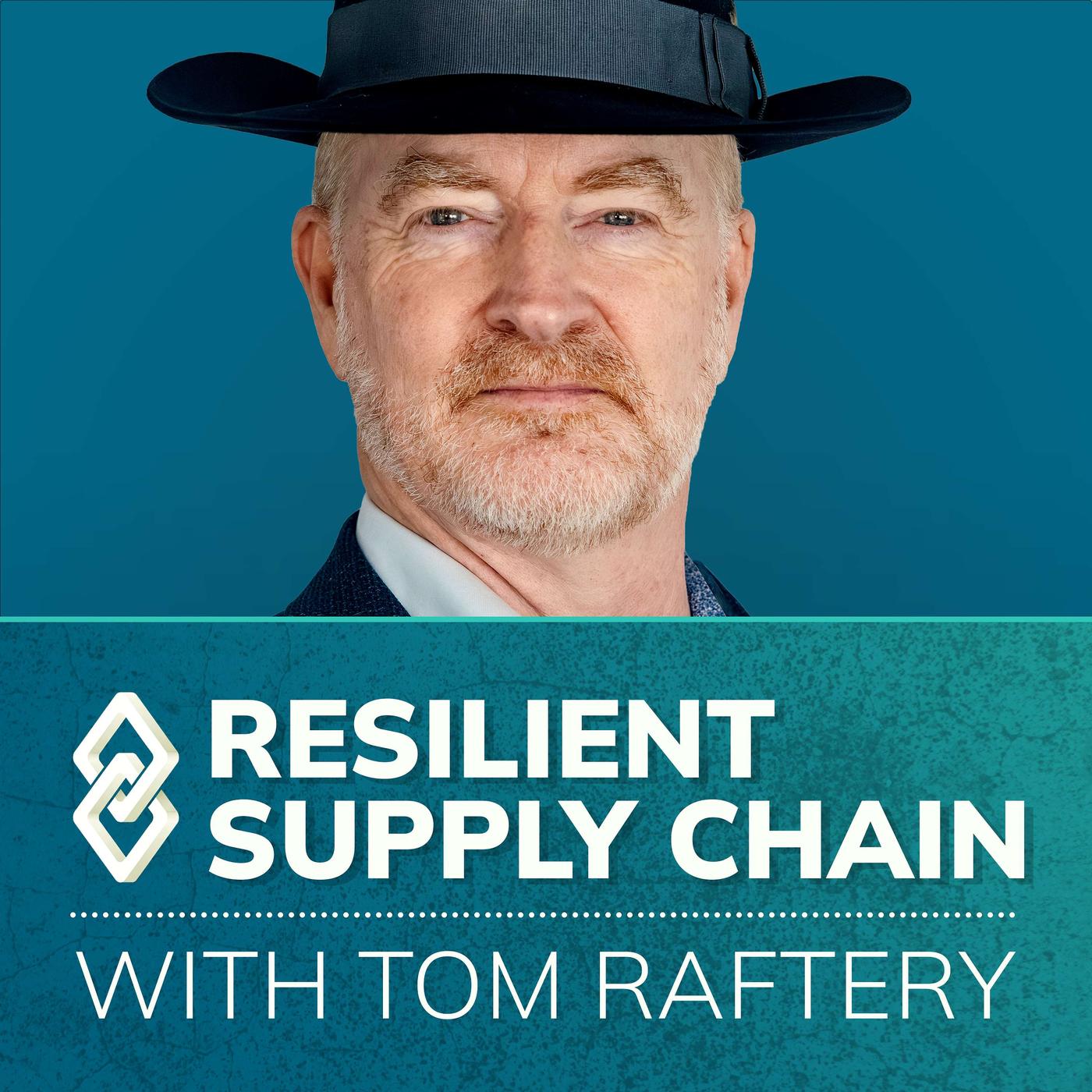
ABOUT THIS PODCAST 🔗
Resilient Supply Chain is for supply chain, operations, procurement and technology leaders who need practical ways to manage disruption, reduce risk and keep business moving.
Each Monday, technology and sustainability analyst, keynote speaker and former SAP Global VP Tom Raftery speaks with the executives, operators, founders and innovators redesigning how goods, information and decisions move through global supply chains.
These are candid conversations about what works in practice—not polished PR narratives or vague predictions. Guests explain how they are responding to supplier failures, geopolitical shocks, volatile costs, capacity constraints, changing regulations and rising pressure to improve both performance and sustainability.
The podcast examines:
- Faster planning and decision-making under uncertainty
- Supplier risk, sourcing strategy and business continuity
- AI, automation, visibility and operational intelligence
- Warehousing, logistics and fulfilment performance
- Scope 3 emissions, circularity and responsible sourcing
- The systems, incentives and organisational changes needed to turn data into action
The central question is simple: what helps a supply chain withstand disruption, adapt quickly and continue serving the business?
New episodes are published every Monday at 7am CET. Resilient Supply Chain+ subscribers also receive bonus analysis, highlights and briefings on emerging industry trends.
Follow Resilient Supply Chain for practical lessons from the people solving real operational problems—and building supply chains that perform when conditions do not go to plan.
AUDIENCE OF THIS PODCAST 🔗
LATEST EPISODE 🔗

SEARCH PAST EPISODES
PREVIOUS EPISODES 🔗




SEARCH PAST EPISODES
PODCAST IS CLAIMED
PODCASTER INTERVIEW
► Tell us about you and your podcast
My name is Tom Raftery. I am Global VP, Futurist, and Innovation Evangelist for SAP, as well as host of the Digital Supply Chain, and Climate 21 podcasts.
The Digital Supply Chain podcast is a show where I bring on guests from across the supply chain world to highlight best practices in supply chain technologies.
The Climate 21 podcast (kicking off Dec 2nd 2020) is a podcast where I will highlight successful climate emissions reduction strategies and stories interviewing organisations who have demonstrated best practices.
The listeners to both podcasts are generally people in the business community, I suspect, as that is who the content is primarily most relevant to.
► Why & how did you start this podcast?
I love listening to podcasts which is one of the reasons why I started these two podcasts.
In the case of the Digital Supply Chain podcast, I was moved into the Supply Chain organisation in our company and I didn't know a lot about the topic, so I thought that if I started a podcast, I could invite experts in the topic onto the podcast, I could amplify their voices, all the while listening and learning about the topic (!)
In the case of the Climate 21 podcast, this is very much a passion project. I am deeply concerned about the effects of climate change on our environment, so I want to help get the word out there about ways organisations have managed to successfully reduce their emissions so others can emulate them (or hopefully do even better).
► How'd you find the time and funding to do this podcast?
For the Digital Supply Chain podcast, because it is part of my job, finding the time is not an issue.
For the Digital Supply Chain podcast I release two episodes a week (Monday and Friday), and the Climate 21 podcast is going to start publishing 1 episode a week on Wednesdays starting Dec 2nd.
I heavily self-fund the podcasts (I bought the hardware, software, domains, I pay the hosting, etc.). I'm not sure how much it all comes to per month, but as the only marketing I do is through my own social media accounts, the costs are quite modest.
► What do you gain from podcasting?
My podcasts, because they are associated with my job, don't elicit sponsorship.
The Digital Supply Chain podcast is still only at about 6,000 downloads a month, so I'm not even sure that it would attract any sponsors, while the Climate 21 because it is yet to launch has effectively 0 downloads per month.
One way I do benefit from the podcasts is that they significantly raise my profile in the sectors relevant to the podcasts, and as I mentioned earlier talking about the Digital Supply Chain podcast, it helped me very quickly come up-to-speed on the supply chain topic, while at the same time allowing me to build a strong network in the space.
► How does your podcasting process look like?
My podcasting process is quite standard, I suspect.
I reach out to interviewees (or they, or their PR firms reach out to me to be featured on the podcast). We use Calendly to times for a prep call, and for the recording.
The calls are made using either Zoom or Teams, whichever the interviewee prefers. I use the recording function of Zoom/Teams as a backup, while I use my rodeCaster Pro soundboard to do the recording of the interview.
I edit the audio file in Hindenburg Journalist Pro. It is light editing, removing parts of the audio files with no audio, adding intro and outs, and music. Then upload to Auphonic to clean up the audio. And finally upload to my host (Buzzsprout), and write up the episode.
► How do you market your show?
Most of my marketing is done via social media. Most listeners listen to the podcast on Apple Podcasts, Google Podcasts, or Spotify (the three together account for 59%), but I don't have any insights into how they find the podcast.
I do promote the podcast on Twitter, LinkedIn, Reddit, and occasionally on Instagram, so that probably accounts for a lot. The rest is likely coming from the networks of the guests who come on the podcast.
► What advice would you share with aspiring (new) podcasters?
I think one of the main things I have learned from podcasting is that it is a medium that is not conducive to feedback. It is hard to get people to engage, so it can often feel like you are screaming into the void (metaphorically!), but that you should persist. Keep at it. Be consistent, and if you're putting good content out there, well, your audience will grow.
For me, one of the best resources I came across is the Buzzsprout Youtube channel. It is chock full of great advice.
► Where can we learn more about you & your podcasts?
To learn more about me, I have (a neglected) blog at tomraftery.com, my Twitter account is @TomRaftery, and feel free to connect with me on LinkedIn (es.linkedin.com/in/tomraftery).
